The Surrealist Bestiary, preface, Paris, Presses de la Sorbonne Nouvelle, 1994, pp. VII-X. 1994, 370 p.
Claude Maillard-Chary first defended, in 1981, a thesis for the 3rd cycle Doctorate at the University of Rouen under the direction of Roger Pierrot: "The theme of the bird in P. Eluard's work" (see below his recent publication). I was part of his jury, so that when the time came to prepare his thesis for the State Doctorate, he joined the Surrealism Research Center and asked me to direct his research concerning the surrealist bestiary. Here is the summary of his thesis: An analytical and interpretative reading of the zoological invariants of surrealism as a magnetic pole of the group's mental topography and amplifier of evolution. Contrary to its degraded status in Judeo-Christian Western civilization, the surrealist bestiary defines itself according to the irreversible strategy of the "ascending sign", in absorbing superimposition of the triptych of natural sciences structurally subservient to writings. To the cosmogony of interregnums forging on new bases the "feeling of nature" corresponds an intertextual signaling, emancipated from the procedures of assignment of the principle of identity, cornerstone of positivist rationalism. This work, very useful for all lovers of the surrealist movement, deserved immediate publication. The work was welcomed by the Presses de la Sorbonne Nouvelle, and one can read my preface below. Meanwhile, Mr. Maillard-Chary collaborated with the journal Mélusine (see on this site) and he extended his research to the ecosystem of the same movement.
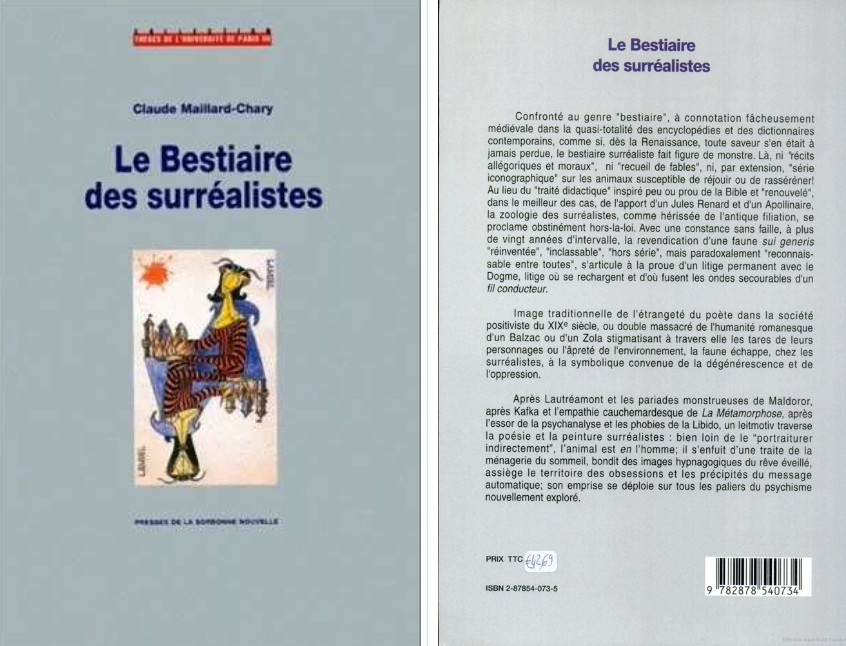
MAILLARD-CHARY, CLAUDE: THE SURRÉALIST BESTIARY [PRINTED TEXT] / CLAUDE MAILLARD-CHARY, PARIS: PRESSES DE LA SORBONNE NOUVELLE, 1994, XIV-369 P.: COVER ILL. IN COLOR; 24 CM, COLLECTION OF PARIS III THESES, SORBONNE NOUVELLE; 2
BACK COVER "The fauna and flora of surrealism are unavowable," declares André Breton in the Surrealist Manifesto. But not unavowed, if the discourse is indeed, as hoped by its first and principal theorist, freed from all constraint of reason, aesthetics or morality.
Read the preface (full text):
Preface "The fauna and flora of surrealism are unavowable" declares André Breton in the Surrealist Manifesto. But not unavowed, if surrealist discourse is indeed, as hoped by its first and principal theorist, freed from all constraint of reason, aesthetics or morality. To verify this, one had to have the courage to read very attentively, pen in hand, if I may say so, most of the surrealist works in their continuity, forming a corpus of nearly fifteen thousand pages. The first step consisted of a meticulous enumeration. This demonstrates that the surrealist bestiary is much less numerous than one would expect. "The sleep of reason engenders monsters," wrote Goya at the bottom of his darkest engravings. Indeed! Or else the surrealists, in their ambition to embrace the totality of the world, conscious and unconscious, did not put their reason to sleep; or else the latter produces few monstrous animals, compared to the whole of fantastic beings accumulated by our different cultures over the centuries. As to a survival of the past, Claude Maillard-Chary is undoubtedly one of the last to take up the challenge of devoting several years to the study of such a phenomenon, by listing all the occurrences of the terms that compose the bestiary proper to the surrealist group. But he did more, by relating each word to its frequency in the Treasury of the French Language (TLF) which is, as everyone knows (or should know), the most important digitized text bank, elaborated by the National Center for Scientific Research in Nancy since 1960. It contains 2,800 French texts from 1600 to 1969, of which nearly 80% are literary works (i.e., nearly 500,000 pages). So that it is possible to realize, by casting a quick glance at the frequency tables gathered at the end of the volume, that the surrealists did not indulge in neology nor did they arouse particularly frightening monsters (if one excepts the "monumentomaure" of the Great War erected by Georges Hugnet), contenting themselves with reordering the animal universe in their own way, and above all attributing to it a different function. That is to say that, considered collectively, their imaginary relies on a set of 720 common forms (or headwords), of which two hundred appear only once. At the head come the bird, the horse, the dog, the fish, the snake, the fly, the cat, the butterfly, while the reference literary ensemble proceeds to a slightly different classification. This step, somewhat tedious for those whom figures do not move at all, was absolutely necessary to establish the nature of the surrealist bestiary, and above all the extraordinary convergence of the twenty-three authors who, without having given themselves the word, composed it. It is then, but only then, that one is entitled to abandon statistics (or, more exactly, to examine the terms of low frequency) to track the totems of surrealism. exotic animals or survivals like the anteater and platypus dear to André Breton. Here the reader must confess his perplexity, or his bad faith. No matter how much one makes of the massive presence of the sheep, the frog or the snail in the works of which he makes his delights, he will only take interest in rare or marginal species. One must be particularly attentive to notice that legendary beings (mermaid, sphinx, phoenix, dragon, Mélusine, etc.) occupy a privileged place in surrealist texts. For each, words have a power, a specific "valence", according to their latent content, the more or less intimate associations they suggest, as dream carriers. One will appreciate the sureness and skill with which Claude Maillard-Chary summons all scientific knowledge to make us better appreciate, in all its nuances, the surrealist imaginary, treating each author individually, then following a sometimes sinuous path, from wing to claw towards the infinitely small, to linger on monsters and, by a marvelous physics of poetry, to cross the limits of the animal kingdom. From morphology to animal sociability, he approaches, not without a very discreet humor, the vocabulary of insults, "bird names", and questions himself about the "language of birds", this hermetic language which, if it could be deciphered, would give the key to the universe. Then intervenes the myth, which Breton is content to give as a possible response to our modern anguishes, that of the Great Transparents, these beings who would double our world by occupying its interstices. It will be understood, unleashing the wild horde, speaking of the animal world, staging it in their poems, the surrealists project their own desires, fears and aspirations into it. Thus they say, in an indirect manner, the sensitivity of an epoch aspiring to reconcile dream and life, constrained, despite itself, to pay its tribute to the Minotaur. Henri BEHAR
Presentation More than any other movement of thought and action, surrealism wanted to be the gravedigger of capitalist and warlike Western civilization. To its legitimate defense before the Unnamable has responded dialectically the necessity of regilding the enslaved language of usage by recharging it at the living sources of dream and unconscious, made available to all and vectors of objective poetry by the systematized practice of automatic message, kickoff and guiding thread of its Revolution. Claude Maillard-Chary explicates its content and actuality, against the deleterious advances of the Anthropocene but in correspondence with André Breton's "Who goes there?" rallying the interveners of the reconstructed Ark, humans, non-humans, the legendary marvelous included, in the sensitive perimeter of a long-range relational ecosystem.
Presentation "We the birds that you always charm from the heights of these belvederes" launched André Breton in his hymn to the "Facteur Cheval" (1932) evoking the surrealist band gathered around the bird-catcher architect of the Ideal Palace of Hauterives. Animator and stakeholder of this Icarus "we", Paul Eluard alias Eugène Grindel - his civil status rewritten "grain d'aile" - has integrated up to sublimating in his work the "passional ornithology" that has magnetized his historically situated life as much as his poetic journey. C. Maillard-Chary wanted to restore the milestones of this original itinerary, fomented from childhood.