"FOR A PROBLEMATICS OF ODORS: ESSENCES FOR ESSEINTES", ÉTUDES FRANÇAISES, MONTRÉAL, N° 31-1, SUMMER 1995, PP.95-108.
Journal presentation: Founded in 1965 at the Department of French Studies of the University of Montreal (which became in 2003 the Department of French-Language Literatures), Études françaises is a journal of literary criticism and theory with an international vocation, whose mandate embraces the entire history and territory of French-language literatures.
Open to dialogues with other discourses — arts, media, history, humanities and social sciences —, it often adopts interdisciplinary theoretical perspectives. The emergence, for more than thirty years, in its issues, of new problematics does not break with the humanist spirit that presided over its foundation: the valorization of the study of the literary text placed in the historical horizon of culture.
Études françaises publishes three issues per year, composed of a "Dossier" which favors cutting-edge reflection around a problematic and free articles, the "Reading Exercises" which account for the diversity of current work and constitute an essential place of diffusion for emerging research. It addresses specialists in French, Quebec and Francophone literatures, and anyone interested in literature.
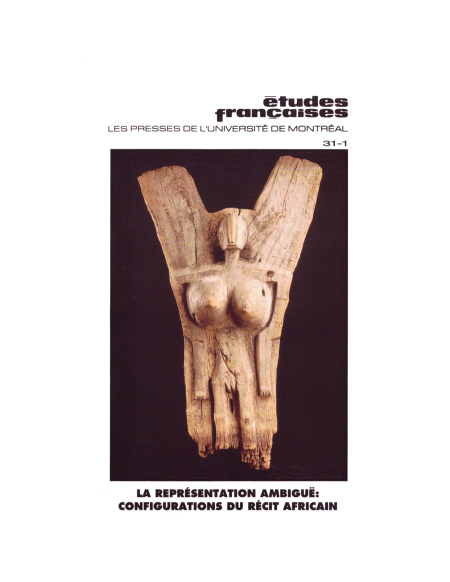
By Lise Gauvin, Christiane Ndiaye, Josias Semujanga, Ahmadou Kourouma, Amadou Koné, Jean-Cléo Godin, Anthère Nzabatsinda, Alioune-B. Diané, Michel Larouche, Henri Béhar and Jacques Cardinal
My contribution to the journal Études françaises, which I had known since a summer period of courses at the University of Montreal, was sent by mail to its editors. So much so that it was published in an issue devoted to "The Ambiguous Representation: Configurations of African Narrative", which was not my subject. But I must say that the cover, representing an African sculpture, as well as the contributions of my Ivorian friends Amadou Kourouma and Amadou Koné were not indifferent to me. The article appeared in the "Reading Exercises" section.
In fact, I wanted to make known the Hubert de Phalèse method, which the research team I was leading had applied to the study of À rebours (see the Cap'agreg series, n° 1). This method was singularly productive for the examination of olfactory data, hence this verbal play concerning the hero of Huysmans's novel.
Text readable in: Henri Béhar, Literature and its Golem, Paris, Honoré Champion, 1996, pp. 185-198.
See: the Cap'Agreg collection distributed by Klincksieck
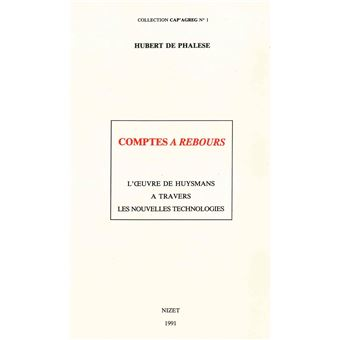
Countdown: Huysmans's work through new technologies
This Cap'Agreg collection proposes to provide the student preparing for teaching competitions with the materials most directly useful to their work, in the field of literary studies, provided by currently available computer tools (databases, digital optical discs, text analysis software). In each work, they will find pre-processed computer data that, otherwise, would require additional preparation. Concerning À rebours by J.-K. Huysmans, historical information on the period, writers, genres and literary themes are gathered; files on vocabulary structure, period words (decadence, neurosis, hysteria, fin de siècle), on the main themes of the work. In addition, in Countdown, one will find a glossary doubled by a concordance of rare or difficult words, a florilegium of opinions expressed on Huysmans and the character of des Esseintes, a bibliography and the index of proper names that was missing from the reference edition. Thus one can guard against the three sins that generally taint literary studies: anachronism, emanatism, confusion of the social self with the writing self. An ambition that, beyond competitions, should concern all lovers of Belles-Lettres concerned with opening themselves to new technologies.
K.-J. Huysmans | Henri Béhar (melusine-surrealisme.fr)
Read on this same site:
"Specificities of À rebours", Bulletin de la société J.-K. Huysmans, n° 104, 2011, p. 69-83.
See:
Michel Bernard: Introduction to computer-assisted literary studies
and, of course:
Read the digitized text of À rebours
Supplements: