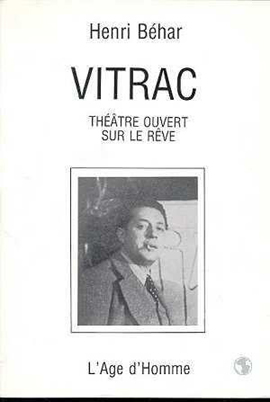
"ONE IS CRIMINAL AT ANY AGE", TNP NOTEBOOK, NO. 19, 2019, P. 42-47. [ON ROGER VITRAC, VICTOR OR THE CHILDREN IN POWER].
Download the published article in PDF
Compare with the initial text:
"One is Criminal at Any Age"
By Henri BÉHAR
The Comédie de Bourges, then National Dramatic Center, staged Victor or The Children in Power in October 1968. Its director, Guy Lauzun, having used my essay, recently published, concerning the life and work of Roger Vitrac, had invited me to the premiere. At the time, theater people did not disdain the opinion of critics and researchers, all the more so as they needed, to maintain the institution, an attentive press. Curious to hear, in the auditorium, the possible echoes between what was then called euphemistically "the events of May 1968", and those that the play evoked, sixty years earlier, I rushed there.
At the end of the performance, the actress who played the beautiful Thérèse, Catherine Dejardin, came to shake my hand and told me of the trouble that had seized her during her performance. My presence having been announced in advance, she had read or reread the passage I devoted to her character in my thesis. I said there that Thérèse, the adulterous woman, was offended, shocked by the feeling of incest that the children, Esther and Victor, suggested when they imitated the adulterous adults.
"I well understood that, in the play, my daughter had been conceived with Victor's father. Consequently, even in play, the marriage of the children constituted incest. But how to make it understood on stage?" my charming interlocutor told me.
This was a theatrical problem to which I could bring no solution. Indeed, contrary to what I have just written, incest is not a feeling but a taboo! "Incest, let justice be done" proclaim the newspapers of the day (February 5, 2019), echoing a documentary projected on television. Certainly, it is a crime, if it is suffered by a child. Today, our society focuses on the rape of a young person by one of his parents, but, in truth, incest is above all a religious, moral, civilizational prohibition. Despite the generalization that Claude Lévi-Strauss will make (opposing Bronislaw Malinowski's observations), incest is sometimes recommended, even imposed, in certain societies or certain classes. Thus Tutankhamun, whose discovery of the mummy in 1922 interested Vitrac so much that he mentioned it in his works, this young pharaoh, dead at nineteen or twenty years old, was the product of incest, and he had married his own sister, by obligation. But the play takes place in France, where incest is legally prohibited. Thérèse therefore had to make understood, through her acting, that, on the children imitating their parents, weighed a prohibition of a completely different dimension: Freud and his Oedipus were stirring in the wings.
I admit that it would not have occurred to me that the performer could hesitate on the immediate meaning and the implications that she could let appear during her performance. I told her so, explaining to her what seemed obvious to me when reading the play. Her husband had been disturbed for so long that one could deduce that he suffered as soon as he learned that his wife was cheating on him, before Esther's birth. Hence the fact that malicious minds, such as those of the families gathered for Victor's birthday, could deduce that the two children were from the same father. The idea of marrying them, suggested by the General, implied that he was provoking an incest. What the spectators had very well understood, all the more so as Vitrac suggested it in the program, not to mention Artaud's expansive remarks, and the vigorous approval of Antoine, the cheated husband, "for a laugh"! Thus, the Théâtre Alfred Jarry, which wanted to be revolutionary and surrealist, defended, implicitly, moral order and the bourgeoisie!
One understands the confusion of our beautiful actress! All the more so as, if it globally opposes the society of its time, surrealism, taken as a collective movement, has hardly discussed this taboo, and has neither praised nor condemned it (with the exception of Paul Éluard, perhaps, positively). In any case, the Surrealist Manifestos object nothing against it. It is only in 1933 that the group will publish a brochure to defend the parricide Violette Nozière, arguing that she had been raped by her father. Were they condemning incest, or were they using it to accuse the victim and defend the murderer, to put on trial "the hideous knot of serpents of blood ties" (Eluard)? The fact is that after having been sentenced to death, the young Violette, with her announcing first name, saw her sentence mitigated by three successive heads of state, until pardon. Their arguments had carried.
To return to our Victor, let us specify that the mischievous song of Esther, naively interpreted by a young actress, should have enlightened the entire auditorium on the same subject:
"You you you the churn The milkman's churn Attracting you you the cat The butcher's cat You you you that she beats While he goes to saw us The liver you you and the spleen And the head of the rentier You you you put the paw In the familiar butter The heart you you dilates To see them shoot each other You you madam feels herself But the fruits are locked
Let the child you you frolic In his cradle the butter dish Before you you the tie Of the good little schoolboy"
If I speak of the innocent acting of the actress, it is because the director, like Roger Vitrac, wanted it thus, and he would not have admitted an immediate denotation of the song that he saw as a parable of the sexual act as a six-year-old child would have perceived it, at the dawn of the century. Besides, the images of the poem correspond to the rural universe of the time, with, notably the churn, erotic instrument par excellence.
Since the creation of the play, criticism evokes Georges Feydeau, because of the vaudeville it suggests. This "intellectual froth", to speak like Vitrac, is never wrong. Except that the playwright seizes traditional vaudevillesque structures to turn them inside out like a glove, at the invitation of Lautréamont's theoretical and poetic program.
Thus, Vitrac does not content himself with the initial vaudevillesque trio, the husband, the wife and the lover, too easy given of 1900 theater. He intends here to provide a realistic spectacle, and, more precisely surrealist, as would be represented by two friendly couples, or, rather, a quartet, charged with embodying the most common adultery. Except that one of the protagonists, the cheated husband, is unhinged, that the children of the two couples are, one supposes, brother and sister, and that the boy whose birthday is being celebrated has decided to destroy all conventions. Superior puppeteer, he intends to lead all this guignol personnel to death, and he will succeed.
Victor takes advantage of the opportunity offered to him to close the mousetrap on the fictional stage of the family living room. Like Hamlet taking the king and queen of Denmark at the mirage of the theater, he mimes with Esther the guilty relations of Charles and Thérèse who become troubled and denounce themselves in public, while Antoine, aroused and less unconscious than he appears, flirts with Émilie. Dignified, and as if to ensure the revelation, she declares: "Let it be well understood that I understood nothing of this scene." General defeat of the adults; Antoine takes distance and withdraws, alone. Playing on the General's stupidity, Victor only has to make him get on all fours. The first act ends with a training session.
From then on, the playwright's program seems perfectly established to us. Certainly, he must implement the procedures of vaudeville, but, at the same time, as President Macron teaches us, he must pervert them by the means that surrealism highlights, and that he himself experimented with in his works preceding Victor: the dream narrative and the dream; word games (with destructive effect); the dissociation of ideas; the appearance of the unconscious, that is to say of the improper for the spectator.
I do not have the leisure, in this short intervention, to list all this arsenal that Roger Vitrac has implemented to construct, the first and almost the only one, the surrealist drama that he postulated. It suffices to refer to certain small pieces that I published in volume III of his theatrical works. Thus, The Painter, where the innocent child, prefiguring Victor, learns to his own detriment the distance between the word and its object: my name is Lebrun and I am white! Elsewhere, the spectacle is constituted of dream narratives sewn together by a single rational scene. The Mysteries of Love (1923) provide a superb example of the gap, the contradiction between gesture and word, between manifest and latent. Thus, Dovic, protests his love for Léa:
… "I have always loved you (he pinches her). I still love you (he bites her). You must do me this justice (he tugs at her ears). Did I have cold sweats (he spits in her face). I caressed your breasts and cheeks? (He kicks her). There was only you (he pretends to strangle her). You left (he shakes her violently). Did I hold it against you? (He punches her). I am good (he throws her to the ground). I have already forgiven you."
In his Complete Poems one finds a generating fragment of our drama, which no critic has commented on, to my knowledge:
"One is criminal at any age. And all their life they will spend it around a cake made with shoulders and breasts and decorated with precipices and crowns on fire. the lamp, the bed canopy and the child himself. Ah! this last one, if they suspect him of carrying hell around a vermilion hat signed Jean-Bart they will mark him with a lace of excoriations until his eyes betray incest. And I see all three of them asleep in the redcurrant syrup." (Dés-Lyre, p. 139)
The entire tragedy is already in place (with its parody), starting from the family nucleus, with the outfit of a little boy of the time, notably this straw hat called Jean-Bart, the birthday cake, and, of course, incest which returns as an obsession. Blood too, figured by redcurrant syrup. A priori, the poem appears as a tender look cast on childhood. In fact, it is exactly the drama that Vitrac will bring to the theater about ten years later.
"This drama sometimes lyrical, sometimes ironic, sometimes direct, was directed against the bourgeois family, with as discriminants: adultery, incest, scatology, anger, surrealist poetry, patriotism, madness, shame and death." explained Vitrac to the spectators of the Théâtre Alfred Jarry.
The target was clearly designated. The discriminants too, although they are not all on the same level, one sees it for incest which is only evoked and not shown in the play. One could say the same of death, embodied by Ida Mortemart, in other words life in death. Beyond the character's aggressiveness towards the public, the tragic caricature of the Pétomane of the Eldorado, there was this difficulty, not in saying death (everyone talks about it all the time) but in showing it, coming erotically to take the child on her knees to lead him to nothingness. Vitrac's diabolical idea, rarely exposed since, is to imagine death as a mortal individual, here a woman, moreover, herself already invested by destruction, which manifests itself in a sonorous and scatological way: "and I can do nothing against this filthy need. It is stronger than everything. On the contrary, it suffices that I want, that I make an effort for it to surprise me and manifest itself more beautifully. She farts long. I will kill myself, if this continues, I will kill myself."
Would this be, paradoxically, a vision of hope? It has always seemed astonishing to me that, at the end of his brief life, in his intimate notebooks, Vitrac became interested in the notion of destrudo, explored, with so many difficulties, by Freud, and that he wanted to concretize it in a drama, another Victor.
Bibliography: one will find Dés-lyre on my site, as well as my studies: http://melusine-surrealisme.fr/en/henribehar/en/wp/
See the information on this show, cast, press review, etc.: https://www.tnp-villeurbanne.com/manifestation/victor-ou-les-enfants-au-pouvoir/
Victor or the Children in Power by Roger Vitrac / directed by Christian Schiaretti. From Thursday March 7 to Saturday March 30, 2019.
Creation, from 15 years old
Inspired by Alfred Jarry's provocative aesthetics, this play with vaudeville appearances actually plays with the taboos and prohibitions of society. Carried with verve and inventiveness by the faithful actors of the TNP, it offers a moment of salutarily sulphurous theater.
On his ninth birthday, Victor, who suspects his father of having a relationship with his best friend's wife, denounces the hypocritical comedy that is played daily in the family circle. By breaking the precious Baccarat vase, he accomplishes a premonitory gesture. His father will break, shortly after, a second vase, thus materializing the explosion of his couple. Despite death, which from the start hovers over the characters, the play multiplies burlesque gags and shows a series of bad tricks fomented by Victor. Endowed with exceptional lucidity, this child of "two meters and terribly intelligent" leads the game briskly, eager to make the truth spring forth. Each protagonist becomes his target. While he rejoices, sure of achieving his ends, he is far from suspecting what he will learn. After having settled his accounts with the others, it is now with himself that he must do so. The farce turns to drama. Totally destabilized by his discovery, it is neither in the exasperating passivity of a mother, nor in the irresponsibility of an absent father that he can hope to find support. The bloody denouement announces, before its time, this "theater of cruelty" dear to Artaud who was its first director. For him, this play shows "a spirit of profound anarchy, basis of all poetry".
Read:
Review: Critique on JSTOR