"The Passionate Attraction of Theater, followed by a Joint Note on Blanche Derval and the Théâtre des Deux Masques" in: André Breton or Surrealism, Even, Lausanne, L'Âge d'Homme, 1988, pp. 76-86.
Marc Saporta (1923-2009), then principal animator of the journal L'Arc, "Mediterranean Notebooks appearing four times a year" wished to devote an issue to André Breton. He contacted me, as he had done for other potential collaborators, belonging to the Surrealist Movement or simple essayists. He wished me to treat Breton's relations with theater, based on my essay on Dada and Surrealist Theater (Gallimard, 1967, 2nd ed. 1979). I gave him my agreement, and sent him my article on the agreed date. All the collaborators waited patiently for the proofs. Stéphane Cordier, the founder of the journal, having died, they thought that another would take over. Failing to see the fortunate benefactor arrive, I then proposed to Marc Saporta to publish this issue in the Mélusine collection, which I had created at L'Âge d'Homme editions. He resolved to do so, after having spared all susceptibilities. Armed with an original photo entrusted by Elisa Breton, I therefore took charge of the layout of the work with Saporta, who proved very efficient and productive. This is how our friendship was formed, consolidated by the fact that we had common origins, at a generation's distance.
Cf. "The Passionate Attraction: Breton and the theatre", Dada/Surrealism, Iowa City, n° 17, pp. 13-18 (English translation).
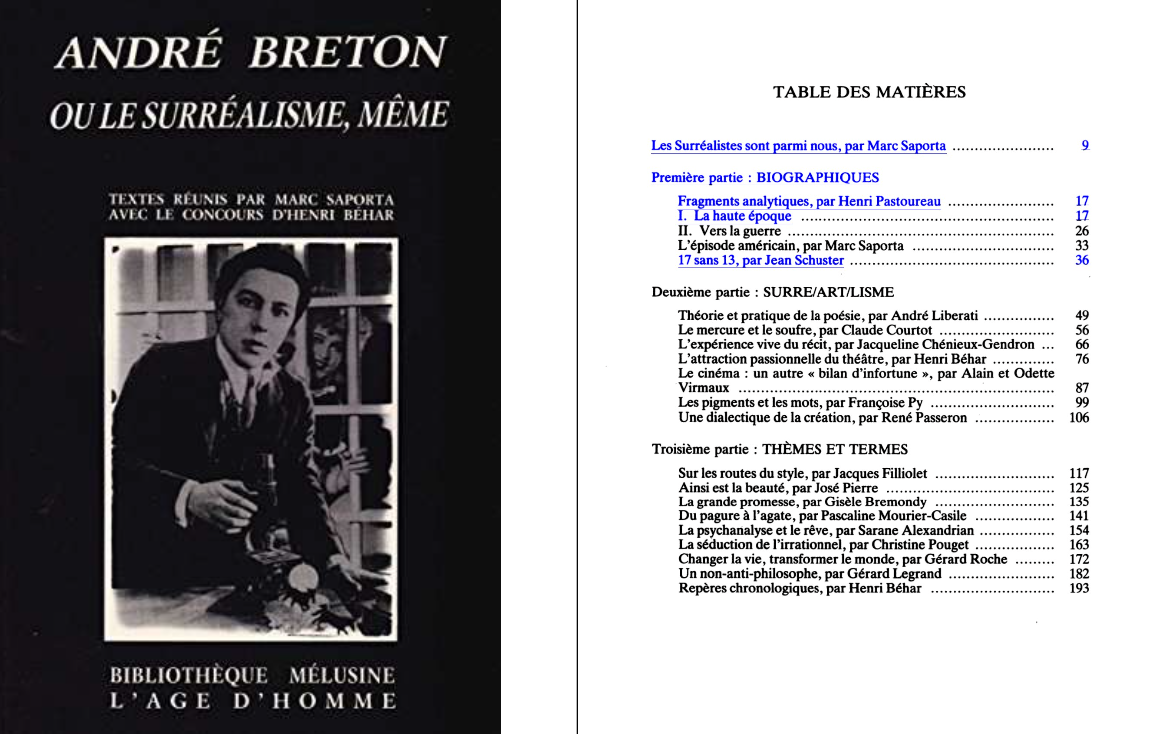
André Breton or Surrealism, Even edited by Marc Saporta assisted by Henri Béhar, Lausanne, L'Âge d'Homme, 1988, 197 p.
Presentation A movement of revolt, born of the immense despair inspired by man's condition on earth, surrealism intends to find a path of salvation in those vital moments when man seems to be lifted above himself and ordinary life. It thus gives hope of a human metamorphosis; it predicts humanity's entry into the dazzling zone of wonders. After a period of eclipse, surrealism is in full renaissance. It would be an understatement to say that it is becoming fashionable again: its new ascent is one of the major facts of 1950. The time is no longer for anathemas or easy enthusiasms. It is a matter of knowing with precision what are the fundamental data of the movement founded by André Breton. This is what the present essay attempts to provide by successively addressing: 1°) the essential principle of the doctrine (Esotericism and Surrealism); 2°) the domains of experience and methods of investigation (Mental disintegration and reintegration – Automatic writing – Painting and surrealist objects – Objective chance); 3°) the positive interpretation of this experience (surrealism and science). Let no one believe, however, that surrealism allows itself to be concluded and that the present work aims to codify it. Surrealism is a thought always awake, an experience always eager to renew and surpass itself. It is only its doors that are described here. Still, it was necessary to give the keys. M. SAPORTA