"Surrealist Criticism" in: Marcel Jean and Arpad Mezei, Genesis of Modern Thought, new edition, Lausanne, l'Age d'Homme, 2001, Bibliothèque Mélusine, pp. 9-23.
See a first presentation of the work on this site: Marcel Jean, and Arpad Mezei, Genesis of Modern Thought in French Literature.
See on this page the poetry collection, Mnésiques, published by us:
Mnésiques by Marcel Jean
First Edition 1950 New Edition 2001
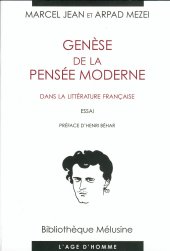
Back cover.
"Surrealist literary criticism exists. Genesis of Modern Thought is its most convincing illustration. To the very contestable duality of man and work, Marcel Jean and Arpad Mezei substitute the dialectic of the real and its double, subjective imagination, which should lead to the unity of modern thought. A revolutionary thesis, in the etymological sense of the word, since it is nothing less than rediscovering the meaning of unitary thought, beyond several centuries of this Christian dualism that separates spirit from matter, by identifying the milestones that, from Rabelais to our day, had allowed it to subsist.
In truth, such a reading, synthesizing various approaches to texts, is more of the order of the poetic than of criticism. It is guided by sympathy and erudition that attaches less to proving than to suggesting, prolonging, and above all determining the configuration of present virtualities. It would be futile to correct what, at more than fifty years' distance, proves to be erroneous, hazardous, or simply contradicted by time, so much does the whole carry conviction, so much does the constellation of the seven sages here designated: Sade, Lautréamont, Rimbaud, Mallarmé, Jarry, Apollinaire, Roussel, the seven poetic lights of our civilization, now inscribed in the firmament of our modernity."
By profession a textile designer, Marcel Jean (1900-1993), painter, poet, and essayist, was an active member of the surrealist movement from 1932 to 1951. He took part in its various manifestations, signed numerous tracts, was an actor in the Octobre group (Prévert) and Le Diable écarlate by Sylvain Itkine who staged Ubu enchaîné by Alfred Jarry. His drawings (Mourir pour la patrie, 1931, published in 1935), his objects, Le Spectre du Gardénia (1936), L'Arbre à tiroirs (1942), L'Armoire surréaliste (1942), his decalcomanias in collaboration with Oscar Dominguez (Grisou, 1936, published in 1990), his floatages and his paintings make him one of the most talented plastic artists of the movement. Blocked in Hungary from 1938 to 1945, he met Arpad Mezei there, a psychoanalyst, psychologist, graphologist, and alchemist in his spare time, with whom he developed the first interpretation of Maldoror (1950), taken up and completed in their critical edition of Lautréamont's complete works (1971), the present Genesis of Modern Thought (1950) and the irreplaceable History of Surrealist Painting (1959).
Marcel Jean published, alone, an Autobiography of Surrealism (1978) and his own biography, Au galop dans le vent (1991).
Text of my preface:
ASPECTS OF SURRÉALIST CRITICISM
The quality of a book is marked less, in my eyes, by the print run or the number of editions than by the number of times it disappears from my library. Genesis of Modern Thought belongs to the species I would call "of multiple occultation." I have tried in vain to replace it as soon as it was missing, each time a passionate borrower forgot to return it to make it their personal property and incorporate it, so essential did its thought seem to them. And, of course, each time I forgot the face of the one to whom I had lent it, too happy to have converted a friend or even a stranger to this type of essay without equal. So much so that, the work being out of print for a long time, I had only one solution: to propose its reissue in the Mélusine library to get myself a new copy that will not be refused to me!
From then on, I am at peace, my visitors will be able to get their hands on it, I will have what it takes to fill the gap that, infallibly, will not fail to occur on the shelves of my old bookcase.
For the Mélusine Library is not reserved for the publication of unpublished works or for the dissemination in French of foreign essays concerning surrealism and its surroundings: it must make accessible to all the significant texts, of creation or criticism—sometimes both mixed—emanating from the Movement.
I no longer remember under what circumstances, at which specialized bookseller—Jean-Jacques Pauvert, Éric Losfeld—or which bouquiniste from the banks of the Seine, I acquired Genesis of Modern Thought for the first time. But what I remember perfectly is the revelation that this book brought me at the time when I was preparing at the Faculty of Letters what was then called the Certificate of French Literature. At a time when the principle "man and work," illustrated by a learned collection devoted to the classics of our literature, which one only had to have read well to be graduated, still reigned for any literature student, this work brought me an Ariadne's thread, of a completely different texture, as the great books of Albert Béguin, L'âme romantique et le rêve; of Marcel Raymond, De Baudelaire au surréalisme; of Denis de Rougemont, L'Amour et l'occident; and above all the dynamics of the imaginary that Bachelard analyzed in his Poétique de l'espace had been able to do.
To the very contestable duality of man and work, Marcel Jean and Arpad Mezei substituted the dialectic of the real and its double, subjective imagination, which should lead to the unity of modern thought. A revolutionary thesis, in the etymological sense of the word, since it was nothing less than rediscovering the meaning of unitary thought, beyond several centuries of Christian dualism that separates spirit from matter, by identifying the milestones that, from Rabelais to our day, had allowed it to subsist.
From then on emerged, obvious and uninterrupted, the chain linking "the seven sages of the double civilization": Sade, Lautréamont, Rimbaud, Mallarmé, Jarry, Apollinaire, Roussel, who lead us to the heart of contemporary reality, synthesis of material and spiritual, masculine and feminine, rational and irrational, objective and subjective principles. That these seven beacons of French literature lead us toward the supreme point postulated by André Breton at the threshold of the Second Manifesto of Surrealism is not surprising: are they not the venerated authors of the Movement, some even discovered by it? Marcel Jean n'est-il pas, à l'époque où il produit cet essai, un actif collaborateur du groupe surréaliste?
Certainly, none of the seven authors studied here reached at once the point of resolution of contradictions and maintained themselves there, but each approaches it, in a certain manner.
A surface reading of the texts does not allow one to realize this. This is why, combining their specialties and their approaches, Marcel Jean and Arpad Mezei have recourse, simultaneously, to psychoanalysis, esoteric interpretation (of the Kabbalah and Alchemy) and, more discreetly, to a mode of analogical reasoning.
Among the first to use a psychoanalytic reading grid of texts, they show that the system of Sadian perversions has, in an underground manner, determined "the psychoanalytic-cathartic process that [...] will characterize in the 20th century the movement of thought" (p. 42). Likewise, by exploring various repressed psychic realities, romanticism brings to light "a new reality" that will be formulated in the following century (p. 51) and whose true content will be revealed by Isidore Ducasse. Contrary to what commonly happens, Les Chants de Maldoror (to which our authors devoted an essay in 1947, now integrated into their critical edition of the text, at Losfeld in 1971) manifest the unconscious and more particularly the love of the father (p. 59) while the poems express, in a more traditional way, an Oedipal love for the mother (p. 64), which would tend to bring the author back into the path of conformity. "Unlike Lautréamont, Rimbaud was incapable of escaping the paternal complex while maintaining himself in the poetic domain" (p. 133).
This means that these Poems did not lead him toward the solution of his problems. The homosexuality that, following Maurice Saillet, they detect in Jarry through his works, seems to them to have to remain passive (p. 153).
The explanation of the Apollinarian text obviously poses them much fewer problems: "The basis of all function, of all activity is therefore in him what analysts call 'oral organization'" (p. 168). Finally, of Roussel they make a systematic ambitious man embodying "the two great human tendencies studied by psychoanalysts, the urethral character and the anal character..." (p. 210).
This observation of works announcing modernity allows them to enunciate some views on the future of society: "it is beyond doubt that modern civilization tends to reinforce the homosexual component through the process of women's emancipation, which confers on them a masculine aspect..." (p. 112). Or again: "Nowadays, the Oedipus complex has, on the social plane, dissolved in the blood of kings. On the individual plane, it tends to disappear through the weakening, increasingly generalized and profound, of family ties" (p. 161).
Such affirmations, applying to texts now perfectly established and known, would need to be discussed, if only in terms of the evolution of psychocritical methods. But they remain no less exciting for the mind, and often premonitory if one thinks of the date of their first enunciation.
They are, however, inseparable from a more original approach that calls upon the esoteric tradition, under its speculative and practical aspects at once. First and foremost comes the Kabbalah, of which the authors evoke the sephirotic tree, or more exactly the two pillars supporting the Crown of the primitive androgyne, Wisdom and Intelligence (p. 80) to account for the divine name, Elohim, articulated by Lautréamont. They have no difficulty in noting the Talmudic erudition of the poet of Alcools, making mention of his Kabbalistic knowledge (p. 170).
Without pushing the analysis far enough, to my taste, they advance that Jarry was the man missing from the Philosopher's Stone, in other words the one who was expected to proceed to the great work, to this definitive transmutation of matter.
Now this occurs after Jarry's death, in Raymond Roussel "the master of Time," the one who applies the principle of hermetic thought by dominating language, by bending it to his will for the realization of the philosophical work whose evident traces, such as the tarots, the alchemical vocabulary, reveal the origin.
Here again the specialist of traditional thought could find fault and contest certain suggestive but no less bold rapprochements. This would be to forget the principle of analogy that underlies all the essayists' argumentation. Thus they explain the passage from Les Chants de Maldoror to the Poems by an analogy with the final episode of the former (p. 63). Such a famous formula has no mystery for them "for the 'intellectual stain' is in reality the ink once projected by Maldoror changed into an octopus, the indelible ink on the fingers of the romantic writer, of the one who reasons and writes with his feelings" (p. 77). It is almost a pun, in any case a play on words that could account for Rimbaud's behavior in Harrar: seeking a thread to life, he wishes "to have a son whom he would raise in his own way..." (p. 133). A same principle of alternation seems to them to dominate Ducasse's work and that of the socialist Proudhon, which leads them to bring them closer (p. 94), without however inferring any influence from one to the other. By pushing analogy further, they come to justify the correspondences of Mallarméan thought with Buddhism, whereas no precise contact could be established. For them, it is not a matter of borrowing but of foreseeable encounter (p. 142). In the same way, Roussellian handling of language proceeds from "analogical understanding between beings" (p. 176), analogies of which they draw up a table from the Nouvelles Impressions d'Afrique (p. 209).
It will be understood: such a reading synthesizing various approaches to texts is more of the order of the poetic than of criticism. It is guided by sympathy and erudition that attaches less to proving than to suggesting, prolonging, and above all determining the configuration of present virtualities. It would be futile to correct what, more than forty years later, proves to be erroneous, hazardous, or simply contradicted by time, so much does the whole carry conviction, so much does the constellation of the seven sages here designated now inscribed in the firmament of our modernity.
Henri BÉHAR