Jarry, Rousseau and the Popular
It was in 1984, from September 14 to January 7 of the following year, that the most important retrospective of Rousseau's works was presented at the Grand Palais National Galleries. The exhibition catalogue contained only four major articles, including this one, which seems to have fallen into oblivion.
Perhaps it is time to offer it to the voracious masses.
Since Henri Rousseau became, in contemporary artistic consciousness, one of our national glories, everyone knows—or thinks they know—that Alfred Jarry was his discoverer or, better yet, his inventor. And people keep repeating, about them, anecdotes more or less fabricated that Apollinaire delighted in recounting.
But it is generally forgotten that when Jarry wrote his first lines in favor of Rousseau, he had just come of age and was still a candidate, for the fourth time, for the entrance exam to the École Normale Supérieure, which he had prepared in the "khâgne" at the Lycée Henri IV. From there to thinking that the praise of the Douanier was a normalien's joke, a kind of "khâgneux" ritual, is a step I refuse to take. Not only because the relationship between the budding writer and the painter seems to be based on family ties (both from Laval, their families rendered each other small services such as testifying for official acts, and Jarry's father was Rousseau's classmate), but above all because Rousseau's painting represents the pictorial solution that Jarry was seeking in his aesthetic explorations. Not that the poems and plays he was trying to publish at the same time had the simplicity of Rousseau's propositions—quite the contrary!—but because they tried to provide an equivalent representation of space-time by taking up a certain popular tradition. Thus, Ubu Roi would appear as the transposition for an adult audience of a puppet play meant to be timeless, that is, immediately situated in eternity and utopia (Poland Nowhere). The set that Jarry wanted for the scenic aesthetic he defended is indeed that of the Douanier Rousseau: "The set by someone who does not know how to paint comes closer to the abstract set, giving only the substance; just as the set that one would know how to simplify would choose only the useful accidents." ("On the Uselessness of Theater at the Theater", Mercure de France, Sept. 1896).
But Jarry does not merely praise certain artistic solutions inspired by popular simplicity or its disregard for classical canons; he joins Remy de Gourmont to create a magazine of original prints, L'Ymagier, intended for wealthy amateurs to remind them of the treasures of popular art and to encourage new artists to take up the tradition of woodcuts and lithography. This artistic continuity is indicated from the first issue of L'Ymagier by Gourmont: "... Alongside and beneath printed literature runs the oral stream: tales, legends, popular songs. There is also popular imagery today synthesized in the Epinal factory, yesterday flourishing in thirty cities, but especially in Troyes. This imagery, loose sheets or pages of booklets, is known to archaeologists and a few amateurs: it is, primarily, our very subject, and everything else in L'Ymagier will come only as a supplement, ornament, source, object of study or comparison.
Here, then, we will teach the lesson of old imagery and tell, with strokes, the joy of those who, for a clipped penny, adorned their little rooms with archangelic confidences—and the joy of a peasant, still Breton, who finds in the peddler's basket the rough faces carved by Georgin, and the symbolic and poignant hearts, the Christs whose pain purifies our own, the miraculous virgins and also the mysterious horsemen who bring, messengers of the King, the news of a joy—and also the legendary Genevièves and the mighty mitered Saints, taller than the bell towers." (Oct. 1894).
When, after the fifth issue, Jarry parted ways with Gourmont (for extra-literary reasons) and founded his own art magazine Perhinderion (two issues, March and June 1896), he said nothing different as a prelude: "As on the squares surrounded by a mound, at the foot of the sanctuaries, the peddlers come on certain dates, with rare images hanging from their fingers, six times a year in Perhinderion the old prints will be revived or new ones will be born..."
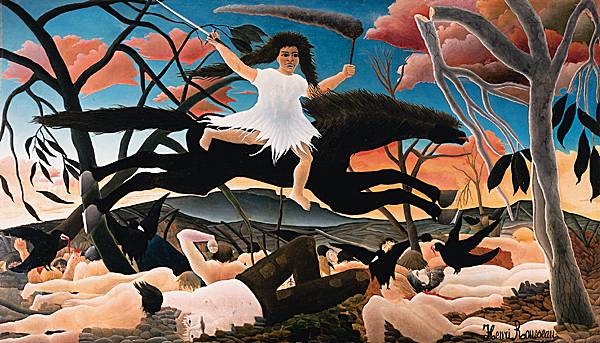
Is not Rousseau's art the immediate answer to such a concern? All things considered, why should he not be, in the eyes of the young aesthete, the Georgin of this end of the century? Just as he made an agreement with the Pèlerin d'Épinal imagery to insert new prints by the engraver of the Napoleonic legend, he encouraged Gourmont to commission a lithograph of La Guerre from Rousseau. He had noticed the painting at the 1894 Salon des Indépendants and had reviewed it twice, in terms that conformed to the required symbolism, which nonetheless reveal his deep impression: "By H. Rousseau, especially La Guerre (She passes frighteningly...). Of his like peroniers the horse stretches in the frightened extension of its neck its dancer's head, the black leaves fill the mauve clouds and the debris run like pine cones, among the corpses with the translucent edges of axolotls, labeled with crows with clear beaks." (Essais d'art fibre, June-July 1894).
From that moment dates the commissioning of Rousseau's portrait of Jarry, which would be exhibited at the eleventh Salon des Indépendants. Even if he did not devote to this painting all the care one would expect from an admirer of the Douanier, there is no doubt that Jarry loved the painter's style, his flat tints, his deliberate disproportions, his disregard for perspective, his invention of the "portrait-landscape", very much in the Symbolist taste, associating microcosm and macrocosm. Thus, the artistic rapprochement turned into camaraderie—in the etymological sense of the word—since Rousseau agreed to host his young friend in his only room on Avenue du Maine from August to November 1897.
It was around the same time that, while writing the manuscript of Gestes et opinions du docteur Faustroll, pataphysicien, Jarry assigned to "Mr. Henri Rousseau, decorative artist, known as the Douanier, mentioned and medaled" the direction of a painting machine intended to transform the hideousness of the National Warehouse, otherwise known as the Musée du Luxembourg. In doing so, he gave him an approximate nickname that still endures.
Rousseau was thus the ideal "ymagier" dreamed of by a young writer eager to revive a declining popular art or, more precisely, to associate it with living creation, favoring the resurgence of that underground stream Gourmont spoke of regarding oral tradition. Now, it so happens that Rousseau, through his legends or quatrains accompanying his paintings, in turn embodied the same tradition. Just as L'Ymagier published old songs (Au bois de Toulouse, La Belle s'en est allée, La légende de Saint-Nicolas, Chanson pour la Toussaint, La Triste noce...), Jarry mixed popular ditties with his most elaborate verses, dramatized his novels with old ballads (such as La Triste noce in Le Surmâle), and above all, never ceased to cultivate what has been called the "mirliton" aesthetic in his theater, which he himself aptly named "théâtre mirlitonesque". He who liked to recall the people's songs:
Three frogs crossed
the ford, Ma mie Blaine.
With needles and a thimble,
Thread of wool...
can we believe he remained insensitive to the legend composed by Rousseau for Un Centenaire de l'Indépendance: "The people dance around the two republics, that of 1792 and that of 1892, joining hands to the tune of Auprès de ma blonde qu'il fait bon fait bon dormir."?
Likewise, the artistic transposition he undertook regarding the painting La Guerre shows that he retained the legend: "La guerre (she passes frighteningly, leaving everywhere despair, tears, and ruin)."
Let us not doubt, he was sincerely moved by the authentic sensitivity of the Douanier, by his good and charitable character, which led him to call him a "well-known philanthropic painter" in one of his speculations in La Revue Blanche (June 15, 1901), where he evokes a guest, less delicate than himself, who, not content with having been clothed, housed, and fed by Rousseau for two months, clung to his savior by accusing him of having sequestered him.
Why not believe that the quatrain accompanying the portrait of Jarry was by the painter himself?
Muses whose dreamlike brow is a lapidary triangle,
Adorn his eyes with your image, so that he may always please,
To readers, seeking in a sincere spirit
To pleasantly enjoy what brings light.
It gives a rather high opinion of the young writer whom the artist honored with his cordial friendship. Certainly, the style is more complex than that of the other poems adorning Rousseau's paintings, but it retains the same elevation of thought. Thus, Le Passé et le présent is accompanied by this allegorical note:
Being separated from each other
From those they had loved,
Both unite again
Remaining faithful to their thought.
And the lost portrait of a Philosopher (1896) was accompanied by the following legend, quite worthy of the anonymous writings highlighting the images of Epinal to which it alludes:
Like the great philosopher Diogenes
Though not living in a barrel,
I am like the Wandering Jew on earth,
Fearing neither the storm nor the water
Trotting along while smoking my old pipe
Proudly braving thunder and lightning.
To earn a modest sum
Despite the rain that wets the earth
I carry on my back and without reply
The announcement of the independent newspaper L'Éclair.
There is, of course, a great distance between these irregular, unpolished verses, ignoring prosody, and the more than learned poems of Minutes de sable mémorial. But are they so far from the rhymed pieces of Le Moutardier du pape, Pantagruel, L'Objet aimé or Par la taille, of which here is the conclusion:
The little clock
Has struck deep in my incredulous ear
Six o'clock. six o'clock in the evening!
I am going to arrive at my ministry
Late
Oh despair!
No one knows if, during his stay with Rousseau, Jarry read his plays, L'Étudiant en goguette, La Vengeance de l'orpheline russe and Une visite à l'exposition de 1889. Besides the technical solutions he brought to the problem of the simultaneity of action and the succession of events (which are similarly found in the Ubu cycle, without being able to speak of influence, given the respective origins of these works), Rousseau displayed a moral goodness and a simplicity of style that Jarry never ceased to identify in his "théâtre mirlitonesque".
The freshness of imagination of the self-taught painter, the childlike vision he managed to preserve in all his works (written or painted) are values that Jarry immediately perceived, he who, at the same time, sought to bring to the stage the intact work of the adolescent genius that is Ubu and turned to the treasure of popular tradition to build his verbal concretions. It is on this ground, without a doubt, that the meeting of Jarry and the gentle Rousseau took place, whom the writer wanted to make popular.
Henri BÉHAR
Article published in the catalogue of the exhibition at the Grand Palais National Galleries, September 1984.