About Tristan Tzara and the Avant-garde
— a dialogue with Henri Béhar —
Article published in Romanian in a journal, presumably in 2012. The interviewee appeals to internet users to find the journal and the journalist. Thank you in advance.
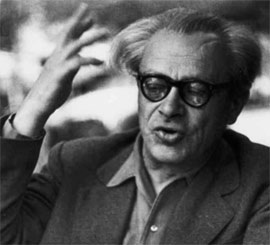
— You recently published the complete poetic work of Tzara at Flammarion Editions, after having produced thirty years ago the great six-volume edition of his Complete Works. This means that our poet remains a living presence in the French literary space. How do you assess the significance of this editorial event? Tell us a bit about the work on this new edition and the conclusions that can be drawn today from rereading Tzara's poetry.
H.B. I am happy that this new edition of Tristan Tzara's poems, which presents itself beautifully and at a relatively affordable price for all lovers of high language, has crossed the borders of the hexagon. It was indispensable in my eyes, since the first volume of the Complete Works had been out of print for ages, and the publisher was dragging his feet about reprinting it. Finally, the solution he chose is relevant: it allows having at hand, in a single volume, the totality of collections published by Tzara during his lifetime, as well as some posthumous works, and even a dossier containing poems he had refused to publish, his youthful works and his experiments from the Dada period.
It now belongs to the reader to say, in complete independence, what place Tristan Tzara's work occupies in our literary space. You can well imagine that I could not devote so much time, so much care, so much attention and so much effort to it unless I place it in the foreground.
— If it were a matter of establishing the main stages of Tzara's poetic evolution, what would be, according to you, the landmarks of this inner history of his work? Which of these stages seems to you the most fertile and most resistant from an aesthetic point of view?
H.B. Although Tzara claimed absolute continuity in his poetic journey, the different stages of his work are well known and, I believe, recognized. After the youthful poems in Romanian, which place him in a late but innovative symbolism for the time, it's the explosion and profusion of Dada, followed by a long surrealist period, to which I link The Approximate Man as well as Where Wolves Drink and a collection explicitly claimed by the movement such as Grains and Issues. This stage is very important, and should not be minimized, as criticism, influenced by the retrospective judgment of surrealists and their epigones, tends to do, wallowing in the sin of anachronism. Then follows an equally lyrical period, where the poet (and not poetry) is plunged into history up to his neck, with finally, especially after the Second World War, a memorial return (From Human Memory, The Inner Face...), not to mention this long period, still very mysterious in the minds of readers, where the poet transforms, apparently, into a scientific researcher, questioning the secret of Villon, that is, about a cryptic way that poets of old used to tell their truth despite all obstacles.
— Surrealism in Tzara's poetry poses some problems, given the rather tumultuous relations of this "foreigner" with Breton and his comrades, the ruptures and successive rallies. What are, according to you, the specific traits of Tzara's surrealism within this movement?
H.B. With the exception of a brief episode related to Breton's struggle against Tzara for the leadership of the avant-garde in France, to which you implicitly refer by the use, in quotes, of this pejorative term, I do not believe that surrealists [whether painters or poets] assumed nationalist positions, for the good reason that being mostly of foreign origin [Max Ernst, Salvador Dali, Victor Brauner], they would have excluded themselves. In fact, it is not Tzara's surrealist poetry that poses a problem, but rather, as I just said, the way criticism subject to retrospective diktats looks at it. Tzara was part of the surrealist group from 1929 to 1935, voluntarily, fully and entirely. He followed Breton in his political commitment, and supported him explicitly within the AEAR [Association of Revolutionary Writers and Artists], an offshoot of the Communist Party. It was at his home, in his beautiful villa on Avenue Junot, that the group met to discuss the affairs of the day, the program of the journal Surrealism in the Service of the Revolution, the tracts they had to launch together.
But, more important in my eyes is the fact that Tzara gave an ideological framework to the poetics developed by the movement at that time. On the one hand with the notion of "experimental dream," which came to reduce, by concrete example, the impasses of automatic writing. On the other hand, with his essay on the "Situation of Poetry," retracing the entire history of poetry according to two axes, poetry as "means of expression," voluntary, conscious; poetry as "activity of the mind," coming from the unconscious. Moreover, he showed the way of the future, indicating a third stage, that of poetry to come, where, by a dialectical reversal, poetry would reconcile these two aspects to achieve a new form of expression.
We must be convinced that surrealism has, historically, integrated these data, and that it can rightly adorn itself with Tzara's poetry as one of the most brilliant of its production. But, as happens in all human groups, there came a moment when some, and not the least [Crevel, Char, Tzara], judged that they had to separate from the bulk of the troop, for serious ideological reasons, and perhaps less serious ones...
— We know that in the 1930s, Tzara expressed quite strong critical reservations about Soviet cultural policy. One proof among others, the interview granted by the poet to Ilarie Voronca, published at the time in the journal Unu. A few years later, we see Tzara engaging on the side of French communists and writing texts marked by this ideological submission. How do you judge his political commitments and their consequences on his work?
H.B. It is true that Tristan Tzara's political evolution, as we perceive it today, may seem inconsistent, to the point that I could speak of a "crossover" with Breton, when we celebrated their common centenary. While one was moving away from the Communist Party, the other was approaching it after having, on several occasions, indicated that one should not mess with it.
But it is too easy to judge things with our current perspective, and what we know about Stalinist perversion. If we refer to the historical context, we can see that Tzara, certainly more aware of what was happening in Germany, where he had many friends, than in the USSR, feared, rightly, the rise of Nazism, and, not trusting intellectuals too much, saw only a workers' party to oppose it. However, I have never been able to find proof of his membership in the PCF before the Liberation. Everything leads me to think that he engaged in the party's cultural organs, particularly at the head of the Solidarity Committee in favor of Spanish Republicans. In other words, I see him rather as a resistance fighter against fascism (whether it wears the colors of Franco or Hitler), which should earn him unanimous recognition. You know the rest: the war, the Occupation, the underground, Tzara being denounced by that bastard Brasillach in Je suis partout as foreign, Jewish and communist... Under these conditions, it is not surprising that he followed Aragon's approach in every way. I do not understand why he is denied the indulgence that is shown to the latter, who is much more responsible.
I add that Tzara was a critical communist, since, returning from a trip to Hungary, he was the first to launch an alarm cry in favor of the Budapest insurgents in 1957 throughout the press, and that, from then on, he definitively distanced himself from the Communist Party.
Moreover, I challenge the reader to find in this collection of Complete Poems the slightest "ideological submission," as you say, or even the slightest acquiescence to the Party's cultural propaganda.
— You wrote an important book on Dada and surrealist theater and you are preparing a special issue of the journal Mélusine devoted to surrealism's relations with the theatrical movement. How to place Tzara's dramatic work in this ensemble today?
H.B. Good question! In this soon-to-be fifty-year-old essay, I wanted to make known to the public the dramaturgical revolution introduced by Tzara and his companions or, if the term seems barbaric to you, show how poetry has settled at the heart of theater. There were the two Celestial Adventures of Mr. Antipyrine, which can be considered as experimental theater, mixing and clashing different types of discourse, then The Gas Heart, too quickly held for an expressionist fable, against which I rebelled, and a perfectly constructed piece like an anti-theatrical war machine, Cloud Handkerchief. I did not deal with The Flight, this dramatic poem which seemed to me then a regression towards the symbolism of his beginnings. However, rereading it closely, I find new qualities in it, which would require a director gifted with certain innovative qualities. Obviously, these works not appearing on theater posters, one can believe them reserved for reading, which, in itself, is not without interest. But I have the feeling that, as for Musset's Theater in an Armchair, these pieces are, even today, a vigorous ferment for the future.
— The same question regarding a current evaluation of his reflections on poetry and literature in general...
H.B. Let there be no mistake: it is not because a timid publisher separated poetry from the essays contained in the Complete Works that the poetic discourse deprives itself of reflections on the destiny of poetry, on its modalities and content. Let's say that everything is already there, the theoretical discourse only explicating what the poem exposes in a diffuse manner. It seems to me more and more that Tzara's poetry remains untouchable, because it immediately placed itself in the absolute. I do not say in abstraction, but almost. When readers have learned to read this form of message that touches both the real and the surreal, without clinging to it, then Tzara will appear as one of the true precursors of what I call high language. As such, his place is already reserved in the pantheon of literature, at the highest degree.
— The Center for Surrealist Studies that you direct at the University of the Sorbonne Nouvelle is never in crisis of research themes. The journal Mélusine, which represents it, always publishes the results of these critical investigations in the field. This means that the avant-garde remains a current topic. Is it also, and to what extent, a ferment or an example for literature and the arts in the so-called post-modern era that we are living?
H.B. I observe with pleasure, my dear friend Ion Pop, that you yourself remain an astute observer of literary research as it is practiced in France. Indeed, the journal I animate is never short of ideas, nor reflections, nor international contributions, and the programs of the research center I still direct renew themselves without difficulty from one year to the next. But I must make a confession to you: although I once attended Jean-François Lyotard's classes, the inventor of the "post-modern," I never understood what that meant, and I do not worry about knowing if the research I conduct is current. What matters most to me is to analyze, to understand the creations of the past, to show their antecedents and, eventually, their posterity. Free to current creators to seize my work, to deduce from it what they will, by adherence or opposition. If this can help them escape the trap of repetition, you see me satisfied.