“OF AN OBJECT POEM,” IN ANDRÉ BRETON, ARCANE 17, FACSIMILE OF THE ORIGINAL MANUSCRIPT, PARIS, BIRO ÉDITEUR, 2008, PP. 7-31.
When Adam Biro, a publisher I had known since collaborating on his vast project (with René Passeron), the General Dictionary of Surrealism and its Surroundings, Office du livre, 1982, asked me to name the most beautiful contemporary manuscript, I had no hesitation. For me, it was the manuscript of Arcane 17, which I had consulted at Elisa’s when I was composing the biography of André Breton. In my opinion, it deserved a complete facsimile edition. Deal! Adam Biro immediately undertook the work. But, whatever specialized printer he had to use, the cost of the book exceeded his budget. Hence a public subscription that allowed him to move the project forward. In the end, he turned to a printer in the People’s Republic of China, which, at the time, was a real adventure. And we had to agree that this printer worked meticulously, even going so far as to hand-punch the small hole found on the playing card…
This long and magnificent printing process confirmed my view of the volume as an object poem offered to Elisa for her wedding. In doing so, André Breton remained faithful to his practice of offering a new work, of his own composition, to each woman he loved. In this particular case, it was a Canadian school notebook, with the right-hand page written in his hand, the left-hand page adorned with a document more or less related to the manuscript’s subject. Such was the point I developed as a preface to the book.
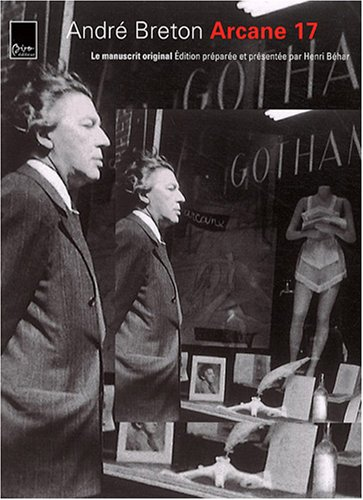
André BRETON, Arcane 17 – The Original Manuscript. [Edition prepared and presented by Henri Béhar], published by Biro. Paris, 2008. 1 sewn paperback volume. Format 24.2 x 18 cm (820 g). 247 pages + XLVIII pages of the manuscript in-fine.
Cover illustration: André Breton in front of the window for Arcane 17 at the Gotham Book bookstore in New York in 1945. The mannequin and window arrangement were designed by Marcel Duchamp, the poster by Matta. Photo by Elisa Breton. Collection Aube Breton-Elléouët.
Back cover:
It was during his stay in Canada, in the midst of war, in 1944, that André Breton wrote Arcane 17. In the tarot of the Bohemians, arcane 17 is the Star, a symbol of hope, freedom, and love. But it is also Elisa, the poet’s companion, his sole inspiration. It is to her that he dedicates this dream narrative.
The manuscript of Arcane 17, one of the treasures of the Jacques Doucet Literary Library, is published here for the first time. The well-known text is handwritten by Breton in a “large school notebook” of 48 pages. The illustration part is completely unpublished. The collages, photos, and found objects are annotated by André Breton and constitute the key to understanding Arcane 17.
Our edition also contains the precise transcription of the manuscript as well as the complete text of Arcane 17. Henri Béhar, biographer of André Breton, professor of French literature at the Sorbonne Nouvelle, director of the Center for Surrealism Research and the journal Mélusine, presents in a brilliant essay this major text of Surrealism.
PUBLISHER’S PRESENTATION: Arcane 17 by André Breton is one of the major texts of surrealism. The facsimile of the original manuscript, written in Quebec and signed by Breton (August 20–October 20, 1944), is presented as a 48-page school notebook in quarto format; the right-hand pages are most often reserved for autograph texts, the left-hand pages for photographs and collages of various documents or objects. The illustration part is completely unpublished. Indeed, until now, book editions have only reproduced the text. Yet the pasted elements are of great importance as they constitute the key to understanding Arcane 17. Most of the collages are commented on by Breton, whether they are maps, transport tickets, photographs, tobacco packets, found plastic objects, or tarot cards. Written in very tight handwriting, with erasures and many corrections, the manuscript is a “work in progress” that is constructed before our eyes. Biro publisher presents for the first time a complete facsimile of Breton’s original manuscript. This edition is published with the authorization of Breton’s heir, Aube Elléouët-Breton. The work is presented by Henri Béhar, biographer of André Breton, professor of French literature at the Sorbonne-Nouvelle, specialist in Dada, Surrealism, and the Avant-Gardes, and author of several major works on the subject. Former president of the Sorbonne, he directs the Center for Surrealism Research and runs the journal Mélusine.
Download the PDF (Of an Object Poem)
See: André Breton Workshop: Arcane 17 (André Breton) (site andrebreton.fr)
Reviews:
For Breton fans: the extraordinary manuscript of “Arcane 17” (nouvelobs.com)
Review by Anne-Marie Amiot: A true labor of love, this new edition of Arcane XVII by Henri Béhar takes on the air of a major literary event for any reader of André Breton—and even for any admirer of Surrealism. Indeed, in addition to a normal reprint of the text (pp.149 to 247), thanks to permissions granted by the writer’s relatives, a facsimile of the autograph manuscript of this hymn to Love is, for the first time, reproduced in its entirety, illustrated with previously unpublished personal documents (pp. 249-end). Moreover, for reading convenience, a printed transcription is offered, folio by folio, line by line of this manuscript (pp. 33-148), as well as a description of the accompanying pieces, whose presence invites the reader to a completely new rereading of this major work, restored to its conceptual totality as an “object poem.”
A poetic genre conceived by Breton, but rarely realized, whose remarkable introduction by Henri Béhar relates and analyzes both the nature and the circumstances of its creation. Thus, “Of an Object Poem” (pp.5-32) exceeds the simple aesthetic purpose to merge it both in the meticulous analysis of the general historical conditions (war, Breton’s exile in the USA), and the personal and precise circumstances presiding over the creation of the poem: meeting Elisa in New York, mad love, trip to Gaspésie, place of inspiration and writing of the poem whose story is told to us. That of the short moment (August 20–October 20, 1944) when “this great school notebook” was written, before the text was printed at Brentano’s in New York, completed on November 30, 1944. “A few days later […] Breton offers Elisa the handwritten notebook, to which he adds to the even pages (those on the left) a number of documents, making it […] a true ‘object poem’ […]. That is to say, as H. Béhar recalls, “a unique object […] created in communion of thought with the recipient” (ibid.15), thus meeting the criteria of its definition in Surrealism and Painting: “The object poem is a composition that seeks to combine the resources of poetry and the visual arts and to speculate on their reciprocal power of exaltation.”
This leads H. Béhar (p.16-24) to analyze both the nature and function of these documents, sometimes simple evocative, poetic presences, sometimes “sensitive testimonies” of the journey, but sometimes also, “material generators” of a text (p.17) that they inspire rather than illustrate. Now, this ensemble, precisely corresponding to the notion of “object poem,” is unique, inaccessible elsewhere than in the facsimile reproduction of the manuscript, which at the same time invites the reader to study its making, in the urgency of its writing, its additions, and its corrections. An invaluable document for anyone interested in the mechanisms of Bretonian writing.
The text is written on the right-hand page of a school notebook, “margined on the left with a red vertical,” which, more and more, Breton “completely covers, leaving no margin, with very fine, tight handwriting, in black ink, with erasures and many corrections […]” (p.24). Thus, an entire page (folio 29) is crossed out and overflows, which is rare, onto the left page, reserved for documents.
It is therefore not automatic writing. Far from it. Nevertheless, its cursive character suggests that the text is written in one go, under pressure. Quickly, Breton no longer respects the order of the notebook’s lines; erasures spring up under his pen, without altering the flow of thought. Clearly, as H. Béhar notes, he writes in a state of creative furor that gives the many thematic wanderings of this text both its momentum and poetic density, as well as its metaphorical, emblematic, and ideological unity, revealed by the very title of the work.
Eminently Bretonian, the theme of the amorous encounter here renews its formulation. Rightly, H. Béhar connects it to Breton’s general philosophy in the face of adversity. Commenting on a letter in which Breton confides to Etiemble (May 1942), “I went through a period of great depression […]”, he recalls (p.10) that “Breton always persuaded himself that he had to rely ‘on the terrible psychological law of compensations’ […] which he formulated in the Introduction to the Discourse on the Little Reality […]. A law where ‘objective chance’ allows the individual to take control of his destiny, if he knows how to interpret the ‘signs’ offered to him. This determines in him a violent refusal of historical determinism, in favor of a mystique of History, that of the ‘Great Initiates,’ Fabre d’Olivet, Saint-Yves d’Alveydre, V. Hugo or Novalis, specifically cited in this narrative, one of the most Nervalian that Breton wrote; for, more than any other, it proceeds both from dream revelation: “I closed my eyes to summon with all my wishes the true night […], she the supreme regulator and comforter, the great virgin night of the Hymns to the Night,” and from revelation by Woman: Elisa(1), “a star, nothing but a star lost in the fur of the night” (p.11).
But a star which, emerging from “the night of enchantments,” becomes for the poet, “in her glory surpassing all others, the Morning Star” (p.192). That of Arcane XVII of the Tarot which illuminates the landscape, young woman kneeling at the edge of a pond, pouring from her right hand the contents of a golden urn while with her left hand she pours just as inexhaustibly on the earth a silver urn. On either side of this woman who, beyond Mélusine, is Eve and is now every woman, a foliage of acacias trembles on the right, while on the left a butterfly hovers over a flower. (p.192).
Anne-Marie Amiot, Nice, November 2008
See also the articles here:
(1) January 5, 1945, on folio 1, “collage in the form of a calligram on a background of stars. In reserve, the outline of a bird emerges” (Ibid. p.15). ↩︎