Duchamp Visits Jarry
(unpublished, Nov. 2014)
(On the adaptation of Surmâle by J.-C. Averty, 1980)
Surmâle is, without a doubt, Jarry’s best-known work after Ubu Roi, and the most published since its appearance in 1902. It is easy to see why, after having brought nearly all the Ubus to the screen, Jean-Christophe Averty felt the need to tackle this work and give it a television equivalent. All the more so since the subtitle, “modern novel,” is perfectly suited to the master of images.
In my thesis on The Dramaturgy of Alfred Jarry (1975), I noted how a number of his narrative works contained spectacular sequences, seen by a man of the theater and even of cinema, at the very moment when the seventh art, after entertaining young and old, was tending to establish itself as an art of movement and life. With a specific color in all cases, rooted in eroticism, the organic component of all his imaginings. Here is what I wrote then:
In Jarry, indeed, the sexual act—or what stands in for it—appears both as a sporting competition, an absolute physical exercise, and a theatrical spectacle. There is no novel in which a chapter is not devoted to the games of love: Faustroll sleeps next to Visité, who “did not survive the frequency of Priapus” (Pl. I, 713), and a variant made the deadly comparison explicit: “she did not survive the frequency of Priapus’s sword.” Les Jours et les nuits opens with a foursome, where both teams have taken care to bring a slate to record their respective scores. In L’Amour absolu, with its significant title, the competition is sublimated by incest, the infinite expression of love. Finally, Messaline and Surmâle, novels of identical structure, bring Jarry’s erotic theme to its peak. The two heroes are, like Emmanuel in L’Amour absolu, gods in their own way or, in Jarry’s vocabulary, monsters, which amounts to the same thing: “Now it is a monster more infamous and more insatiable and more beautiful than the metal female, who returns to her lair: the only woman who absolutely embodies the word that, long before the city was founded, from the first Latin word, is hurled at the faces of prostitutes in a spit or a kiss: Lupa, and this living abstraction is a worse prodigy than the soul suddenly infused into an effigy on a pedestal” (Pl. II, 76). Both are disguised actors. The Roman empress as a courtesan wears a blonde wig; the lord of Lurance as a Native American, his chest painted red, equipped with a calumet and tomahawk. If one wonders about their need to show themselves by hiding, to have their talents recognized by denying them, there is only one answer, formulated about Marcueil: “To check if his mask held well, no doubt…” (Pl. II, 253). “Both claim to achieve unbeatable records, Messaline enduring twenty-four assaults in one night, but never satisfied, Marcueil surpassing the frequency of seventy consumptions in twenty-four hours. Each time, the game they play is a spectacle for others. No need to repeat, after Jean Genet, the theatrical qualities of the brothel where Messaline goes; Marcueil’s room might seem more intimate, reserving the partner’s anonymity to the fur mask, but it is not so: it is arranged so that an observer (a scientist, in fact) can, without being seen, officially record the success, and has a small window from which the seven courtesans can, at the last moment, witness the defeat of their rival. Thus, the trial will be spied on from two different places and will give rise to two contradictory versions. Finally, both heroes find in death the absolute of their desire, Messaline with the sword, a phallic god, Marcueil by making the machine fall in love with man, ending crowned with thorns and crucified.”
Forgive this lengthy quotation, which was necessary to show how my analysis anticipated the “reading” proposed by Jean-Christophe Averty. To such an extent that one may wonder if the director was not inspired by it, as he tells us he did for certain works in his corpus, for which he likes to testify that the idea to stage them came to him from reading my Study on Dada and Surrealist Theater (1967).
Others will study the properties of this adaptation. Suffice it to say, to simplify, that it is absolutely faithful, like all the works the video artist has undertaken. It is enough to know that the novel has three essential sequences, on which the film is built.
A. “Love is an act of no importance.” This peremptory statement is made by the hero himself. It leads to various episodes in the novel, intended to highlight it.
B. The 10,000-mile race; a competition between a quintuplet and a train; mysterious pedaler (as was said at the beginning of the last century to designate a cyclist).
C. The Indian’s record. Physical experiment.
At this point, it is essential to immerse oneself in the TV film (or its DVD) produced by the Institut National de l’Audiovisuel. To be brief, during our study day on November 22, 2014, I showed the 10,000-mile race and then projected about thirty images from a PowerPoint document, showing how a painter, who is never named, either in the text or in the adaptation, made a surreptitious appearance and delegated his main productions, though few, in such a way that they guided our vision and, more generally, the understanding of the work.
The book reproducing the statements made during this day cannot reproduce all the images that were shown. I will limit myself, by necessity, to providing those that attest to the truth of my remarks.
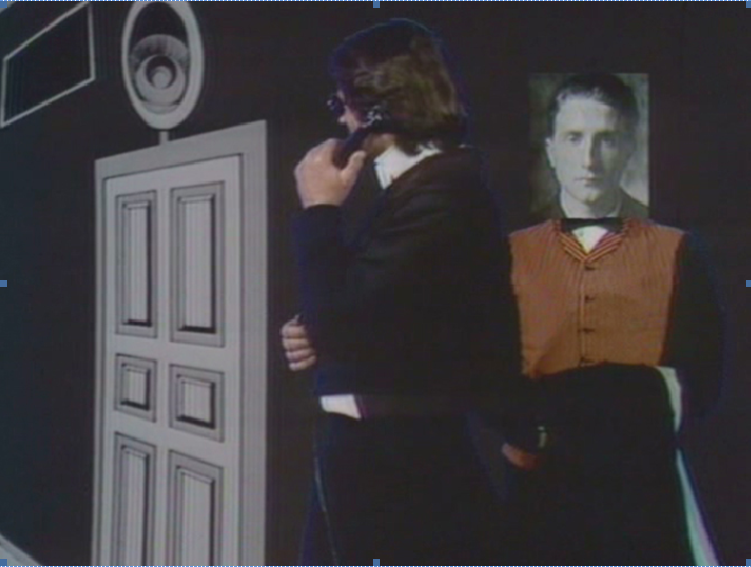
First, here, emerging from the darkness, is Marcel Duchamp himself, dressed as a servant, bringing Marcueil’s coat as he prepares to leave.
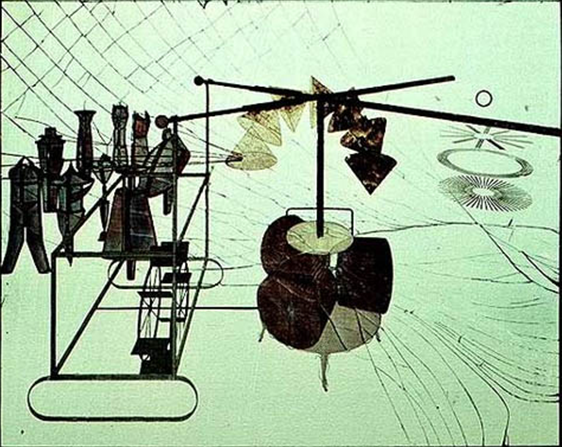
Nowadays, no one is unaware of the famous The Bride Stripped Bare by Her Bachelors, Even (1915-1923), also known as The Large Glass, by Marcel Duchamp. For the record, and for strictly demonstrative purposes, here is an image of the lower part of the glass painting:
This part forms the setting of the first scene. Without realizing it, the characters find themselves inside the machine designed by the painter of enigmas:
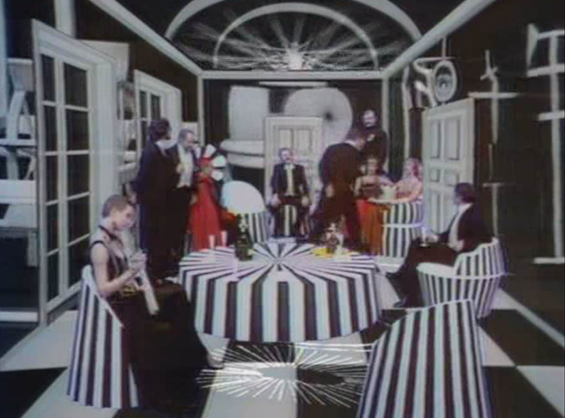
It would be a very entertaining game to look for all the elements in Averty’s staging that function as echoes of Marcel Duchamp’s complete works. We will limit ourselves to pointing out a few, the most objective. Here the protagonists discuss the name “ten thousand miles” and its numerical value:
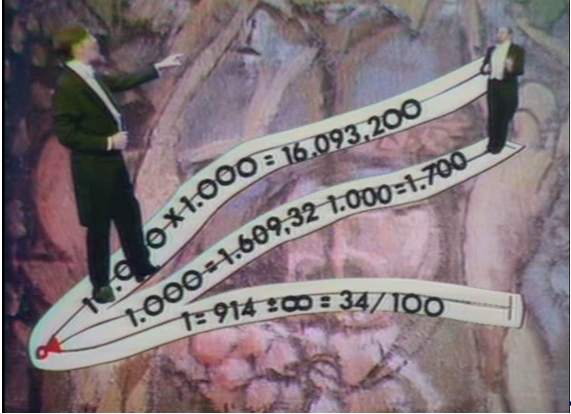
This snapshot is reminiscent of the painter’s calculations around the master standard, and especially what he sought to prove with the “stoppage-étalon.”
Let us not forget that in the story, we are, in anticipation, in 1920. More than a wink to Duchamp, the operation seems to say: see how these apparently useless and uninteresting researches of the secret plastician were to find their field of application in the future, becoming for us a future anterior!
Throughout the film, there are multiple reminders of Marcel’s work; verbal games of Rrose Sélavy, roto-reliefs, sets borrowed from Anémic-cinémA, sketches on the board of the “bachelor molds,” or, with no apparent connection, representation of the “ocular witnesses,” and even, as an interlude, the bride’s veil, etc. Fleetingly, the shadow of a character climbing the stairs signals to its inverse model, the nude descending the staircase, etc.
In this area, borrowing is imposed on the entire work, including the least publicized.
Here is a very peculiar sofa, which immediately refers to the cover of the catalog of the 1947 Surrealist exhibition:
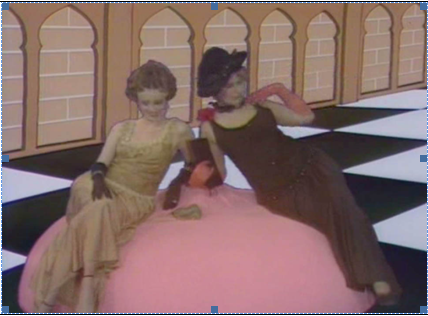
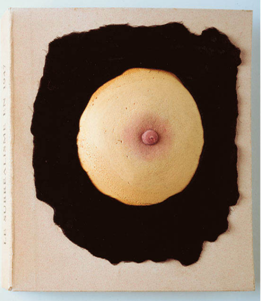
Duchamp, whose every gesture was thought out and measured, reserved for himself the task of painting the nipple of each foam breast… To conclude, let us pause at the moment when the Surmâle, tied to the love-inspiring machine like a condemned man, manages to reverse the current by making the machine fall in love with him:
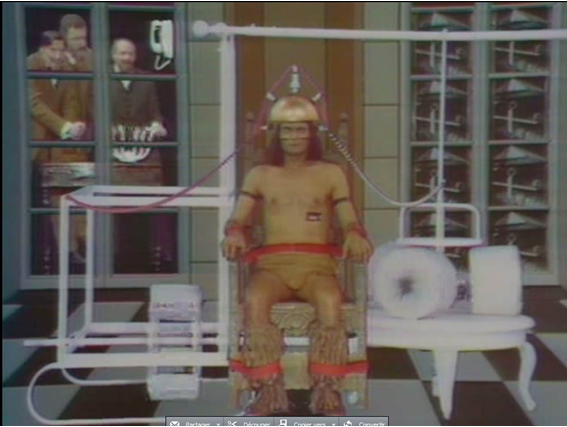
If the electric wires are reminiscent of traditional science fiction illustrations, one nevertheless perceives allusions to Duchamp with the hat rack serving as a rheostat, an arrangement of coils similar to the chocolate grinder, and the general frame recalling figure 2.
It must therefore be admitted that Marcel Duchamp, the painter of bachelors, even, has invaded the television transposition of Jarry’s novel, structuring it, giving it both its background and its internal motifs, laying bare the most obscure passages. Yet, one question remains: why did Jean-Christophe Averty feel the need to create such a confrontation? Not that it is illegitimate in our eyes, especially since the intrusion of the artist is mentioned from the opening credits.
* * *
All this, it seems to me, comes from a simple reading of Michel Carrouges’s essay: Les Machines célibataires (Arcanes, 1954). We know how much, despite the debates within surrealism sparked by the Carrouges-Pastoureau Affair (the latter denouncing the former’s ties with the Dominicans), the essay on such machines present in the greatest novelists of the time impressed the readership of the era.
The author devotes a chapter to Jarry, and more precisely to Surmâle on the one hand, and Les Jours et les Nuits on the other. To be brief, I will focus only on the former, where Carrouges distinguishes three bachelor machines, whose functioning he analyzes. I briefly recall their motifs below.
1) The Ten Thousand Miles Race:
The woman dominates, in the train, alive and present (unlike Duchamp and Kafka). Signs of defloration: the glass covered with roses comes apart = what Duchamp calls “the passage from the virgin to the bride.” Her father does not play the familial role that society normally assigns him, he is the inventor of perpetual motion food.
On the road, the quintuplet, the dwarf, the supermale form a group of 7 bachelor males. The person responsible for the whole affair is the corporal (Catholic linen), etc.; three death signals lead to the cemetery of uniforms in livery.
In the competition, a shadow = ocular witnesses, bicycle spokes… Final post topped with red roses, one can guess what it symbolizes!
2) The Great Hall of the Château de Lurance:
Uniforms and liveries (policeman, judge, gamekeeper, Indian, etc.).
Theater, 3 glass organs: porthole, gallery, monocle-phono.
The 7 venal women = 7 ocular brides. Add the Doctor and the phono = cyclops = 3 ocular witnesses.
Act = 82 times, coitus interruptus: “they cared only for themselves and did not want to prepare other lives.”
Apparent death of Ellen. Exhaustion of the Indian.
3) Electromagnetic Machine:
Love-inspiring machine. Surprise: it is the Indian who charges it and makes it explode! But he runs into the grid, electrocuted.
Remains the perpetual motion food, essential nourishment, with no reference in Duchamp.
Another chapter is devoted to the joint analysis of Kafka’s In the Penal Colony and Duchamp’s The Large Glass. Impossible to follow it in detail, which would take us away from our subject, especially through a biblical reading that has no place here, despite Jarry’s religious culture (see my Cultures de Jarry).
In summary, Carrouges clearly demonstrates that all this is part of a new myth, synthesized by Duchamp in the visual arts, by Jarry and others in literature. The convergences between Michel Carrouges’s analysis and Averty’s scenario are such that one cannot believe the filmmaker did not read it. I am not saying that he was inspired by his reflections with pen in hand. The substance given to the new myth postulated by André Breton, in the form of the “bachelor machine,” could only seduce and quietly influence him.
* * *
To conclude, I believe I can affirm that, willingly or not, J.-C. Averty perceives Jarry through the work of a great bachelor (in the mythical sense): Marcel Duchamp. It does not matter whether this is true in reality. Whether Marcel behaved as a permanent bachelor or married changes nothing to the structures of the imagination he sets up with his works, which function according to the principles Carrouges was able to outline. This should not surprise us since Jarry was a god to Duchamp (the fact that he was promoted to satrap of the Collège de ’Pataphysique proves nothing, except an objective sympathy). The chain leading to Jean-Christophe Averty is no more mysterious. Moreover, he confided to us, during the discussions following this presentation, that he had met Duchamp at length in Cadaqués, who directed him to Surmâle, to the point that he had only one idea in mind when he was given the opportunity to adapt it for television: to bring in Duchamp and his retinue of doubles.
However, there remains a mystery in my eyes. While Marcel Duchamp died in 1968, and, by will, the work secretly created for the Philadelphia Museum became visible a year later, Averty does not go so far as to intertwine Surmâle with Duchamp’s ultimate work: he seems unaware of Étant donnés… (1946-1966), revealed to the public in 1969. There is no shortage of signs linking the installation to the novel.
Henri BÉHAR