257. "On method in literature", Europe, n° 1031, March 2015, p. 359-363.
ON METHOD IN LITERATURE
Those who have had the happiness of reading The Rabbi's Cat remember this very brief sequence where Rabbi Sfar despairs because he knows that the letter he has just received, and which he dares not open, announces his failure in the certificate of studies imposed by the Consistory. His Muslim cousin, Sheikh Sfar, orders him to open it, to learn of his success. There are many who do like our learned rabbi! To such an extent that it was necessary to theorize this widespread attitude. Recently, after many others, Pierre Bayard brilliantly devoted himself to it in his essay: How to talk about books one hasn't read? (Minuit, 2007). But what is entertaining in the comic strip or even in a purely superficial social practice, is it tolerable in a critical activity?
In a recent issue of Europe, one could read this, to which I subscribe to the point of transcribing the first paragraph in full: "I understand by critical spirit the attitude consisting in only making judgments on what one has first endeavored to understand; to resort as much as possible to first-hand sources of information rather than ready-made syntheses; to hold nothing as definitively acquired and to refuse by principle any argument of authority; to beware of sterilizing admiration as of puerile aspirations to originality; to always ask oneself if what we are told about really exists, why certain discourses seem seductive when they do not resist thorough examination, and how to make a thought both logically coherent and empirically verifiable, rigorously argued and open to discussion, even when the latter takes a polemical turn" (Jean-Marc Mandosio, Europe n° 1027-1028, November-December 2014).
No need to gloss the quotation, so much what is recorded here should constitute the foundation, the basic charter, the Hippocratic oath of literary criticism. Charter, alas! rarely observed. A recent episode, amplified by the Internet network, provides us with proof. A very young historian of literature, working on his thesis, encounters a phenomenon that seems to him to require particular attention. So astonishing that, with the agreement of his research director, he decides, not to make it an appendix to his ongoing investigation, but a specific small volume, provided that a publisher wants to seize it. Shortly after, the publisher announces the release of this essay under the title "Du Nouveau chez Rimbaud". Note the capital letter transforming the adjective into a noun, it gives all its value to the pun that one would have liked to find oneself, since it is about the poet friend (and even more) of Rimbaud.
Immediately, one could read in Libération of October 31, 2014: "According to an essay, the poet's Illuminations collection would be due to his mentor Germain Nouveau. A few years ago, a leather-scaled sea serpent resurfaced: Corneille would have written Molière's plays. It has since returned to the bottom of its loch. Taking care to distinguish himself from the previous one, Eddie Breuil publishes this Friday at Champion editions Du Nouveau chez Rimbaud. He seeks to demonstrate that the Illuminations of the second would have been written by his friend Germain Nouveau, the wonderful author of the Valentines, great poet and his hero. As always in these cases, the demonstration plunges into uncertainties that it turns into revelations..."
We see what it's about: being the first to inform the public of a rich discovery, and demolish it in the same movement, so that it is no longer discussed elsewhere! The scoop that goes pschitt immediately, new figure of journalistic exceptional. In passing, it's not bad to pour one's venom on academics who are concerned with reading manuscripts (think about it, in the digital age!) and verifying the accuracy of facts that are given as Gospel truth. Even better if one can break this very young man who doesn't stick to the evangelical reading of so-called information dailies!
In this order of ideas, it's not bad to show erudition, and to show that one could teach the most learned a thing or two. We therefore allege the antecedents, making a jubilant amalgam (in the eyes of the erudite only). Corneille and Molière don't miss the appointment. From there to evoking revisionist theories, there's only one step, cheerfully crossed by the ignorant of the Net. Which, of course, makes our young researcher jump, who has no words too harsh for these theories of Nazi origin, and whose sole ambition is to eradicate them from our horizon as much as from the future of men.
However, verification made with the publisher, the columnist could not procure the book (nor the proofs), which suffered a delivery delay... So that the supposed information is only a figment, elaborated from the press release and, more seriously, from notes floating on the network, also uncertain. Everything advanced by the said columnist is false and unfounded. Note that I have seen worse: a reviewer gives an account of a big dictionary by denouncing the absence of an entry that is well printed in all copies, except his perhaps? Would the authors henceforth be obliged to offer glasses to their detractors? The same occasional erudite pretends that Breton has nothing to do with the creation of the Art Brut Company, which anyone can verify, without it costing him a penny, by questioning the "Atelier André Breton" site where all the necessary documents are stored, including correspondence. Great beast that I am, go! I still haven't understood that current literary criticism has only one raison d'être: denigration.
Not everyone can be Lanson, even if Lanson is still the object of a heavy misunderstanding in secondary education, and we know why, since he was among the first to be concerned with mass education, and to advocate objects and research methods that are still not implemented today.
Let's start from the beginning. To prove that I don't invent for the needs of the cause, here is the problem as it was posed before, and as I summarized it for the annual supplement of the Quillet Encyclopedia in 2008:
"The Illuminations collection, published in 1886 by Félix Fénéon, poses the same problems as Pascal's Pensées. According to the order in which one reads them, according to the meaning one gives to the title, according to their presumed date of composition, one forms a different idea of their significance. One thing is certain: Rimbaud never wrote this title on any of his manuscripts, and he would only have been concerned with gathering his prose poems for publication in 1875, without following through. According to Verlaine, "Illuminations", in English, would be "coloured plates", that is to say colored engravings, or even illuminated glasses, for the magic lantern; but one can understand otherwise: sudden inspiration, or else feasts of the spirit.
"The date of writing does not cease to pose a problem. Under the influence of the family gloss of Isabelle Rimbaud and Paterne Berrichon her husband, it was long believed that Illuminations was prior to A Season in Hell, the collection by which Rimbaud renounced literature, and good minds like Étiemble don't give it up. Until the moment when in his thesis, Bouillane de Lacoste, relying on a graphological analysis of manuscripts and copies, believed he had proved the anteriority of the Season. Today, with André Guyaux, we think rather that certain of the Illuminations are prior to the Season, others posterior (between 1872 and 1874, until 1875 according to some), and that from one to the others are established connivances, even an interdependence, the poet conducting his two registers simultaneously. Thus the Illuminations are still an unachieved literary project, from which Rimbaud detached himself after having devoted himself to it with fervor.
"Just as one forms a different opinion of Pascal's Pensées according to whether one reads them in the Brunschvicg edition or in Lafuma's, one will have a vision oriented by the grouping effected by Fénéon, usually reproduced by all editors, which rests on no chronological or logical justification, and that of André Guyaux in relation to what he calls 'the poetics of the fragment'.
"This theory, according to which Rimbaud would have precisely refused the idea of a concerted work from start to finish, authorizes various classifications, according to form or content.
"From the point of view of form, these fifty-four pieces range from narrative in several sequences ("Childhood", "Lives", "Vigils", "Youth"), which happen to correspond to a narrative project of autobiographical character, to isolated sentences, scraps of thoughts torn from the imponderable, like this one: "I have stretched ropes from bell tower to bell tower; garlands from window to window; golden chains from star to star, and I dance". It happens that discontinuity predominates, nominal sentences, juxtaposed words, ellipses, blanks give each fragment its particular breathing, to the point that "Marine" can pass for the pattern of free verse as the symbolists spread it.
"This formal discontinuity is inscribed in a fabulous rhetoric, as if the poet tried to throw a bridge between the different literary genres and the new form of the small prose poem inaugurated by Aloysius Bertrand and Baudelaire. In disorder succeed tales, biblical legend ("After the flood"), enigma ("H"), prayer ("Devotion"), Parnassian description ("Flowers"), realistic ("Workers") or impressionist ("The Bridges") tableau, utopia ("City"), up to fragments, which are not notations for a more elaborate text, but indeed complete poems, sufficient unto themselves.
"The multiplicity of personalities embodied by the narrator, the one who says "I", disconcerts the reader. It is difficult to admit that the same personal pronoun could represent at the same time the young Rimbaud, whose feelings, emotions and impressions one shares: "In an attic where I was locked up at twelve I knew the world, I illustrated the human comedy" ("Lives"); the infernal companion, whom one understands evokes a moment of his liaison with Verlaine: "I had indeed, in all sincerity of mind, taken the engagement to restore him to his primitive state of son of the sun, — and we wandered, nourished by the wine of the caves and the biscuit of the road, I pressed to find the place and the formula" ("Vagabonds"); and the one who declares "I am the saint, in prayer on the terrace..." ("Childhood"). It is that here the poet finds himself in a second state, exalted to the point that he does not recognize himself and passes easily from one personality to another, to all the figures of humanity if need be. "Here is the time of the ASSASSINS", he declares at the end of "Morning of Drunkenness", signifying by a play on words that the poetic state annexes all faculties, including those procured by artificial paradises, wine or hashish.
"As for the "Vowels" sonnet, an erotic reading is always possible on the whole collection. It is even indispensable for certain pieces like "Antique" which depicts the hermaphrodite, and "Bottom" which, more than the metamorphosis of a donkey in Shakespeare's A Midsummer Night's Dream, evokes the triumphant mornings of virility. At another level, the poet, in a state of trance, explores the known and unknown world, past and future. He situates himself in a new temporality, "After the flood", which has nothing to do with banal daily life. So one can consider that this poem was to open the collection, as a prelude to the tableaux that Rimbaud brought back from his exploration to the confines of the possible, before arriving at the negative balance of "Sale", where he seems to sell off his finds. Between these two pillars would unfold the panorama of the new world, the sequence of lived imaginations, glimpsed fairylands, deployed feasts. So one has quite rightly brought certain of these poems closer to the theatrical universe, where everything is at once material and factitious, effect of language.
"Everything is new in the Illuminations, but the poet runs up against the ineffable, the incommunicable, and one could see an admission of failure in the manner in which Rimbaud lost interest in their publication. This is not taking into account his impulsive character, which led him to distance himself from what he had just accomplished and to turn towards other horizons, abandoning to those who wished it these texts reputed unreadable, of which he nevertheless affirmed: "it means what it says, literally and in all senses".
"At the time when Rimbaud is supposed to have completed the Illuminations, he is in England with the poet Germain Nouveau who helps him recopy certain of his poems. He ekes out a living from French lessons and seeks a tutor position. At the end of 1874, he returns to Charleville. From there begins an era of wanderings and vagabondage, which has intrigued all his admirers, including Verlaine who designates him as "the man with soles of wind", by allusion to his qualities as an indefatigable walker. But above all, he definitively turns away from poetry, to become a man of action, declaring to a companion who informed him of the publication of his poems in La Vogue, in 1886, that he no longer wanted to hear about these "rinsings"!"
From this situation, Eddie Breuil returns to the manuscripts, some of which have recently been sold. He compares the writings, confronts the familiar themes of one and the other poet, and tells himself that Germain Nouveau could have brought his stone to the edifice otherwise than by copying.
Let him be read well: he only asks that we discuss a hypothesis, according to which the text given for the Illuminations would not be from Rimbaud alone. That two different hands, two heads, could have intervened successively and even simultaneously. In doing so, he brings sufficiently convincing arguments to attribute some poems to their true author. But this does not entail that the whole of the poems usually grouped under the title of the Illuminations owe nothing to Rimbaud. Eddie Breuil suggests, leaving the reader to decide, by calling for research taken as a collective entity.
In doing so, he does not venture without biscuits, nor without precursors. Without speaking of people whose profession it is (from Latin ministerium), the poets have expressed themselves. Before him, André Breton said that one would never know what part of reciprocity there was in the making of these poems: "On this stay at 178 Stamford Street, Waterloo Road, which was theirs in common, closes one of the great parentheses of our time. [...] Rimbaud-Nouveau, Nouveau-Rimbaud: nothing will have been said, nothing will have been poetically crossed as long as this relationship has not been elucidated." And, as usual, Aragon pushed the cork as far as possible: "the Rimbaldians are afraid that, in Nouveau's mirror, one might see how they have disfigured (or transfigured) Rimbaud. [O]n the very destiny of poetry, Nouveau's poetry, and its kinship with Rimbaldian poetry, bring a testimony embarrassing for those who want that, shortly after 1870, poetry, with Rimbaud, entirely changed meaning and route."
How to answer the questions posed by the poets themselves? Certainly, no one can do it with a stroke of the pen. And it takes uniting many forces, many methods, many skills.
First, push historical research: have we well explored all the traces left by the beggar of Aix? Are there not proofs in the notaries' terrier? Who has ensured their systematic exploitation? Félix Fénéon generally passes for a serious man. But his concern for brevity, recorded in his famous three-line news, would it not have led him to put aside some document, of which current research would make its honey?
Let's not return to the graphology alleged formerly by Bouillane de Lacoste, but are we certain to have drawn all the possible benefit from the instruments made available by current techniques? Why would the Palace have the right to the favors of science, which would not be appropriate in the circumstances?
It is not from today that the artistic practice called literature calls for a science of literature, a "science of texts and documents" as was said formerly at Jussieu, or else "literary facts", as I prefer. The first step consists in establishing these facts, and when one doesn't know, to say so. To admit this is not an act of honesty or humility, it is to respect oneself.
Henri BÉHAR
See the work in question:
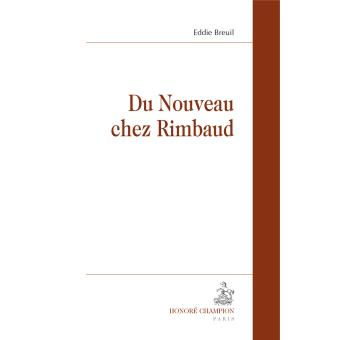
The history of literature is made of errors, of rectifications, which sometimes take time to be admitted, whether it be attribution errors (the works lent to Louise Labé, the Portuguese Letters) or editorial approximations (the various forms of Pascal's Pensées). The Illuminations have known several major versions: mixture of verses and proses or proses alone. Can one only know with certainty the content of this collection? By retracing the journey of the manuscripts and re-examining first-hand testimonies, one realizes that many approximations have been progressively presented as certainties. Concerning this collection, everything is to be reviewed!
This study allows us to take stock by going back to the first traces of the project and the crucial moment that was the companionship between Arthur Rimbaud and Germain Nouveau, begun in Paris and prolonged for a few months in London, during which the manuscripts usually gathered in the Illuminations were put to clean copy. When one follows step by step this literary adventure, the old truths collapse and others emerge. A new reading of the whole of the texts is proposed, reading no longer etiological but based on concrete elements and giving to reinterpret the author's poetics.
Eddie Breuil is preparing a thesis on critical editing under the direction of Philippe Régnier in the LIRE team (UMR 5611) of Lyon. He pursues work on critical and electronic editing of literary texts.