Dada as destruction-creation
The increasingly frequent contemporary reference to the economic theory of Joseph Schumpeter (1883–1950) leads me to make available to the widest possible audience a paper delivered at the University of Seville on 11 May 2006. There one will see how the activity of the Dada Movement perfectly illustrated the thesis of the Austrian economist. Dada, as destruction-creation, is an artistic and literary movement that overturned artistic and cultural conventions. It was founded by Tristan Tzara and Hugo Ball in 1916 in Zurich, in the midst of the First World War. This movement was a cry of protest against the horrors of war and the rigid conventions of bourgeois society. The Dadaists rejected aesthetic norms and used innovative techniques such as collage, photomontage and the ready-made to create works that shock and provoke. Dadaism was also a call for the destruction of bourgeois culture and for the creation of a new form of art emerging from absurdity and chaos. This movement profoundly affected the art world, redefining the limits of creativity and artistic expression.
Creating by destroying
Dada cannot be reduced to a chronicle of scandal. The many short-lived journals, the paintings, the collections published under the aegis of the movement, despite a certain jumble due to circumstances (reaction against criticism, internal quarrels), served as a laboratory for a new poetry and a new aesthetics, freed from the concern for anecdote and directly expressing emotions and the jolts of individual consciousness. On the visual and plastic level, among the abundance of genuinely new productions, I shall limit myself to three problematic aspects of the Movement : abstraction, assemblage, chance and the machine, in order to bring out Dada’s originality before concluding.
Abstraction
Dada’s policy of rallying the extreme avant-garde necessarily led it to encounter abstract art. Much more than Cubism or Futurism, abstraction had become an international practice as early as 1913. But this rallying was partial and eclectic. Partial, because Dada, despite the influence it underwent from it and the overtures it made to it, never succeeded in attracting Kandinsky, who had embarked on a kind of mystical quest and not, like Dada, on a moral revolt. Nor did it attract Léger or Delaunay, who wished to remain realists in the sense that their abstractions were meant to signify the characteristics of a visual and mental universe entirely transformed by industrial techniques and urban life. By contrast, Dada brought together artists such as Duchamp, Picabia, Hans Arp, Schwitters, Ernst and the whole Zurich group, that is, those who conceived their enterprises as formal games, free gambols of the plastic imagination. Given this freedom of principle, one understands the eclecticism of the non-representational images produced by Dada. They never display any systematic formal kinships among themselves. Hans Arp gave the reason for this : “Dada is as devoid of meaning as Nature.”
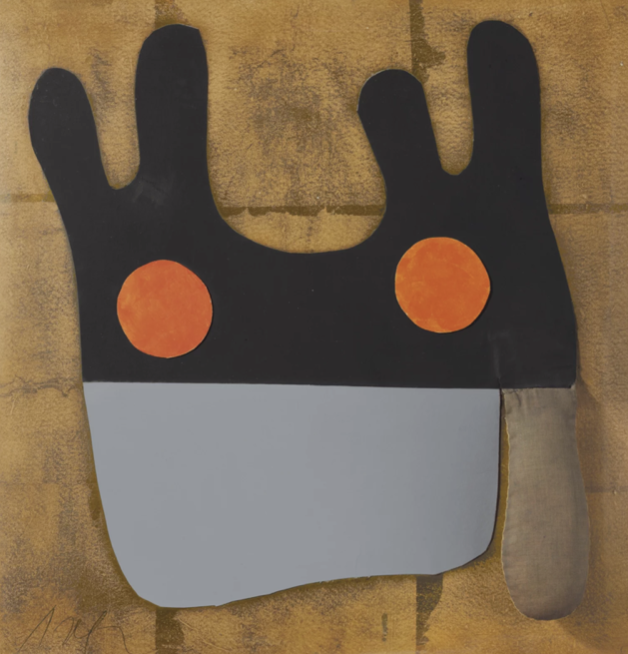
© VG Bild-Kunst, Bonn 2023
Take a Head (1920) by H. Arp, a painting that, according to the artist, may equally well be called abstract or concrete, since these forms are indeed present, material, even if they do not represent any known element in nature. And since one must give it a title, we shall say it is a head, even though the red circles have nothing to do with eyes, nor the four kinds of horns with hair! This implies, according to Dada, that every artistic experiment has a spontaneous, playful, irrational character and is necessarily highly individual. That is why Dada had to contest not only tradition but any methodical enterprise whatsoever, Kandinsky’s no less than Surrealism’s. What I say here applies, of course, just as much to Dada poetry, in forms specific to language, as I have shown in my commentaries on the works of Tristan Tzara.
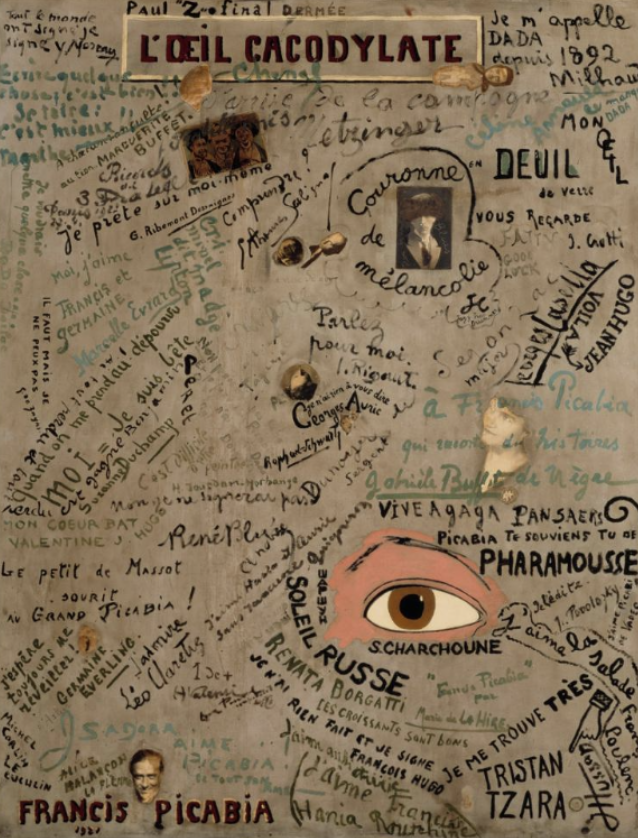
I am thinking of The Cacodylic Eye (1920) by F. Picabia. This is obviously not an abstract painting. But this composition, the result of a collective action in which each contributor, at Picabia’s invitation, represented himself by his name or by a phrase, perfectly illustrates an assemblage of arbitrary signs laid out in advance by the creator. Iron sodium cacodylate is used in injections against asthenia. Needless to say, I think, that this painting caused a scandal at the Salon d’Automne exhibition in 1922.
Assemblage, montage and collage
The term montage entered the vocabulary of art criticism and of cinema at the same time. It refers to the selection and assemblage of a film’s shots under certain conditions of order and duration, and results from the fact that what is projected to the viewer follows a precise order defined by the director, different from that of the shooting. It is also a way of reusing leftovers by assembling pre-existing film elements to form a new work. Minus movement, the same holds true for the painting or the work (it would be hard to call it otherwise), in which figurative elements, borrowed from nature or from artifice, when thus mounted, give a new temporal and spatial coherence to the components that make it up.
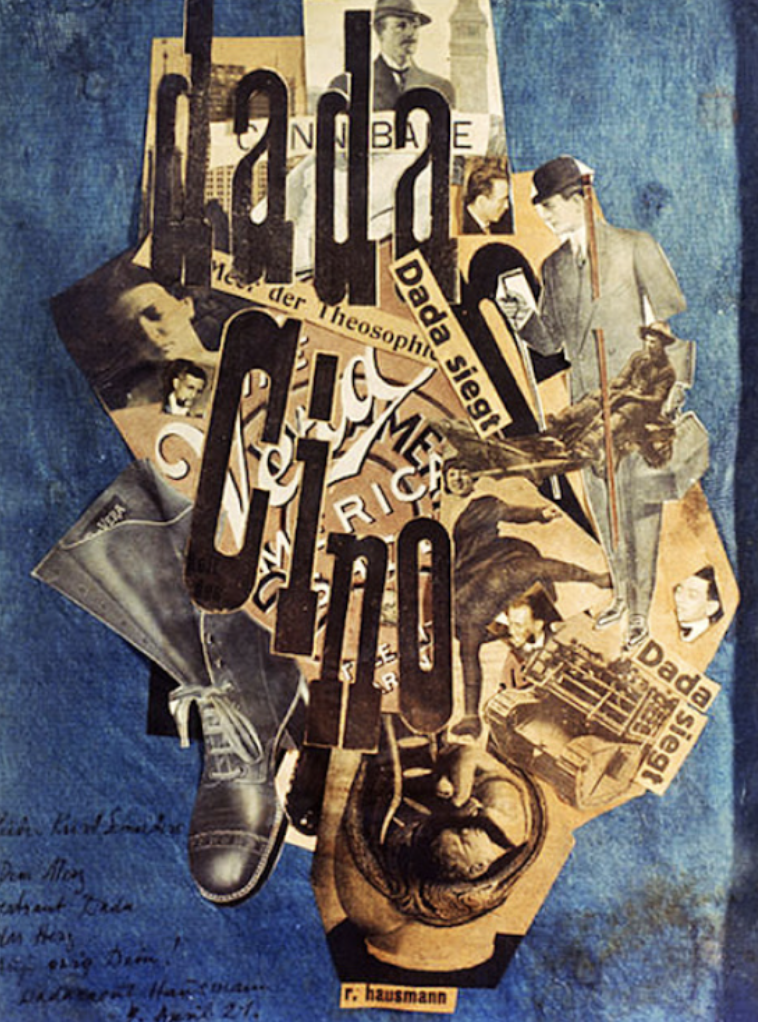
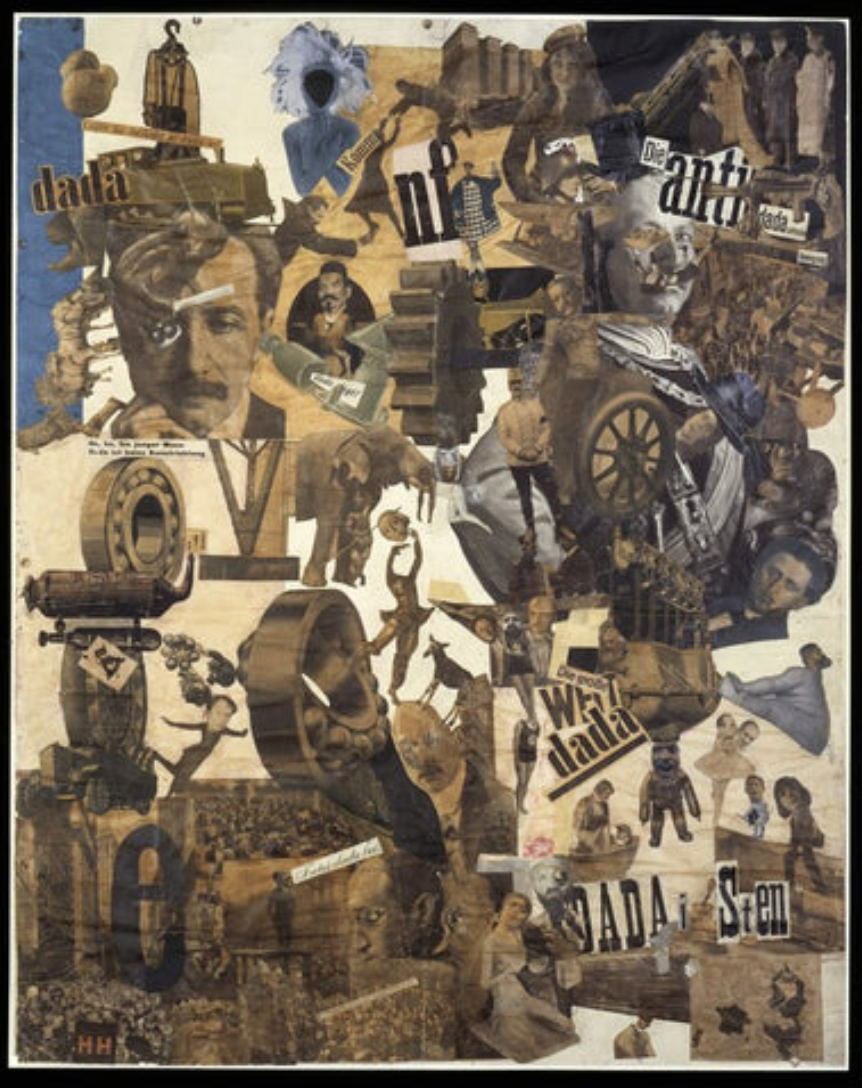
Collage and photomontage, Dada Kino (1920) seems to be the first picture produced by Hausmann when, by chance, as he said, during a stay on the Baltic Sea, he grasped the possibilities of a technique consisting in substituting some elements of a photograph with others. Here, the cut-out self-portrait, the wide-open mouth in close-up, protests against the art of the past; the photographs of Berlin Dadaist friends and the cut-out typographic elements announce that “Dada continues”.
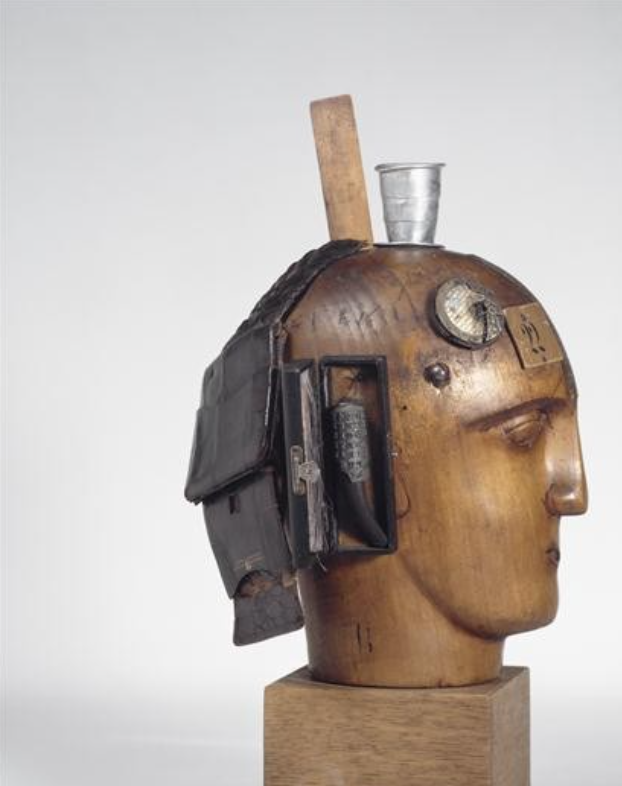
Assemblage : from the same Raoul Hausmann, let us now take Mechanical Head or The Spirit of Our Time (1919). It is made of a wig-maker’s dummy, carefully smoothed with sandpaper, onto which are glued various “emblems” of modern man : a no. 22, part of a camera fixed to a wooden ruler, a purse, a jewel box containing a printing cylinder, a piece of a dressmaker’s measuring tape on the forehead, a tumbler balanced on the top. It is out of the question to assign a single, univocal meaning to each object taken in a symbolic sense. What matters is the impression produced on the onlooker : image of an era, mirror of the viewer, critique of measurement and of science… The explanations subsequently provided by Hausmann, the “Dadasoph”, do not exhaust the subject. The history of the work is itself symbolic : it was returned to its maker in 1968 by Hanna Höch, who had buried it to protect it from Nazi raids. This, incidentally, reminds us that Dada was more open than other movements to women’s collaboration.
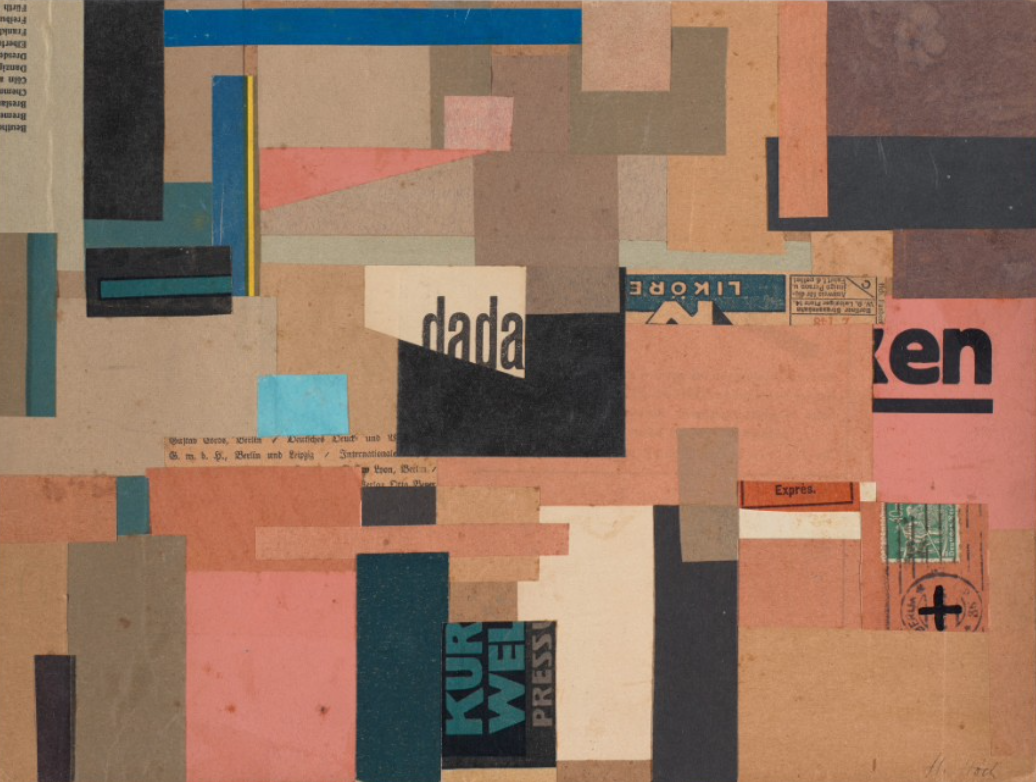
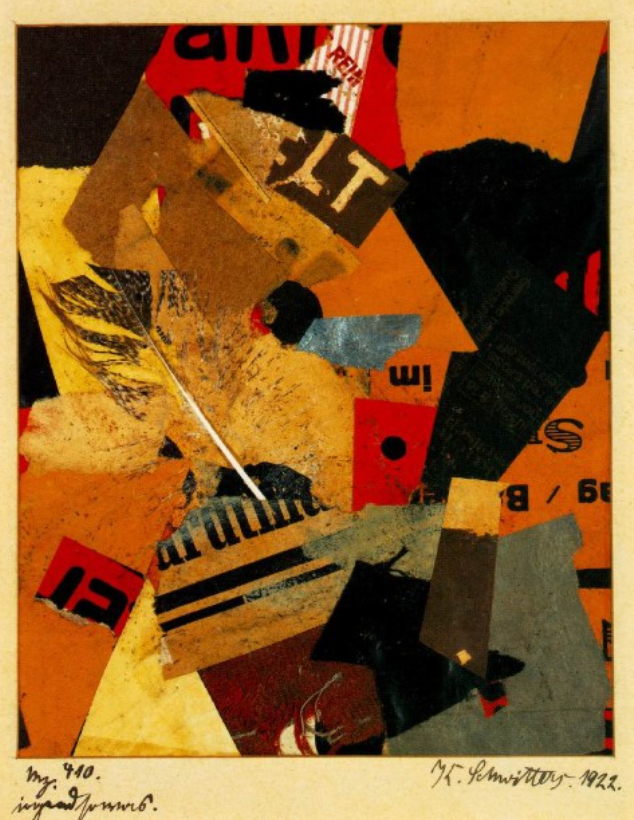
“Anything at all” is the caption of Merz 410 (1922), this picture by Kurt Schwitters made of various elements : fragments of posters, packaging, miscellaneous papers, to which are added a chicken feather and a scrap of wallpaper. It is not an assemblage of chance, but the arrangement in the sense intended by the artist, completed by a few touches of paint.
Here again, the intended effect is above all poetic. Quoting Schwitters, I cannot fail to mention that enormous assemblage of diverse materials and found objects on which he worked all his life, of which only one state, photographed in 1923 before its destruction by the Nazis, remains. This column contained niches dedicated to each of his friends, who entrusted him with an object, a lock of hair, a piece of tie, and so on. The state recorded by the photograph is still very simple and does not yet rise beyond one storey, as would later be the case…
Expressionist images and Dada photomontages formally belong to what we may conveniently call an aesthetics of shock or of contrast, because the entire avant-garde of the early twentieth century referred to these notions. The aim is to obtain effects of opposition by juxtaposing colours traditionally considered inharmonious, representative elements shown at disparate scales, and symbolic signs whose juxtaposition acquires an unusual, scandalous, obscene meaning. The coherence of the image is not first provided by its plastic harmony, but by the anecdote or the idea.
The same applies to Picabia’s collages, in which a traditional conception of the image is carried out with materials generally regarded as base, and also to Max Ernst’s collages, which illustrate a kind of poetic discourse that is sometimes, moreover, spelled out in the titles. Schwitters, by contrast, although he too finds his expressive materials in rubbish, ceases entirely to link the image to any discourse whatsoever; he operates by combinations of colour sensations, thus reconnecting with several experiments in abstraction predating the war.
But whether Dada turns the image into a double of discourse, however incoherent, or whether it treats form-making as an unlimited combinatory, in every case it refuses to attribute any intentional, significant value to the organizing structures of figuration. Ultimately, Dada would like to confer on forms a meaning beyond any intelligible order, that of a thought it itself called absurd because it would place itself outside any cultural system. Dada’s last word would thus have been spoken by Marcel Duchamp when he practised “dust breeding”, or by Hans Arp when he tore coloured papers and pasted them where they had fallen, according to the laws of chance.
The machine, chance
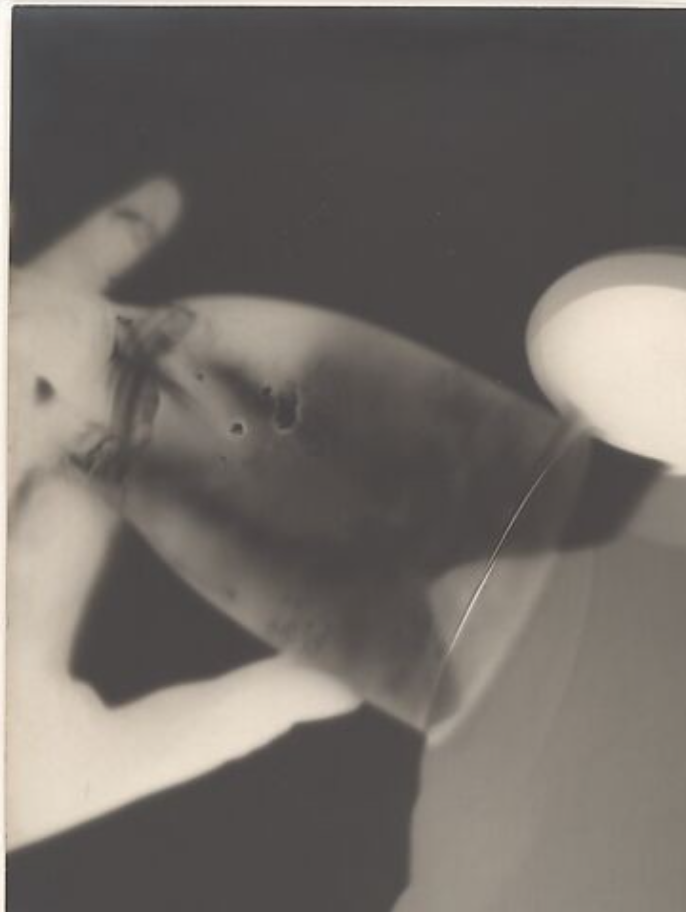
There would be far too much to say about the irruption of chance into contemporary art. I shall content myself with a single example, taken from among the various techniques invented or exploited by Dada: rayography or Schadography (depending on the artist who uses it), discovered by chance, according to Tristan Tzara, by his neighbour in a room at the Hôtel Istria, Man Ray, who, having left a few objects lying on a photographic plate that was inadvertently exposed to light, brought out what Tzara would call “delightful fields”. Delight at the find: aesthetic intention seemed to have been completely eliminated. But artistic arrangement soon reasserted itself.
The same mad desire to get out of culture, to jump over its shadow, can be seen in Dada’s confrontations with the industrial universe. Dada was haunted by the image of the machine. This was not only because of the war and the unleashing of mechanical forces. The face-off between culture and industry, art and technology, had already taken on a dramatically tense character by the end of the nineteenth century. The photomontages of Raoul Hausmann and Hannah Höch still bear witness to this state of mind. They mingle images of the disjointed human being with those of his mechanical instruments, with a polemical intent.
Picabia and Duchamp, on the contrary, attempt an absolute reversal of values—or rather, they attempt to step outside any established system of values. Picabia gives most of his compositions a structure that may be called asymmetrical, because it brings together two kinds of heterogeneous elements. Words, scraps of phrases are inscribed on the canvas, bearing witness to the way shared culture represents human realities. As on an emblem, the image of the machine is set against these elements of a culture that claims to be universal, even though it cannot integrate other elements no less real, those of the social production of wealth symbolised by the machine. In the same spirit, but even more radically, Marcel Duchamp would like to identify the technical object and the aesthetic object. The Large Glass is a pseudo-machine whose elements and structures are supposed to signify the psychological relations of The Bride Stripped Bare and her Bachelors, Even. As for the ready-mades, these are utilitarian objects that Duchamp exhibits in official Salons, forcing people of culture to admit that an object is cultural only because it has been recognised as such by convention, that is, by the will of those who govern the Museum.
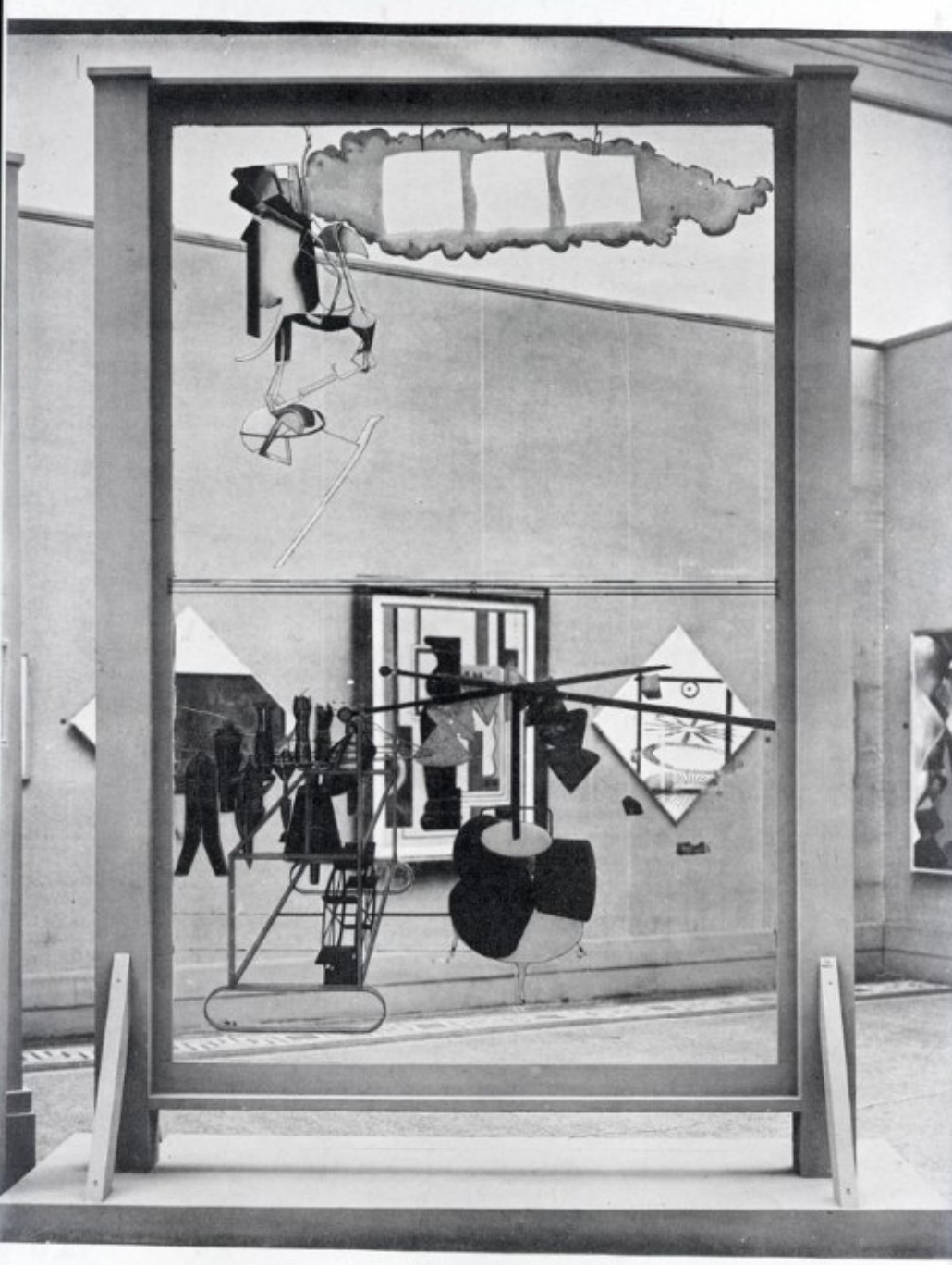
Such, then, was the maddest and strongest thought of Dada, whether poetical or visual. It attempted the impossible: to invert the order of things, to step outside culture in order to criticise it radically.
Dada’s originality
One may well ask what Dada’s original contribution was: free-word poems and disordered typography had already been used by the Futurists; it was not Dada that invented the simultaneous poem or the sound poem; automatism, collage, photomontage, abstract art, even if Dada discovered or propagated them, are shared with others and do not form an integral part of its conception of the world. In reality, it was able to bring these procedures to light because it trusted in chance and, as Jacques Rivière clearly saw, it knew how “to seize being before it had yielded to compatibility, to reach it in its incoherence, or rather its primitive coherence, before the idea of contradiction had appeared and forced it to curtail itself, to construct itself; to substitute for its logical unity, necessarily acquired, its absurd unity, alone original” (“Reconnaissance à Dada”, N.R.F., August 1920). By practising incoherence, it opened the floodgates of the unconscious and enabled humankind to discover the full range of its powers. Above all, it teaches that every genuine artist must know how to forget the past and look within himself (and not in the blissful admiration of a progress that increasingly constrains human beings) for the sources of a lyricism that has no need of conventions to express itself.
Beyond these essential principles, the Dadaists proved the effectiveness of the group. With them, the poet must mingle with other people, for poetry lies not only in words; it lies in action, it is life itself. The individual merges into the group, where he finds and surpasses himself, where all the combined forces prove superior to the sum of their components and make it possible to break down every barrier.
It is not the least of Dada’s paradoxes that a movement which claimed to be destructive should have produced so much, thereby demonstrating reductio ad absurdum that human beings create as naturally as they breathe. It is therefore wrong to distinguish two contradictory currents within Dada, one anti-artistic, represented by the writers Tzara and Huelsenbeck, the other deliberately creative, led by the painters Janco, Arp, Richter… The two approaches are only apparently contradictory. Dada created while destroying. In demolishing old structures, Tzara was well aware that he was erecting a new order, but he had the wisdom not to present it as better than the others.
Nor should we oppose Dada and Surrealism, still less reduce Dada to a provocative tendency within Surrealism. The kinship between the two movements is undeniable. It is also quite clear that the Dadaists, individually, felt the need to move towards new horizons; they knew that Dada Terror could not last, but the whole quarrel came down to a question of timing. Breton wanted to establish the rule of the new spirit, whereas Tzara, considering that the ruins were not yet numerous enough, wanted a general conflagration. Surrealism’s particularity would therefore lie in defining a domain and techniques for tracking down poetry, which, according to Breton, “we now know must lead somewhere”, whereas Dada lived anarchically in the present and rejected all method. If it is true that Breton and Soupault’s Les Champs magnétiques corresponds to certain writings by Tzara and Picabia, it is no less true that the former sought, by means of automatic writing, to reveal the real functioning of thought, apart from any moral or aesthetic concern, while the latter were engaged in an experiment with no tomorrow.
Conclusion: the meaning of the movement
Why did a group of perfectly respectable young people attack in this way the foundations of society, its language and its logic? There is no doubt that the war had something to do with it. But that explanation remains inadequate. The history of Dada shows that the movement only took on its definitive form after the Armistice; one cannot therefore maintain that Dada was born in reaction to the armed conflict. The Dadaists did not oppose the war directly. One would be hard pressed to find a word on the subject in all their production. They were not pacifists, did not share Romain Rolland’s views, and when revolution broke out in the East in 1917, they did not welcome it, for lack of information, they said later, but above all because they had no political training, with the exception of the Berlin Dadaists, who stood alongside the Spartacists in 1920. In short, the Zurich and New York Dadaists merely did their best to escape the war, while their French and German comrades faced one another at Verdun. The war served as a catalyst for Dada. As has been said, Dada explains the war as much as the war explains Dada.
In fact, Dada’s implicit claim went further than the cessation of hostilities or a change of policy. The Dadaists aimed to call into question the human being in general, who had allowed, if not summoned, the catastrophe. Dada was born of a profound disgust for everything that had taken part in the shipwreck, and particularly for language, a deceptive instrument of communication. Thus the Dadaists strove to overturn whatever could still subsist of a world plunged into chaos, through derision or humour, their absurd works mirroring what they saw around them. It is unfair to label them, as Camus did in The Rebel, as “drawing-room nihilists”. Destructive, iconoclastic they were, but above all they expressed through their acts a powerful joy in living, the hope of attaining a better humanity, and that exhilaration in creating which does not belong to the artist alone. The public understood this, since it recognised itself in Dada when it attended their events, even at the risk of compromising the movement by taking it seriously.
Henri BÉHAR