"Running the fields, beating the countryside", preface to: André Breton and Paul Éluard, L'Immaculée Conception, facsimile edition of the Picasso Museum manuscript, presentation and transcription by Paolo Scopelliti, L'Age d'Homme, 2002, pp. 7-11.
This is very precisely the exact reproduction of the autograph manuscript of this capital work in surrealist production. Paolo Scopellititi, whose thesis on the contribution of surrealism to psychoanalytic theory I had directed (published in the same Mélusine collection at L'Age d'Homme), devoted himself to transcribing word for word, including corrections, the handwritten text of the two collaborators, whose handwriting precisely attests to the perspective. I give to read my preface in full, since it indicates the circumstances that led us to propose this work that no publisher would have accepted, at the time, outside of V. Dimitrijevic, the founder of L'Age d'Homme editions. Should I specify that the Picasso Museum bookstore refused to put this collection on sale...
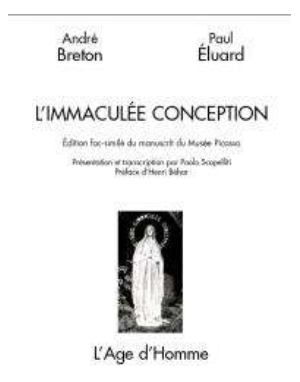
L'Immaculée conception appears in December 1930 at the Surrealist editions, two months after the publication of the first part "L'Homme" in volume 2 of Le Surréalisme au service de la Révolution. A complete dossier of the original manuscripts of this text is found at the Pablo Picasso Museum, format 24x36 cm. These are the four folders of this exceptional document of French literature that L'Age d'Homme reproduces in facsimile. Read my preface below:
Running the fields, beating the countryside
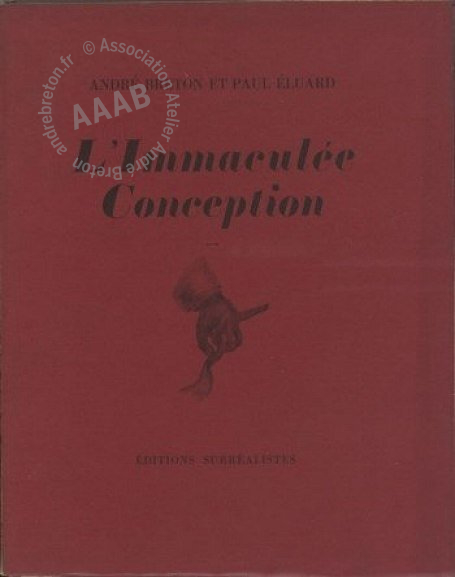
Life reserves you these surprises! One day when I had stupefied myself reading I no longer know what old work at the Sorbonne library, I went for a walk around the Luxembourg, and I entered José Corti's bookstore. His eternal gambier in his beak, behind a table cluttered with books, manuscripts and invoices, the latter was listening affably to a client praising the unsurpassable merits of Victor Hugo. The remark seemed incongruous in such a place, but I let it be said. Old age must pass! Perhaps by provocation, I who have never collected anything, I asked the master of the place if he still had surrealist books, of those that he used to publish under the sign of the "surrealist editions" when he kept shop on rue de Clichy. Alas no my good sir, it's been a long time since all that has disappeared. However... and, heading towards a small glass cabinet, he took out a volume with a wine-colored cover. It was L'Immaculée Conception, by André Breton and Paul Éluard, of which he had just found a few forgotten copies in a warehouse, in perfect condition. I took it like the holy sacrament, leafed through the uncut notebooks, appreciating the impeccable printing on laid paper. By the magic of the book, I suddenly found myself in 1930. A ray of the setting sun struck the shop obliquely. The acquisition was quick, since the object was offered to me at the initial selling price, or almost, in old francs of course. It was, it should be specified, about forty years ago. Thus, the two thousand copies of the initial print run had not found takers in thirty years! What to say then of the collective reading of this book that I imagined sulphurous, as the Dali vignette on the cover suggested to me? At first glance, it's just a hand, devilishly hairy, holding a lock of hair, whose exaggeratedly stretched little finger resembles a horn. At that time, the surrealists had no right of citizenship in school textbooks, and Dali was playing the fool as he could, not without notable success, it must be admitted. I then read, in complete ignorance of the facts, these pages of which I did not even suspect that they were the result of psychic automatism: "A day understood between two other days and, as usual, no night without a star, the long belly of the woman rises..." Such is the conception, genesis of the text and reading. Ah! to find the freshness of the first reading, the brand new impressions, at the price of some misunderstandings, what does it matter? It is undoubtedly the second section, "The possessions", which then struck me the most. Naively, I believed in these attempts to simulate mental deviations, of which the authors said they had become aware of unsuspected inner resources. What did it matter to me to know if general paralysis, this inflammation of the brain caused by syphilis, could or could not give rise to such writings? It was enough for me to read "My great adored beautiful like everything on earth and in the most beautiful stars of the earth that I adore..." I was carried away by the dynamism of this obsessive, redundant speech and yet full of golden sparkles. However, a text from the following section had put a flea in my ear: one had to be deaf not to hear the Kama Sutra behind these 32 amorous positions, superbly named! Finally, the paradoxical wisdom of "Original Judgment" seemed to me like Gide of The Earthly Nourishments turned inside out like a rabbit skin. One had to read between the lines, contemplate the white of the text and be inspired by it. But could one take this text as simply at its publication, in 1930, knowing from whom it emanated? Every reading is historical, whether one wants it or not. The press of the time bears witness to this, which reacted according to the surrealist label of the authors. Not accepting the surrealist ambition to change the world and life, it could not understand their poetic attempt. This is not to say that it was insensitive to certain beauties of the text, to its literary and poetic qualities. More perspicacious, some, such as Jean Cassou, saw in it an effort of "communication of the thinkable with the unthinkable" or again André Rolland de Renéville emphasized the "reconstruction of human existence in its totality". However, on the whole, no one knew how to approach the latent content of the work, that by which it stands out from all contemporary production. Indeed, for the two authors, whose friendship was growing closer, it was nothing less than retracing the latent epic of man, and giving surrealism a new start, following what Breton and Soupault had originally done in 1920 with Les Champs magnétiques. In short, to overcome the contradictions of the real by the exercise of poetry. After the Wall Street crash, it was that of the heart. Each of them was going through a distressing sentimental crisis. Gala had left with Dali. Éluard had had to separate from his wife, with whom he was united by a great complicity, not only erotic, as evidenced by the letters he continued to address to her, confiding to her all the details of his thoughts and gestures. For his part, divorced Breton could not understand what he thought was the fickleness of Suzanne Musard, the mysterious woman who intervened at the end of Nadja to, he believed, reveal to him the meaning of his life. Both wandered from one woman to another. Passion was elsewhere. In March-April 1930, during an expedition with René Char in his fief of L'Isle-sur-Sorgue and its region, they had attempted to write poems in three alternating voices. A collective experience of a playful nature, Ralentir travaux had brought them a moment of comfort, the feeling of an absolute complicity. Yet, as soon as published, this collection had seemed to them a way of giving the change, nothing more. Forced to sell the manuscript of Nadja to a collector, Breton wrote "This man, in April 1930, would terribly start over if it were to be done again. He has only the experience of his dreams. He cannot conceive of disappointment in love but he conceives and he has never ceased to conceive life — in its continuity — as the place of all disappointments. It is already curious enough, interesting enough that it should be so..." How not to think of the suicide of the Russian poet Mayakovsky, brutally posing the question of the relations of the individual with the revolution? Commenting on this gesture, Breton sees in it the drama of a love without reciprocity, and of course he speaks for himself in the first place. It would be necessary to be able to radically change the status of woman in capitalist society for her to be in unison with the revolutionary, the being in the world least defended against a feminine gaze. As for the communist society in the process of creation, there would be much to say, and the revolutionary duty must be deduced from the most general human duty, not the reverse. There is no way out of this! As we can see, Breton (Éluard thinks no differently) does not envisage his becoming outside that of the revolution, as he had just affirmed in the Second Manifesto of Surrealism. Provoking lively reactions among his old friends, he had aroused a regrouping around his person and his ideas, launching a journal whose title, inspired by Aragon, is in itself a whole program: Le Surréalisme au service de la révolution, of which the first issue comes out in July. The inaugural message addressed to Moscow confirms the absolute commitment of the surrealists alongside the Soviets. Nevertheless, the rest of the publication proves that surrealism continues, and that it intends to develop on autonomous bases. "There will be once": Breton dreams again of a phalanstery that he would locate not far from Paris, transforming for the benefit of his friends a hotel in Verneuil where he had gone in the past (curiously, certain pages of the draft of L'Immaculée Conception are written on the letterhead of this establishment), and to affirm superbly that "the imaginary is what tends to become real". Beautiful formula, indeed, to overcome the great depression. In July, Aragon is the witness of this period of absolute pessimism: Breton begins to speak of suicide again. To distract him, the virtuoso author of La Peinture au défi (work published in March 1930 where he makes himself the apostle of collage in painting) proposes to compose with him a third Faust, a scenario in the manner of Le Trésor des Jésuites, which would be adapted to cinema by René Clair, with music by Georges Antheil. But the affair doesn't work, and nothing remains of it in Breton's archives. To make matters worse, the collaborations to the journal Le Surréalisme au service de la révolution are not crowding or are frankly disappointing. It will be necessary to compose something a little lyrical. This is when Éluard intervenes positively. At the end of August, he had taken lodgings in the same building as Breton, and both launched into the composition of a four-handed poem, if I may say so, which they would publish in the SASDLR with vignettes by Dali, already engraved. "I am writing with Breton a long text on man in five parts: conception, intra-uterine life, birth, life and death. Not bad, but what work" Éluard confides to Gala on August 27. As we can see, the project is ambitious: to tell the whole life of man, all their life, from beyond-birth to beyond-death. Few have ventured there until then: a complaint by Laforgue, a poem by Cendrars, that's about all, and it's very short. Now, they had read Otto Rank's treatise on the trauma of birth, which serves them, in a way, as a trigger, with Hegel (in Vera's translation), Breton's bedside reading. Then rise their amoebic songs, each evoking in turn his memories of early childhood and even beyond. Immediately after the publication of SASDLR n° 2 in October, L'Immaculée Conception comes off the presses at the end of November. This first section, of properly poetic creation, has been increased by three other sections, of which "Les Possessions" claim to be, according to the editors, an attempt to simulate diseases that are locked up. The manuscript is dated September 1-15. Fifteen days is very short for such a dense ensemble. Yet, with a few details, it is the time it took them to mount these new experiments. Arrangement made with José Corti who sells the drafts and manuscript to Valentine Hugo and the Viscount de Noailles, the collection can appear immediately. One cannot help thinking of the speed of writing of Les Chants de Maldoror and Poésies by Isidore Ducasse, of that of Les Champs magnétiques as well, and one says to oneself that there is there a technique, a surprising means of accelerating poetic discovery. Since then, different works have shown the important part of collage in this writing. Besides the Kama Sutra, already mentioned, the editors of Breton's Complete Works in the Pléiade, using the Picasso Museum manuscript, have detected the presence of fragments of articles from the journal La Nature, and of a text by Gérard Bauer in L'Intransigeant of September 11, 1930. But the most important discovery is that of Alain Chevrier, published in Mélusine n° XIII in 1992. He shows there, with supporting evidence, what "Les possessions" owe to the Writings and drawings of the insane in nervous and mental diseases by Rogues de Fursac (1905). Thus, the authors had indeed been inspired by authentic writings of mentally ill people, which suffices to guarantee their purpose. While these same writings inspire sadness and compassion, theirs breathe, I have already said, the joy of creating, as if the exercise of these mental deviations had liberated them from their own depression! It was necessary to take their warning (written by Breton alone) literally: it is possible for the poet (or the mind "trained poetically") to integrate certain delusional ideas, without losing reason, and therefore to simulate a whole range of writings likely to replace traditional literary genres. By their own admission, the "confusional intentions" which had presided over the essay in question, and which aimed to call into question psychiatrists (especially those who intervene in courts), and literary critics strong in their frozen rhetorics, had succeeded. No specialist of the time perceived the texts that were at the source of this undermining work. Not content to pursue the polemic with the alienists inscribed at the opening of the Second Manifesto of Surrealism, Breton was settling accounts with the institution that had dared to send poor fearful beings to the lantern during the war by accusing them of "simulating" madness, by internment Nadja. For him, the proof was made: there is no barrier, no limit between the supposedly sound mind and madness, between the real and the fantasy. To claim the contrary is a denial of justice. Not to mention the magnificent creative impulse that this expedition beyond uses provides. Thus, the dogma according to which automatism would be pure spontaneity is in bad shape. Yet, what do these intra-textual researches prove? That the poets lied? Not at all. The title they had chosen for the collection, L'Immaculée Conception, had to be taken in its literal sense: a conception without stain (of ink) since paper and scissors almost sufficed. Similarly, the epigraph "Let's take the Boulevard Bonne-Nouvelle and show it", which, besides the anti-Catholic charge contained in all the surrealist writings of the time, referred to a long period of Nadja where this Parisian boulevard was evoked for the "magnificent days of looting" during the workers' demonstrations against the death sentence of the Italian anarchists Sacco and Vanzetti in America. Such an exergue clearly indicated the sacking. In the same way that the popular riot erects barricades with everything found on the great arteries of the capital (conceived by Haussmann to break the demonstrations), any writing can serve as fodder for poetry. It only takes a little attention. Everyone now agrees: Max Ernst's collages are pictorial creations, while so many collagists, with identical materials, achieve nothing showable. It is curious that the same question has never been asked about poetic productions. To succeed in a collage, one must choose one's starting material, cut it properly, I mean according to the objective to be reached, glue it on an adequate support, set the whole in a determined purpose. Even if it is not as easily visible as in a graphic, the written collage does not proceed otherwise. It takes a mind "trained poetically". Even more when the collage is "aided" as Marcel Duchamp said, retouched in the direction we have just seen. In short, automatic writing, attempt to simulate mental illnesses, plagiarism, more or less corrected collage, imitation are to be placed on the same plane. These are different modalities of poetic creation. This is exactly what Paolo Scopelliti shows in the introduction that follows, through a careful reading of the different manuscript states. What can the facsimile reproduction of all these documents that generally do not cross the threshold of the printer serve? Certainly, they do not reveal a collage. At least they show the poets at work, the alternation of their voices, their hesitations, their repentances, their finds too. They show how the failures of writing are suddenly cancelled, surpassed by another formula, which itself leads to a higher plane. Thus the poets have let their mind run the fields, beat the countryside. As for the reader, he will find there the most fervent testimony that exists on the creative capacities of the human mind. Henri BÉHAR
Text reproduced in: H. Béhar, Histoire des faits littéraires, Paris, Classiques Garnier, 2022, pp. 79-86.

Two centuries ago, the supporters of the New Sorbonne theorized the principles of literary history as an independent discipline. Today, it is appropriate to complete it with the analysis of literary facts, these individual or collective phenomena that constitute its inseparable foundation. See: original edition in the André Breton collection