"She who reads" and she who writes between two cultures", Les Mots la vie, n° special issue, spring 2006, p. 131-143.
Besides the very moving Butterfly Kiss, I had the opportunity to review a novel by Colette Guedj, who is also a Professor at the University of Nice, animator of the research group on Paul Eluard. It was in a note in the journal Europe, which follows. It dates from January 2005:
Colette Guedj, L'Heure exquise, JC Lattès, 216 p., 2005. We know the definition of the Jewish sweater: "it's the sweater I put on when my mother is cold". I couldn't help thinking of this universal story throughout the eighteen tableaux (perhaps one should write sound takes) of this novel. The narrator, who decidedly could not accommodate the fate made for her aged mother, works to soften the end of her life, in dignity and respect. Now this is visibly a human dimension that the authorities and even the staff of retirement homes ignore the most, no doubt because it has no price. Hence the bitter humor of these snapshots where, according to the consecrated formula, "any resemblance to any establishment for elderly persons can only be pure coincidence". Not that there are not, in passing, admirable behaviors, meritorious devotion, but because, by isolating the elderly person from their usual environment to put them in a specialized residence, by cutting up society into age classes without communication between them, modern society only increases the isolation of one and the other, hastening their race toward the inevitable. It would be time, with Colette Guedj, to give back to the most usual, most worn words their primitive meaning and their emotional charge, as in this play where Madeleine Renaud, the queen mother, gently finished the performance by humming "l'heure exquise": Endgame.
I learned from the journal's friends that my note had pleased them very much, particularly the sweater of my mother. It must be believed that it also pleased Colette Guedj, who sent me her Journal de Myriam Bloch, so that I could contribute to the issue that the journal Les Mots La Vie that her usual partners intended to devote to this novel, notably on cultural identity and the transmission of memory. In line with what I had just written, I composed a detailed article on the cultural complexity of her narrative.
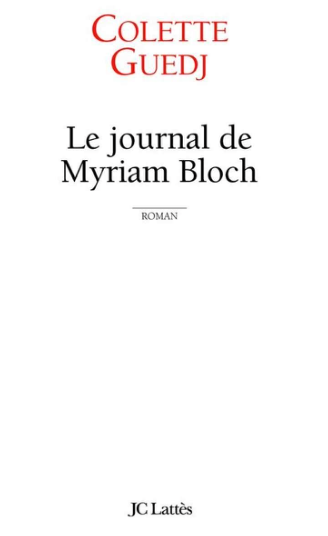
Back cover: Work by Colette Guedj: Le journal de Myriam Bloch, J.C. Lattès, 2004 Everything begins from a book read in early childhood, The Journal of Myriam Bloch of which a page will forever mark the narrator. It is the story of this book, lost and found, which will trigger, by a mirror effect, the writing process of this life story. The narrator retraces her journey as a woman whose childhood was bathed in Jewish and Oriental traditions, to which she feels linked by a kind of carnal alliance; relatively protected childhood in Algeria, in the harmony of a mixed identity, while in France Jews were being deported. But the unspeakable catastrophe will catch up with her, first through the accounts of the death camps that reach her and will make her a "second skin", then through history pure and simple which in a certain way continues. Two motifs run throughout the book, referring to the theme of memory: that of the palimpsest, our life being made only of successive layers which to cover each other are never totally erased; then that of the stairwell which orchestrates, as in a sound box, the comings and goings of our destinies always similar and always different.
Read: Les Mots la Vie, n° Special issue: Writing identity, writing memory; collective work around Colette Guedj's novel, Le journal de Myriam Bloch, JC Lattès, 2004 Special issue spring 2006 of Les Mots La Vie, Journal on surrealism Nice, Éditions du Losange, 2006. Back cover: "The stake of this issue is, more than ever, that of the relationship between words and life" wrote Colette Guedj recently in opening an issue of the journal Les Mots la vie entitled Autobiography: from desire to lie. This is still true, oh how much, of this one, except that what is at work in the Journal of Myriam Bloch under Colette Guedj's pen is the flagrant desire to tell the truth, to write at least as justly as possible, both identity and memory... This is what is emphasized here, each in their own way, but very unanimously, by the different contributors" to whom the journal chose to give carte blanche around Colette Guedj's novel, within the framework of their specialty.
Contents: Foreword by Paul Léon First part: Multidisciplinary meeting – Ali Benmakhlouf, Identity and fiction, on The Journal of Myriam Bloch Jean-Pierre Zirotti, The question of identity in The Journal of Myriam Bloch Paul Léon, Colette Guedj's books of life Marie Virolle, Colette Guedj's Algeria: words, body, rites or the carnal alliance Tristan Hordé, The name of the reader – Arlette Chemain, From Anacolette to Myriam Bloch, movements and connections Joël Candau, Mnemotechnics – Arnaud Beaujeu, From loss to passage, life palimpsests Henri Béhar, "She who reads" and she who writes between two cultures Second part: Reading and friendship notes – Serge Gaubert, The staircase and the cage – Albert Bensoussan, Those who kept the key – Robert Fillon, Memory traces Maurice Adjiman, As in sagas Éveline Caduc, "Léhaïm, To life", the little music of the Journal of Myriam Bloch Third part: From Tiaret to Pfastatt A tomb in the air, an unpublished story by Guy Dettmar À voix nue by Colette Guedj.
Download my article: She who reads and she who writes between two cultures
Text appearing in: H. Béhar, Essay on cultural analysis of texts, Classiques Garnier, 2023, pp. 229-238: Essay on cultural analysis of texts - She who reads and she who writes between two cultures (classiques-garnier.com)