“APOLLINAIRE, CHAMPION OF EUROPE,” EUROPE, NO. 1043, MARCH 2016, P. 234
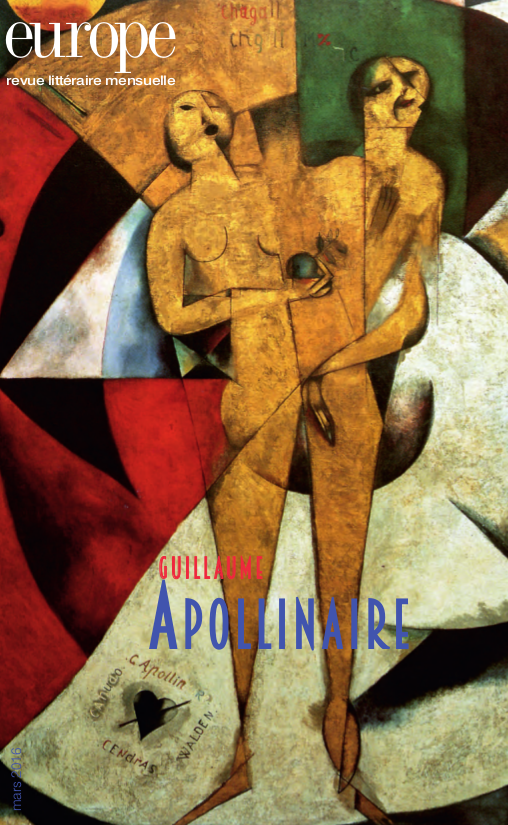
Published monthly, Europe has not always been, as it is today, a literary magazine. Since it also dealt with culture and political ideas, one can understand why writers’ and poets’ names were not always prominent within its pages, and why, at its founding in 1923, it showed little concern for establishing a hierarchy of literary figures. All the more so because, oriented toward Europe and, so to speak, the whole world, the French were not meant to be center stage. Founded by former members of the Abbaye group and friends of Romain Rolland, the magazine was more concerned with social justice and advocacy than with the avant-garde. Nevertheless, it did not ostracize the contemporary avant-garde, often regarding it with amused or at times horrified curiosity, while awaiting the day when, their youthful exuberance spent, these young writers—like Philippe Soupault—would join its ranks. Let’s not forget that its very first issue published a previously unseen text by Count de Gobineau!
Catering to a generally “left-leaning” audience—without fear of contradiction—made up of school teachers, self-taught individuals, but also managers, organized workers, and well-informed readers eager to become even more so, it was obliged to provide both information and insight, to open broad horizons towards foreign cultures, and to offer essential overviews of the history of ideas, reciprocal influences between countries, and the aesthetics at work here and there. Early on, the publication of foreign texts greatly contributed to its diffusion. As a result, after almost a hundred years of existence, it occupies a notable place within the French cultural landscape. Whether by design or not, it has engaged in a kind of ranking of values and even today contributes to the “pantheonizing” of certain authors—both foreign and French—helping to popularize them in France, notably through its special issues. So much so that these special issues have now become the norm.
To verify the above assertions, we have an unparalleled tool that many researchers envy: the DVD archive of Europe, in full text, faithfully reproducing the entire collection from 1923 to 2000, in both image and searchable text format. Lexicometry expert Étienne Brunet described it as follows: “From 1923 to 2000, there are 860 issues, including a suspension between 1939 and 1945. This amounts to 13 meters of shelving in a library, or, in smaller units, 7,500 different authors, 28,000 articles, 140,000 pages, and 58 million words. This approaches the gigantic scale of the Encyclopaedia Universalis (6,025 authors, 30,000 articles, 52 million words) and the 19th-century Grand Larousse (90 million words).”
Thus, the Apollinaire enthusiast quickly learns that the poet’s name appears 3,224 times, making it one of the most frequent in the corpus, far behind Romain Rolland, of course, but well ahead of all his contemporaries (not to mention about thirty occurrences of the derived adjective “apollinarien”). That is why the title of this article essentially imposed itself, mathematically speaking. Apollinaire is a champion of Europe by virtue of his presence under the pens of editors, his aura among readers, and perhaps implicitly because, during his lifetime, he embraced the European idea—his biography shows him as above all a European, one who lived “Across Europe clad in multicolored flames.”
Taken aback by the remarkable critical reception of the poet in Europe, I will establish the place he occupies in the 860 issues considered, analyze the most significant works within his repertoire, and finally linger over the image that the magazine’s contributors painted of him.
Why is Apollinaire the champion of Europe? Quite simply, because he is the most frequently mentioned author of his generation. I define Apollinaire’s generation, in Thibaudet’s sense in his History of French Literature from 1789 to the present day, as all authors born within five years before or after Apollinaire himself. Here, by descending frequency, is the ranking from the corpus considered (that is, all issues of the magazine from 1923 to 2000): Apollinaire = 3,224 occurrences, Max Jacob = 2,524, Jules Romains = 1,464, Giraudoux = 1,368, Ramuz = 1,349, Raymond Roussel = 1,171, Victor Segalen = 842, François Mauriac = 823, Valery Larbaud = 817, Jules Supervielle = 724… In light of these frequencies, it would seem justified to devote issues to Jules Romains, Giraudoux, and Ramuz, after having done so for Max Jacob and Apollinaire.
Regardless of what one may think about such tallies, this ranking offers a telling picture of the esteem the magazine holds for some writers of this generation, such as Jacques Chardonne—highly praised by a former President of the Republic—or Paul Géraldy, author of Toi et moi (a collection to be found in every family library), with a mere 18 mentions. However diverse these contemporaries are, none is as significant or as highly considered as Apollinaire—this is obvious.
The second, Max Jacob, who could be called his comrade-in-arms despite their fluctuating friendship, follows a frequency curve that closely parallels Apollinaire’s, with the notable difference that Jacob’s dossier preceded Apollinaire’s by nine years and is much discussed in 1949 due to many articles dealing with his tragic fate.
However, as is rightly said, such numbers should always be put in context. Thus, Romain Rolland, leader by a wide margin, appears 6,671 times, including a special issue (no. 109-110, 1955) devoted to this father figure. Claude, who had a dedicated dossier in 1982, appears 2,242 times; Gide comes in at 2,183, and Péguy at 1,836—barely more than Jarry, his “conscript,” born the same year, with 1,696.
Younger contemporaries fare still less well. Cendrars earns just 1,975 mentions (including a dossier in 1976); Reverdy only 1,182, despite a double issue in 1994; not to mention the devoted André Salmon (191 mentions), nor Pierre Albert-Birot, unjustly mocked by his Surrealist contemporaries.
It is worth noting, in passing, that dedicating an issue to a writer systematically increases their frequency in the magazine by about a thousand occurrences.
Thus, our poet rightfully holds first place in his generation and even beyond. The high frequency of his name does not mean that it is evenly distributed throughout the 218 articles in which he is mentioned between 1923 and 2000. Year-by-year statistics (which a graph would make more eloquent) reveal spikes in 1953, 1958, 1966, 1970, 1982, and so on. Plainly, the high tally of 1,100 in 1966 coincides—as previously noted—with the issue entirely devoted to the poet. Conversely, there are completely blank years, with no mentions at all (1928, 1929, 1930, 1932, 1934…). In others, he is barely referenced: four times in 1949, nine times in 1965—the very year preceding the special issue on his work!
To sum up this chronological overview, he is named 62 times in the prewar period (1923–1939), 29 of those in 1924, mainly in René Lalou’s column marking the fifth anniversary of his death. A mixed column—enthusiastic for the poet of Alcools, extremely critical of the theorist of “The New Spirit”!
He is cited 1,748 times between 1946 and 1968, mostly in the already-noted 1966 double issue no. 451-52, which I will examine in detail below.
With the magazine’s return after such difficult times nationally, it’s unsurprising to find Aragon discussing Apollinaire alongside Max Jacob in his “Chroniques du Bel-Canto” (April 1946, p. 106), and Claude Roy—writing in 1948—surveying recent books by André Rouveyre, Louise Faure-Favier, André Billy, Aegerter, and Labracherie, searching for a “discontinuous lyricism” that Apollinaire at times achieved.
Continuing this tally, I note that between 1969 and 1984 there are 1,031 appearances of this chosen name, 278 of them in 1970 and 222 in 1982, particularly in the June-July issue focused on “Cubism and Literature.”
Note also a marked decline in the most recent period: from 1985 to 2000, there are only 383 occurrences, including 67 in 1993 and 57 in 1997—still six times more than prewar!
Yes, one may say, Apollinaire is often cited in your magazine. But this high frequency does not tell us whether the mentions are positive or negative, in praise or in criticism!
I regret not being able to reproduce here, as is done in biblical studies, a table showing all the “concordances” (an alphabetical, line-by-line index of the 3,224 appearances of “Apollinaire,” with their location in the complete magazine collection), in order to instantly gauge their value and context. Nonetheless, as an example, I will venture to illustrate what one might see for the first period (1923–1939), with entries sorted to the left of the keyword:
[concordance sample left in French for reference]
Notably, with a simple click on the computer, I can immediately see the full context, allowing me to note that the “Christian name Apollinaire” appears in an Isaac Babel story and is not relevant here (there are 9 occurrences of the first name Sidoine, and the fact that it is included in the total Apollinaire frequency hardly affects the whole corpus of 3,224 occurrences). Even a superficial examination of the table shows that the poet is almost always referred to only by his surname, without his forename—an indisputable sign of notoriety. Looking further, one will note the names that most often accompany Apollinaire, and the terms most frequently associated with him: images, aesthetics, poetics… The value of such tools no longer needs demonstration (even if only a very few actually use them). Seeking to position Apollinaire among the concerns of Europe’s contributors, I will focus more closely on the various categories of texts mentioning his name.
The first, most obvious category is that of documents bearing the late poet’s signature. There are three autograph facsimiles included in the 1966 special issue, then at the bottom of the manifest “L’Antitradition futuriste,” printed in March 1975 using the same method. In each case, these are rare documents: manuscripts of poems (“Apothéose,” fragment—Coll. Chobot; “Exercice”—to G. Turpin. Coll. Adéma), or a letter (March 1916 letter-card, Coll. Madeleine Pagès), entrusted by Jacqueline Apollinaire, André Salmon, Pierre-Albert Birot, and most of all his biographer and collector Pierre-Marcel Adéma, who generously opened his archives. The cover illustration for no. 451-52, reproducing a Max Jacob watercolor, is all the more remarkable since—until the 2000s—the magazine barely contained any illustrations. This underscores the importance attached to the poet’s handwriting itself, not to mention the quality of the previously unpublished documents shown to readers for the first time.
Next come the studies and articles within the first special dossier dedicated to the Magician himself—a real milestone, since it paralleled the literature aggregation programs of the time, a fact still remembered by many.
The structure of these special issues required, at that time, an introduction by the editorial lead, a contextualization of the writer in his era, and a chronology. This issue follows that pattern, with Pierre Gamarra’s introduction (after returning from Georgia) drawing, under the title “De faïence et d’escarboucle,” a curious parallel between Apollinaire and the great eighth-century national poet Rustaveli, author of the 7,000-verse epic The Knight in the Panther’s Skin, whose people are able to spontaneously recite long stanzas (Gamarra himself could recite, if not the entirety of Hugo’s The Legend of the Ages, at least The Little King of Galicia, with tone and breath; one imagines he could have done the same for that knight, given the time). This leads him to reflect on the idea of popularity, which now characterizes Apollinaire, and on the blend of classicism and anticipation: the very formula of modernity. “Couleur du temps,” sketched out vividly by Maurice Bouvier-Ajame, remains useful to those not convinced that poetry springs fully formed from the mind of the artist. Finally, Michel Décaudin’s chronology resets the record on many controversial points.
Within this tally, it would be superfluous to analyze every individual contribution in detail. Allow me instead to reproduce the table of contents as it appears to the reader:
Jacques Gaucheron, Etoile Apollinaire, 31
Michel Décaudin, An Impossible Chapter, 36
Jean-Claude Chevalier, Apollinaire and the Pun, 56
P.M. Adéma, “The Feast of Aesop,” 78
Franz Hellens, Apollinaire with Hindsight, 86
Claudine Chonez, Apollinaire Among Us, 97
Simone Delesalle, The Language of Apollinaire, 105
Roger Chateauneu, Inventing the Alphabet of the Phoenix, 112
Pierre Lagrue, Guillaume and Blaise, 118
Hélène Henry, Guillaume and Max, 124
Roger Navarri, Poet of Displacement, 132
Henri Meschonnic, Illuminated Amid Shadows, 141
Françoise Han, Images of the Future, 169
Noémie Blumenkranz Onimus, Toward an Aesthetic of “The Ardent Reason,” 173
Georges Dupeyron, Space and Time, 193
Bernadette Morand, Absence and War, 202
Lionel Follet, Unhappy Love in “The Seven Swords,” 206
Frédéric Robert, Apollinaire and His Musicians, 239
Louis Durey, “Beautiful Clarity, Dear Reason,” 248
Jean-Claude Chevalier, Apollinaire and Criticism, 251
Marie-Louise Coudert, Apollinaire 66, 257
Albert Fournier, Pied-à-terre to Dovecote, 295
It’s difficult to detect an organizing principle, since thematic articles blend with historical studies and more technical approaches, except that pride of place goes to a poet familiar to the magazine who, using a woodland metaphor, signals both the undisputed place Apollinaire occupies in contemporary letters and his own reservations (as held by some of Apollinaire's immediate disciples) regarding his conception of modernity, order, and adventure. To some extent, this is echoed a few pages later by another poet, Franz Hellens, “with the benefit of hindsight.” There’s no doubt that Georges Duhamel’s judgment—comparing Apollinaire’s poetry to a bric-a-brac shop—still carries weight, with several contributors striving to contradict it, such as Lionel Follet’s determined analysis of the odd “Seven Swords” interlude.
Thus broad literary history studies highlight ambiguous points in Apollinaire’s life and work (Décaudin), chart his conflicted relationships with his allies Max and Blaise, show his role as a journal editor, and analyze in detail the materials being published at the time, such as the collection of letters to Madeleine Pagès, Tender as Memory (Bernadette Morand). Albert Fournier continues his original enterprise: situating writers in their homes and bringing literature to life through walks, whether real or imagined.
But what was—and will remain—a landmark moment was the publication of a collaborative project: that led by Jean-Claude Chevalier, Simone Delesalle, Henri Meschonnic, and their colleagues at the Faculty of Letters in Lille. Such was their research base. I can personally attest to their collective thought and their insistence on scientifically justified vocabulary, as someone who often saw them at work in the Flèche du Nord. They pursued their debates in Lille, resulting in independent yet interconnected articles. This was the era when linguistics was moving to occupy the full field of literary studies. Here it stepped into the open, with a benevolent, even seductive, smile. Simone Delesalle explored the powers of metaphor, Jean-Claude Chevalier laid out an urgently needed theory of the creative pun. As for Meschonnic, it fell to him to sum up everything, using a method I’d have then called “structuro-global,” which he would have quickly refused, insisting instead on his conception of rhythm as totality.
A third grouping of contributions colors the Europe review, which could never be considered insular. Thus, Apollinaire is seen from Prague and from Georgia. Hubert Juin finds traces of his native Wallonia; N.I. Balachov offers a lesson on the Zaporozhian Cossacks; Michèle Loi notes a generation of young Chinese poets turning towards the West, explicitly referencing Apollinaire, just as the “Cultural Revolution” targeted foreign sympathizers1.
The exceptional quality of such an issue shouldn’t obscure the 180 or so other articles mentioning the poet of Alcools during the period in question. To go straight to the point, I will mention only those texts that refer to him by title. Since the DVD allows it, we’ll set aside book reviews and focus on in-depth articles.
An indisputable sign of notoriety: three poets, from three different generations, each dedicate a poem to him. These are, successively, Anatol Stern2, ex-avant-garde Polish poet who claimed to have discovered Apollinaire’s Napoleonic descent and evoked “good Guillaume’s” path in 17 songs, in the vein of “Zone”; Walter Lowenfels3, American poet, whose elegy (in English) was first published in 1930 by Nancy Cunard at Hours Press, her small rural publishing house, and translated by Charles Dobzynski, who was very attached to Europe and believed, like Baudelaire, that the best commentary on a text is still a poem.
Following these poetic tributes, come depictions of his milieu and daily life, such as the memorial by Henri Hertz4, recently deceased, recalling Apollinaire’s ability to take on the tone of everyone he met, his interest in Jews, his whimsical journalism, and the adventures of The Feast of Aesop. He ended by citing Apollinaire’s unwavering faith in the future. Paris pedestrian in his own way, Albert Fournier5 reported the day after Apollinaire’s death (August 21, 1967) on a visit to Jacqueline Apollinaire, describing what he called the Apollinaire Museum, repeating assurances from Apollinaire’s nephew about access to the collection. Earlier, a certain Laurent6 (giving only an initial) recounted taking part in the international Stavelot meeting, visiting the historic places where Apollinaire and his brother grew up, led by Pierre Adéma, and ticked off most of the poems born in those fertile Ardennes.
Among substantive articles, we first note—following his major essay “Poetic Pleasure, Muscular Pleasure”—an unusual document called up by André Spire7: a detailed text by George Sand protesting the use of capitals at the beginning of every poetic line. For Spire, the fading of such capitals is far more significant than the dropping of punctuation, which Apollinaire had pioneered in the proofs of Alcools (published by Tristan Tzara in 1953). Ten years later, in the issue on the year 1914, Roland Pierre8 commented on Apollinaire’s remarkable poetic creation during the war, notably his famous exclamation “Ah God, how beautiful war is!”—for he was thinking of the future and new areas to be explored. Calligrammes dismayed A. Breton, while Aragon saw in it only irony and indirect provocation. And “Couleur du temps,” written after his death, conveys all the hope he placed in love. In a dossier on Picasso, Michel Pierssens9 presents a strong opinion of Apollinaire as art critic: recalling their meeting at the Bateau Lavoir, he rebuts the received idea that Apollinaire “explained” Cubism. Instead, he provided impressionist criticism as a poet, moving ever closer to Cubism, his commentary ever more lyrical; his criticism did not explain, but rather accompanied the painter’s creative surge. In the last period under review, scholarship comes to the forefront. Four articles thus enlighten Europe’s readers. The first, by a specialist in Hispanic studies, examines “Apollinaire’s Spanish Sources in The Three Don Juans”10 and demonstrates Apollinaire’s nuanced knowledge of Spanish. The second, chronologically, finally answers the question of “Apollinaire’s Cubist Writing”11. With this issue dedicated entirely to literary Cubism, the author explores affinities between Cubist painting and avant-garde poetry via the books that Apollinaire kept in his library. She highlights Kandinsky’s concept of “inner necessity” (from On the Spiritual in Art), which would prove particularly influential, with Breton, notably. Above all, she draws out the influence of Gaston de Pawlowski’s novel Journey to the Land of the Fourth Dimension—a work that challenged linear reading and prompted the emergence of the Calligrammes. The same issue also gives us “Reading Cubism through Two Poets: Apollinaire and Reverdy”12. The poets, more than the painters and theorists, articulated Cubist theory, and so the analysis contrasts Apollinaire and Reverdy: Apollinaire highlights “the real as representation” and “material-work.” Lastly, in the issue dedicated to Fernand Léger, Michel Décaudin stresses the importance of the subtitle in Apollinaire’s essay Méditations esthétiques, in which the poet distinguishes the new painters under the banner of Cubism13.
Everyone knows the period in question was especially rich in re-publications of Apollinaire’s works as well as previously unpublished material, much sought after by readers—especially his intimate letters, notebooks, and allegedly “licentious” works, which allowed him to earn a living. This led to about ten reviews, labeled “reading notes” in the magazine (ndl on the DVD), which tracked the publication of Apollinaire’s work. Ten are found between 1948 and 2000, each covering individual volumes published under Apollinaire’s name.
The first is a short note by Jacques Gaucheron, then new to the Europe team and part of Aragon’s circle14. He celebrates the long-awaited publication of Ombre de mon amour (Pierre Cailler, Geneva, 1948). After so much scholarly exegesis, he finds the collection refreshing, though it does not dispel the poet’s enduring mystery, which ought to be embraced in all its forms, without censorship. It is, he concludes, a trove inviting further research.
The second, by Alain Guérin, salutes the complete publication of Que faire?—“an excellent serial,” he says—especially as it is prefaced by Jean Marcenac, a postwar mainstay of the magazine15. “Couleur du temps”: he considers that poetry—what we rightly call the New Spirit—now places its hope in science, and quotes the famous Lysenko, so much admired by Aragon for his genetic theories, which plunged Europe into Stalinism for a decade and tarnished its reputation! Luckily, Apollinaire did not fall victim to such sectarianism, as the special 1966 issue shows, marking Europe’s new direction.
Earlier, Marc Le Bot commented on Breunig’s publication of Apollinaire’s Art Chronicles, emphasizing their value for understanding contemporary taste and society and calling for a revised image of the poet—his eclecticism, his contribution to the development of modern art, his role in echoing his friends16.
Again, Jacques Gaucheron, in the wake of this issue, reviews the Lettres à Lou, edited and annotated by Michel Décaudin. He recounts the development of this volume resulting from the “strange interlude,” as the preface has it17. For him, poetry and letters are inseparable, with the poetry illuminated by sensual experience, reinventing love in both body and soul. As seen, his analysis is far from Marxist vocabulary. He distinguishes two phases: the first, from September 28, 1914 until March 1915, when Apollinaire was at the front; the second, when Lou became invisible and the poet projected a book titled Correspondence with the Shadow of My Love. It is never simple: then arises the mental shadow of Madeleine, whom he dreams of shaping to his liking. The reviewer concludes by noting the revision of poetic values prompted by the collection.
Subsequent reading notes discuss further correspondences—Max Alhau on Apollinaire’s letters to his mother and brother, describing his mother as well-known for being demanding and always anxious and Albert as an admiring and generous brother18. The Virmaux note on Apollinaire’s correspondence with Picasso19 records increasing curiosity about such intimate writings, always hoping for a secret revealed, usually in vain. Here, the contribution is clear: Picasso’s drawings and Apollinaire’s poems support each other, and above all, the demanding friendship between them is expressed—illuminated by Pierre Caizergues’s detailed annotations and their generation’s legacy. In the same vein, the Cocteau-Apollinaire Correspondence, presented by the same scholars, is warmly reviewed by Jean Pandolfi20, who sees it reviving the artistic and literary life of Noël 1916 to November 5, 1918.
In the same issue, Jean-Paul Corsetti reports on the Journal intime d’Apollinaire, published by Michel Décaudin21. In brief, he notes how fully it reflects the poet’s many facets—curiosity, taste for the unusual and the strange—and concludes, “A unique and entertaining book and a truly beautiful bibliophile object.”
It should be said that reviewing a publication in Europe is a matter of chance—sometimes depending on an overlooked press release or on an unpredictable team of reviewers—resulting in inconsistencies. Thus, one might think that the new Pléiade edition of the Complete Works would have prompted a review each time a volume appeared. This was not the case, but this does not mean, on the contrary, that the author of Alcools was disregarded. So it was the second volume of the prose works that inspired Max Alhau’s reflections22, emphasizing the art critic Apollinaire’s search for unity: “I love today’s art because above all I love light, and all people love light—they invented fire.” As for literary criticism, Alhau laments its sad drift into a certain nationalism, and closes by praising the outstanding scholarship of Décaudin and Caizergues. The same Max Alhau, the following year, reviews volume III of the prose works23, declaring it likely to satisfy readers’ curiosity, what with its anecdotal and erotic (The Amorous Devils), even pornographic (The Exploits of a Young Don Juan) writings—so “the reader is never disappointed.”
A demanding Apollinaire aficionado may wish for Europe to cover or review all the poet’s works and all works devoted to him. He will agree, I think, that ten such reviews in the period considered is far from insignificant, especially since two refer to monographs: the first, March 1946, favorably notes André Rouveyre’s small book on his friend, published by Gallimard24; the second reports on Robert Couffignal’s essay in the “Writers before God” series25, which Jacques Gaucheron bluntly dismissed as “an abominable little book,” totally wrong, especially in its reading of “Zone.”
Apollinaire’s image in Europe is far from negligible—both quantitatively and qualitatively. For many reasons—not least his central position in the avant-gardes that exploded after World War I—the poet of Alcools and Calligrammes became, in some sense, the touchstone of contemporary poetry, beyond the articles explicitly devoted to him. He is constantly referenced in discussions of every writer of the subsequent generation, both for debts owed and for the deference shown. Thus, as early as the second line of Georges Sadoul’s article on Paul Éluard (July-August 1953, p. 39), “his failing was to have died too soon…” The same holds in dossiers devoted to Tzara, to Breton, and so forth.
Certainly, there is no “Apollinaire School”—at least not in this magazine. Even though Aragon’s mere presence on the committee could have reminded readers of this tutelary figure, no one attempted to claim him for their own camp. On the contrary, it seems that, to avoid such temptations, successive editors deliberately gave voice to academics, researchers, and the best experts on the poet, steering clear of polemics or aggression—and, conversely, of undue sanctification.
In this respect, it would be interesting to see, over the same period, the attitude of Mercure de France, which first published “La Chanson du Mal-Aimé,” and that of La Nouvelle Revue Française. All the same, no one was better placed to delight Europe’s editors than the poet who had, in Calligrammes, announced the “Bells across Europe.”
Henri BÉHAR
1 Reference: Vladimir Brett, “M. de Kostrowitzky in Prague,” 273/ June Hubert, “Apollinaire and Wallonia,” 276/ N.I. Balachov, “Apollinaire and the Zaporozhians,” 281/ Gaston Boitchidzé, “Apollinaire in Georgia,” 283/ Michelle Loi, “Apollinaire in China,” 285 2 “The House of Apollinaire,” Jan. 1970, p. 196. 3 “Apollinaire, An Elegy,” June-July 1977, pp. 143-148. 4 “Guillaume Apollinaire,” Jan. 1970, p. 132. 5 “Jacqueline Apollinaire,” Nov. 1967, p. 213. 6 “Guillaume Apollinaire in the Ardennes,” Nov. 1950, p. 111. 7 “George Sand, Precursor to Apollinaire,” June–July 1954, p. 22. 8 “Guillaume Apollinaire and the Future,” May–June 1964, p. 155. 9 “Apollinaire, Picasso and the Death of Poetry,” April–May 1970, p. 178. 10 José Sanchis-Banus, Sept. 1976, p. 161. 11 Claude Debon, June–July 1982, pp. 118–126. 12 Denis Milhau, June–July 1982, p. 44. 13 Michel Décaudin, “Léger, Apollinaire and the Futurists,” June–July 1997, p. 97. 14 Jacques Gaucheron, “Guillaume Apollinaire, Ombre de mon amour, Geneva, Pierre Cailler,” 04/1948 p. 123. 15 Alain Guérin, “Guillaume Apollinaire: Que faire?” 02/1951 p. 99. 16 “Guillaume Apollinaire as Art Critic,” Feb.–March 1962, p. 254. 17 Jacques Gaucheron, “Apollinaire, Letters to Lou,” 06/1970 p. 268. 18 Max Alhau, “Guillaume Apollinaire: Correspondence with his brother and mother,” 06-07/1988 p. 220. 19 Alain and Odette Virmaux, “Picasso, Apollinaire: Correspondence,” 06-07/1993 p. 217 20 Jean Pandolfi reading note: Pierre Caizergues, Michel Décaudin: Cocteau–Apollinaire Correspondence, March 1992, p. 215. 21 Jean-Paul Corsetti, “Guillaume Apollinaire: Journal intime,” 03/1992 p. 214. 22 Max Alhau, “Guillaume Apollinaire: Complete Prose Works, Vol. II (Pléiade, Gallimard),” 03/1992 p. 213. 23 Max Alhau, “Apollinaire: Complete Prose Works, Vol. III (Pléiade, Gallimard),” 08–09/1993 p. 212. 24 Apollinaire. André Rouveyre 03/1946 p. 119. 25 Apollinaire. Robert Couffignal 12/1967 p. 310.