« DOMINIQUE BERTHET, THE UNPREDICTABLE ENCOUNTER », 2024
par Pedro Hussak
February 7, 2025
Dominique Berthet, L'imprévisible rencontre. L'autre, le lieu, l'art, Presses universitaires des Antilles, coll. « Arts et esthétique », 2024, Par Pedro Hussak van Velthen Ramos, Universidade Federal Rural do Rio de Janeiro
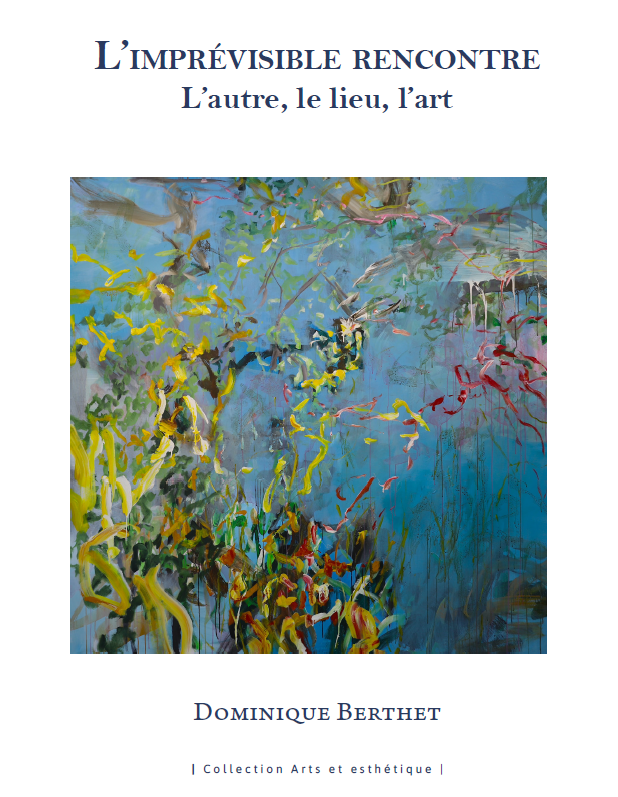
The central theme of the book is what Dominique Berthet calls the determining encounter, which is distinguished from a programmed and premeditated encounter precisely by its accidental, unforeseen and unexpected character. These encounters, according to the author, have the capacity to change the course of things and to upset the current state of affairs. Berthet calls this dimension of the encounter event-advent, an event that has repercussions on the future. In this sense, we can ask ourselves: doesn't reading a book, any book, constitute one of these decisive encounters? Opening a book is always being ready to face something unknown that will transform us. The arrival of L'imprévisible rencontre in my hands was therefore one of these encounters, especially for a reader belonging to another cultural reality, in this case Brazil. This intercultural exchange became very fruitful when I realized the enormous convergences between the contemporary Caribbean artists mentioned in the book and a large part of current Brazilian production. Berthet's book allowed me to meet artists such as: Gilles Élie-Dit-Cossaque, Laura Facey, Bruno Pédurand, Laurent Valère and Richard-Viktor Sainsily Cayol. Berthet's selection presents works that attempt to elaborate the memory of slavery, a theme common to Caribbean and Brazilian history. Hence the great thematic and procedural similarities with what many artists do in Brazil, such as Rosana Paulino. These convergences could certainly lead to greater cultural exchange in contemporary art, as interest in the French Antilles has gradually developed in Brazil, particularly thanks to the adoption of the quota system for Blacks in Brazil, which has also led to demands for change in the agenda of thought. Consequently, Brazilian universities are increasingly interested in Martinican intellectuals who have long reflected on issues related to decoloniality, a very fashionable theme today. Aimé Césaire, Frantz Fanon and Édouard Glissant are authors who are experiencing new editions in Brazil, promoting Francophilia in the country through the singular perspective of Caribbean literary and philosophical production. I would like, therefore, to consider my own encounter with the book as one of these decisive encounters that Berthet speaks of, in the sense that it was a stimulating encounter that, in a certain way, engendered a transformation. However, as the author points out, decisive encounters are not always positive. On the contrary, they can be very violent and destructive. However, the second point of the first chapter, The shock-encounter, deals with this dimension of the encounter. The author analyzes one of these decisive moments in history, which he calls the catastrophe-encounter, namely, the violent conquest of America by the Spanish. But this destructive character can also be the occasion for a germ-catastrophe and offer, as works of art do, openings to new creative possibilities. To think about these germinations, the works of Mexican authors Octavio Paz and Carlos Fuentes are evoked, the concept of creolization, created by Édouard Glissant, and the baroque of Minas Gerais, with which the author came into contact thanks to the exhibition Brésil baroque, entre ciel et terre at the Petit Palais in Paris in 1999, under the curatorship of Ângelo Oswaldo. All these references have in common the emphasis on the tendency of the arts in America to open up to multiple influences. These references prepare the great praise that Berthet makes of the phenomenon of hybridization and its link with the dimension of encounter. In this sense, the presence of the Cuban painter Wifredo Lam, whose work is addressed in the last chapter of the first part, is determining. There would be much to say about this passage of the book, but I would like to share a thought that came to me while reading it. Although modernist movements, like surrealism in particular, adopted an openly anti-colonialist position, there is a very strong tendency, in the context of current decolonial thought, to reject the modernist heritage. To summarize, we can say that the reasons for this rejection are related to the link that modernist tendencies maintained with the ideals of primitivism. From this perspective, modernists are reproached for only being interested in the cultures they studied to the extent that they provided them with a decontextualized stylistic element to use in their works. In other words, there was no real interest in the culture of the other, but only a stereotypical use of its forms in order to develop an artistic expression intended to be exhibited in major centers and artistic institutions. It is in this perspective that the article by Bárbaro Martínez-Ruiz, A reflexão impossível: uma nova abordagem sobre os temas africanos na arte de Wifredo Lam, which, on the one hand, accuses the painter of being "officialist," for allegedly expressing Cuban nationalism in the 1940s, particularly during the Cuban art exhibition at the Museum of Modern Art in New York in 1944, and, on the other hand, emphasizes the fact that this nationalist imaginary used Afro-Cuban elements, presented from a conception linked to exoticism. There would thus be a process of homogenization of Afro-Cuban cultures that would erase their diversity, presenting them as a unique and coherent corpus. This exoticism would come from the fact that Lam, having studied art in Europe, would be limited by a Western vision of the world, from which he would see Afro-Cuban expressions. Martínez-Ruiz specifies: "While claiming to depict Afro-Cuban realities, Lam, by adopting this type of approach, essentially ignored Afro-Cuban visual culture, material culture and aesthetic principles, concealing their nature as a product of a very specific and different cultural reality, while simultaneously reifying and deconstructing them in a series of basic formal codes" 1. Dominique Berthet presents us with a completely different version of Lam's work. Here, the painter does not claim, as Martínez-Ruiz would like, his belonging to the "Afro-Cuban community," but is someone who has been traversed by various encounters that have marked not only his life, but also his creation. His vision of the world is not univocal, but marked by multiple cultural influences: Asian, African, Cuban and European, particularly from Spain, where he studied and was in contact with Picasso's work. Berthet relates the many intellectual and artistic encounters that the painter made throughout his life and which deeply marked his production, which will be punctuated by assimilations, associations, combinations, fusions, in short hybridizations. Etymologically, as Berthet points out, hybrid comes from the Greek hýbris, that is, excess, what "exceeds the bounds," hence its use in the field of biology as the crossing of different species, that is, the crossing of beings who in principle "should not cross," which is why the Latins used this term to designate the "bastard child." In the field of aesthetics, the term is used to designate precisely the composition of heterogeneous cultural elements, proving the fertile and creative character of the encounter between disparate cultures. It is because of this hybrid character that the 35th São Paulo Biennial in 2023, entitled Cartografias do impossível, gave Wifredo Lam a leading role as an artist who, although he lived and worked in another context, fruitfully dialogues with current themes related to decolonialism. The second part of the book, devoted to the encounter with place, refers to the fact that encounters are not only made between people, but also with places that also have the capacity to transform our lives. In general, it uses the successful strategy of combining philosophical reflection with the analysis of works of art: first a more abstract reflection on the relationship between aesthetics and place, such as flânerie, walking, travel, wandering; then a confrontation with artists, whose works are selected on the basis of a very personal criterion, related to the author's peregrinations and his personal encounters with artists and works that touched him in one way or another, such as his encounter with the works of Jean Paul Forest in Tahiti, whose work recalls Land art a little, but who, unlike the artists of this movement, does not seek entropy, but introduces a disruptive element into nature by sewing rocks with metal cables. The commentary on the Venezuelan artist Ismael Mundaray also attracts much attention from Brazilian readers, because at the moment there is a lot of interest in Yanomami culture, thanks in particular to the publication in 2015 of the book La chute du ciel, a partnership between the shaman Davi Kopenawa and the French anthropologist Bruce Albert, which gave rise to a series of films, exhibitions, books, etc. In this context, it was all the more interesting for me to come into contact with this artist's gaze and his encounter with these people who live both on Brazilian and Venezuelan territory. In the third part, The Aesthetics of Encounter, Berthet returns to the theme of hybridization, relying on a theme that goes back to classical aesthetics, particularly to Lessing, of the mixing of artistic languages, to then move on to a philosophical reflection on the theme of desire and how it can be the engine of decisive encounters. Assuming the personal character of encounters, the author adopts a first-person voice to recount his personal experiences with the works he encountered in Venice during the 59th Biennale in 2022: Chun Kwang Young, Anish Kapor, Anselm Kiefer. The chapter continues with a reflection on time and its relationship with artists such as Urs Fischer and Rodrigue Glombard. What is perhaps most striking in the entire book is the author's ability to evoke themes from classical aesthetics and artistic modernism to analyze their contemporary manifestations which, in turn, express the questions of the time in which we live. The beautiful edition, filled with excellent quality photos of the commented works, many of which were taken by the author himself, is certainly a beautiful invitation to read the text in a fluid and pleasant way. By way of conclusion, I would say that evoking an aesthetics of encounter is to emphasize the capacity that art can have to generate in the viewer an opening to otherness. In a world where political leaders want to build walls to separate countries and expel immigrants from their countries at once, this possibility appears as a utopia. If, as Berthet reminds us, encounters are not only positive, but also violent and destructive, art must have the power to make them germinate, even where the worst catastrophes occur. Producing decisive encounters where openness to the other is favored is a current political task of art. A delicate task, no doubt, given the violence of the current world. But if art does not have the power to tear down walls, it can at least crack them to make a little vegetation germinate there.
Pedro Hussak van Velthen Ramos
1 Martínez-Ruiz, Bárbaro, A reflexão impossível: uma nova abordagem sobre os temas africanos na arte de Wifredo Lam. 19&20, Rio de Janeiro, v. XVIII, 2023. https://doi.org/10.52913/19e20.xviii.08.