WHY L'HOMME APPROXIMATIF?
par Henri Béhar
December 6, 2015
Why L'Homme approximatif?
Download the communication in PDF
This interrogative title actually poses two questions: on the one hand, it asks how to understand the title of Tristan Tzara's collection; on the other hand, it questions the wording given to the Strasbourg exhibition, which thus qualifies the poet himself. I quote: "TRISTAN TZARA/ L'homme approximatif/ Poet, art writer, collector".
I will not go into the details of the journey that led us, through changes of responsibility and postponements, to the inauguration of this magnificent Strasbourg presentation, the first to show the totality of Tristan Tzara's artistic activity. The director of the Museum of Modern and Contemporary Art, Estelle Pietrzyk, who is also the exhibition's curator, writes to me that she chose it somewhat intuitively, considering that L'Homme approximatif (1931) is certainly the text that will remain among the author's fifty or so works, and especially remembering this Baudelairean verse: "approximate man like me like you reader and like the others" inviting her to think that it is not solely a question of an individual external to the author. For my part, I only remember having pointed out, on several occasions, that I found no explanation of the subtitle referring to Tzara's title, "L'Homme approximatif," in the catalog being drafted, let alone in the press release or the press kit.
This presents, despite everything, an advantage: in the absence of explanation, framing, or guide, the reader, the visitor (who are often the same) can interpret it as they wish: Tzara = L'Homme approximatif, that is, the author of the collection thus named, who is not fully known, somewhat imperfect, unfinished, and therefore completed by the presentation of a poet, an art writer, and, what is less known, a collector. But one can read the formula differently, thinking that the exhibition will focus on this work of the poet's maturity, his masterpiece according to contemporary criticism.
Reading the press kit, which was kindly communicated to me by the Museum's management, convinces us that no commentator lingered on the poetry collection, or even on the exhibition's title.
It also seems that all the organizers' efforts focused on the concern, not to eliminate Dada (always present), but to reduce it to its simplest expression, for fear of seeing it invade everything with its intrinsic energy.
Circumstances of the Poem
It was from the spring of 1925 that several songs from a long poem by Tristan Tzara entitled L'Homme approximatif began to appear, in French and even in English, in various avant-garde journals. Until the moment, in December 1929, when La Révolution surréaliste gave a fragment, which would become the last song of the definitive edition of the collection of the same title. The choice could not have been more judicious, at a time when the movement's official journal was questioning its audience: "What kind of hope do you place in love?". As a prelude, André Breton, director of this publication, explained why it had ceased to appear. His argument took the form of a manifesto: the Second Manifesto of Surrealism, published in full before it came out in volume, slightly augmented.
It is obviously to this writing, first draft one might say, that one must refer to read in its entirety the appeal he launches to Tzara, after having conducted a general examination of the poetic situation since the first manifesto:
That said, we feel on the other hand the desire to render to a man from whom we have been separated for long years this justice that the expression of his thought still interests us, that judging by what we can still read of him, his concerns have not become foreign to us and that, under these conditions, there may be reason to think that our disagreement with him was not founded on anything as grave as we may have believed. It is doubtless possible that Tzara, who, at the beginning of 1922, at the time of the liquidation of "Dada" as a movement, was no longer in agreement with us on the practical means of pursuing common activity, was the victim of excessive prejudices that we had, for this reason, against him – he also had excessive ones against us – and that, during the too famous performance of Le Cœur à barbe, to make our rupture take the turn we know, it was enough on his part of an unfortunate gesture on the meaning of which he declares – I have known this for a short time – that we were mistaken. I very willingly accept, for my part, to stick to this version and I see no reason then not to insist, with all those who were involved, that these incidents fall into oblivion.
Since they occurred, I believe that Tzara's intellectual attitude having not ceased to be clear, it would be showing narrow-mindedness not to publicly acknowledge it. As far as we are concerned, my friends and I, we would like to show by this rapprochement that what guides, in all circumstances, our conduct, is nothing less than the sectarian desire to prevail at all costs a point of view that we do not even ask Tzara to share integrally, but rather the concern to recognize value – what is value for us – where it is. We believe in the effectiveness of Tzara's poetry and it amounts to saying that we consider it, outside of surrealism, as the only one truly situated. When I speak of its effectiveness, I mean to signify that it is operative in the vastest domain and that it is a marked step today in the direction of human deliverance. When I say that it is situated, it is understood that I oppose it to all those that could just as well be from yesterday and the day before: at the forefront of things that Lautréamont has not made completely impossible, there is Tzara's poetry. "De nos oiseaux" having barely appeared, it is fortunately not the silence of the press that will stop its misdeeds so soon.
Without therefore needing to ask Tzara to pull himself together, we would simply like to urge him to make his activity more manifest than it could be in recent years. Knowing him desirous himself of uniting, as in the past, his efforts with ours, let us remind him that he wrote, by his own admission, "to seek men and nothing more". In this regard, let him remember, we were like him. Let us not let it be believed that we thus found ourselves, then lost ourselves.
I quote at length, integrally. So many others have referred to this Second Manifesto as a simple book of accounts, of settling accounts, I mean, that I must well make heard in its entirety André Breton's reasoning when he accepts to return to his previous attitude. He was not a man to repent, and it must be believed that he had excellent reasons to arrive there, without knowing if his appeal would be heard. He had attentively followed Tzara's publications since the moment when he had, in a way, excluded him from the group, and he recognized in his work the qualities he expected from all works published under the banner of surrealism. It must be believed that he was so far from the mark that he accepted to return to his personal intervention during the Cœur à barbe evening in July 1923, on the insults both verbal and autograph uttered against him. The alleged excuse is not without salt: he would have been mistaken about the meaning of Tzara's gesture before the police, at the entrance of the Théâtre Michel. Consequently, he offers him the peace of the brave, without asking him to account for his opinions of the moment.
Indeed, while surrealism was evolving toward engagement with the Communist Party, Tzara, who, since the beginnings of Dada, distrusted all political enlistment, continued to preach the total independence of the poet. This is why Breton does not hesitate to say that Tzara's poetry is the only one that is situated. The term is to be taken in the sense that Max Jacob confers on it in the preface to Le Cornet à dés: "Everything that exists is situated" (1916). A situated poetry is a poetry issuing from personal language, a poetry of its time, which expresses the ideas and feelings of men.
This is why Breton reminds him of the goal he assigned to poetry: "to seek men," and asks him to resume this quest in common.
In summary, Tzara was not wrong to pursue his solitary path, but, given his poetic production, he should rejoin the surrealist movement. No reproach will be made to him, and even he will not be asked to embrace the communist theses of his new old friends. The proof is provided by the publication of the last song of L'Homme approximatif immediately following the Manifesto, in the manner of Poisson soluble, destined to follow and exemplify the theses of the First Manifesto of Surrealism.
In the journal, the reader could not know that he was reading a part of the XIXth and last song of a long epic poem, which was not to appear integrally in volume until two years later, under the same title.
The Text of La Révolution Surréaliste
Based on this single fragment, we can determine what could have seduced the surrealists to the point of fraternizing with their dissident author.
First and foremost, there is this fact, surprising for some readers, that Dada has not reduced poetic activity to nothing. On the contrary, one might say, it emerged completely new and as if regenerated by the treatment it had undergone. Tzara's poetry concedes nothing to the reader. The author accepts no compromise, no return to formal or narrative poetry. Similarly, he accepts none of the recipes of surrealist automatism (I say recipes, and not aspirations). So that a new tone emanates from this individual song, which proclaims man's difficulties in living in the world, within a fundamentally hostile nature.
How can one not feel implicated by this repetend1, in the Baudelairean manner, this sort of refrain of three or four verses returning several times with an internal variation:
and rocky in my schist garments I have vowed my waiting
to the torment of the oxidized desert
and to the robust advent of fire
The continuation of the song, not published in La Révolution surréaliste, clearly shows that, from the origin, it was thought to serve as a conclusion to this lyrical epic by recapitulating all human approximations, anxieties and vertigos to which man finds himself confronted, to the measure of his trials. The effectiveness of this poetry is not appreciated in terms of practice but of spiritual action, of the contemporary reader's adherence, I mean of the time of writing as of the present time.
In doing so, I have not explained the title, L'Homme approximatif. It seemed to me to conform to the definition of Littré, more precisely of the Petit Littré that Tzara practiced assiduously: "Approximatif: Which is made by approximation. Approximate estimation. Approximate calculation." This is to say that the adjective designates successive approaches, while marking its proximity to mathematical vocabulary. Apparently, there is no particular difficulty there, especially when we know Tzara's pronounced taste for this discipline.
However, the latest translation of the volume proposed in Spain and in Spanish highlights the double meaning of the adjective. It is titled El hombre aproximado (2014), replacing the academic El hombre aproximativo (1975). Even if one has not been raised in Picasso's language, one clearly feels the difference2. The translator explains himself by accusing his predecessor of using a Gallicism. In short, it would be a matter of distinguishing between the passive form and the active way: a fixed value, entirely relative, opposed to knowledge through repeated approaches.
To know the meaning that Tzara wanted to give to this title (which returns 7 times in the verses), and to have the heart clear, I know no other method than to note all the occurrences of the term in Tzara's complete work, in order to see what meaning, what particular nuance he conferred on this term. In all his writings, verse and prose mixed, he uses approximatif 14 times, approximative 4 times, and 10 times the noun approximation (in singular and plural). Within the framework of the present study day, I do not have the leisure to display each occurrence with its context. They will be found in the appendix below. Let us retain only this declaration from the Dada Manifesto 1918: "approximation was invented by the impressionists" (I, 360), which brings us back to the universe of pictorial creation. Then comes a poem entitled "Approximation," published in 1924 and reprinted in L'Arbre des voyageurs (II, 31). This is, without doubt, the primitive nucleus of song III of our collection, and even of the entire text, the poet interpellating:
you come you swim you dream you read
You sometimes run after the clear the unlimited why of your actions (OC II, 31)3
Later, at the time of memories, Tzara explained himself very clearly on his realization, during his radio interviews with Georges Ribemont-Dessaignes:
L'Homme approximatif was written between 1925 and 1930. It was in 1929 that a fragment of this poem appeared in La Révolution Surréaliste, events having led me to reconcile with the surrealists. Parallel to them, my evolution made me abandon the demonstrative, provocative, and negating character of poetry for a more constructive expression of poetic matter. I was moving toward a conception of life where the extreme individualism that was mine was going to reconcile itself with the basic feelings common to most men. It was no longer words that, by their unusual rapprochement, made their customary meaning explode, but it is the complex of the poetic image that was substituting itself as a component to my first concerns. This was the passage toward a new objectivity. (OC V, 405)
But we possess a testimony from the very time of the collection's elaboration, which French surrealists should hardly have known, for they would certainly have rebelled against certain judgments concerning their recent political engagement. The paradox is well there: while, nowadays, Tzara passes for the poet most linked to the Communist Party (after Aragon, obviously), it is he who, from Dada until the thirties, is the most hostile to the group's rapprochement with any political organization! He says:
To recognize the materialism of history, to say in clear phrases even for a revolutionary purpose, this can only be the profession of faith of a clever politician: an act of betrayal toward perpetual Revolution, the revolution of the spirit, the only one I advocate, the only one for which I would be capable of giving my skin, because it does not exclude the Holiness of the self, because it is my Revolution, and because to realize it I will not need to soil it with the help of a lamentable mentality and pettiness of a picture dealer. […] Communism is a new bourgeoisie starting from zero; the communist revolution is a bourgeois form of revolution… (OC II, 418)
Now, hold on tight, he says this to the poet Ilarie Voronca, who came to question him in his magnificent villa on avenue Junot, who publishes his remarks in the Romanian journal Integral in April 1927, (fully reproduced in the Complete Works).
Two formulas summarize them: in 1920, he wrote "to seek men". Disappointed in his quest, he continues: "I continue to write for myself, for the moment, and failing to find other men, I always seek myself." (OC I, 417)
Concerning a quest for oneself, it is appropriate to date each of the remarks well. This is indeed the moment when, while uttering his attacks against the surrealist group and its leader, Tzara comes to revise his positions, to such an extent that, two years later, he will shake hands with the one who had most ostracized him.
Conversely, it is quite possible, as historians and the sociologist of surrealism explain, that Breton saw there an opportunity to rebalance his troops after the ruptures and great purges that followed the Bar du Château meeting. With the departure of Soupault, Vitrac, Artaud, Desnos, Baron, Leiris, Limbour, Prévert, Queneau, etc., the return of a poet of Tzara's stature was a windfall for the group, especially since it was going to be accompanied by the entry on stage of René Char, Dali, Georges Hugnet, Georges Sadoul, André Thirion, René Magritte. However I remain convinced that, above all, the poetic quality of Tzara's works is the necessary and sufficient cause of this rapprochement.
In those days, we have many examples, poets still read each other! They could not have remained insensitive to the remarkable evolution that, from the Twenty-Five Poems and the Seven Dada Manifestos (1924) led to The Indicator of Heart Paths (1928) and to The Travelers' Tree (1930), to arrive at these nineteen songs of L'Homme approximatif. The depth of the song took precedence over the anecdote, the petty human quarrel, to such an extent that the outbursts of the performance of Le Cœur à gaz (1923), the accusatory remarks of Les Pas perdus and Nadja found themselves denounced by their own author. The reconciliation took place in 1929, and we have several examples of the rediscovered friendship, but I prefer to quote, because it is of a private nature, this less known testimony of their reconciliation, which can be discovered in one of the exhibition's display cases:
To Tristan Tzara
to the poetry he embodies
and which will have had his forehead his eyes
his laugh (his unforgettable laugh) when
I was twenty years old, thirty years old and
many other ages yet,
and to the man I adore
who is made of astonishing ideas for hair, of out-of-line feelings
for the slightest movements, of future actions
full of meaning and grandeur for the fine and perfect hand,
with the pride and joy of
knowing him at every minute
when I do not kill myself
17ndré 13reton.
This is the autograph dedication carried on an original copy of the original edition of Le Revolver à cheveux blancs (1932). The individual Tzara is therefore poetry in itself, and the best remedy against depression, anxiety, and despair!
Lycanthropy
This is not, however, the image that the common reader has of the said poet. I deduce from this that Tzara, just as ambivalent as the rediscovered friend, had succeeded, by means of the poem, precisely, in dominating his own solitude, the feeling of what he called lycanthropy4. This term, characterizing the very nature of the poet, does not appear in the collection L'Homme approximatif. Tzara will define it shortly after in his "Essay on the Situation of Poetry" as "a latent state of fury and hatred, of explosion and frenzy" (1931), then concerning the Bousingos, of which Pétrus Borel is a part. He called himself "the lycanthrope," making this mental attitude the symbol of the revolt of individuals considering themselves superior, against society and against God. He comments:
Pétrus Borel's Lycanthropy is not an aesthete's attitude, it has deep roots in the poet's social behavior […] who becomes aware of his inferiority in social rank and of his superiority in moral order. (OC V, 111)
As far as he is concerned, the author of L'Homme approximatif is a partisan of an individual and perpetual revolution. The solitary self engages in a long introspection:
I empty myself before you pocket turned inside out
I have abandoned to my sadness the desire to decipher the mysteries
I live with them I accommodate myself to their lock (OC II 87)
Everything happens as if the individual had to return to the origins of the world to know himself and understand his destiny, through a revolt always contained.
Epic of the solitary man, L'Homme approximatif, always as awkward and unfinished, emerges from the depths of the unconscious, arises from the original magma. The song is so powerful that one could speak of epic poetry, of a sort of Legend of the Centuries referring to the history of man in his relations with nature. Tzara reveals himself here as a shepherd of words, guiding them through primitive darkness to the sun of life. Seized in his uncertain being, before any logical reconstruction, it is a man, or a stone, or a tree that speaks, as in the fourth of the Songs of Maldoror.
Always anxiety dominates: "the earth holds me tight in its fist of stormy anxiety" (OC II 83), he declares at the threshold of a long wandering. Lycanthrope, the poet is more than ever in this song IX where he identifies with the solitary animal, the one who wants to ignore the gregarious instinct of the pack:
the wolf bogged down in the forest beard
satiated and broken by jerks and fissures
and all of a sudden freedom its joy and its suffering
leaps in him another more supple animal accuses its violence
he struggles and spits and tears himself away
solitude only wealth that throws you from one wall to another
in the cabin of bone and skin that was given to you
as body
in the gray enjoyment of animal faculties packets of heat
grave freedom torrent that you might remove my flesh my shackle
the fleshy chain around my vertiginous impetuous tense soles
adventures that I would like to throw by puddles packets and handfuls
at my shameful timid face of flesh and so little smile
o powers that I have only glimpsed at rare clearings
and that I know and sense in the tumultuous encounter
brake of light walking from one day to the next along the meridians
do not put your collar too often around my neck
let my flight spring from my earthy and dull creature
let it shudder at the contact of bodily terrors
escape from the cavernous veins of hairy lungs
from almost rotten muscles and delirious darkness of memory (OC 114)
At the end of this song, the un-bogged wolf will find his shepherd, "the shepherd of incommensurable clarities" whom one could identify with I don't know what god of religions but who, for Tzara, can only be the ordering principle of language, reigning over the "celestial pastures of words"5.
Which will make Jean Cassou say in Les Nouvelles Littéraires:
extraordinary primitive poem, one of the most resolute, most complete testimonies of contemporary poetry. It demonstrates that in poetry there are never dead ends and that only extreme positions are valid. By persisting in what could only appear as a sterile act of negation, a fatal explosion, Tristan Tzara produces a positive, abundant, generous, passionate work, and which imitates everything that is most ardent and voracious in creation. (OC II 419)
Tzara will develop and radicalize this image of the poet as a solitary wolf, moved by an excessive desire for purity, in Où boivent les loups (1932), published the following year, and he will analyze its particular function in his "Essay on the Situation of Poetry," a poetry that, according to him, developed on two simultaneous and successive axes, "poetry activity of the mind" and "poetry means of expression," which meet and rival each other in contemporary times, destined to produce "poetry-knowledge". This critical examination of the "principle of lycanthropy" and "poetic necessity" will continue in other essays, perfectly analyzed and synthesized by criticism.
To finish on this central point, it does not seem anecdotal to me to specify that, in the correspondence deposited at the Doucet fund, his wife, Greta Knutson, to whom L'Homme approximatif is dedicated, always calls him wolf.
Composition
I said that L'Homme approximatif was known by the publication of fragments or entire songs in various journals. The order of publication does not necessarily follow the time of writing, insofar as each journal has its own rhythm of publication, and also because Tzara only definitively classified his nineteen songs at the moment when he handed over his manuscript to the publisher. Here again, I refer to the appendix a table presenting the chronological order of publication of the songs, confronted with the final choice, leaving it to the reader to determine if there is adequacy of the proposed text to each journal's orientation. The examination of the various states of the text, from notebook to drafts, to typewritten copies and multiple manuscript states, reveals no plan or any principle of classification. It is clear, however, that the form, a long poem in several songs, is primary. From the beginning, in 1925, Tzara knows what he is tending toward.
The reader, the popular public that Tzara designates in his commentary on literary genres, is not accustomed to reading fragments of the epic, published in disorder, at the whim of the edition. So I wondered, in presenting the collection in the Complete Works, if there was a prior order of composition. I searched for a project, a plan among the numerous drafts, without finding the slightest trace. Nevertheless, reading it in its continuity, one has a good feeling of a coherent composition, of a movement going, by successive approximations, that goes without saying, from an anguished expression of the individual, to the full conquest of his being.
In 1929, Jean Cassou (1897-1986), literary advisor to the bookseller-publisher Jacques-Olivier Fourcade (1904-1966), informs him that the latter wishes to resume the conversation regarding this publication, which will include as a frontispiece an engraving by Paul Klee, signed by the author and illustrator, to adorn the ten numbered copies.
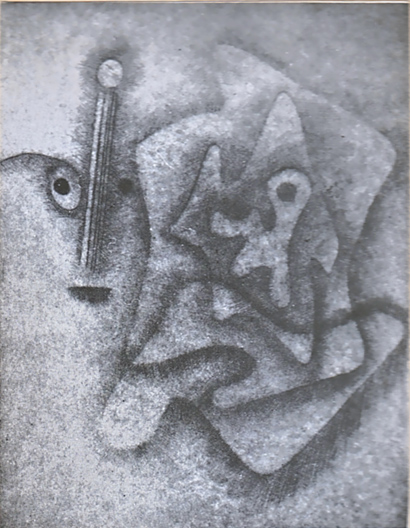
Paul Klee does not intervene by chance in the making of the volume. In Dada times, in Zurich, Tzara had exhibited him at the Galerie Dada (March 17, 1917) and at the end of the same month, he had organized a conference on him, presented by Dr. Waldemar Jollos. He had also solicited him, successfully, for the Dada journal. Unfortunate correspondent of Vanity Fair, invited to treat German expressionism, he devotes an eulogistic paragraph to him, presenting him as "the most remarkable personality of this Weimar school," adding pleasantly: "Klee has succeeded in making an important work in a small format, at a time when all painters were seeking external monumentality." (OC I, 602). Later, he will explain why the surrealists rejected cubism in favor of their own painters, as well as Picasso and Klee, who assigned to art the goal of illuminating the vital principles of creation and imagination. And especially, he was to devote to him a masterly transposition of art (ekphrasis), "Paul Klee the sun's apprentice," published in the issue celebrating the resurrection of Cahiers d'art, in 1945, modulating somewhat, with the same enthusiasm, the "Homage to Paul Klee" of 1929. It should also be noted that, apart from this etching, the painter has never illustrated but two books, both in 1920: Candide, and Postdamer Platz by Curt Corinth.
It is therefore without surprise that he received in Dessau the paper for the etching's printing, which he did in Leipzig for quality reasons6.
Dedicated to Greta, his wife, married in August 1923 in Stockholm, the collection is dated 1925-1930, which corresponds exactly to the extent of its composition, the first song (1925) and the last (1930) remaining immovable in all classification projects.
Avoiding repeating what I have already written in the notes of the complete works, and in order to base my impressions on a somewhat scientific approach, I submitted the collection to a factorial analysis of correspondences. And there, prodigy: all the songs find themselves grouped at the center of the graph, at the intersection of abscissas and ordinates, except song X and song IX, which oppose each other radically while being situated apart from all the others. Written in 1925, song IX which begins with this verse: "the wolf bogged down in the forest beard" is the song of the wandering solitary wolf-man, anxious, affirming his certainty when he proclaims the omnipotence of a creator shepherd, shepherd of words, and makes mention of a religious anxiety, by which he distinguishes himself from the whole.
At the opposite, Song X has nothing more memorial. It is globally turned toward the exploration of arid and stripped spaces at altitude.
It would be necessary to be able to pursue the analysis of each of the songs, confronting it with the data of lexical statistics, doubtless the most indicated in this case, since any coherent sampling can only appear as a coup de force. This will be the work of our successors!
Generic Classification
Faced with the scope of this work and its unity, some have questioned its generic identity. Emphasizing its generalized lyricism, as one speaks of generalized relativity, criticism immediately spoke of epic poetry, going so far as to speak of "anti-human epic," by reference to the qualifier that Tzara attributed to the Songs of Maldoror (OC I, 418). Saying this, one advanced cautiously, for Tzara's poem presents none of the traits of medieval epic, and above all one does not see its hero, unless one considers that modern man is always "anti-human". In developing his reflections on poetry, Tzara held the epic genre as a means of expression, tending to exalt religious or national sentiment, which is obviously not the case of the present collection. All the more so since, in his eyes, the only form both lyrical and poetic addressing the assembled people, was now only found in cinema, with the Fantômas series for example.
How could they think, these critics à la manque, as Tristan Tzara familiarly said on the radio, that he could have written a single "anti-human" word? nor that he could have been interested in adversaries of humanity? Certainly, he admired Lautréamont since his Zurich stay, explaining to whoever wanted to hear him that several fictitious characters took the floor in turn: "the illuminated assassin," "the annoying petit bourgeois," the "illuminated prophet," as many figures of the anti-human, in his eyes.
It will therefore be appropriate to read this Tzaraist epic by determining the nature of the man he sings and, in the same momentum, to fix the characteristics of the aoidos, the one who says I, unlike traditional epic. Here again, I would need many pages to closely follow the different actors of this lyrical composition, and the subject of their discourse. Today, I will stick to what seems to me essential, man.
What is man?
"What is man, that thou art mindful of him? And the son of man, that thou visitest him?" asks the psalmist (Psalms, 8, 4-5). And Kant, in turn, without really answering the question. Tzara seizes the interrogation and develops his response throughout these songs.
Take the expression "approximate man," which gives its title to the collection.
It is used seven times in the whole, of which 4 in Song II and then at the closure of Songs VIII, XIV and XVI, while specifying the identity of such a man with the narrator, the reader and, finally, any other individual. However, Tzara does not content himself with this formal repetition, he varies the context in such a way that I cannot dispense with quoting, first in the same laisse of Song II:
approximate man like me like you reader and like the others
heap of noisy flesh and echoes of consciousness
complete in the only piece of will your name
transportable and assimilable polished by the docile
inflections of women
various misunderstood according to the voluptuousness of interrogating currents
approximate man moving in the approximations of destiny
with a heart like a suitcase and a waltz in place of a head
steam on the cold ice you prevent yourself from seeing yourself
great and insignificant among the landscape's frost jewels
however men sing in a circle under the bridges
of cold the blue mouth contracted further than nothing
approximate man or magnificent or miserable
in the fog of chaste ages
cheap habitation the eyes ambassadors of fire
that everyone questions and cares for in the fur of caresses of his ideas
eyes that rejuvenate the violences of supple gods
leaping at the triggers of dental springs of laughter
approximate man like me like you reader
you hold in your hands as if to throw a ball
luminous figure your head full of poetry (II, 84)
Then in closure of three songs, operating a progressive reduction:
approximate man like me like you and like the other silences (VIII, 113) 1931 approximate man like me like you reader and like the others (XIV, 147) 1927 approximate man like me like you (XVI, 155) 1929
Now, if it is impossible to date the first citation, the following ones appeared, respectively in 1931, 1927, 1929. One can only arrive at a single conclusion: the man that Tzara conceives, by successive approaches, is universal and permanent, failing to be eternal! And the intention of the poem has not varied from one song to another in the time of writing.
Man is visibly an essential preoccupation of the poet who invokes him more than fifty times, under the composed form that we have just examined, but also alone, determined, compared to a "furnace of invincible constancy" in the last laisse of the last song (XIX, 170), but also submitted to fire: "a man who vibrates to the indefinable presumptions of the labyrinths of fire" (XIX, 171). Let us recall the one who appears in the previous song: "man a little flower a little metal a little man" (XVIII, 162). In fact, as often happens in a corpus of a certain length, the term appears as if in bursts, thus at the center of song XV:
a man would like to burn a forest of men
at the noise of phosphorescent troops in the night of my consolations
a man would like to cry a man
a man would like to throw his head in the fresh river his head
a woman would like to cry over the man
a man is so little thing that a fine thread of wind carries him away
the man (145)
this at the end of a laisse where the individual is both violence and weakness, so uncertain that one would believe to hear the words of Ecclesiastes, son of David! This feeling of total vanity, the reader will have already experienced it in song IX:
so much does man fear the face of his god that deprived of horizons he trembles
so much does man fear his god that at his approach he falls he drowns
so much does man without horizons fear his death that deprived of god he
hides his tomb
so much does man fear" (116)
However, one should not hasten to conclude that Tzara speaks of his faith. It seems to me that he treats here of primitive man and the gods he has built, monumental, in various points of the earth. Still the use of the singular allows doubt. Further on, the narrator will clearly explain his function: "I sing the man lived to the voluptuous power of the grain of thunder (XIV, 144). Not him, but all man, in his historical dimension.
What is man? I asked above, situating him in his cosmic space. One can also define him by his actions, which here are in series, in alphabetical order of state or action verbs:
"man tears apart the prey of his rancor" (129)
"and claws seize the man in quest of a thank you of brick (132)
"and the man was growing under the wing of silence" (113)
"man walks prisoner in the lining of his soul" (132)
"man nests his senses and his proverbs" (137)
"man shortens himself with the year infinitely" (98)
"man shortens himself with the shadow until night" (98)
Conclude
In responding to the surrealists' invitation, Tzara brought them the most beautiful collection, as desperate as it proclaims the presence of a vital energy. Retracing the evolution of humanity, from primitive caves to cosmic explorations, ontogeny recapitulates phylogeny, I would say in parodying Haeckel's principle. Only his poetic trajectory, starting from a neo-symbolist lyricism, exploding under Dada's battering rams, opening wide the doors of the unconscious, could allow him to express himself thus, in search of truth. And, as if this interrogation on man, this quest for humanity had to be endless, he prolongs it in the collection Où boivent les loups, which will itself be followed by Grains et Issues, this prose poem that mixes oniric lyricism with notes, with reflection on poetry in the process of being written. We know, this volume, Tzara will make it his divorce gift with surrealism. Which does not mean that he has, from then on, renounced this poetics. He will pursue it, indeed, while transforming it to take even better account of the history in which he was immersed up to his neck, he will say.
University Paris III
Sorbonne Nouvelle