POLITICS OF META-AESTHETICS: SURREALISM, JAPAN AND COLONIALISM
par Satoru Hashimoto
June 10, 2016
Surrealism was an international movement. Not only because multiethnic writers and artists took part in it in Paris, but also because it spread from Africa to North America, from Latin America to Asia. In fact, surrealism embodied the internationality of literary and artistic modernism that flourished in the early twentieth century. It was within this transnational circulation of cultural capital that surrealism reached the shores of Japan in the early 1920s. The influence it exerted on Japanese literary and artistic fields was immense, to the point that Andre Breton, according to John Solt 1, said he was struck to learn from a Japanese artist in Paris that some five hundred poets and painters in Japan considered themselves surrealists. Solt even argued that, in retrospect, surrealism had a greater impact in Japan than anywhere else, "including in its own country of birth" 2. In the 1920s and 1930s in Japan, many artists and writers claimed surrealism, many surrealist journals were published, and surrealist art was regularly exhibited in urban galleries. Postwar artists referred to surrealist styles, vocabulary, and ideas to produce the arts of a new generation 3. Surrealism even crossed the boundary between low and high culture by introducing into everyday language the term shuru (シュール), an adjective derived from the prefix "sur-" in "surrealism," and used colloquially to describe something bizarre, strange, or unreal in general.
Surrealism, of course, has its place of origin in Paris in 1919, when Andre Breton and Philippe Soupault experimented with automatic writing, some results of which were published in Les Champs magnetiques (1920). But the extent and variety of its reception in Japan lead us to consider Japanese surrealism as a unique phenomenon, relatively independent of the French context, and perhaps symptomatic of issues specific to modern Japanese cultural history. In considering surrealism and Japan, we must address the question of "transculturation." In place of the reductive approach that would view cultural transmission from center (Paris) to periphery (Japan) as a purely one-way introduction, the concept of transculturation focuses on the complexities of arrangement on the receiving side, or "how subordinate or marginal groups seize on, or invent from, materials transmitted to them by a dominant or metropolitan structure" 4. From this perspective, we should not merely examine Japanese and French surrealism in terms of similarities and differences, but rather explore Japanese surrealism for its performative importance. What did it mean to adapt surrealist practices in the context of Japanese cultural modernity? What did Japanese writers and artists do with surrealism?
One of the fundamental aspects of surrealism in the Japanese context, as we shall see, was the function it fulfilled as a meta-aesthetic. For certain writers and artists, surrealism was not simply one aesthetic school among others such as classicism, romanticism, or futurism, nor particularly a French, or even Western, aesthetic school. Instead, surrealism was regarded by them as a universal aesthetic order that should enable Japanese writers to create modern literature per se, beyond cultural or national particularities.
Rather than merely imitating or adapting French works, or producing purely national works, Japanese writers practiced surrealism in a way that allowed them to bracket differences between Japan and France, and between West and East, and thereby create modern literature in the full sense of the term, that is, universal literature. Consequently, for many Japanese intellectuals, surrealism embodied the very condition of modern aesthetics, as Michel Foucault formulated it: "[literature] becomes the pure and simple manifestation of a language whose only law is to assert - against all other discourses - its steep existence" 5. In the name of surrealism, Japanese writers consciously and precisely practiced a literature that "seeks to recover, in the movement that gives it birth, the essence of all literature; and so all its threads converge toward the sharpest point - singular, instantaneous, and yet absolutely universal - toward the simple act of writing" 6. Despite their distance from Paris, the capital of the "world republic of letters," Japanese writers managed, through "the simple act of writing," to position themselves at the forefront of literature in a purely universal endeavor.
If Japanese writers introduced surrealism as an aesthetic of universal order, how are we to consider the practices of surrealists in Japan in relation to those of their French predecessors? How can we conceptualize the relationship between Japanese and French surrealists?
These two questions must also be raised regarding the reception of surrealism in Japanese colonies. In the 1920s and 1930s, writers in Korea and Taiwan were likewise exposed to European literary and artistic modernism, often through Japanese interpretations and translations 7. The phenomenal popularity of surrealism in the metropole helped spread its discourse throughout the Japanese Empire. While Japanese writers embraced surrealism as a universal aesthetic, authors in colonial Korea, for example, found in surrealism the same force of liberation observed in the Japanese context. For Japanese writers, surrealism represented an aesthetic that could wean and free them from the structural dichotomy that made Japanese modernity seem secondary or belated, and allowed them to practice universal literature. Likewise, for colonial writers, surrealist poetry embodied the radical potential of modern aesthetics as an autonomous regime independent of politics and economics, including the dynamics of colonial power. This ideal made their engagement with colonial realities far more complex than a simple dichotomy between resistance and resignation.
I therefore maintain that the question of surrealism in Japan, and in its colonies, constitutes a unique case for exploring the transculturation of literary and artistic modernism in the early twentieth century. Examining this process presses us to deconstruct hierarchical dichotomies such as center/periphery, original/copy, and universal/particular, and to seek concepts for understanding relations among modern literatures, each of which is both an absolute universal endeavor and a particular form with regard to socio-political context.
From this theoretical standpoint, this article aims to examine the question of surrealism and Japan. To do so, it focuses on Takiguchi Shuzo (1903-79), surely one of the most eminent critic-poets of Japanese surrealism, and Yi Sang (1910-37), a famous poet of colonial Korea known for his enigmatic graphic poetry. Surrealism inspired Takiguchi Shuzo, who devised new poetic practices transcending the East/West dichotomy, while Japanese surrealist works influenced Yi Sang's geometric poetry, through which he created a new universal ground for Korean poetry. Despite its universal rhetoric, however, surrealism in both poets' works evokes colonial discourse: Takiguchi's surrealist avant-gardism took on imperialist connotations in the 1940s, while Yi Sang's fiction pointed to the inexorable self-destruction of modern aesthetics under colonization. The return of political discourse that surrealism sought to overcome reveals a distinctive political implication of this meta-aesthetic in East Asia in the twentieth century.
* * *
If we return to its origins, we can see that Andre Breton himself conceived surrealism as a meta-aesthetic. Breton conceived surrealism not simply as one aesthetic form among others, but rather as a definitive aesthetic that established itself as the very source of poetic imagination. In the Manifesto of Surrealism (1924), Breton declared: "Farewell to absurd choices, dreams of abyss, rivalries, long patiences, the flight of the seasons, the artificial order of ideas, the handrail of danger, time for everything! Let one merely take the trouble to practice poetry. ... It was a question of returning to the sources of poetic imagination, and what is more, of remaining there" 8. The "journey" toward these "remote regions" of poetry, for which surrealism is a guide, is a perpetual battle against contingencies external to literature. Surrealism is therefore a practice "... in the absence of any control exercised by reason, outside all aesthetic or moral preoccupation" 9. In this way, surrealism delimits a space proper to literature where the essence of literature as a whole is expressed - a space where not only the voices of writers from Aragon to Vitrac, from Swift to Roussel converge and resonate, but also those of "Cumae, Dodona and Delphi" 10.
As William Gardner argues, Japan's contact with Europe in the early twentieth century was visibly "multi-layered": literary, artistic, cinematic, and theatrical movements coexisted in mutual interaction, making it impossible to demarcate a clearly defined territory for each aesthetic school. Surrealism, in fact, was one current among others within a flow of heterogeneous materials simultaneously imported from Europe, from German expressionism to Italian futurism, from Anglo-modernism to Russian constructivism 11. For example, one of the many literary magazines used to introduce surrealism to Japan, Shi to shiron (Poetry and Poetics, 1928-33), was in reality an open venue for modernist poetry in general, featuring Breton alongside Valery and Gide, as well as Joyce and T. S. Eliot.
It was against this multifaceted backdrop that Takiguchi Shuzo, one of the main contributors to Shi to shiron, engaged with surrealism. Despite the heterogeneous nature of its introduction to Japan, Takiguchi preserved the core of surrealism as Breton conceived it. Like Breton, Takiguchi expected surrealism to be precisely an absolute aesthetic. He articulated the nature of surrealism's realm of poetic purity in terms of "nothingness"; as he stated in 1931 in his famous essay "Shi to jitsuzai" ("Poetry and Existence"):
It is true that poetry comes from a unique nothingness [mu], or from what may be called, not necessarily from a dichotomic point of view but from a logical point of view, the non-poetic. Let me define it for myself: nothingness always has a spirit beyond meaning and existence. While everyone has always been accustomed to believing that poetry was merely one literary form among others, I have at the same time been convinced, without any doubt, that poetry was non-existence. (I see no particular need here to deal with the distinction between the spirit of Greece and that of the Orient) 12.
By virtue of this qualification of poetry as "a unique nothingness," Takiguchi universalizes poetry: it is therefore not one literary form among others, but rather an absolute and privileged aesthetic practice.
As such, poetry defines itself within an autonomous space, beyond any external limitation, including the historical distinction between Greece and the Orient. Takiguchi therefore believed that poetry, as a universal endeavor, would reconcile and resolve the deeply rooted distinctions that obsessed Japanese modernity. Surrealism indeed embodied this kind of aesthetic universality. Discussing the contemporary importance of surrealism, Takiguchi claimed: "What is at stake is the unification of the imaginary tradition of Japanese painting and that of Western painting. This is certainly a definitive drama that we should conclude as quickly as possible." It would be surrealism, Takiguchi predicted, that would help achieve "this most important overcoming" 13. Surrealist aesthetics, then, would provide Japanese artists with the crucial framework of their own position on the universal plane of art, a place where they would transcend all external differences and could practice art for itself.
Colonial Korea's engagement with Western artistic and literary modernism was as complex a process as Japan's. Not only because transculturation often occurred through the additional mediation of Japanese materials, but because artists and writers also had to struggle with colonial power dynamics. The work of the poet Yi Sang embodied the complexity of colonial Korean modernity. Through expansive reading, Yi Sang positioned himself in a global imaginary and cultural field connected to everything from ancient Chinese philosophy to German idealism, from French modernist painting to modern Japanese fiction. "Ultimate art," Yi Sang argued, is "without any limit, like humanity" 14. Yi Sang's universal conception of literature and art appears in his poetic works. Inspired by two Japanese poets associated with Dadaism and surrealism, Hagiwara Kyojiro (1899-1938) and Kitasono Katsue (1902-78), Yi Sang produced a number of graphic poems composed through recurrent use of geometric forms and mathematical symbols. A notable example is the poetic series O gam do (Crow's-Eye View, 1934); the fourth poem in this series is particularly emblematic (Figure 1).
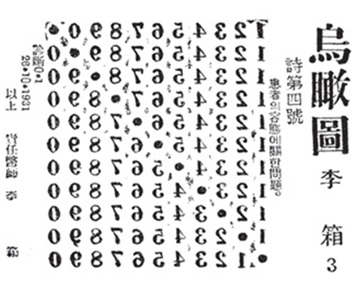
The fourth poem
A problem regarding a patient's condition
[matrix]
Diagnosis 0:1
26•10•1931
The above named -> attending physician -> Yi Sang
In the poem, inverted numbers are centrally placed, arranged diagonally with a diagonal line of black dots, producing a refractive effect. The matrix as a whole is meant to be a medical observation leading to the cryptic "Diagnosis 0:1," carried out by the "attending physician," who bears the same name as the poet, "Yi Sang." If numbers and geometric forms are essential building blocks in scientific language, the fact that they are inverted and produce refraction marks the singularity of the poet's own viewpoint. What the poet projects is the unique, idiosyncratic expression "of the crow's way of seeing," opposed to the omniscient, objective one perceived in scientific perspective ("bird's-eye view"). Thus, in this poem, by dislocating scientific language itself, poetry defines itself in universal terms: "Poem No. 4" is a meta-poem, that is, a poem about poetry per se.
As a committed modernist poet, Yi Sang's work testifies to the desire to create universal poetry, and thus to materialize aesthetic autonomy in colonial Korea. In the very act of creating universal poetry, Yi Sang had to engage what was external to the aesthetic regime, which leads us to read his poems "in context" 16. Indeed, if we compare "Poem No. 4" to its original Japanese version, entitled "Shindan 0:1" ("Diagnosis 0:1," 1932), we can see distinct linguistic and material contexts producing different poetic forms (Figure 2).
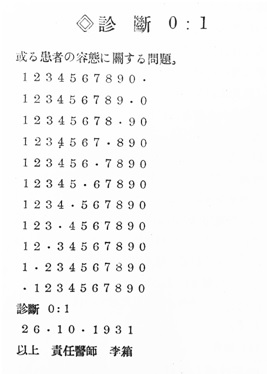
◇ Diagnosis 0:1
A problem regarding a certain patient's condition
[matrix]
Diagnosis 0:1
26•10•1931
The above named -> attending physician -> Yi Sang
Most notably, in translating his work, the poet reversed the number matrix along a vertical axis. If we imagine the poet-as-doctor writing his poetic "diagnosis," that gaze is thus turned 180 degrees in the process of translation. The Japanese and Korean versions of the poem therefore evoke an unbridgeable abyss splitting Yi Sang's gaze in two, rendering him incapable of giving a synthetic and unified perspective in the context of colonial bilingualism and, more importantly, within the colonial "Manichean order."
Yi Sang's meta-poetry therefore undermines itself. Though writing in the capital of belles-lettres, Yi Sang wanted to establish universal poetry; yet in the colonial capital of Kyongsong, such hope and ambition could only remain a dream. On the roof of Kyongsong's largest department store, the protagonist of Yi Sang's short story Nalgae (Wings, 1936) exclaims at the end:
I suddenly feel itching under my arms. Ah, these are the scars of my artificial wings from when they were growing. Today those wings do not exist. In my head, the pages on which the words hope and ambition had been erased wavered, as if I were leafing through a dictionary.
I wanted to stop my steps and exclaim, just once: Grow, my wings, once again. Let us fly. Fly. Fly. Let us fly once again. Just one more time, let us fly 18.
Suffering from inertia, the story's protagonist lives a reclusive existence. He is confined to a back room and completely dependent on his wife for survival; she prostitutes herself in the front room, thereby earning money to support the couple. But the protagonist is ignorant both of his wife's work and of the value of money, effectively cut off from economic reality. He merely sleeps, daydreams, meditates, takes occasional walks in the city, and lingers in cafes; he is pathetically unproductive and miserably powerless. This sad and even comic image of the protagonist draws a biting, sarcastic portrait of a bohemian lifestyle under colonial conditions. If asociality and wandering were important signatures of poetic distance and aesthetic life, those same attitudes here become nothing more than dependence on the wife's prostitution. Seen in a satirical light, Wings thus describes the consequences of social corruption when one lives within a purely aesthetic regime, and reveals a colonial reality in which social conditions for realizing the modernist aesthetic ideal are desperately lacking, reduced to a dilapidated back room entirely cut off from the outside world.
In adopting surrealism, Yi Sang strove to write universal poetry; but by the very act of separating the regime of aesthetic purity from reality, he also illuminates the distance between reality and the aesthetic ideal, which consisted of a new way of life corresponding to modernist aesthetics and its absolute practice of freedom of mind. Under unfavorable social conditions, the ideal of meta-aesthetics had to be affirmed and reaffirmed endlessly, as the protagonist's exclamation at the end of Wings allegorically demonstrates. These poetic acts of pursuing "the greatest freedom of mind" inevitably take on political meaning by imagining, with utopian imagination, a society capable of resolving the "fundamental questions of life" 19.
Breton himself confronted the problem of surrealism's "limits." Many of his writings are compelling testimonies to his repeated attempts to direct, delimit, and transform his aesthetic movement in order to affirm its weight vis-a-vis reality, even though surrealist aesthetics was, of course, fundamentally defiant of external concerns. A paradox was reached in his reflections when, in 1927, Breton decided the movement should join the Communist Party and expelled Artaud and Soupault from the circle. He then stated: "For each of us it mattered to condition, truly to condition, surrealist action, with unanimous awareness of its revolutionary aim, and for that purpose to assign that action the exact limits it entails, limits which, speaking revolutionarily, are not imaginary but real." Breton thus criticized "[a] game not worth the candle," as he considered the movement had become, because of its "irresponsibility," and limited the group to those who were surrealist communists 20. Such an action was certainly contradictory and in fact amounted to betraying "first surrealism, pure surrealism," as Artaud rightly denounced 21. But Breton's gesture of urging surrealism continually to surpass its present form and redefine itself embodied the paradox, for this irreducible avant-garde movement, of asserting social relevance as "the aesthetic anticipation of the future" 22, as well as its potential concerning "the applications of surrealism to action" 23.
Like Artaud, Takiguchi Shuzo was also critical of Breton's decision to join the Communist Party. Takiguchi argued that one had to guarantee "the freedom of applications of surrealism to reality," rather than impose political ideology on the movement. But at the same time, Takiguchi maintained that "national policies are the primary subject of politics; therefore fine arts must respond closely to them while preserving their own motivations" 24. Does this need to "respond closely" to "national policies" then sacrifice the modernist ideal that so inspired him, the ideal of absolute artistic freedom? How could Takiguchi criticize the politicization of surrealism while submitting art's general conformity to "national policies"? Takiguchi's discourse loses the critical distance between art and politics, a distance Yi Sang's poetry illustrated through self-translation, and which Breton continually manipulated in defining the movement. Moreover, in Takiguchi's criticism of the 1940s, avant-garde art was used as a kind of metaphor for the nation's political life. Beyond his expressed support for Japan's imperialist aggression, Takiguchi regarded the formation of the so-called "Greater East Asia Co-Prosperity Sphere" as an opportune moment for Japanese art itself. In his view, the imperialist project should free the nation from Western civilization as well as outdated national customs, while opening Japanese art directly to "a greater East Asia as well as to the whole world." In this new era, he continued, Japanese art "could have refreshed creativity and leadership based on the Nation's autonomy and should assume universal dignity" 25. In this discourse, the self-proclaimed "world-historical position" of the Japanese Empire 26 not only becomes analogous to the subjective position of universal aesthetics, but also provides real conditions for its ultimate realization.
As he abandoned the critical distance between art and politics, Takiguchi - who had received surrealism as the quintessence of modern aesthetic manifestation - embodied its ultimate and ironic consequence: the aestheticization of politics. Both Takiguchi and Yi Sang adopted surrealism as a discourse of humanity's fundamental liberation, which is also at the heart of Breton's manifesto. Far from the epicenter of modern cultural capital, surrealism gave these East Asian writers an opportunity, by returning to "the sources of poetic imagination," to create literature of universal value. In wartime Japan, however, this radical and universalizing power of modernist aesthetics would become a political allegory of imperial mission 27.
* * *
As Walter Benjamin made clear, one way for modernist artists to resist the aestheticization of politics was the politicization of aesthetics 28. Yi Sang's poetry, outside any ideological allegiance, embodied, I argue, the paradoxical promise of surrealism that Breton himself advanced and practiced throughout his life. Efforts to historicize, beyond simple adaptation or influence, the transculturation of surrealism in early twentieth-century Japan and East Asia must take account of this irreconcilable dialectic between aesthetics and politics.
Bibliography
Artaud, Antonin. Oeuvres completes. Paris: Gallimard, 1956-.
Benjamin, Walter. Tr. by Harry Zohn. Illuminations. New York: Schocken Books, 1968.
Breton, Andre. Oeuvres completes. Tome 1. Paris: Gallimard, 1988.
Casanova, Pascale. La Republique mondiale des lettres. Paris: Editions du Seuil, 1999.
Chosen to kenchiku (Korea and Architecture)
Choson chung'ang ilbo (Korea Central Daily)
Foucault, Michel. Les Mots et les choses. Paris: Gallimard, 1990.
Gardner, William O. Advertising Tower: Japanese Modernism and Modernity in the 1920s. Cambridge, Mass.: Harvard University Press, 2006.
Kim, John. "The Poetics of Diagram." Ph.D. Diss., Harvard University, 2014.
Koyama, Iwao, et.al. eds. Sekaishi teki tachiba to Nihon (World-Historical Position and Japan). Tokyo: Chuo koron sha, 1943.
Pratt, Marie Louise. Imperial Eyes: Travel Writing and Transculturation. New York: Routledge, 2008.
Ranciere, Jacques. Le Partage du sensible: esthetique et politique. Paris: La Fabrique Editions, 2000.
Sawa, Masahiro, and Hirofumi Wada, eds. Nihon no shururearisumu (Surrealism in Japan). Kyoto: Sekai shisosha, 1995.
Solt, John. Shedding the Tapestry of Meaning: The Poetry and Poetics of Kitasono Katsue. Cambridge, Mass., Harvard University Press, 2011.
Takiguchi, Shuzo. Korekushon Takiguchi Shuzo (Collection Takiguchi Shuzo). Tokyo: Misuzu shobo, 1991-1998.
Tansman, Alan. The Aesthetics of Japanese Fascism. Berkeley: University of California Press, 2009.
Thornber, Karen. Empire of Texts in Motion: Chinese, Korean, and Taiwanese Transculturations of Japanese Literature. Cambridge, Mass.: Harvard University Press, 2009.
Yi, Sang. Yi Sang munhak chonjip (Complete Literary Works of Yi Sang). Seoul: Munhak sasang sa, 1991.
1. John Solt, Shedding the Tapestry of Meaning: The Poetry and Poetics of Kitasono Katsue, p. 2. ↩
2. Ibid., p. 46. ↩
3. For a general introduction to the reception of surrealism in Japan, see for example: Masahiro Sawa et al., eds., Nihon no shururearisumu, p. 1-90. ↩
4. Marie Louise Pratt, Imperial Eyes, p. 7. ↩
5. Michel Foucault, Les Mots et les choses, p. 313. ↩
6. See: Pascale Casanova, La Republique mondiale des lettres. ↩
7. On writers in colonial Korea and Taiwan, and their relation through Japanese literature, see: Karen Thornber, Empire of Texts in Motion. ↩
8. Andre Breton, Manifesto of Surrealism, in Oeuvres completes, vol. 1, p. 322-3. ↩
9. Ibid., p. 328. ↩
10. Ibid., p. 328-9; 344. ↩
11. William Gardner, Advertising Tower, p. 51. ↩
12. Takiguchi Shuzo, "Shi to jitsuzai," in Korekushon Takiguchi Shuzo, vol. 11, p. 227. ↩
13. Takiguchi Shuzo, "Chogenjitsushugi no gendai teki igi" (Contemporary Implications of Surrealism, 1937), in Korekushon Takiguchi Shuzo, vol. 12, p. 83. ↩
14. Yi Sang, "Hyondae misul ui yoram" (The Cradle of Modern Art), in Yi Sang chonjip, vol. 2, p. 262. ↩
15. Initially published in the newspaper Choson chung'ang ilbo (Korea Central Daily) on July 28, 1934. ↩
16. The need for a "contextual" reading of Yi Sang's poetry is explained above in: John Kim, The Poetics of Diagram. ↩
17. Initially published in the July 1932 issue of Chosen to kenchiku (Korea and Architecture), p. 25. ↩
18. Yi Sang, "Nalgae," in Yi Sang chonjip, vol. 2, p. 344. ↩
19. Andre Breton, Manifesto of Surrealism, in Oeuvres completes, vol. 1, p. 312; 318. ↩
20. Andre Breton, "Au grand jour," in Oeuvres completes, vol. 1, p. 927. ↩
21. Antonin Artaud, Oeuvres completes, vol. I**, p. 276. ↩
22. See: Jacques Ranciere, Le Partage du sensible, p. 44. ↩
23. Andre Breton, Manifesto of Surrealism, in Oeuvres completes, vol. 1, p. 344. ↩
24. Takiguchi Shuzo, "Zenei bijutsu to bunkateki kadai" (Avant-Garde Art and Its Cultural Task, 1939), in Korekushon Takiguchi Shuzo, vol. 13, p. 158; 156. ↩
25. Takiguchi Shuzo, "Daitoa senso to bijutsu" (The Greater East Asia War and the Fine Arts, 1942), in Korekushon Takiguchi Shuzo, vol. 13, p. 710-11. ↩
26. On this discourse advanced by philosophers of the Kyoto School, see: Koyama Iwao, et al. eds., Sekaishi teki tachiba to Nihon (World-Historical Position and Japan). ↩
27. For more on Japanese fascism and aesthetics, see among others: Alan Tansman, The Aesthetics of Japanese Fascism. ↩
28. Walter Benjamin, Illuminations, p. 242. ↩