PAUL SANDA, CINEMA, POETRY & THE MARVELOUS
April 16, 2024
Paul Sanda, Cinéma, poésie & merveilleux : évocation, images & surréalisme, avec des peintures de Françoise Segonds,
tirage limité à 200 exemplaires numérotés de 1 à 200, Collection Art Artistes, Éditions Rafael de Surtis, 2024.
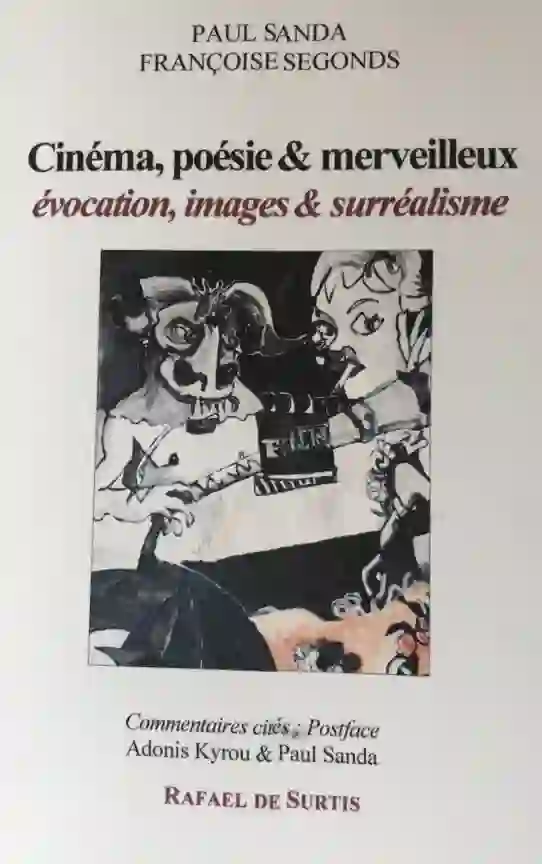
This brief but dense work is published on the occasion of the exhibition Cinéma, poésie & merveilleux, at the Musée d'Art Moderne Yves Brayer in Cordes-sur-Ciel from March 15 to May 13, 2024, in homage to the Centenary of the Surrealist Manifesto (1924-2024). The Cordes region media library is associated with the "Cinéma, poésie & merveilleux" exhibition which runs until May 12 at the Musée d'Art Moderne in Cordes-sur-Ciel. This is a dive into the 7th art through an original creation composed of Françoise Segonds' paintings, numbering twelve (each commentary is accompanied opposite by a painting by Françoise Segonds) and texts by Paul Sanda. It is a journey around the great names of cinema, but also around film noir of the 1930s-1950s. As a partner of the museum, the media library presents, in addition to this exhibition, a selection of films that inspired the artists' work. Books and comics enrich this documentation that users can borrow. You are invited to see or rewatch films by Wim Wenders, Kieslowski, Kubrick, Murnau or Gus Van Sant and many others, and thus discover the cinematographic theme proposed by the artists (La Dépêche).
Ado Kykou wrote in 1953 that cinema "is of surrealist essence." He meant by this: "a means of expression more complete, richer, freer than all others" and he estimated that "this has absolutely no relation to Art (capital A), nor to Technique (capital T), nor to sermons or commerce, nor to Hawaiian dances" etc. (Le Surréalisme au cinéma). "Ô sculpted mysteries of Fernando Arrabal; ah... yes, incredible cannibal feast of curses and blasphemies, since soon everything will disappear...". Thus exclaims Paul Sanda in his commentary entitled "The visionary horse of Fernando Arrabal," about the latter's film: I Will Go Like a Mad Horse 1973. The reflection (commentary) "On the uncertain (& sensitive) quays of Prévert" begins with Noël Herpe's statement: "Prévert's first period is a period that could be qualified as post-surrealist with an anarchist tendency," which continues: "These are films that play on the absurdities of language, on the alienations of language in fact," while mentioning Drôle de drame, Le Quai des brumes, Les Visiteurs du soir. Jean Tulard sees in Fritz Lang "the greatest German director." He notes in the commentary entitled "The German accusation of Fritz Lang" that M the Damned 1931 offers a "hallucinatory evocation of the underworld." What about "The surrealist margin of Jacques B. Brunius" now? On this poet director of short films, for Paul Sanda "so important, so pioneering," Jean-Pierre Pagliano chooses to affirm that "each film was for him an opportunity to risk an idea." What does Paul Sanda think of "Nosferatu, Murnau's surreal specter" (Nosferatu the Vampire, 1922)? Let us not be surprised. He sees in it "the memory of a wandering soul capturing the essence of the very nature of palpitation...". Regarding the "Enigmatic mystery of Man Ray's castle" (L'Étoile de mer, Le Mystère du château de Dés), Paul Sanda especially remarks the camera "which contracts, controls & gets lost, escapes in the adjournments of conformity". Then comes "The dog of the regrettable dream, Buñuel's revolt". About The Andalusian Dog. Ado Kyrou reminds us that "presented for the first time at the Vieux-Colombier, this bomb risked being misinterpreted because it was surrounded by 'avant-garde' films. Yet a new force was unfolding the black screen that came to spread over the spectators." Paul Sanda draws from it, so to speak, the lesson: "Surrealism provokes the skeleton, the anthropological reason, liquefied, assailed, paling & then, finally annihilated; & then the eye... which will slip away in the disorders...". Let us now come to "The founding ecstasy of Walerian Borowczyk" (Cérémonie d'amour, Histoire d'un péché). For Paul Sanda Walerian Borowczyk is "to the most brutal, most oblique atmosphere, of what a rosary of love, in the most sumptuous eroticism, will prolong...". Guillermo del Toro marks his recognition to Nicolas Roeg who made him understand "that, thanks to editing, it was possible to juxtapose events, small facts apparently without relation between them, and thus create a feeling of hyperrealism; this influenced me a lot" ("In the stifled labyrinths of Nicolas Roeg"). When we arrive at "Alexander Nevsky, Eisenstein's abstract epic" (Alexander Nevsky, 1938), it is Sergei Eisenstein himself who should be quoted: "It is a question of realizing a series of images composed in such a way that it provokes an affective movement which in turn awakens a series of ideas. From image to feeling, from feeling to thesis... I think that only cinema is capable of making this great synthesis, of restoring to the intellectual element its vital, concrete and emotional sources". The last word goes to Paul Sanda who writes in his postface: "When Adonis Kyrou wrote in 1953: 'Guided by the surrealist spirit, cinema must reverse itself, deny itself to better find its flamboyant power, offer the total spectacle of what is to better project us into total life,' he believed in free surreality and ascending sign. The 'Society of the Spectacle' seems, alas, to have proven him wrong." "How could cinema, having become a machine to manufacture entertainment for the masses, from colossal sums of money, still make ardor and dream meet in a magical union that would again give meaning and birth to true life, that of the path of awakening and poetic elevation which, alone, can authentically open the essential doors? [...] It is time to return to the fundamentals, to the experimentations, from Man Ray to Buñuel, from Nicolas Roeg to Fernando Arrabal".