DARING ART IN FRONT NOIR
par Georges Rubel
January 23, 2022
I met Louis Janover and Front Noir in 1962. I was then seventeen years old, an age when one often has difficulty taking the exact measure of what we are allowed to access. However, from the outset I could only be on familiar ground: I had already attended on numerous occasions the discussion group on council socialism led by my father, Maximilien Rubel.
My interest in the Dada and surrealist movements dates from my first year literature class at the Lakanal high school. We were a small group of students passionate about literature, theater and cinema, and in search of a surrealism not yet found in school textbooks, but already strongly influential, at least in the field of visual arts, which interested me primarily. I obviously had much to learn, to read, to reflect on.
It was the intellectual complicity between Louis and my father that allowed me to approach and integrate as a young comrade Front Noir, the group and journal that claimed both surrealism and a political thought oriented towards the movement that was then called councilist.
The requirement posed in Breton's first Manifesto to link artistic practice to social revolution was firmly defended there. It coincided with the critique of a surrealist movement – or already post-surrealist – in the process of "bourgeois" integration. Already practicing drawing since my earliest childhood, and concerned with learning a pictorial syntax now neglected at the Beaux-Arts although indispensable to expression, I was wary of a modernist current in full erratic race and influenced by certain transgressive postures adopted by a post-war surrealism. This movement was already in some respects more concerned with careerist recognition than expression, and its political options, even if qualified as "revolutionary," seemed very questionable to us. We were already turned towards council socialism while certain members of the surrealist group seemed to us still in search of a party that would have been the true heir of bolshevism, which seemed to us at the antipodes of Marx's thought.
Front Noir claimed a permanence of surrealist revolution against a surrealism in the process of consecration in the dominant official history. This claim of permanence is still mine today, with all the nuances that the distance of time and age allow.
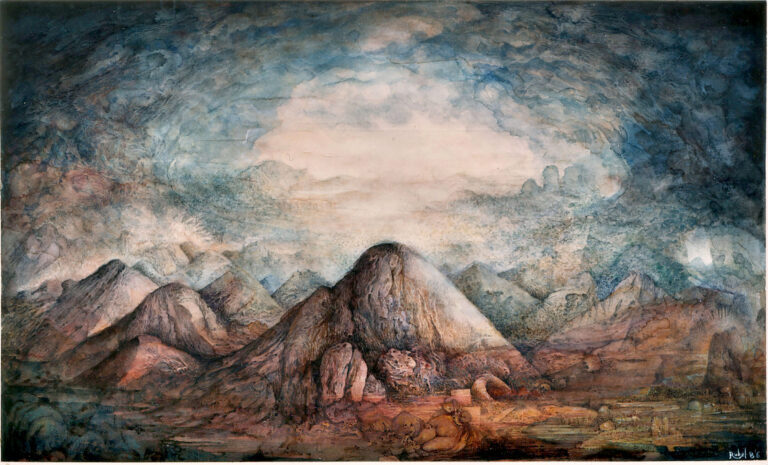
Daring art in Front Noir? Certainly, we must admit that we were totally against the current of the pictorial practices of the moment, which already announced the contemporary conceptualists to the detriment of the artisanal practice of fine arts, the disappearance of the painting, among other duchampisms now quoted on the Stock Exchange and spread in industrial abundance. It was not for Gaëtan Langlais, Georges Grumann – my "pseudo" at the time –, Manina, Le Maréchal, Monique and Louis Janover, Serge Ründt a matter of ideology, because we did not have to claim any avant-garde aesthetics, but rather an ethics; and, on this level, the presence of Le Maréchal was decisive, along with that of his friend Gaëtan Langlais, who came like him from lettrist and situationist circles. Louis and Gaëtan made me meet the artist, painter, engraver, poet – already appreciated by André Breton as early as 1957, and featuring prominently in Le Surréalisme et la peinture –, welcomed in the journal with poems and reproductions in black and white of some absolutely fascinating painted and engraved works. Louis had introduced me to Le Maréchal as "a young man very eager to learn," and he could not have said it better. The technical apprenticeship that the master (as according to the rhetoric in use in the bodegas of the past!) dispensed to me was in truth as decisive as its existential aspect, which took on considerable importance for me: I had met the poet, the one in whom work and life are indissolubly linked, the ethicist of life little concerned with the historico-aesthetico-avant-garde categories or not that certain specialists might have been tempted to impose on him.
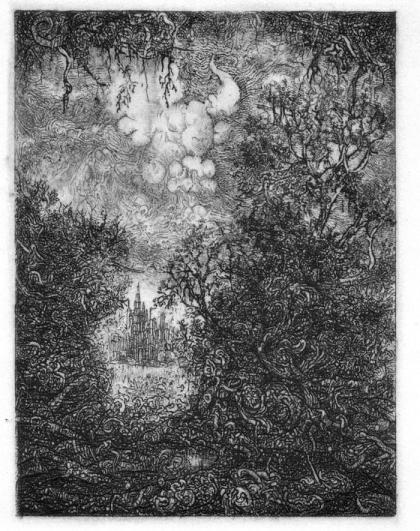
My first fascinations for the practice of engraving, I owe them to Le Maréchal who, during most of the time he devoted to me, had returned to engraving. My journey after May 68, and after the Front Noir episode until today, is that of an engraver. In certain group exhibitions of the 1970s to 1980s, bringing together young artists who often worked in my company, Le Maréchal sometimes figured. The latter did not accommodate any of these opportunities to exhibit otherwise than through the friendship he bore to some of us; I will note especially one, memorable: Stratégie de l'ombre, exhibition organized in the 1980s in Douarnenez by Roland Sénéca, and prefaced by Claude Louis-Combet.
Subsequently, and for some – including Le Maréchal and myself – against their will, Michel Random gathered this informal group under the label of the Visionaries. Michèle Broutta, gallery owner and publisher, devoted to our team several very beautiful exhibitions – personal for some of us, including Le Maréchal – taking up this uncertain category of art history. In reality Le Maréchal no more than myself found themselves in this category inaugurated by Michel Random. But however the latter was one of the first authors to devote a work to Le Grand Jeu which, as we know, had not spared Breton and the self-proclaimed surrealist avant-garde; and this well illustrates the attitude that was ours at the time: mistrust towards avant-gardes, whether they were situated in political or aesthetic terrain, or confusing these two notions; and in this sense this position – moreover not claimed by most of the interested parties – is close to that of Front Noir. Only Le Maréchal and myself at that time had knowledge of the ideas defended in the journal which circulated in artistic circles dominated by the influence of the surrealist group.
But I insist once again: through the requirement – existential, ethical – of the artists who came freely to Front Noir – and, beyond, at the heart of a variously contrasted artistic environment – the hope of a transformed world, of a changed life, has always remained very much alive at the heart of our practice of the arts.
Admitting that the posture of the poet, of the visual creator has today become a challenge in the face of the inconsiderate overflow on the market of culture of words and images, the major purpose remains the same: still and always... let us dare!
Georges Rubel November 2021