THE SURREALIST WIRELESS
par Georges Sebbag
July 1, 2024
In the Surrealist Manifesto – finished printing in Bruges on October 15, 1924 –, André Breton reviews various technical inventions, such as photography and cinema, the telephone and radio: "And, from then on, I feel a great desire to consider scientific reverie with indulgence, so inappropriate after all, in all respects. Wireless? Good. Syphilis? If you like. Photography? I see no inconvenience. Cinema? Bravo for the dark rooms. War? We would laugh well. Telephone? Hello, yes. Youth? Charming white hair." Breton gives the mention Good to radio, to wireless telegraphy and amuses himself by mixing wireless with syphilis. Radio, which takes off in 1922, sees newspapers devote columns to it and announce its programs. From March 16 to May 11, 1924, Breton chains in seven school notebooks about a hundred stories to which he mixes fourteen collage poems. This will result in Poisson soluble, preceded by the Surrealist Manifesto. Breton's interest in "wireless" is patent in two collage poems. That of April 18, 1924, "What will be in two years / André Breton...", includes the cutting "En marge de l'écoute" (Excelsior, April 3, 1924, p.3), in other words the title of a column relating to radio broadcasts. Even better, in the collage poem "Des chiffonniers..." of April 20, let us examine the four cuttings of the sequence "La lampe / en nids d'abeilles / ne s'éclaircit pas / sur les pas": 1. "La lampe [à trois électrodes génératrice d'ondes]" (L'Œuvre, October 21, 1923, p. 6): under the "Wireless" column, the article explains, with drawing, how a three-electrode lamp "is likely to produce sustained oscillations in an oscillating circuit of a transmitting station."
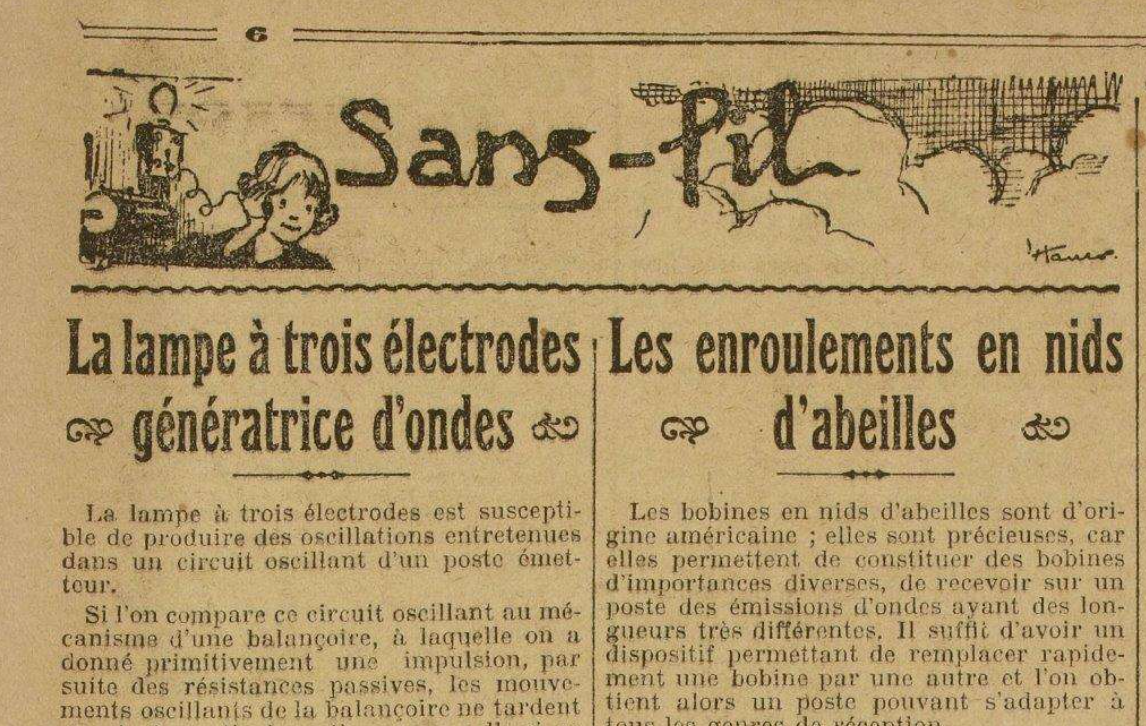
2. "[Les enroulements] en nids d'abeilles" (L'Œuvre, October 21, 1923, p. 6): adjoining the previous article, still within the framework of the "Wireless" column, this other didactic article concerns honeycomb coils which allow receiving on a station "wave emissions having very different lengths."
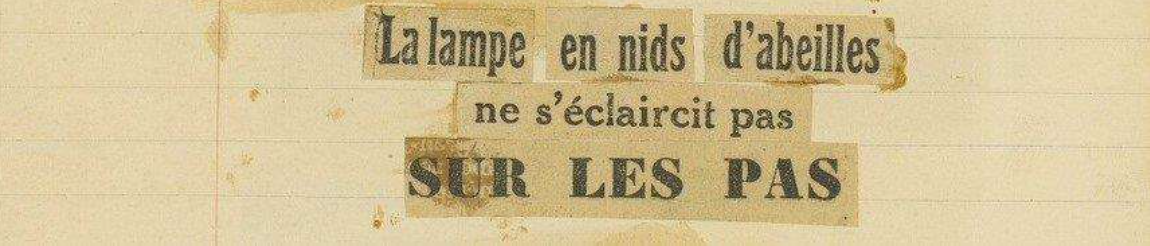
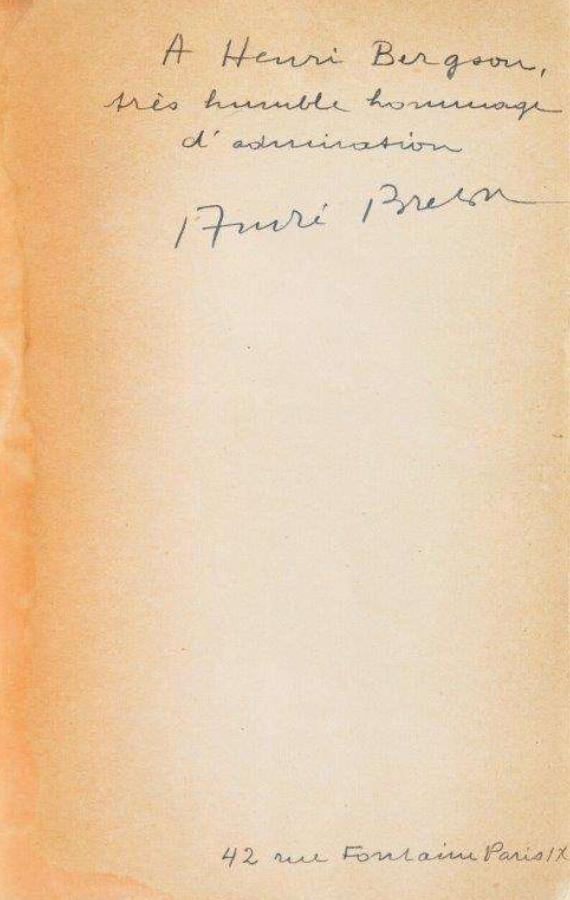
3. "[Le mystère de l'homme coupé en morceaux] ne s'éclaircit pas" (L'Œuvre, October 21, 1923, p. 3): little progress is made on the case of the man cut into pieces, during this assize session in Brussels. This macabre news item is far from rare. Let us point out this title from L'Œuvre, of April 10, 1923 relating to the crime of Moult-Argences in Normandy: "Le mystère de la femme sans tête ne s'éclaircit pas." 4. "[La neige] sur les pas" (Le Journal, April 19, 1924, p. 2), in other words the title of a novel by Henry Bordeaux. Is Breton thinking of his collection of texts, Les Pas perdus, which has just appeared, and more precisely of the incipit of his introduction to Jacques Vaché's Lettres de guerre: "Les siècles boules de neige n'amassent en roulant que des petits pas d'hommes"? On the occasion of this sequence, we discover that Breton is haunted by "la femme sans tête" (another cutting in this same collage poem) as by the man cut into pieces and that he begins to conceive a new order of time, that of a wireless time 1. In February-March 1925, Breton will honor the expression "wireless" from the incipit of his Introduction au Discours sur le peu de réalité: "Wireless, here is a locution that has taken place too recently in our vocabulary, a locution whose fortune has been too rapid for much of the dream of our era not to pass through it, for it not to deliver to me one of the specifically new determinations of our mind." The "wireless," this laconic password of modernity and cutting-edge technology, is the index of a mutation of the mind but also of time, as Breton insists in the following sentence: "It is weak landmarks of this order that sometimes give me the illusion of attempting the great adventure, of somewhat resembling a gold seeker: I seek the gold of time." The arrow of time, measured and quantified time, chronology, irreversibility, historical, dialectical or eschatological becoming, all these paradigms are swept away. In a word, the thread of time gives way to wireless time. To a deflagration of time responds a revolution of the mind. An additional clue allows us to indicate that Breton no longer obeys the time of clocks. In October 1924, on a copy of the Surrealist Manifesto, he addresses this dedication to the philosopher of duration: "To Henri Bergson, very humble homage of admiration / André Breton / 42 rue Fontaine Paris IX".
- See André Breton, Poisson soluble. Le Manuscrit, edition established and presented by Georges Sebbag, Jean-Michel place éditeur, 2024.