TRIBUTES TO JEAN-MICHEL GOUTIER
1er septembre 2020
Jean-Michel Goutier has left us
by Étienne-Alain Hubert, in agreement with Marie-Claire Dumas and Philippe Bernier, collaborators of the edition.
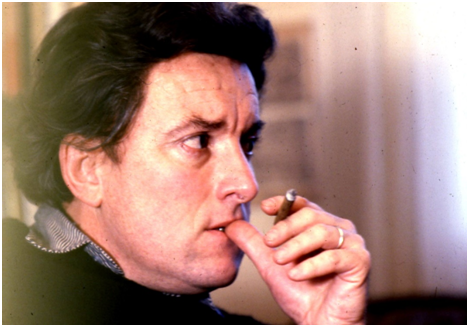
Poet and essayist, Jean-Michel Goutier has just passed away, at the age of 85, on August 27, 2020. He belongs to that generation, now rare, who knew André Breton. It was at the latter's request that he created, with his companion Giovanna, "La Carte absolue" on the theme of androgyny, as part of the International Surrealist Exhibition in 1965: "L'Écart absolu". From then on, he actively participated, starting in 1965, in the activities of the surrealist group until its dissolution in 1969. We can never say enough how much the members of this group were durably marked by it, the impression of belonging to a non-esoteric initiatory community, a kind of egregore Jean-Michel would say, which bound them by a pact. Having returned disgusted from the Algerian war, he could not find a better place to express his revolt and give it a new meaning aimed at "changing life" and opening thought to poetry which was for him synonymous with freedom. Throughout his life, his commitment to defending and promoting the surrealist ideal was unwavering.
Jean-Michel Goutier never much concerned himself with creating a personal work. To this, he far preferred the pooling of means of expression in collective writings and adventures, thus responding in a certain way to Lautréamont's injunction: "Poetry must be made by all. Not by one." However, a few books have marked his journey: "Chanson de geste" (Le Soleil noir, 1976), "Pacifique que ça" (Éditions La Goutte d'eau, 1995), "Toute affaire cessante", with drawings by Giovanna (Éditions A noir, 1998) and a monograph on Iván Tovar. But his generous temperament led him above all to evoke the work of poets and artists whom he loved and of whom he knew how to speak magnificently. Here is, by way of example, what he writes in his preface to Stanislas Rodanski's book, "Des proies aux chimères": "But there are certain rare works like distant submerged continents for which there exists neither map nor compass, comments and references are struck with inanity and then one must advance alone towards the unknown."
He wrote numerous prefaces – Maurice Blanchard, Stanislas Rodanski, Aloysius Bertrand, Édouard Jaguer, Jacques Lacomblez, André Breton (Lettres à Simone Kahn), René Crevel… – and texts for exhibitions – Kurt Seligmann, "André Breton, la beauté convulsive" (Centre Georges Pompidou), "La Révolution surréaliste" (Centre Georges Pompidou), Arshile Gorky, Magritte, Jean Arp and Sophie Taeuber, José Pierre, Giovanna, Yves Elléouët, Jacques Hérold… –, not forgetting many conferences, including in an international context, where his performances were highly appreciated. Moreover, he had conceived and realized "Je vois, j'imagine", an art book on André Breton's poem-objects (Éditions Gallimard). It is precisely this intense and warm activity that constitutes Jean-Michel Goutier's work and it would be important to gather all these scattered texts, as well as his poems published in journals, in a book that would thus bear witness to what surrealism was, at least certain of its orientations, after André Breton's death.
We cannot pass over in silence the energy he deployed over the years for the publication of sometimes little-known and forgotten authors. Thus, he animated "Les cahiers noirs du soleil" at Éditions du Soleil Noir, was co-founder of the publishing collective "Le Récipiendaire", created and animated the collection "En Dehors" at Éditions Plasma.
Finally, it is important to emphasize the essential role he played for the publication of Benjamin Péret's works and certain letters of André Breton published by Gallimard: "Lettres à Aube" and "Lettres à Simone Kahn".
Jean-Michel Goutier was a man of integrity who, like Péret, detested any compromise, which may have earned him enmities. A poet, he was so in his life as in his multiple activities and rare are those who have carried the taste for freedom as high as he did.
Farewell Jean-Michel.
Alain Roussel
September 01, 2020
For Jean-Michel Goutier
When a being like Jean-Michel Goutier disappears, it is stupefaction that grips the survivors. We find ourselves incredulous before this brutal tearing away, before this "injustice", to use the word employed in her message by the one who will have shared his entire life, Giovanna, alongside whom we gather: Giovanna, who will have lived with him so many years made of fusional love, of complicity of bodies and minds, of reciprocal suscitations to creation, in art as in poetry.
This September 2, 2020, I remember the questioning that the death of a friend, Pierre Mabille, dictated in 1952 to the one whose meeting and work will have marked Jean-Michel's destiny early on. You can guess that I want to speak of André Breton.
The dense and dully troubled text that Mabille's death inspires in Breton a few days later opens with the overwhelmed astonishment before the unimaginable, astonishment condensed in the formula: "You, Pierre, in the shadows?" Hardly pronounced, the painful questioning finds its denial, Breton immediately invoking the human and spiritual radiance that emanated from the departed friend. He thus speaks of the "gap of light" that each of his passages seemed to establish in the instant or of the starry universe that constituted his immense knowledge.
Today, it is our turn to ask ourselves: "You, Jean-Michel, in the shadows?" No, he could not rally to the shadows, place of oblivion, he whose light that resided in his intense, piercing, even dazzling gaze we all keep present in mind.
Jean-Michel's eye could sometimes light up with the indignation aroused by injustice. His voice then took on particularly vibrant intonations and one then remembered that he had been, very young, won over to anarchy, the "clear Tower that dominates over the waves" to use the formula of the poet Laurent Tailhade that Breton liked to quote.
For Jean-Michel Goutier had the will to remain a man of vehemence, declaring that he admitted neither compromises, nor the games of arrivisme, nor intellectual recuperations, especially when the maneuvers that irritated him found their pretext in works devoted to that surrealism which will have been the soul of his entire life and in whose orbit he will have composed himself a work of poet and critic. As for him, he wanted to remain guided by an élan of being, an élan which implied in his eyes a disinterestedness without concessions.
It was often the fire of sympathy, the joy of reunions, the expression of passionate enthusiasm that lit up his face, his gaze. He was, in a way, the enemy of the neutral. When he spoke of what he loved, his voice was charged with pressing inflections, words rushed into his mouth. I do not forget one of our last telephone conversations, of which the publication of Breton's texts — whom he designated no other than "André" — was once again the subject.
I met Jean-Michel thirty-five years ago, around 1985, when with the admirable, irreplaceable Marguerite Bonnet began the setting up of the Pléiade of André Breton's complete works, of which I did not know then that it would be for me an adventure of more than twenty years. In those times, we had the chance to consult Breton's manuscripts and books in the magical workshop of 42, rue Fontaine, which remained in my memory inseparable from Elisa's presence, with her beautiful veiled gaze. Age did not prevent her from following and encouraging our work. After André Breton's death, Jean-Michel would devote an immense part of his time to assisting Elisa, notably in the management of the work and in the incessant correspondence tasks that ensued. He did not spare himself then to facilitate our own work, responding with exemplary promptness to our requests.
It is this unreserved availability that I found in him in recent years during the preparation of two volumes of André Breton's correspondences (letters to Jacques Doucet and correspondence exchanged with Paul Eluard). Aube Breton-Elléouët would say much better than I the role he fulfilled in these publications to which she herself gave more than ten years ago a decisive impulse to which Antoine Gallimard's unreserved commitment allowed to give an exemplary realization. No, our publications could not have been done without the attentive and generous follow-up that Aube and Jean-Michel made them benefit from. I can only remember with gratitude and emotion the thankless reading of the proofs of the Breton-Eluard volume to which Jean-Michel, at my request, had kindly agreed to submit.
May he be thanked once again, I say spontaneously using the words that rise to my lips. Dear Jean-Michel, it is again a quote from Breton that comes to mind to situate you today. It is more exactly a quote made in the tribute to Mabille that I evoked earlier. Borrowed from the Tombeau composed in 1897 by Mallarmé for Verlaine's death, these are a few words slipped by Breton in italics at the end of his text: "Un peu profond ruisseau calomnié".
In truth, after "ruisseau calomnié", Mallarmé had added: "la mort". Well, Breton had eluded this definitive word, as if to signify that Pierre Mabille still lived in his own eyes. You too, dear Jean-Michel, you are and will remain alive for us.
Étienne-Alain Hubert
September 2, 2020