ENDRE ROZSDA OR TIME REGAINED
par David Rosenberg
March 1, 2015
Endre Rozsda or Time Regained, by David Rosenberg, published in Mélusine numérique journal n° 1
Endre Rozsda had a noble idea of art. In this domain, he was only interested in or more exactly he only loved what seemed to him at once living, unique, meaningful and integral. And it mattered little whether the work had been created yesterday or a thousand years ago. Time was abolished from the moment a living exchange was established between the work and the person looking at it. If a work was successful, it transformed you and transformed your vision of life. On this subject, he often cited his first encounter with Bartók's work where, one evening in 1937, he had attended a concert during which the composer had performed his own works, presumably accompanied by his wife. Bartók's music had not only moved him: it had at once broadened his idea of art and offered him the possibility of understanding that beyond the fact "of playing with colors and exercising one's talents", it was a matter of creating one's own language, one's own idiom and becoming, as he so rightly said, "contemporary with oneself". Rozsda also often evoked his encounter with the great Russian authors or his discovery of Marcel Proust's work. Their works, too, had transformed him. He compared their books to sorts of passages that metamorphosed those who took them: one did not see things or life in the same way before and after reading them. Painting, like reading, allowed him "to walk on the dimension of time". The studio was the place where Rozsda withdrew so that memory would gradually impregnate him and his canvas. He let himself drift and slide back to his past, but even more curiously, he wrote, "to that of his predecessors, as if he were contemporary with very ancient events". According to him, the perpetual present encompassed everything. There was one last element always present in his thought but rarely named: the marvelous. In the wall of everyday life, the work creates a crevice, a small opening which, if one takes the trouble to enlarge it a little, allows one to perceive another dimension of life and thought, richer and more luminous, but also sometimes even more dull and gray, if the artist has nothing substantial to offer. He was very careful about this question of the marvelous in art which according to him should never be confused with simple distraction or aesthetic seduction. It was towards the high peaks of beauty and mystery that he wanted to go. In our opinion, he succeeded. The notes that follow allow us to grasp the most salient characteristics of the different moments of Endre Rozsda's life and pictorial research, from his beginnings in Budapest to his last canvases, painted in the secrecy of his Bateau-Lavoir studio.
On the Motif (1930-1936)
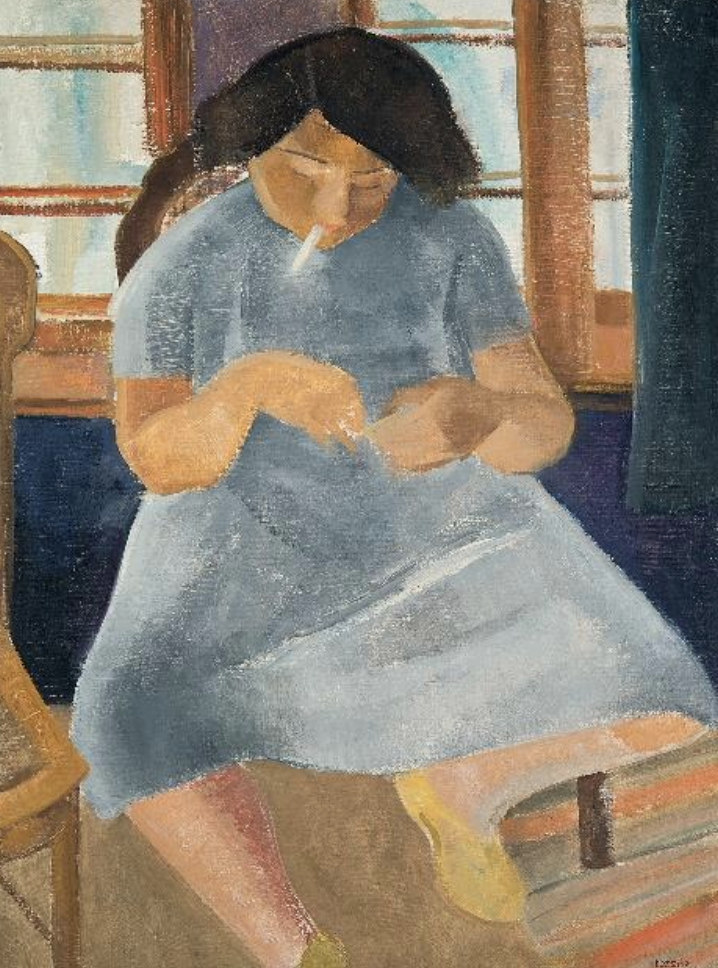
Rozsda began his career as a painter in Budapest in the early 1930s. After his baccalaureate, he enrolled at the Free School founded by the painter Vilmos Aba-Novák, who made Rozsda his apprentice, then very quickly encouraged him to work alone. By his technique and choice of subjects, he was close to the Hungarian practitioners of plein air painting from the Nagybánya school, heirs of the Barbizon school and the French impressionist movement. But, even at that time, his work was difficult to define or summarize under a single designation. One can notice "three painters" in one and the same person. There is the walker who sets out with canvases and colors in search of a sunny corner of countryside or a viewpoint that will inspire him, there is the city painter who plants his easel in the middle of the living room, in a corner of the kitchen or by a window, and finally there is the studio painter who slowly matures carefully studied compositions. Plastically, this gives three bodies of works easily identifiable: canvases sketched with a rapid and flowing touch in green, gray or ocher tones (Marbrier), paintings in gray-blue tonal harmonies with more structured composition and more affirmed drawing (Girl with Cigarette) and finally some rare works where a palette of shimmering colors laid flat serve the meticulous treatment of the subject and whose more hieratic composition evokes the "classical taste" of the 1930s (Marianne). The painter's first years of work are marked by the constant alternation between these different styles.
The Surrealist Night (1936-1943)
From the beginning of his stay in Paris, Rozsda accentuates the gestural and calligraphic aspect of his painting work. A sinuous and unrepentant touch serves to lay down color and drawing. He daubs the canvas and, to the immobility of the subject – most often still lifes – responds the dynamism of gestures and the trace of the brush. He then begins to become passionate about the work of surrealist painters, such as Max Ernst, André Masson and Miró. The young painter is also interested in Salvador Dalí's latent images or notions of dream and automatism. In the midst of German occupation, he goes to admire their works at Jeanne Bucher and the rare galleries that continue to show their paintings clandestinely.
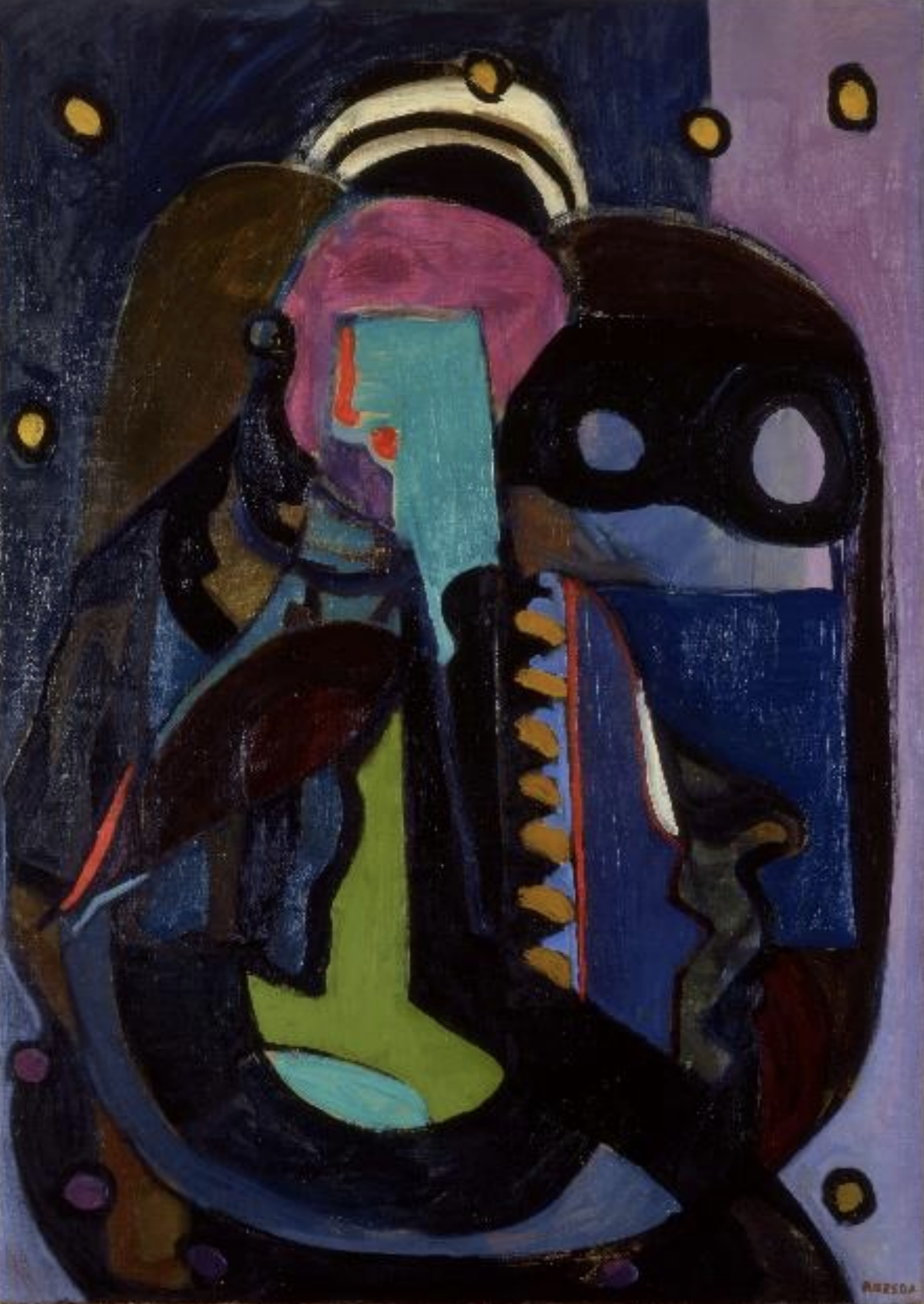
The starting point of the canvases from this period most often remains the observation of a subject arranged by the painter or simply framed. Certain elements of the composition are treated according to different scales of size. The schematized or stylized figures and the use of color henceforth depend more on composition than on subject. He gradually abandons all naturalism. From 1941 to 1943, Rozsda works on abstract compositions where imposing geometric masses are ordered, most often treated in flat areas outlined and contrasted. On a smaller scale, signs, graphic elements are sometimes scattered on the canvas. The lines are supple and sinuous. The blacks, blues, violets are illuminated by vivid, sometimes fluorescent tints, mauve, orange, red or green.
The Dawn of Europe (1945-1947)
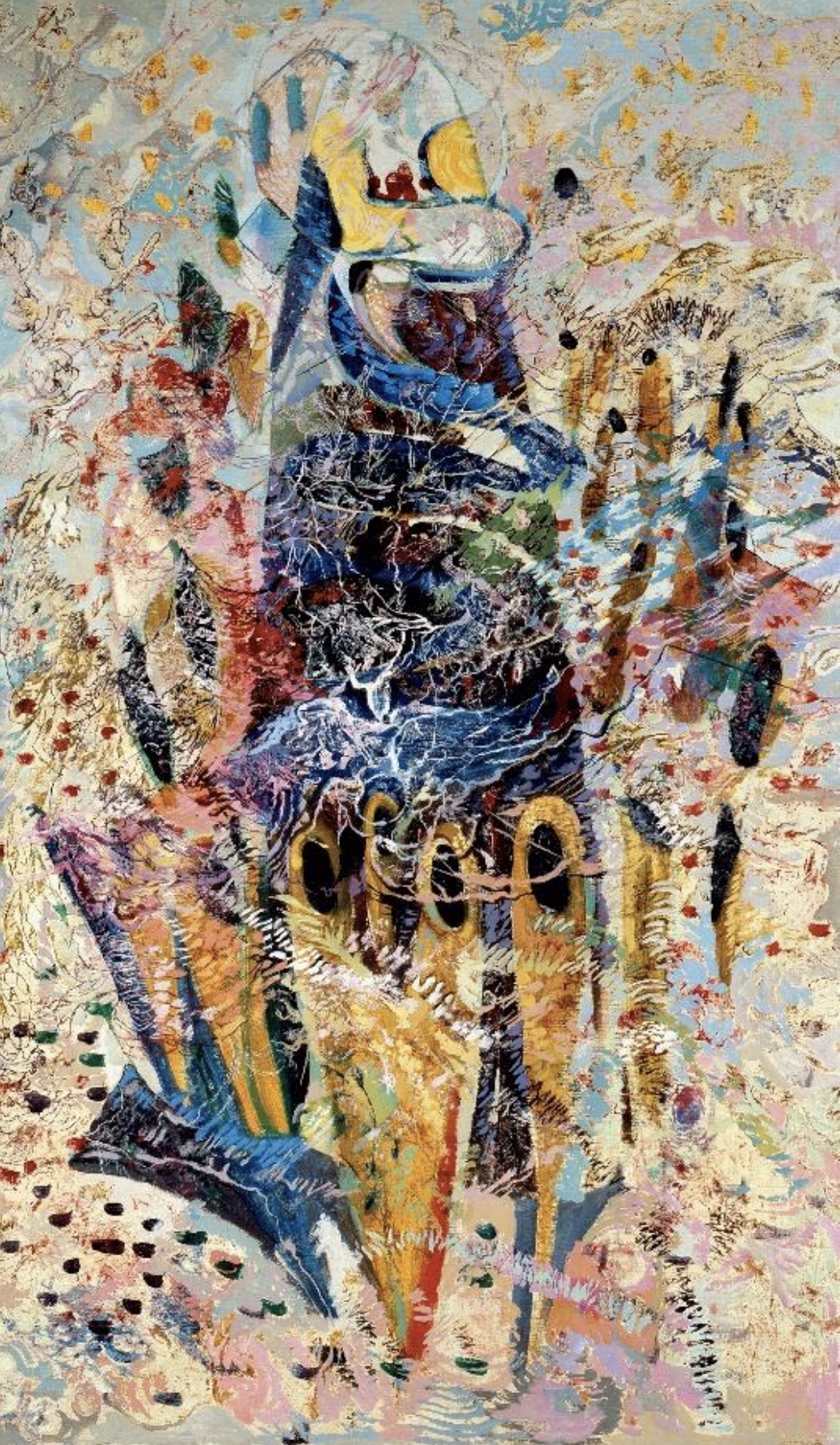
At the end of the war, Rozsda runs a painting workshop for workers in Budapest and participates in the founding of the European School, a movement which, during the three years of its brief existence, will mark with its imprint the Hungarian artistic and intellectual life in the process of rebirth. Artists, poets and philosophers sometimes meet in Rozsda's studio, transformed for the occasion into a meeting room, to discuss surrealism, but also the necessity of creating bridges between arts, peoples and cultures. Rozsda's works created in this context present great formal homogeneity. The characteristic signs of this period are clearly identifiable from 1945: swarms of minute details, patterns and structures, capillary networks. Rozsda resorts to an elaborate system of multiple planes in relationships of transparency and opacity, sometimes overlapping, sometimes interlocking. The painter takes as his starting point images of nature of animal or vegetable origin: truncated or sectioned forms, reconstructed or assembled, enlarged or reduced, constitute a lexicon of graphic and pictorial elements. It's as if our gaze plunged inside a cell or into marine depths teeming with mysterious life. If we compare with the canvases created just before his departure from Paris in 1943, the palette has considerably lightened. But the luminous space of the canvas sometimes darkens, saturated with chiseled motifs. These researches are brutally interrupted with the arrival to power of Stalinist communists and, overnight, Rozsda like so many other artists is forced to conceal his work.
The Castle of Memory (1956: Exile and After)
In Hungary, from 1948 onwards, freedom of expression is abruptly muzzled and only "official art" has the right of citizenship. Rozsda almost ceases to paint and then turns to drawing, working clandestinely until 1956, the date of his exile and his definitive return to Paris. Father and Mother in the Cab (1954) is one of the rare canvases dating from this period. The time of memory and that of narrative order a composition where landscapes, objects and characters from the painter's childhood coexist. To this work imbued with nostalgia respond the delicate interlacings and vivid colors of his drawings created during the full Hungarian insurrection in 1956, with a technique that he would never cease to refine to the point of purity as evidenced by his ultimate drawings.
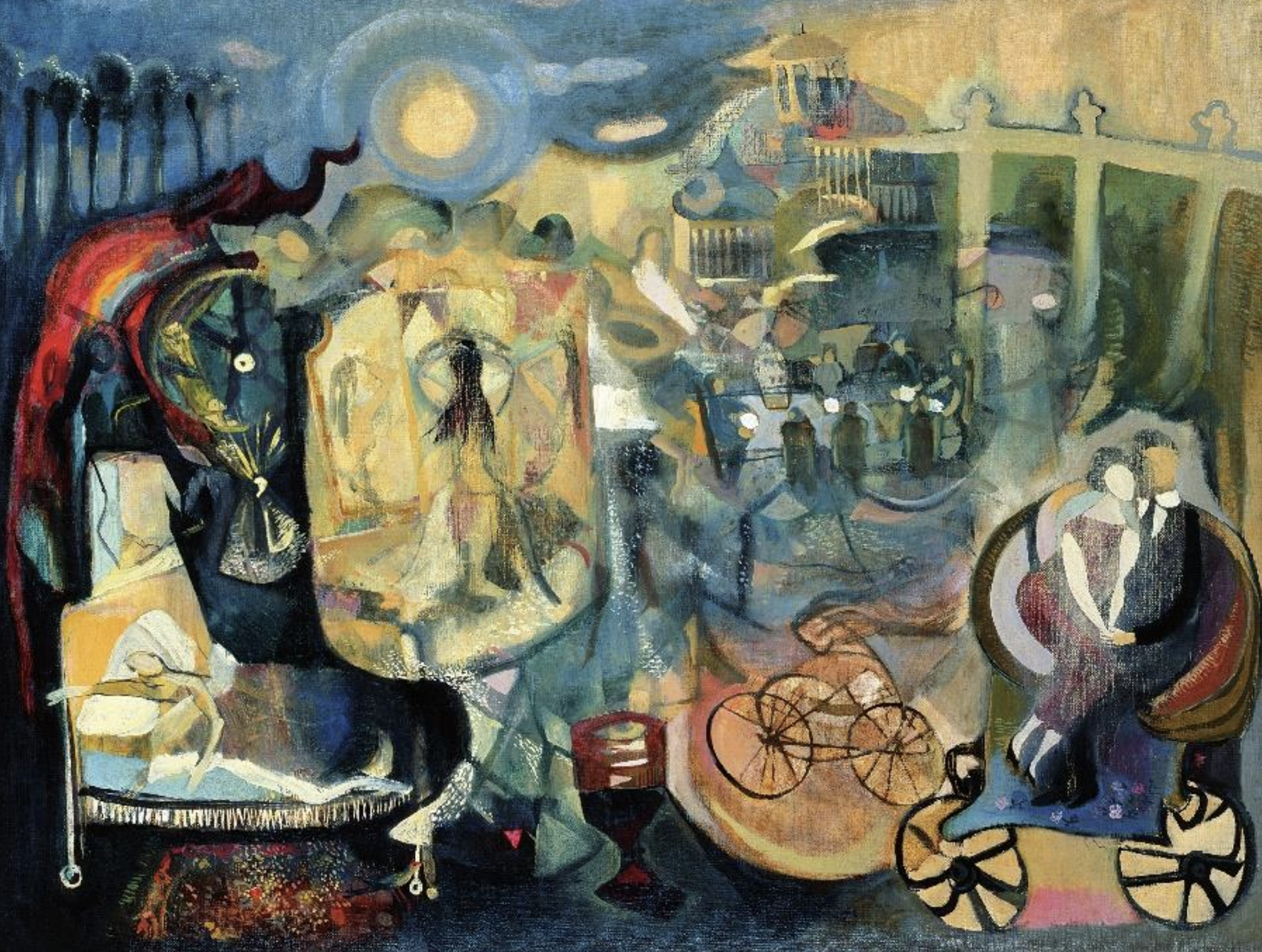
When Rozsda resumed painting in the late 1950s, memory and memories played a preponderant role in his work. Each canvas is the fruit of anamneses, but also of stubborn work: a myriad of minute details, interlocked with each other, create a dense and complex world, where sometimes appear a sign, a recognizable figure or fragments of architecture. According to him, it is "the material that creates the mental surface" from which he can set out in search of time. A memory or even a form – an eye, a window, a tree leaf, a letter or a number – transforms into a colored geometric motif or vice versa. Abstraction and figuration merge, thus creating a dense fabric "of forms that knot and unknot under the gaze".
The Eye Listens, or Rozsda and Music
The relationship that unites Rozsda's painting to music goes back to the beginning of 1938, when the artist attended a Bartók concert where the composer, accompanied by his wife, performed one of his own works: Sonata for Two Pianos and Percussion. The discovery of Bartók's music crystallized all the questions that preoccupied him then: "What to paint? Why paint? What meaning to give to art?"
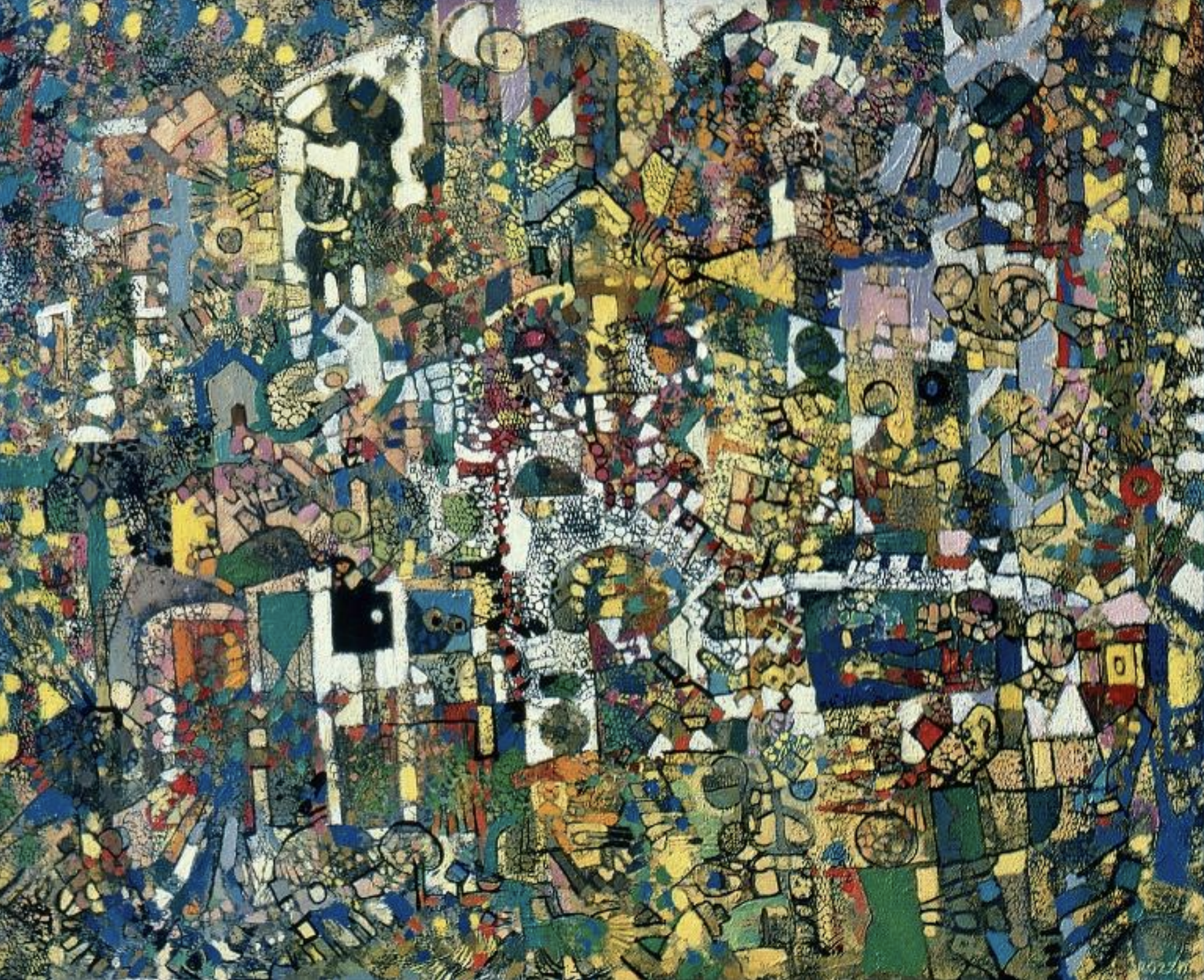
Thus, it was classical and contemporary musicians just as much, if not more, than avant-garde artists who led him to glimpse what modernity in painting could be according to him. Bartók's Bluebeard's Castle, Mozart and his sonorous sky, Fauré and Debussy's Masques et Bergamasques: so many works testify that painting and music were intimately linked for Rozsda. Works explicitly referring to music constituted less, according to the artist, a homage than a pictorial transcription of the auditory and emotional experience of their music.
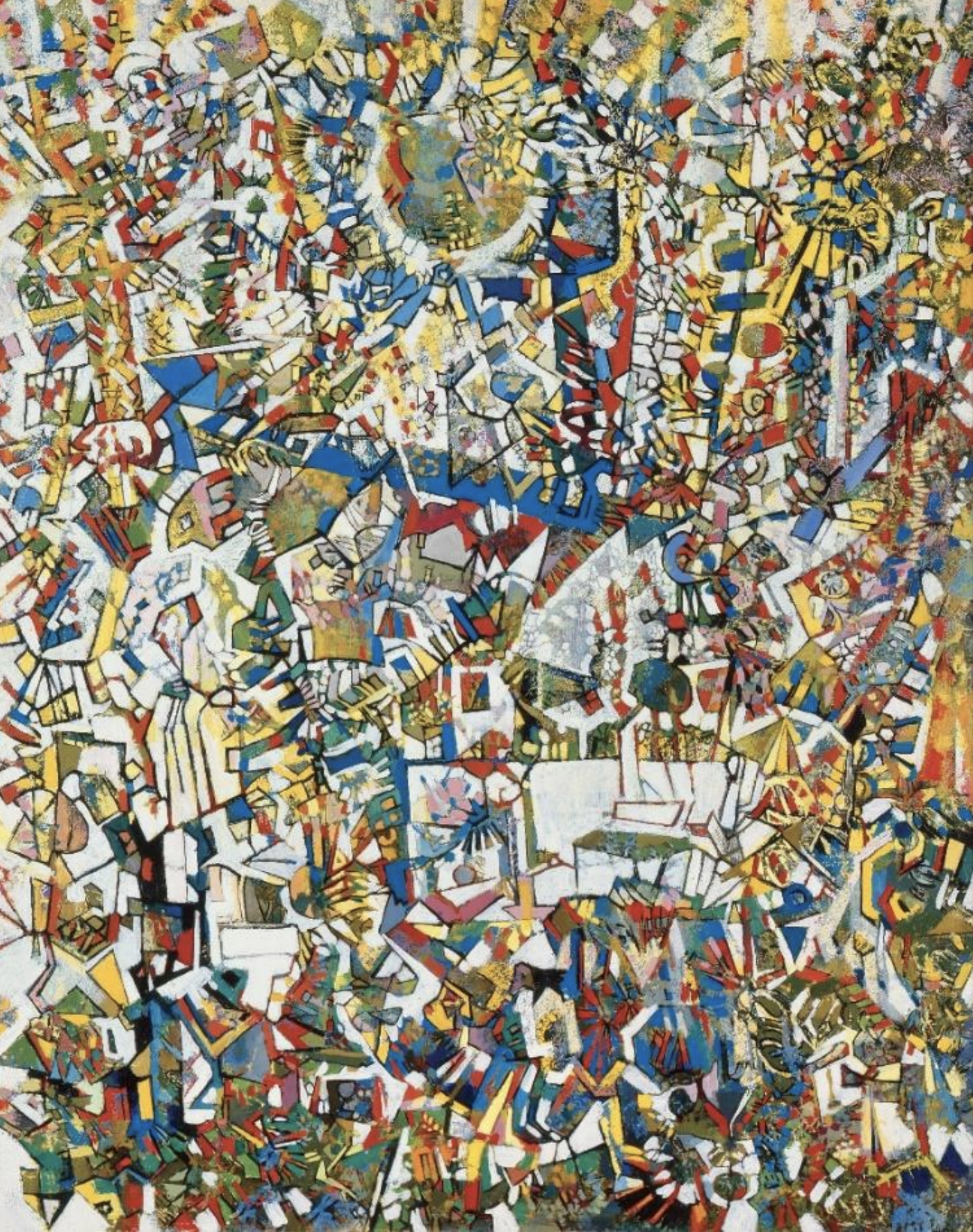
Initiation (1969-1999)
In the late 1960s, Endre Rozsda was initiated into Freemasonry. Without modifying his working technique, he then introduces into his canvases numerous symbols borrowed from this tradition. But it is truly the question of time that will become central in his work. This induces a profound change in his way of envisaging the act of looking and the act of painting, a mutation that the works of the previous decade announced. Rozsda then seeks to elaborate a new perspectival model, "by substituting the depth of time for that of space". On this subject, he writes: "When I start to paint, I do everything possible to eliminate from the canvas everything that is white, everything that disturbed me. I strive to create a troubled surface on which I can start searching, groping, for a certain order which, degree by degree, modifies the previous order and creates another disorder. It is the material that creates the mental surface from which I can set out in search of time". It's as if painting sedimented all at once the gaze, memory or the fleeting premonitions that cross the painter's mind. In Rozsda, the delicate assembly of forms and colors, the play with light, can evoke the chiseling and ornaments of medieval jewelry, the art of stained glass, that of sacred architecture, oriental carpets or Byzantine mosaic. However his works are exempt from symmetry or repetition. Each canvas constitutes a geological layer with innumerable strata where are preserved – frozen and alive at the same time – images, memories and thoughts, like a "dense fabric made of light and memories" coming to life under the gaze.