BRUNO GENESTE & PAUL SANDA, A CENTURY OF WRITERS IN CORDES-SUR-CIEL AND SURROUNDINGS
June 9, 2022
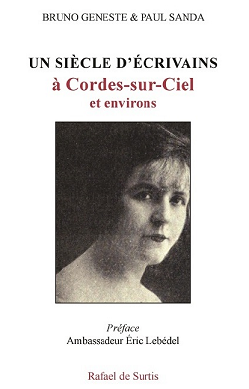
"For exactly 800 years, Cordes-sur-Ciel, shadowily built on the Mordagne, seduces, attracts, magnetizes, and sometimes, retains. No wonder it has retained in its nets so many bewitched, charmed, stunned writers." This is how Éric Lebédel presents this immense and remarkable study dedicated to the eight-hundredth anniversary of the foundation of the City of Cordes. It is a beautiful tribute to the contemporaries of the previous century and the present century who have gathered the heritage of Cordes' prestigious past, made it fruitful and considerably renewed it. Finally, it is above all an impressive sum of literary history, rich, precious, faithful, carrying a flamboyant inspiration. Nearly forty writers (of whom we can only cite a few) are presented and analyzed in their relationship to the Cordaise city. These are novelists, poets, painters, lawyers, journalists, philosophers. Paul Sanda, who directs the House of Surrealists in Cordes, presents them as "poets, original surveyors of the true meaning buried in the heart of secret countryside." We begin in the 19th century with Prosper Mérimée, the rigorous Inspector General of Historical Monuments who gratified Cordes with an attentive visit; we make room for the poet Maurice de Guérin and his sister the woman of letters Eugénie de Guérin; we find Hector Malot (while remembering that some typical scenes from the film Rémi sans famille were shot in Cordes in 2018). And then we enter the 20th century, perhaps surprised to meet in Cordes T. E. Lawrence, the famous Lawrence of Arabia who in 1908 writes: "Cordes, yet another of those indescribable places without any possible parallel. To think that such a city exists, in our Europe of the 20th century... Cordes is a paradise for a painter." The authors then lead us to an important inaugural figure, that of the novelist and journalist Jeanne Ramel-Cals, who held a literary salon in Paris and was the author of the Legendary of Cordes-sur-Ciel: it is indeed with her that Cordes becomes "sur ciel" (above sky). Her contemporary Philippe Hériat offered Cordes a beautiful analogical image, speaking of a "Mont-Saint-Michel of the Earth"...
Jean Giono, Albert Camus, Violette Leduc, Yves Bonnefoy are writers who approach Cordes with all their sensitivity from elsewhere, and for whom the discovery of the City and its landscapes and monuments, its vibrant atmosphere, constitutes a wonder sui generis. In his presentation of Carnet du Maroc by Yves Brayer (in 1963) Giono testifies to his arrival in Cordes, similar for him to the cities of Castile: "same severe nobility, same golden ramparts; the watchtowers tear a sky historiated like a blazon." Still striking is his allusion to a certain silence: "In the narrow alleys sleeps a cool shadow, very black, a silence barely disturbed by the rumblings of a mountain wind that strikes the city like a drum." Writing a sort of travel journal, which will become the book entitled Trésors à prendre, Violette Leduc, dazzled, sees the rose window of the Saint-Michel church of Cordes as a sort of erotic and mystical mirror: "Colors of the rose window, fainting mysteries, I faint too." This ecstasy follows a no less inflamed tour of the cathedral of Albi. Less fulgurant and more appeased, Camus's discovery of Cordes in 1953 is expressed in terms that have become memorable: "The traveler who, from the terrace of Cordes, looks at the summer night knows thus that he has no need to go further, and that, if he wants, beauty, here, day after day, will lift him from all solitude." As for Yves Bonnefoy, essential was for him "this so mysterious city of Toulouse which, pushing him even further, will lead him to peregrinate to Cordes..." But if it is indeed, according to him, "the excess of words over meaning" that attracted him, when he came to poetry, "in the nets of surrealist writing," we know that he gradually freed himself from it to return to a "more Rimbaldian" vision of poetic writing.
Now this book – endowed with rich iconography in portraits, engravings, landscapes, photos, black and white and color (for example the Barbacane tower, high place of surrealist rendezvous in Cordes, around Francis Meunier, where numerous poets and painters stayed from 1947 to 2009) – this book, I say, does not content itself with constituting an anthology, erudite and very beautiful moreover. It is desperately alive, even bubbling like a cauldron, with original inspirations and creations, arisen in Cordes itself, both local crucible, if one can say so, and relay for other artists and poets animated by similar quests. I have named surrealist inspiration on the one hand, esoteric inspiration on the other. The interaction, even the intrication, between the two, very strong in Cordes, is certainly one of the points that makes the keen interest of the joint enterprise of Bruno Geneste and Paul Sanda. A pertinent light comes from the author of a History of Occult Philosophy (1983) and a History of Erotic Literature (1989), Sarane Alexandrian, founder in 1995 of the poetic review of surrealist inspiration Supérieur Inconnu. At odds with André Breton and the group following the exclusion in 1948 of the painter Matta, Sarane Alexandrian came to Cordes in 2003 on the occasion of the exhibition devoted to Maurice Baskine, "Eroticism in Alchemy," his eponymous work was published in 2019 by Éditions Rafael de Surtis.
A part of the book is reserved for those whom one can call "the surrealists of the surroundings": Malrieu, Arnaud, Herment, Puel. Jean Malrieu lived in Penne-du-Tarn, the other city of poetry, close to Montauban and "obligatory passage before discovering Cordes," one of the high places of local surrealism where he frequented for two decades his friend Noël Arnaud, member of La Main à plumes, the surrealist group active under the Nazi Occupation, as well as Georges Herment, poet, painter, sculptor who endeavored to reestablish "a sort of primitive dialogue with telluric forces." He made of this place "a cosmic celebration and a troubadour's path." Bearer of an ardent fire, Malrieu initiates "a sort of mystique of love." Noël Arnaud was, from 1937 to 1940, member of the Dada prolongation group Les Réverbères, for a time "revolutionary surrealist," co-founder of the second Situationist International. Links with Éditions Rafael de Surtis, creation of the surrealist prolongation review Pris de peur, close to the review La Dragée haute. Gaston Puel, in 1946, he founded in Albi the bookstore "La Tête d'or." Linked to Francis Meunier, correspondent with André Breton, Hans Bellmer, Joe Bousquet, Tristan Tzara, René Char, he is the author of a collection of poems entitled L'Âme errante (1992), a collection that Geneste and Sanda consider as "well decisive around [our] surrealist poetic commitment." A few years later, and with other protagonists, a regrouping takes place around the House of Surrealists, inaugurated on July 26, 2002 at the Porte du Vainqueur, then installed in 2005 at 7 rue Saint-Michel. Center of art and alchemy whose ultimate goal is to "make avant-gardes and traditions meet." Meeting place, also of realization of collective objects, experiences of group work. A mine for those who are interested in the relations between surrealism and esotericism such as Patrick Lepetit has explored them in his book Le Surréalisme, parcours souterrain (2012). Habitué for more than ten years of this House of Surrealists in Cordes, Jacques Kober knew how to make the poetic journey appear as an initiation, "as an invitation to change (up to the most intimate) eternity." He meets Jean Breton in 1977, as well as Rafael de Surtis. He appears as "the inventor of the most mad veneration, like the surrealist dowser of the first age."
Surrealist in his beginnings, André Verdet, named the "poet of the stars," the friend of astrophysicists, painter, sculptor, ceramist, art writer, was an original and multifaceted creator. On the ramparts of Cordes the Tour du Planol contains bas-reliefs and stained glass windows made by him. In his autobiography in the third person he recounts: "1964 – Journey to Cordes-sur-Ciel in the Tarn: the famous Cathar city reminds him of his Saint-Paul de Vence by its configuration at the crest of a hill." Executing frescoes in quick cement, forms camped in a sovereign hieratism charged with history, he has "the concern to keep the double medieval and religious meaning and to make it significant in an atmosphere, a climate of occult presence." He donated to the Cordes Museum his works and works by Picasso, Léger, Klee, Magnelli, Prévert, Arman, Appel... He was welcomed by Jean-Gabriel Jonin who was for a quarter of a century one of the most remarkable figures of Cordes-sur-Ciel, both as a painter and as cultural affairs officer at the heart of the municipality. Author of La Cité cathare – Cordes-sur-Ciel ou l'échine du Dragon (1992), Jonin devoted himself to the direct search for mystery, "wanting to pierce the hermetic secrets of Cordes and the scope of its alchemical breath. If his thought, erudite, relied heavily on readings of tradition, his creator's gaze was also able to largely dig into appearances, acute silences to better traverse them." According to him, "the force of the City since the real draws writing into the density of the occult that one cannot unveil." Closer still to us, born in Albi and "frequenting inexhaustibly the Cordaise City," "so beautiful poet, of Cordes and elsewhere," Marie-Christine Brière enchanted in her time the waves of Radio-Cordes with her subtle verses. She was "of the species of discreet poets, although quite engaged in a combat of elevation and strong conviction." On the occasion of the publication of her Montagnes à occuper in 1978, Jean Breton wrote: "Marie-Christine Brière's poetry is a mixture of autobiographical realism, baroque, and surrealism, by the surging, disorienting image, point-blank." In her collection Cœur passager (2013), one can read a "very admirable text, nostalgic and emblematic," entitled "Cordes-sur-Ciel," a poem dedicated to the Cérou, the river that crosses the Cordes valley, another on the Grésigne, forest of the Cordais country. Herself engaged in the feminist combat in 68, organizing theater workshops for women in Cordes, Marie-Christine Brière is also the author of an essay in homage to Thérèse Plantier, surrealist feminist poet, linked, like Violette Leduc, to the nearby Provençal south.
Having just left us last year, here is Hervé Rougier, traveling writer, "citizen of the paths," crossed the Cévennes on foot in the footsteps of R.-L. Stevenson. Impregnated with the works of Joseph Delteil he also meditates on the thoughts of Francis Jammes "this spiritualist poet of nature." Activist in his concrete ecological approach, he inscribes himself in a poetic meditation that attaches to traditional Alchemy. In his unpublished text offered for this book shortly before his death he writes: "The city is rooted in the Gold of time, this Gold that André Breton recognized with the master of Savignies, Eugène Canseliet. At two or three steps from the Saint-Michel church erected at the summit of Cordes in the manner of a menhir, here is a bookstore where works of esoteric inspiration are treasured, the House of Surrealists. All Cordes is in stone and sky."
To finish, as well as to Christophe Dauphin and Odile Cohen-Abbas, Bruno Geneste devotes a few pages to Paul Sanda, declaring that with him one enters "a country of high turbulence where the real of stone and its mist sentinels give birth to a poem of the abrupt, a poem carved in the escarpment and which conceals a true thought, a shattering poem against the wall of received ideas."