AT THE GERMAN ROMANTIC SOURCES OF SURREALISM
par Georges Bloess
November 26, 2017
At the German Romantic Sources of Surrealism
Tracing back to the German romantic sources of surrealism? I warmly thank Henri Béhar for having drawn me into this adventure. Yet, what a challenge! A succession of trials. Judge for yourself:
an immense territory to explore, extending over nearly a century, continuing until Wagnerian opera but which has already been the subject of countless studies, among which figures the unsurpassed sum of Albert Béguin, The Romantic Soul and the Dream, whose 80th anniversary it is1. What to add to this volume which has not aged? Has it not closed the debate once and for all? Finally and above all: the paradox of a possible filiation between German romanticism and surrealism! The surrealist ambition is to contribute to political and social revolution, to continue everywhere the liberating combat of October 1917 – and without any compromise! Yet German romanticism appears profoundly, viscerally conservative, it is even the initiator, the inventor of the conservative revolution which will, for a long time, plunge Europe into terror after 1815. These facts, the fine connoisseur of History that André Breton is knows nothing of them, and does not seek to dismiss them. "Ultra-reactionary," that's how he speaks of Novalis, the master thinker of romanticism, in his Introduction to the Bizarre Tales of Achim von Arnim, written in 19332. German romanticism and Surrealism, these two movements seem well situated at opposite poles from each other.
And yet! These remarks overflow with enthusiasm, admit a genuine fascination for this period that André Breton will qualify, on many occasions, as "magical." That is to say: its very irrationality makes it attractive. And that's the whole problem.
They are multiple, almost innumerable, the traces of a memory of German romanticism, not only in Breton, but in the entire surrealist movement. To draw up an inventory? A task as vain as it is tedious. Better to place oneself at the heart of this conflictual and passionate relationship, and attempt to resolve the contradiction of which André Breton is a prisoner.
For he shows at the same time a visionary intuition: this irrationality claimed by the romantics is revealing, is creative! Of what, precisely?
First of all, of individual resources. André Breton expresses or lets it be understood on many occasions: German romanticism gives birth to the individual, to his irreducible singularity.
However, this singularity makes plural singularities blossom at the same time through the intensity of the personal relationships it arouses; thus appear friendships still unknown in cultural history, escaping all logic; they expand into quasi-amorous constellations, where young women – Bettina von Arnim, Caroline von Günderode notably – shine with a quite particular brilliance.
Through such personalities is revealed a feminine power that André Breton admires, of which he is already marked and which he celebrates in this Introduction..., devoting several pages to it.
One can guess what, for the founder of the surrealist movement, constitutes an event, a rupture in German romanticism: he believes he can contemplate there a humanity connected, sublimated by magical accidents, true sources of creativity. Hence their strong resonance on the friendly community that Surrealism forms; hence, also, the echo of German romanticism in the telluric shock that represents, for Breton, the encounter with Nadja.
I formulate this hypothesis: German romanticism offers an in-depth illumination of Surrealism, it works on it, operates its radiography, if I believe these lines of André Breton in Surrealism and Painting II, written in 19413: "The fervent light that bathes Heinrich d'Ofterdingen or Aurelia..." It is therefore appropriate to question, rather than a fortuitous identity between "leitmotifs," a dynamic, a common genius between these two movements; a same path, which leads us, from the lights of Reason to the night of a Sur-rationality, and from that, to a light of a quite different nature, bringing the revelation of a superior knowledge, regenerating humanity in the universal practice of poetry.
Let us attempt to verify this hypothesis from this founding text of romanticism that is Heinrich von Ofterdingen, and from a few works by Caspar David Friedrich, true visual interpretations of Novalis's novel, of which this painter is the exact contemporary.
I. Heinrich von Ofterdingen, novel of a journey
This trajectory which leads us from day to twilight, makes us cross the night to place us suddenly face to face with a dazzling light, summarizes a journey. It is indeed in this typically Germanic tradition that Novalis's narrative is situated. It takes up the motif dear to the so-called "formation" novel. An education worthy of the name is done at the school of life, apprenticeship is accomplished through the use of the world, and therefore first on the road; it can follow the joyful and stirring rhythm that inaugurates, in Schubert, the cycle of The Beautiful Miller's Daughter, or adopt the funereal pace of the lugubrious Winter Journey.
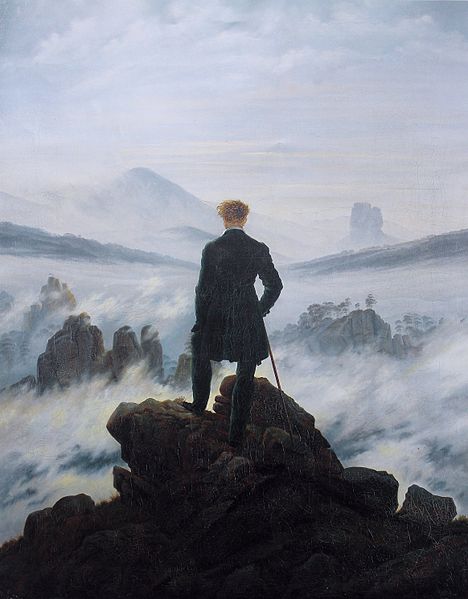
One would be tempted to see, in The Wanderer above the Sea of Fog, painted by C. D. Friedrich in 1818, the culmination of this adventure. Alone, it could summarize the trajectory, the "geste" romantic. Certainly the character is considerably older than Novalis ever was – the latter had passed away, before even reaching thirty, letting himself voluntarily consume after the disappearance, in 1796, of his young fiancée Sophie von Kühn. However insurmountable, this mourning was nevertheless the starting point of a prodigious philosophical and poetic inspiration, of which our novel marks the culminating point. Sophie's death is therefore not an end, but a beginning – one cannot help thinking that André Breton is roughly the same age as Novalis at the time of writing Nadja, and that the mysterious disappearance of his friend is, for André Breton also, the source of a creative surge.
As for the Wanderer painted by C.D. Friedrich, he is not identifiable with certainty, even if it is permitted to suspect that it is a self-portrait: he turns his back on us. Turns away from us, as from all human society; he has traveled hostile paths to dialogue only with immensity. It is a manifesto of rupture. In the Germanic cultural space of this period, the spiritual guide is, by unanimous opinion, Wolfgang Goethe, whose Wilhelm Meister, in its two stages, the years of apprenticeship, followed by the Years of travel, teaches that an individuality has the mission of finding its vocation, then of inscribing itself in a social milieu where it usefully exercises its talents. Nothing of the sort in C.D. Friedrich. His hero is alone, the summit he has climbed marks an ultimate point, a stop before the abyss. Similarly in Schubert, certain silences seem less to constitute simple technical pauses than to suggest the mute contemplation of a chasm.
Sublime spectacle indeed this fog that creates confusion: is it an ocean, a mountainous massif? In Novalis also, the young Heinrich – who has undertaken a great journey across Silesia at his mother's insistence, because she found him too inclined to reverie –, is torn between fear and wonder at the sight of such a landscape: "at the threshold of a distant world (...) He was about to plunge into the blue of these waves"4.
In Friedrich, the character does not seem to lose all self-control. Chaos appears mastered by the artist. The geometric construction places the wanderer at the summit of a triangle, it makes him the center, the point of convergence of a bundle of forms – foggy masses? Mountain ridge lines? – that he welcomes in his heart; a harmonious exchange between the individual and the universe seems to be accomplished.
It is not always so: sometimes the universe can take the upper hand, reduce the human element to an insignificant trace: for example in The Monk by the Sea of 1810 – this ink-colored sea making one think more of the Lethe river of Greek imagination –, or again in Mountain Landscape with Rainbow, dating from the same year. Similar visions bring us closer to the exiles and stateless who, in certain Schubert Lieder, go like wrecks, dragging their sad lament.
Similarly in Novalis appears a pilgrim who seems to have inspired the visionary talent of C. D. Friedrich:
"He had now reached the mountain where he hoped to find the goal of his journey. Hoped? He no longer hoped for anything. Terror and despair drove him to seek the frightful sensations of the mountain (...) He was exhausted, but calm. At the moment of sitting down, he still saw nothing (...) A splendor seemed to spread before his eyes. He wanted to pour all his tears toward the distance, so as to leave no trace of his existence."5
Are these landscapes the reflection of these dramas, or do they rather provoke them, to lead them to their paroxysm? It matters little. There is a deeper, more essential drama: it is the one that subjects these landscapes to the test of Time. In its most imposing manifestations – plains, reliefs, mountains, forests, narrow gorges, vertiginous abysses, these are the cycles of this Nature that the painter makes us contemplate each time; he studies its phases, according to the hours of the day, the luminous or seasonal variations.
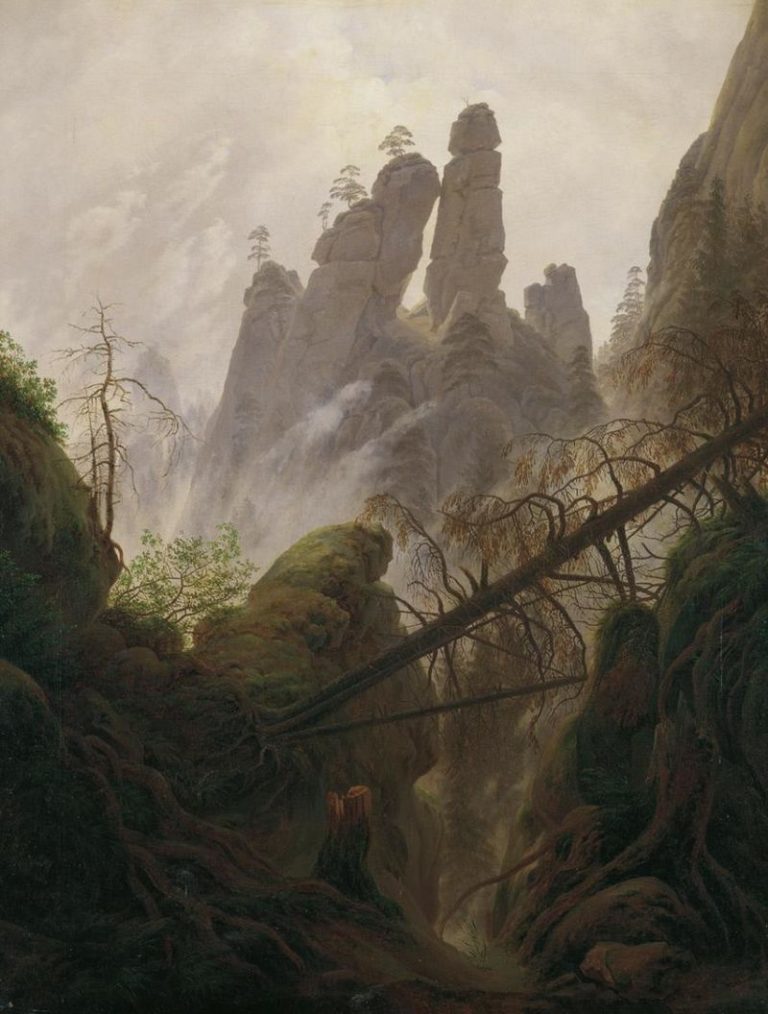
he lingers to emphasize the cracks, the fractures or on the contrary the slow erosion.
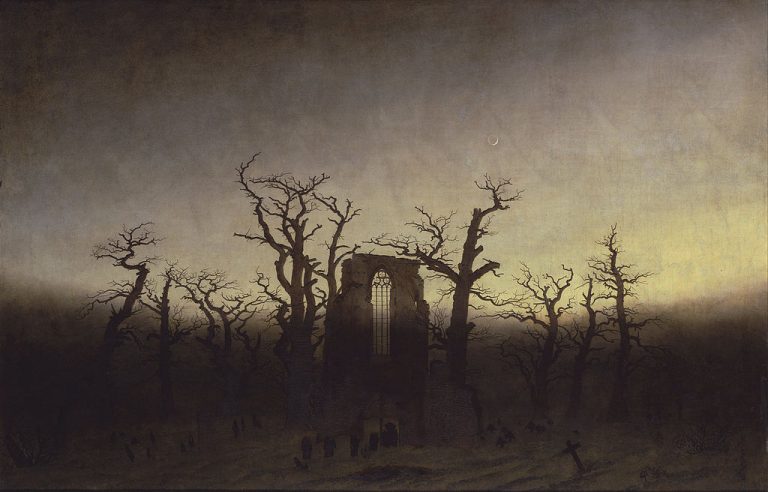
He dreams long on the ruins; those of castles, abbeys, even those of rocky massifs, which he deliberately confuses with certain monuments of heroic ages. With Novalis, he shares a nostalgia for ancient times when, in the image of Nature, humanity showed itself united by stronger bonds6. No doubt the construction of the novel served him as a model: constant confrontation between past and present, interweaving of the strata of ancient times and immemorial epochs, between those of action and memory, even of real and imaginary. Does not the engine of the novel lodge precisely in this inaugural dream of Heinrich who, in his adolescent sleep, glimpsed a marvelous blue flower that he will then pursue tirelessly in his waking life? Let us note in passing that the narrative of André Breton's encounter with Nadja also takes place under the sign of a dream: "I have always dreamed of meeting, at night in a wood, a beautiful and naked woman..."
Confusion between waking and sleep, dream and conscious life, in Novalis it serves to mislead the reader, and to make Heinrich doubt his identity. Is he only himself, in his current age, or would it rather be his avatar of ancient times who through him continues to exist a second life? From then on his journey becomes a journey in reverse, crossing the stages of various reincarnations, each marking a step in his quest for himself. In Goethe it is quite the opposite: Wilhelm Meister does not have to know himself, it is enough for him to become, through his works within a collectivity. In the image of Haydn's Seasons, whose argument summarizes the conception of German Classicism: it is the generous melody of a nature to work as much as to celebrate, in perfect harmony with a humanity united in joy to the rhythm of harvests, hunting, grape harvests and festivals. This tonality is absent from Schubert's compositions, and nothing of it subsists on C. D. Friedrich's canvases: Nature is no longer to be cultivated, but to be contemplated, in a posture of melancholy recollection. Almost always these contemplative beings are alone, and their meditation sends them back to themselves, to their destiny, to their uncertain identity. "Who am I?" The author of Nadja also asks this question, after having been, like Novalis, strongly shaken by an encounter that changed the course of his life by leaving an immense void in it.
II. Toward "the inner space of the world" (Rilke)
Nature, mirror of our person? It would then become quite vain to travel the world: "We never cease to journey in the outer world. Is the universe not within us? It is toward the interior that the mysterious path goes. It is in us, and nowhere else that we will find it," Heinrich enunciates during a dialogue.
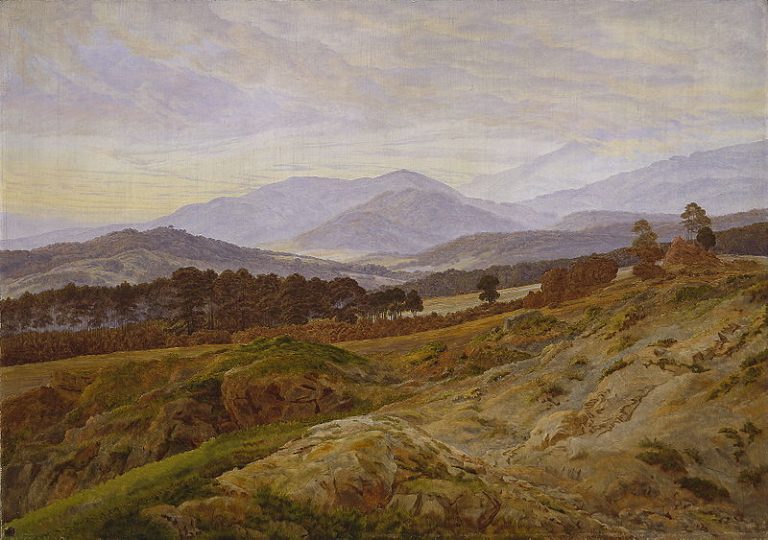
Exploration of this "interior of the world" and quest for its intimate reality will henceforth go hand in hand in Novalis. After having climbed a steep slope and "trod a stony soil covered with moss," one of his characters reaches a meadow, sees an opening that seems to him "the beginning of a labyrinth carved in the rock"; engaging in it, he ends up penetrating into a vast vaulted space. C.D. Friedrich, in his evocations of faults, crevices, abysses, becomes the interpreter of the poet's visions; in him the mountain sometimes seems to rise before our eyes, like a wave, suggesting an underground animation. And it is not rare to see in him a ghostly being venture into a rocky crevice, in search of a cave, and to draw us toward a quite strange spectacle. In Novalis this exploration proves even more fruitful, it manages to flush out a spirit of the cave, in the person of an old hermit, survivor of the crusades, witness of heroic times; having overcome the ordeal of the loss of dear beings, he now devotes himself, he explains to his visitors, to "interior contemplation."
Simple poetic fancy this exploration? It more closely resembles a Knowledge approach, it possesses the rigor of a Knowledge7. It is situated at the intersection of three territories: between that of philosophical thought, that of science and that of pure experience (the latter dividing into two aspects, experimentation by method or by transmission between generations, "Erfahrung," and personal, intimate lived experience, including also artistic creation, "Erlebnis"). Thus when during the novel, Heinrich meets mining workers, it is as an informed man that Novalis speaks: his status as a mining engineer authorizes him to join to the poet's imagination the precise information of the technician. There is certainly some emphasis in his manner of praising the miners by naming them "lords of the earth," by placing them on equal rank with poets. But in reality, the engineer here gives free rein to his visionary intuition, he acquires the conviction that there is a life of the Earth, perfectly ignored by scholars in the so-called "Age of Enlightenment." Novalis brings us this good news: far from being inert matter, our planet behaves like an organism endowed with imagination, and Nature, through its creatures, speaks to us in a language rich in symbols. It is not even the plant that does not express itself in a mute language; Novalis writes in his First Hymn to the Night8 that it is "pensive" ("sinnend," and not "denkend"). And although it is inert, the stone itself is not, according to him, devoid of existence.
Certainly, such knowledge is accessible only to rare individuals. Knowledge of the nocturnal side of life, given to solitary beings who wander in C.D. Friedrich's landscapes. It is up to us to distinguish them, to decipher them rather, for they do not always have human appearance: they can appear to us under the form of some "solitary tree" for example – and therefore hold certain secrets, notably shelter the soul of a deceased young girl, then free her from the bonds of death when a young man – of whom Heinrich seems the reincarnation – comes to weep under its branches the loss of his beloved.
III. A crossing of darkness
Death? It is only too familiar to romantics in general – it is not necessary to dwell on this point, which belongs to the domain of the sociology of art and literature. It is constantly present in Friedrich; it becomes gentle, dangerously caressing in Schubert; in Novalis, it is an object of nostalgia:
Let us descend into the heart of the Earth, let us flee the empire of light, the violent blows and the bites of sufferings are the sign of a joyful departure. In the narrow boat, we will quickly reach the shores of paradise.9
By leaving his physical envelope to rise to his "supra-sensible" state (übersinnlich), will he not rejoin Sophie, his spiritual fiancée? Like his Hymns to the Night, this canticle resonates with this call, of which the novel constitutes the reasoned development.
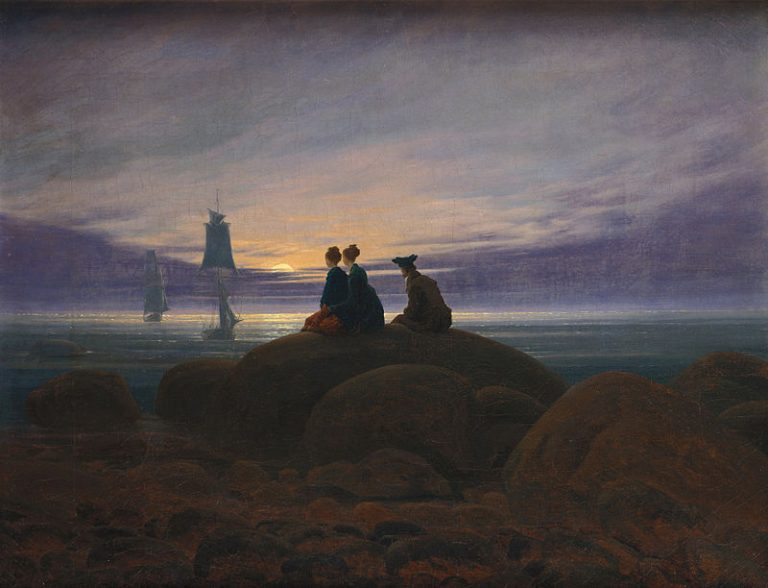
Friedrich, when he evokes death, willingly adorns it with its most lugubrious attributes: visions of freshly dug graves, cemetery portals, at whose threshold a young couple hesitates to cross, but is barely distinguished from the mourning-colored fog that envelops the scene. Representations after all still external. They do not deliver the essential: for most German romantics, death is beginning, birth; it is situated, not at the end, but at the beginning of another life, of an "interior life." Here the novel borrows the detour of symbol and myth to celebrate this unconscious life, source of a superior knowledge, placed under the protection of the lunar star; it thus gives all its force to a maternal symbolism.
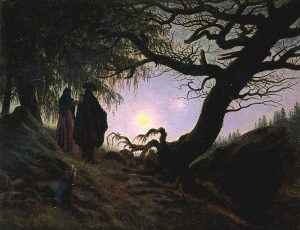
More than once in C.D. Friedrich, the moon occupies the center of the canvas, contrary to all verisimilitude: to contemplate it, humans do not have to raise their eyes, we rather see them incline their heads. Thus the moon becomes a heart, its diffuse light a fecundating energy10 and this night is propitious to us, it has, as the poet hopes, "for us perhaps some complacency"11.
Would it be this mother divinity that, in the chaos of their silly rivalries, the ancient gods once led to its destruction? Novalis supposes that her ashes were subsequently collected, mixed with a beverage then absorbed by her descendants, in order to fecundate a new generation and restore life to the entire universe. In this he takes up Jakob Boehme's theosophical thought: visible nature must die to make way for eternal, invisible Nature.
Thus the Mother – but already, in the eyes of the romantics, the youngest of fiancées – would possess the power of mediation between the natural world and the spiritual universe; it is she who gives birth to the poet. Nothing surprising then if, in Friedrich, we see her, bathed in a supernatural light at twilight – would it be the moment of her immolation? – or, in the most ordinary life, rising before disappearing at the turn of a staircase; in figuring this ascension, the painter reveals himself visionary.
It is this same light that radiates in a work intended for religious purposes and which, for this reason, has provoked the anger of institutions: a crucifixion intended to decorate the altar of a chapel is planted in the middle of the firs. Would the Son have been fecundated by the Earth? Unacceptable! Especially since the rays supposed to magnify this vision take their source, not in the heavens, but in the depths. By instinct, C. D. Friedrich has correctly interpreted the myth forged by Novalis. Indeed, under the traits of the Redeemer, of the Sacrificed, it is indeed a new prophet who stands here; the one who possesses the Knowledge issuing from darkness, the Poet, the one to whom it is finally granted to contemplate the blue flower; through his mouth speaks a divinized Nature.
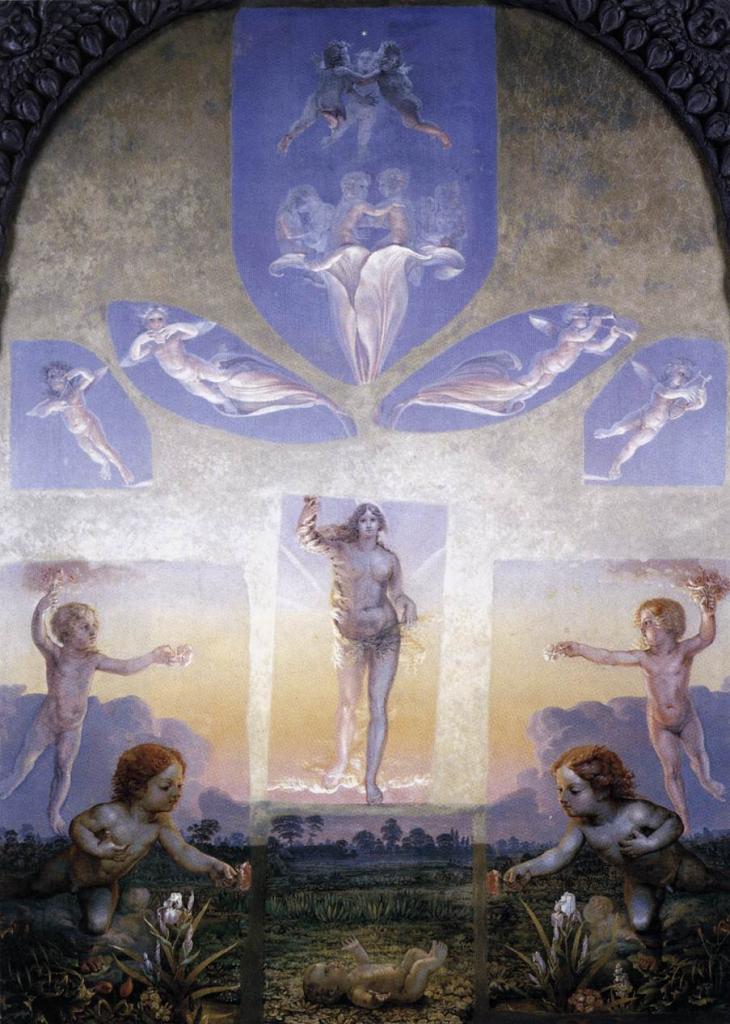
One could not better summarize this triumph of poetry than Philip Otto Runge did in 1809, in this testament that his Grand Morning figures. Divided into panels, the canvas announces from the outset a will of simultaneous representation; in its dynamic, it unites two worlds, earth and sky, two states of humanity, childhood and destiny12. The newborn is son of Nature, he is the chosen one toward whom his brothers incline corollas. At the heart of the painting: the woman, mother, mediator; higher, the flower, almost transparent in the supernatural light, while the loves celebrate by their song the restored cosmic harmony. The encounter between the arts, conforming to Novalis's aesthetic thought, completes the expression of a desire for eternal beatitude.
Romantic utopia, surrealist utopia: fertility of a dream The utopia of a reconciled humanity, regenerated by the magic of poetry – that is to say of the advent of the individual in his singular and liberating voice for each –, this utopia has not been realized. Novalis will have known neither the immense fortune of his thought nor the savagery of the wars that have swept over Europe, always in the name of freedom; nor either the climate of White Terror that followed, while underground was being prepared the industrial boom and with it, a new enslavement.
Would History have had the last word, by reducing the romantic dream to nothing? This would be to forget the underground path of this dream: from Carl Gustav Carus's philosophy of the Unconscious leading to Carl Gustav Jung's thought and clinical practice (the heritage being transmitted through the first names themselves) to Surrealism (everything contributes to bringing André Breton much closer to Jung, even if he never mentions him, than to Freud). Through all these minds, Novalis's Magical Idealism remains alive, and with it the marvel of the Encounter, capable of changing the course of a destiny, of restoring the meaning of existence.
To Novalis's blue flower responds Breton's Nadja; she too is the mediator introducing to the Other World; perhaps the Revolution has Nadja's face.
On the horizon: faith in the power of the dream, in no way reducible to a fantasy, but language of an authentically creative Unconscious13. It will not be betraying Max Ernst to declare: "The Night, the Revolution."
Paris, November 2017