CHARLES RATTON, THE INVENTION OF 'PRIMITIVE' ARTS
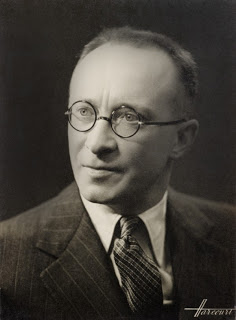
Charles Ratton Archives. Guy Ladrière, Paris
© musée du quai Branly, photo Claude Germain.
Having been unable to recognize, behind often poorly lit display cases with illegible labels, those masks, statues, objects, and fetishes whose tangible presence the fortunate photographs of the Atelier Breton captured so well, I would hardly have imagined one day recommending a stroll at the Musée du Quai Branly to Melusine enthusiasts passionate about surrealism. Yet the exhibition dedicated to Charles Ratton allows us to rediscover, through the intermediary of the dealer-collector who was Breton's friend, some beautiful surrealist pieces. While the sections are thus constructed more or less chronologically, the biographical angle chosen for this fluid staging of the history of a "primitive" art collection judiciously contextualizes the relationships between the avant-gardes and the quasi-autodidact that Ratton was. Let us note that, although the latter's office, carefully reconstructed in one of the first display cases, gives pride of place to ithyphallic statues or those celebrating an exacerbated femininity – it suffices to compare it to 42 rue Fontaine for this workplace to reveal all its rigorous sobriety. For in the registers of a collection established above all for sale, the analogical spark of bringing objects into contact is, of course, not appropriate. Among many other display cases and sections most pleasing to the eye – including the one dedicated to a screening of the splendid Les statues meurent aussi by Marker and Resnais, in which the dealer participated in 1953 – it is good to remember that it was in Charles Ratton's gallery, at 14 rue de Marignan, that the surrealist exhibition of objects took place in May 1936, accompanied by Breton"s famous text on the "Crisis of the Object."
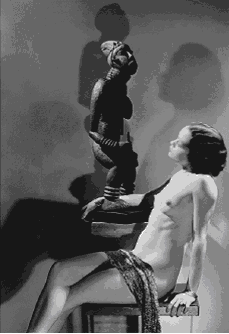
And it was doubtless the same year – that is, ten years after his Noire et blanche – that Man Ray had a nude model pose before a Bangwa queen statue from the Ratton collection. Of these untitled shots, the one chosen for the exhibition poster is a play of shadows and gazes: beneath the haughty and somber statue with fixed eyes standing proudly, the ivory nudity of the model with raised breasts is now merely a foil – a rather foolish pedestal/base. Yet, in the background of gray shadows, in a silent dialogue far from the power games of postures and poses, the two feminine profiles seem quite simply to face each other, as equals. Could we not then see in this image a utopian staging of the links between collection and creation? And if the omnipresent poster in Paris this summer had not yet quite managed to seduce you, know that you can visit this exhibition until September 22.
Articles and texts (illustrated) around the exhibition:
Charles Ratton, l'invention des Arts'Primitifs on the Quai Branly website