ENIGMAS...
par Jean-Paul Morel
Sorry to discover belatedly, – in the "astu" section that you have reinvited me to consult –, the article (moreover undated) by Nelly Feuerhahn, "Pierre l'Ébouriffé: the enigma of a surrealist figure".
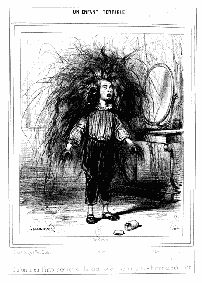
Since it's a question of enigma, a source of this Struwwelpeter seems to have been overlooked, which is nevertheless not of indifferent origin: it comes from the "poet of chlorosis' sung by Baudelaire, namely Gavarni..., author of an advertising drawing published in La Caricature, March 22, 1840, under the title "Un enfant terrible" and with the following caption: "...Whom one had the imprudence to let play with a pot of Pommade de Lion".
Our author then passes a bit too quickly over the reading that the psychoanalyst Georg Groddeck made of this so-called "children's book" and which he considers as a "fourth manual of psychoanalysis'. The text, recomposed by the German publisher from his lecture manuscripts, and datable between 1918 and 1927, takes up no less than 17 pages in the French Gallimard edition published in 1969 (pp. 201-217). Here, one and a half lines.
The translator, Roger Lewinter, then specifies (p. 311) the oddities, often resulting in mistranslations, of the French "adaptation". We can do no better than to repeat his warning:
"There exists a French adaptation of Struwwelpeter [1st French ed., Paris, Louis Hachette, 1860], but it presents numerous differences from the German original, and sometimes even inversions of drawings (cf. the Story of the Matches, Pierre l"Ébouriffé, etc.), which contradict the very meaning of the work as Groddeck brings it out. / What we propose here [p. 311-316] is therefore not an adaptation that tries to render the doggerel verses in French, but a word-for-word translation that faithfully follows the order of the German verses and respects the singularly outdated and adult character of the text, in absolute contrast with the childish violence of the images."
A bibliographic reference, absent from Nelly Feuerhahn's review, would have spared her these omissions: Boris Eizykman, Der Struwwelpeter, Paris, Éditions Phot'œil, 1979, which includes: 1. a preface by Sigrid Metken (p. 7-15), which emphasizes the reference to Gavarni; 2. the edition reordered by Roger Lewinter of Pierre l'Ébouriffé (p. 17-46); 3. a very subtle analysis by Boris Eizykman (p. 47-96) – who debates with Groddeck –, concluding with Dr Hoffmann's preface for the 100th edition of the work in 1876 (p. 97-100). Let us recall, anecdotally, that this classic of "children's' literature reached 25 million copies sold by 1980...
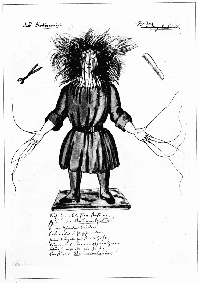
What made me revisit this text is that it may be possible to offer you, if the rights holders give their agreement, a translation of the – hitherto unpublished in French – Struwwelhitler, an anti-Nazi pamphlet by two English illustrators, Robert and Philip Spence, published in London in 1941, and an undisguised parody of our world classic.
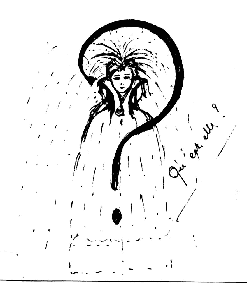
Since Nelly Feuerhahn concludes with Nadja, we believe we can solve one last enigma. Nadja... "what is she?": It is neither magic nor automatic drawing, but, if not a quasi-direct copy, the recollection of an advertisement for the Gaumont establishments, made for the launch of the film Les Vampires by Louis Feuillade in November 1915 (poster signed Harford), and in praise of Musidora, hailed the same year, as we know, with Le Trésor des jésuites...