ENIGMAS... AND RESPONSE FROM NELLY FEUERHAHN
par Jean-Paul Morel
Sorry to discover belatedly, – in the "astu" section that you have reinvited me to consult –, the article (moreover undated) by Nelly Feuerhahn, "Pierre l'Ébouriffé: The Enigma of a Surrealist Figure".
The article is the French translation in 2003 of her original German version dated 2002. It was a friendly tribute to Walter Sauer, president of the association of friends of the Heinrich Hoffmann museum, of which I have been a member since the 1980s (Was, Walter! Sixty!?. Festschrift für Walter Sauer anlässlich seines 60. Geburtstags am 14. April 2002. Herausgegeben von Ulrich Wiedmann, Pfinztal. Frankfurt am main, 2002).
Since it's a question of enigma, a source of this Struwwelpeter seems to have been neglected, which is nevertheless not of indifferent origin: it comes from the "poet of chloroses' sung by Baudelaire, namely Gavarni..., author of an advertising drawing published in La Caricature, March 22, 1840, under the title "Un enfant terrible" and with the following legend: "...who had the imprudence to let play with a pot of Lion Pomade".
In my book Le Comique et l'enfance. Paris, Puf, 1993 you will find this illustrated document on page 73 and the history of this cultural transfer (pages 63-77).
Our author then passes a bit quickly over the reading that the psychoanalyst Georg Groddeck made of this so-called "children's book" and which he considers as a "fourth manual of psychoanalysis'. The text, recomposed by the German publisher from the manuscripts of his conferences, and datable between 1918 and 1927, makes, in the French Gallimard edition published in 1969, no less than 17 pages (pp. 201-217). Here, a line and a half.
It was not a psychoanalytic article, but rather to show the richness of links other than youth literature. What no one had pointed out before my publications, the first on this subject dating back to 1989!
The translator, Roger Lewinter, then specifies (p. 311) the oddities, often resulting in misunderstandings, of the French "adaptation". We cannot do better than to take up his warning:
"There exists a French adaptation of Struwwelpeter [1st French ed., Paris, Louis Hachette, 1860], but it presents numerous differences from the German original, and sometimes even inversions of drawings (cf. l'Histoire des allumettes, Pierre l" Ébouriffé, etc.), which contradict the very meaning of the work as Groddeck brings it out. / What we propose here [p. 311-316], is therefore not an adaptation that tries to render in French the mirliton verses, but a word-for-word translation that faithfully follows the order of German verses and respects the singularly outdated and adult character of the text, in absolute contrast with the childish violence of images."
A bibliographic reference, absent from Nelly Feuerhahn's review, would have spared her these omissions: Boris Eizykman, Der Struwwelpeter, Paris, Éditions Phot'œil, 1979, which includes: 1. a preface by Sigrid Metken (p. 7-15), which emphasizes the reference to Gavarni; 2. the edition put back in order by Roger Lewinter of Pierre l'Ébouriffé (p. 17-46); 3. a very subtle analysis by Boris Eizykman (p. 47-96) – who debates with Groddeck –, to conclude with Dr. Hoffmann's preface for the 100th edition of the work in 1876 (p. 97-100).
There, too, I must refer JP Morel to my publications, particularly the reference at the end of my text on Astu ("De Pierre l"ébouriffé à Crasse-Tignasse. La réception française du Struwwelpeter (Heinrich Hoffmann, 1845). Contribution à une histoire des échanges culturels comiques en Europe", Autour de Crasse-tignasse, Proceedings of the Brussels colloquium augmented and illustrated, Brussels, Théâtre du Tilleul, 1996, p. 24-40)
More recently, I wrote the article "Struwwelpeter" for the Dictionary of the Germanic World under the direction of Elisabeth Décultot, Michel Espagne, and Jacques le Rider (Paris, Bayard, 2007, page 1089-90)
Finally, I have been invited to various conferences: "Comment le Struwwelpeter ébouriffa les Français'. Introductory conference to the exhibition of Nadine and Walter Sauer's collection (La Petite Pierre, April 30, 2009).
Then to a masterful conference at the University of Frankfurt for the celebration of the bicentenary of Heinrich Hoffmann's birth: "Die unmögliche Rezeption der Komik des Struwwelpeters in Frankreich l'impossible réception du comique du Struwwelpeter en France" (May 13, 2009)
Let us recall, anecdotally, that this classic of "children's' literature reached 25 million copies sold in 1980...
The rejection or even silence of the French was at the origin of my curiosity. While everywhere in the world from the 19th century it is translated (Scandinavian countries, Russia, China, Japan). There currently exist translations in almost all languages.
What made me revisit this text is that it will perhaps be possible to offer you, if the rights holders give their agreement, a translation of the – unpublished in French to this day – Struwwelhitler, anti-Nazi pamphlet by two English illustrators, Robert and Philip Spence, published in London in 1941, and undisguised parody of our world classic.
Struwwelhitler. A Nazi Story Book by Dr. Schrecklichkeit. Robert & Philip Spence, London, 1941). Published in The Daily Sketch for the benefit of English troops and victims of German bombings across the Channel during the Second World War.
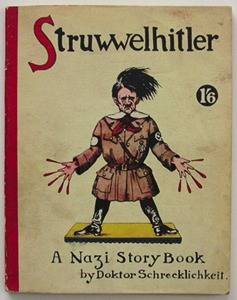
The work now exists in paperback. And the Internet brings much information on this motif. For example: http://traube.blog.lemonde.fr/2010/04/01/from-struwwelpeter-to-struwwelhitler-the-work-of-robert-and-philipp-spence-in-the-daily-sketch-and-sunday-graphic-england-1941/
On this point, there would be much more to say because other political parodies appeared as early as 1848 and later with the war of 1914 for example. The tradition is still very much alive of these pastiches (advertising or political) and these parodies of this album for children in Germany as in the United States – where the tradition was exported by emigrants thus with the Watergate affair...
Since Nelly Feuerhahn concludes with Nadja, we believe we can resolve a final enigma. Nadja... "what is she?": It is neither magic nor automatic drawing, but, if not the quasi-direct copy, the remembrance of an advertisement for the Gaumont establishments, made for the launch of the film Les Vampires by Louis Feuillade in November 1915 (poster signed Harford), and to the glory of Musidora, hailed the same year, as we know, with the Treasure of the Jesuits...
I doubtless do not have Jean-Paul Morel's competence concerning surrealism (but are we not all a bit these "Fachidioten [specialized idiots]" according to the enlightening expression of students of the critical university of Berlin in the 1960s?). Nevertheless, the allusion to the drawing seen during the exhibition evoked in my text does not refer this questioning. We are far from the lunar magic of Struwwelpeter with the latest advertising illustrations that you evoke...
The grandmother that I have become can only smile at Jean-Paul Morel's impatience to rediscover this extraordinary little character that so fascinated me. Good luck! Don't forget that much has been done on these questions and that sometimes by pushing open doors, one can with a little luck find real new information....