PIERRE THE DISHEVELED: THE ENIGMA OF A SURREALIST FIGURE
par Nelly Feuerhahn
The Dictionnaire abrégé du surréalisme, the catalogue that André Breton created for the International Surrealist Exhibition in January 1938 at the Galerie des Beaux-arts in Paris, surprises academic expectation not only by its form but even more by the strangeness of its definitions. From the outset with "Absurd' as the first occurrence, the tone is set; the citations proposed by the different collaborators borrow from various authors or invent in the most unpredictable manner. The small work is composed of two parts of which the first mentions Paul Eluard's collaboration, while the second entitled "Supplement" is attributed to Breton alone. The word "Alphabet" which begins this supplement brings a first light on the subversive usage affected to this eminently arbitrary form: "The magical alphabet, the mysterious hieroglyph reach us only incomplete and falsified, either by time, or by those very ones who have an interest in our ignorance; let us find the lost letter or the effaced sign, let us recompose the dissonant scale, and we will take force in the world of spirits (Nerval)".
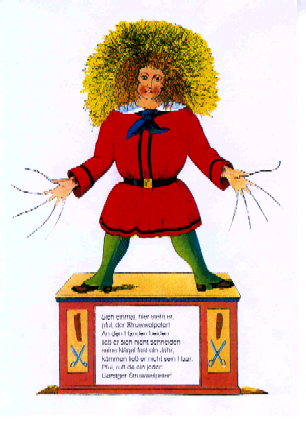
If the "Supplement" particularly interests us, it is to encounter there the image of Pierre the Disheveled, a small character borrowed from a children's album, Der Struwwelpeter published in 1845 by Heinrich Hoffmann (1809-1894) and very popular in Germany. A motif which in the Dictionnaire abrégé du surréalisme has every reason to surprise both those familiar with surrealism and those with children's productions. How does the eponymous figure of this album find itself in this catalogue? How to understand this particular interest of André Breton for an image unknown to most surrealists until today? What is Struwwelpeter doing in this document intended for avant-garde art enthusiasts in the late thirties? How to situate the motif in a collection where definitions are deliberately incongruous citations extracted from surrealist texts? So many questions to which common sense and reason do not spontaneously respond. Yet, at the crossroads of the powerful attractions exercised on André Breton by childhood, primitive arts, and German culture, I would like to point out some clues likely to illuminate this unusual presence.
ANDRÉ BRETON AND GERMAN CULTURE
In 1938, the military-political conjuncture is not favorable to cultural exchanges, so the representation of Germany is a place of violent contradictions. Among young people born before the First World War, some are sensitive to the great currents of thought which, from German romanticism, with its returns to the supposed sources of popular mentality, to the rigor of philosophical thought, are given as exemplary. In 1918, there were many opponents to the national triumphalism of those who in France opportunistically attributed to themselves the victory of the most murderous first war in our history.
The pacifist currents of the interwar period can only be understood from this visceral refusal of warlike barbarism by the generation that went through it and survived it. Far from manifesting a Germanophobic sentiment, this pacifist opposition of surrealists in the late thirties testified to an active critical will toward a political situation whose future proved the destructive madness, a critique which moreover wanted to surpass the nihilism of the Dada movement that appeared as early as 1916.
Educated at a time when the reform of education in France was inspired by the efficiency attributed to that of the other side of the Rhine[1], André Breton (1896-1966) learned German as the first foreign language and stayed in the Black Forest during the summer of 1910 to perfect his knowledge. From this period, the young high school student will retain an attachment to Germanic literature and thought which his readings and future references will testify to. Moreover, the Dictionary presents in epigraph a citation borrowed from the German linguist Georg von der Gabelentz (1840-1893): "Language does not only serve man to express something, but also to express himself". This citation precisely incites to read the man André Breton beyond words. A man whose major interests for mental illness, childhood, and humor bring him close to Heinrich Hoffmann, the creator of this enigmatic Pierre the Disheveled.
HEINRICH HOFFMANN AND ANDRÉ BRETON, SURREALIST CONVERGENCES
Heinrich Hoffmann, an alienist from the early 19th century – and therefore a pioneer in the interest for these diseases newly understood as mental – was also a renowned humorist in a wide circle of friends[2]. Specialized in child care – there too a discipline in full invention in the first part of the 19th century –, Hoffmann imagines Struwwelpeter and thus creates the first comic album intended for little ones from three to six years old in its modern form. This small illustrated book includes ten stories that all draw inspiration from a misadventure born of daily life but whose resolution involves nonsense. The title is eponymous of one of the childish characters characterized by immense nails and ample hair, hence his name of Pierre the Disheveled. Breaking with the expectation of warning, the dramatization of the brief narratives is defused by their unpredictable, excessive, amoral conclusion. Thus, in "The story of Robert who flies in the air", the young boy braves the dangers of the storm to play with an umbrella. A violent gust carries him away and he flies into the sky, a little Icarus inventor against his will of an uncontrollable machine.
No one knows where this adventure will lead him and even less where his hat flies away, thus concludes on an enigma an adventure halfway between reality and imagination. Another example fits into a lineage that anticipates black humor: Gaspard doesn't want to eat his soup, he grows thin until he's nothing but a thread and dies. A logical ending, without comment, except for the graphic presence on the tomb of the soup tureen become symbol of a battle lost by Gaspard. The rhymed text is not a flat moralizing narrative of events, its descriptive naivety translates the spontaneity of children curious about everything, the conclusions offer no model of reparation, each story accomplishes its logic to the absurd.
*
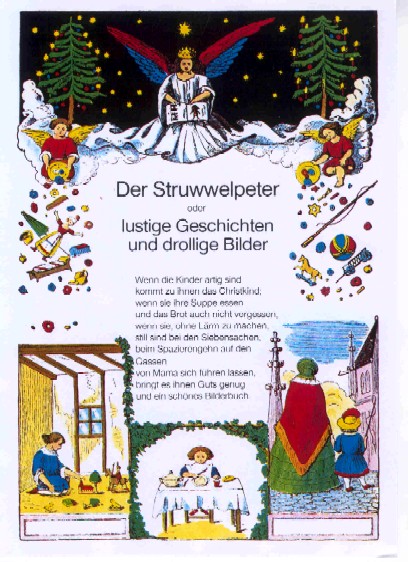
This invention fits into a period where popular imagination arouses the most vivid interest with the collection of tales in Germany, a movement linked to romantic effervescence. From the first frontispiece of the album, among various representations of traditional little toys, figures an angel holding an open picture book toward the reader. This angel motif is likely taken from the motif of the Kinder und Hausmärchen[3] drawn by Ludwig Emil Grimm in 1819, but with an ironic intention in Hoffmann. Indeed, there is every reason to think that the author of Struwwelpeter draws inspiration from the caricatural style adopted in 1823 by George Cruikshank (1792-1878), who was the first to illustrate with great success the Grimm tales in a comic mode in their English translation[4]. However, Hoffmann's purpose goes further who denounces the realism of books circulating at the time, "these repertoires of the world of objects' on the initial model of the Orbis sensualium pictus (Nuremberg, 1658) by the Czech humanist Comenius. A thousand leagues from these too wise images, he claims for his illustrated books a function never expressed: "The book is there precisely to arouse unreasonable, horrible, exaggerated representations... [...] For the child, everything is marvelous... [...] he who has known how to save a part of his child"s soul from the misty dawn of his first years into his adult life, that one is a happy man![5]"
André Breton, a medical student, was first mobilized in February 1915 as a military nurse at the Nantes hospital then at the neuro-psychiatric center of Saint-Dizier directed by a former assistant of Charcot. From this period, André Breton appears less as a humorist than as a curious enthusiast of this expressive manner. It is at the Nantes hospital that he meets Jacques Vaché in convalescence. The latter then affirmed "I object to being killed in wartime[6]" and manifested a cold and detached humor, terribly new, a humor that represented a capital moment in the course of André Breton's life. Moreover, from 1924 onwards, André Breton's capital interest in childhood is affirmed:
The mind that plunges into surrealism relives with exaltation the best part of his childhood. It's a bit for him the certainty of one who, being in the process of drowning, reviews, in less than a minute, all the insurmountable of his life. [...] From childhood memories and a few others emerges a feeling of unseized and subsequently of deviated, which I hold to be the most fecund that exists. It is perhaps childhood that approaches closest to "true life"; childhood beyond which man has at his disposal, in addition to his pass, only a few favor tickets; childhood where everything nevertheless conspired to the effective, and without hazards, possession of oneself. Thanks to surrealism, it seems that these chances return. (Breton, Manifeste du Surréalisme, 1924)[7].
THE SURPRISING IMAGES OF THE DICTIONNAIRE ABRÉGÉ DU SURRÉALISME
The surrealist image is first a poetic image that overwhelms the one to whom it offers itself. Light born from the fortuitous rapprochement of two terms, the image finds its beauty from the spark produced. From then on, the illustrative function of images which seems primary in documents with textual dominance, does not exercise itself on this mode with the Dictionnaire abrégé du surréalisme. Some images certainly illustrate definitions which are most often unusual or incongruous, others on the contrary bring a counterpoint to the text, others still are more or less enigmatic references to various themes of surrealist inspiration. The images thus constitute an interweaving of motifs linked by mental associations; most are graphic citations borrowed from the internal culture of the surrealist group. Thus, many images are taken from Minotaure[8], the flagship review of surrealism where the unusual and unexpected in art were particularly sought. Different photographs represent Bellmer"s dolls (Jointures de boules, 1936), The appetizing sole belonging to Eluard"s collection of the most beautiful postcards (December 1933). The "Forestière[9]" alphabet that punctuates the first part of the Dictionary illustrates in Minotaure "Les mystères de la forêt", a text by Max Ernst where perhaps already passes the shadow of Pauline, another small character from Hoffmann's album[10]: "...what are forests for? To make matches that are given to children as toys." Through the pages of Minotaure, one also encounters the image of Alice under the features that Tenniel[11] had lent her at Lewis Carroll's request. One finds this great figure of nonsensical originality in a good place in the Anthologie de l'Humour noir and at different times in André Breton who evokes in particular Alice and her rabbit in L'Amour fou ↑. In the supplement of the Dictionary, it is the definition of the word "Smile" that is borrowed from it: "If he smiles a little more, the extremities of his mouth will join behind... and then what will become of his head? I'm afraid it will fall' (Lewis Carroll). For André Breton, Lewis Carroll represents the "first truant schoolmaster" of "all those who keep the sense of revolt[12]".
How then to characterize the image of Pierre the Disheveled in this strange universe? Sometimes images seem simply illustrative as in the case of this mysterious "Amphitrite" coupled with its definition. Nevertheless, this impression is deceptive, because the figuration commands very personal evocations that relate to André Breton's love life. Indeed, this sea goddess celebrates less ancient culture than the "fatal' encounter that André Breton made on May 29, 1934, with Jacqueline Lamba. She who would become the Ondine of L'Amour fou was then participating in a swimming number at the music hall; for her, Breton wrote the same year L"air de l"eau. A possible reading consists in seeing a search for maximal contrast between our hairy hero and the very hairless "Cynthia (Life: Eisenstaedt-Pix)", the photo associated with him in parallel. It is the photograph of a nude and bald female model made by the great German photographer Eisenstaedt (1898-1995)[13]. This model obviously recalls one of the great attractions of the 1938 exhibition where an entire room had been populated with dressed-decorated mannequins with everyday objects, each by a different artist. This intentionally provocative exhibition moreover presented incongruous assemblages like Salvador Dali's Taxi pluvieux, the reconstitution of the atmosphere of the collage novel Une semaine de bonté ↑ by Max Ernst, whose originals were also present. A revolutionary exhibition whose staging aimed to emotionally and intellectually subjugate the visitor (Schneede, 1998).
The motif of Pierre the Disheveled is placed near the words: "Eidetic, Awaken, Expectative, Unknown", a conceptual field that orients on the links maintained by images in consciousness. The definition proposed by Breton for eidetic gives: "'Term created by E. R. Jaensch (of Marburg) to designate a disposition to visualize recent memories, in such a way that they project outward, in the manner of a consecutive image. (Ed. Claparède)'". It is possible to imagine that such an image experienced as subjective, and yet perceived as real, evokes in many respects certain memories associated with Breton's first encounter with the small character. The text placed under the Struwwelpeter image comments on the image by assuming a disgust attributed to spectators:
Look at him, there he is
Ugh! Pierre the Disheveled!
For almost a year
He has not let his nails be cut
He has not let his hair be combed
Ugh! Everyone says:
How ugly this Pierre the Disheveled is![14]
This undesirable evokes another claiming to be such. The "Breton" entry of the Dictionary presents a self-portrait of André Breton, a 1938 photomontage, entitled L'écriture automatique followed by the comment: "Author's judgment on himself... his greatest desire would have been to belong to the family of great undesirables." It could well be that Pierre the Disheveled curiously resonated with the same desire among his first readers, since it was at their request that this story passed to the head of the album and gave its name to the title.
In the chronology of Breton's life and work established by Marguerite Bonnet[15], she mentions that it is from the communal school of Pantin that he will keep "his taste for school notebooks with illustrated covers and the memory of prize distributions, that of adventure books written for children, with their striking illustrations, like that of scary stories that Mr. Tourtoulou told to his students." There is every reason to believe that the most popular little picture book of funny images in Germany once slipped among the young student's more elevated readings and that from this unusual encounter remained a memory with pleasant echoes. An attraction still confirmed with André Breton's evocation of Pierre-le-Hérissé in "L"échelle de l"évasion", one of the prose texts parallel to the painted motifs of Joan Miro's Constellations (1940-1941)[16].
THE DISHEVELING IMAGINATION OF CHILDHOOD
Struwwelpeter is the first album where one reads the spectacle of childish imagination and its seductive unreason. Hoffmann insists on the visual hold on the child's consciousness, he simultaneously affirms that the latter is an emotional being, fascinated by the unpredictable effects of his actions. The long history of the non-reception of this album in France is explained in part by the incomprehension of this address to children's imagination. A form of cultural exception confronted with the massive diffusion of the album in German-speaking countries and more broadly in the world due to its numerous translations or adaptations. Interest in Struwwelpeter is attested in Freud, who sees in it an illustration of the mode of symptom formation in his Introduction to Psychoanalysis (1916-17). In the years 1916-18, the psychoanalyst Georg Groddeck also took an interest in the small character and devoted an essay to him published later in La Maladie, l'art et le symbole. In France, intended for children, past the years around 1860, where the work appears in echo to its enormous success in Germany, the work will no longer be published in its original form. In 1929, the publisher Fischbacher whose Alsatian origins explain the interest, reissues the small work already published by his father in 1872, a limited initiative. It was then necessary to wait until 1979 to find a new translation by Cavanna under the title of Crasse-Tignasse, which installs its inspiration in the movement of Hara-Kiri and its stupid and mean humor. Nothing in common with the reception reserved for Struwwelpeter by Anglo-Saxon countries, since the translation by Mark Twain at the end of the 19th century. The most recent manifestations that no longer limit themselves to the childish public, count the astonishing Edward Scissorhands ↑, a film by Tim Burton or again the show Shockheaded Peter given at the Opéra Comique (Autumn Festival, 2000) by a British troupe exaggerating to horror the latent black humor of the stories. A modernity from which troubling images emerge.
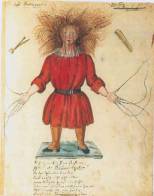
The enigma of the figuration of Pierre the Disheveled in surrealist culture certainly remains open to other meanings. In fact, the image has never been really identified by French surrealists who ignored and still ignore its comic and childish origins. Curiously, one must wait for the publication of a thesis devoted to the surrealist bestiary in 1994 for his name to be cited (Maillard-Chary, 1994). Struwwelpeter, this "homunculus with wolf's head' there illustrates animal magnetism in connection with the universe by the irradiating virtue of its phaneres. This characterization of the character joins – and confirms by this aesthetic recuperation – the magical values mentioned by Beate Zekorn in her catalogue for the exhibition "Haargeschichten. Vom Struwwelkopf zum Rastazopf ↑". More concretely, Pierre the Disheveled is very close to the wild child, whose existence and scientific stakes Hoffmann could not ignore at the very beginning of the 19th century. Dr. Itard's care had then made of the discovery of little Victor, left abandoned in a forest of Aveyron, a sensational clinical case.
*
With his small drawn notebook, Heinrich Hoffmann had found his best and first inspiration to compose himself the Christmas gift for his young son in December 1844; at eighty years' distance, the last chapter of L'Amour fou, entitled "Chère Ecusette de Noireuil[17]" testifies to the poetic power that a child inspires in her father, André Breton. Radical critique engaged by Hoffmann against the flat realism of children's books, for those who know it, the image of Pierre the Disheveled renews this trouble forever installed from childhood by its drollery and its unusualness. For those who discover it with the surrealists' fresh gaze, it offers other readings and other emotions. Naive visitor of the recent exhibitions[18] devoted to surrealism, an encounter stopped me, troubling by its coincidence with the questions that inhabited me: The portrait of André Breton, hair irradiating his face, drawn by Nadja. An image undeniably charged with magnetism.
CENTRE D'ETHNOLOGIE FRANÇAISE
MUSÉE NATIONAL DES ARTS ET TRADITIONS POPULAIRES, PARIS
Bibliographic References
BRETON André, ELUARD Paul, Dictionnaire abrégé du Surréalisme ↑, Paris, reissue José Corti, 1995.
BRETON André, Œuvres complètes, Paris, Gallimard, tome I ↑ et tome II ↑.
FEUERHAHN Nelly, Le Comique et l'enfance, Paris, Presses Universitaires de France, 1993, (pages 63 to 77 particularly concern Struwwelpeter).
FEUERHAHN Nelly, "De Pierre l"ébouriffé à Crasse-Tignasse. La réception française du Struwwelpeter (H. Hoffmann, 1845). Contribution à une histoire des échanges culturels comiques en Europe", Autour de Crasse-Tignasse, Bruxelles, Théâtre du Tilleul, 1996, p. 24-39, distributed by Éditions Lansman (Belgium).
GRODDECK Georg, La Maladie, l'art et le symbole. Translated from German and prefaced by Roger Lewinter. Paris, Gallimard, 1969.
MAILLARD-CHARY Claude, "Le dictionnaire abrégé du surréalisme au pied de la lettre ou l'étrange survie d"un catalogue d"exposition", Mélusine, Cahiers du centre de recherche sur le surréalisme, n°XII, "Lisible-visible", p. 105-122.
MAILLARD-CHARY Claude, Le Bestiaire des surréalistes, Paris, Presses de la Sorbonne Nouvelle, 1994.
SAUER Walter, Der Struwwelpeter auf französisch, Stuttgart, Philipp Reclam jun., 2001.
SCHNEEDE Uwe M., "Exposition Internationale du Surréalisme", L'art de l'exposition. Une documentation sur trente expositions exemplaires du XXe siècle, p. 173-187, Paris, Editions du Regard, 1998 (translated from German).
ZEKORN Beate, Haargeschichten. Vom Struwwelkopf zum Rastazopf, Frankfurt am Main, Heinrich-Hoffmann-Museum, 1996.
1 — . Cf. Claude Digeon, La Crise allemande de la pensée française (1870-1914), Paris, PUF, 1959. ↩
2 — . See the texts of Heinrich Hoffmann edited by Insel Verlag (1985, 1987, 1990), see also Roland Hoede und Thomas Bauer, Heinrich Hoffmann. Ein Leben zwischen Wahn und Witz, Frankfurt am Main, Waldemar Kramer, 1994. ↩
3 — . The first edition of the tales in 1812 included no illustrations. ↩
4 — . Illustrations "full of humor, really funny and [which] always maintain an ironic distance with the tales (Sie sind humorvoll, ja schwankhaft und bewahren stets ironischen Abstand zum Märchen)" Cf. Heinz Wegehaupt, Hundert Illustrationen aus zwei Jahrhunderten zu Märchen der Brüder Grimm, Verlag Dausien, Hanau (without date), p. 18. ↩
5 — . "Das Buch soll ja märchenhafte, grausige, übertriebene Vorstellungen hervorrufen. [...] Dem Kinde ist ja Alles noch wunderbar [...] Der Verstand wird sich sein Recht schon verschaffen, und der Mensch ist glücklich, der sich einen Theil des Kindersinnes aus seinen ersten Dämmerungsjahren in das Leben hinüber zu retten verstand' Postface written by the author on the occasion of the jubilee edition ↑. ↩
6 — . An affirmation not contradicted by his suicide on January 6, 1919 (Jacques Vaché [1895-1919], Lettres de guerre, Paris, K, 1949). ↩
7 — . The relatively late translation of André Breton's Manifestes into German is due to Ruth Henry: André Breton, Die Manifeste des Surrealismus. Hamburg, Rowohlt, 1968, reissue 1977. ↩
8 — . Review published between February 1933 and May 1939 by Albert Skira ↩
10 — . Pauline plays with matches and dies burned causing the despair of the cats who had admonished her to obey the wise recommendations of parents. ↩
11 — . John Tenniel (1820-1914) English caricaturist who made the illustrations of Alice's Adventures in Wonderland in 1866. ↩
12 — . Cf. Œuvres complètes, notes p. 1723. ↩
13 — . Emigrated to the United States in 1935, Alfred Eisenstaedt would become a photographer for Harper's Bazaar, Vogue, and Life. Nicknamed the father of photojournalism, he covered the Ethiopian war for Life in 1936. Pix is the name of his agent. ↩
14 — . I propose this word-for-word translation, which does not render the rhyming game of the German text: ↩
„Sieh einmal, hier steht er,
Pfui! Der Struwwelpeter!
An den Händen beiden
Ließ er sich nicht schneiden
Seine Nägel fast ein Jahr;
Kämmen ließ er nicht sein Haar.
Pfui ! ruft da ein Jeder :
Garst"ger Struwwelpeter!"
15 — . Cf. André Breton, Œuvres complètes, Paris, Gallimard, 1988, tome I, p. XXX. ↩
16 — . Although only published in 1959, Constellations finds its inspiration in the context of the Second World War: "Begun in Normandy, these 23 small gouaches dated from January 21, 1940 to September 12, 1941 crossed France in the artist's luggage in 1940 to be completed in Majorca, at a moment when Miro needed this outlet to exorcise the anxiety of a world on fire and blood. In 1945, when Breton discovers them in New York, he says he is fascinated by this 'emblematic fabric' (Cf. Miro. Le peintre aux étoiles, Juan Punyet Miro et Gloria Lolivier, Paris, Découvertes Gallimard, 1993, p. 65)". ↩
17 — A charming spoonerism for squirrel and hazelnut, terms with poetic and amorous value already present in Poisson soluble ↑. This text is a letter addressed to his daughter, then aged eight months. Aube Breton was born on December 20, 1935, her mother, Jacqueline Lamba, is the inspirer of L'Amour fou. ↩
18 — A drawing dated approximately 1926 and presented at the recent exhibition "La révolution surréaliste" reconstituted by Werner Spiess at the Centre Georges Pompidou in 2002, then in "Trajectoires du rêve" at the Pavillon des Arts in 2003. ↩