CLARIFICATIONS
The Nantes-based journal 303 – arts, recherches, créations, in its October 2025 issue devoted to “Claude Cahun and Marcel Moore,” strives to endorse the chimerical thesis of a joint and fused artistic production that would justify, beyond the eclipse of Suzanne Malherbe’s name (the aforementioned “Marcel Moore”), the erasure of Claude Cahun as subject and author of her work—all in favor of a systematic aggregation of the two names, a dual signature (1). This claim, born of ignorance, preconceived ideas, or deliberate confusion, has ultimately seduced a certain academic and institutional audience, to the point of becoming a new norm.
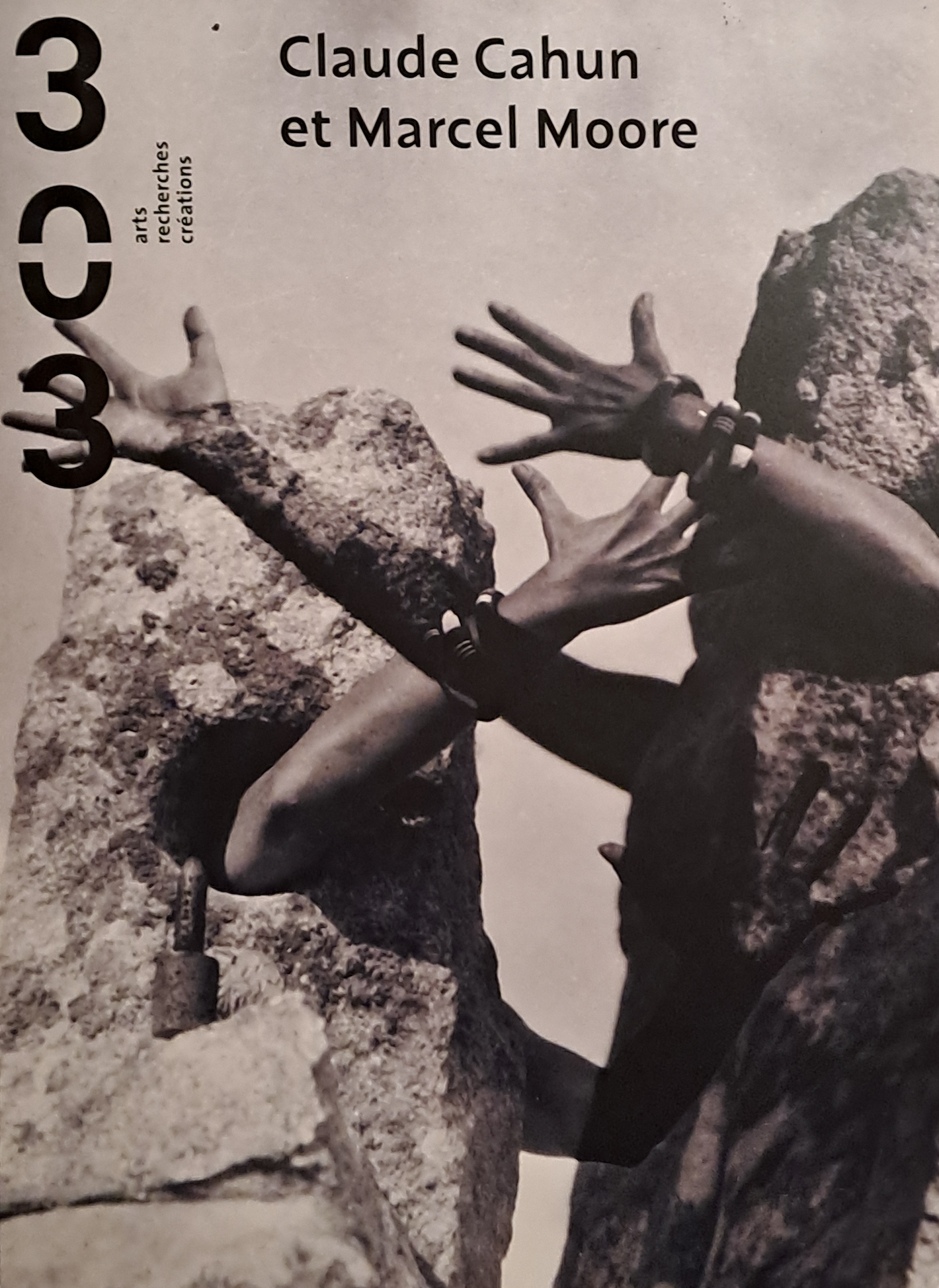
Before outlining the reasons that make this stance utterly untenable and irresponsible, we will note two inaccuracies, passing over the lesser ones (2).
From the foreword (p. 4), a double photographic portrait is supposed to bring together “Marcel Moore and Claude Cahun.” Clearly, it is not Suzanne Malherbe (the aforementioned “Marcel Moore”), but rather her mother, Marie Eugénie Malherbe, née Rondet, wife of Maurice Schwob (father of Lucie Schwob, alias Claude Cahun).
On page 36, we learn—and the news is as outlandish as it is aberrant—that Suzanne Malherbe, daughter of Dr. Albert Malherbe and Marie Rondet, was… “Jewish”! (It is repeated on page 40).
* * *
We recall that the name “Marcel Moore” had only an occasional and ephemeral existence—we know of five or six instances (3). It was soon supplanted by “Moore.” Both were used by Suzanne Malherbe exclusively to sign her graphic and plastic works between 1913 and 1930. From then on, she stopped drawing and attributing any personal production to herself. We remind that she died in 1972. For over forty years, “Moore” was, so to speak, out of circulation.To conflate the epicene name of Claude Cahun, adopted in 1917 by Lucie Schwob (from the Cahun branch via her paternal grandmother) as her “true name,” with that of Moore (or Marcel Moore), which in fact had only a limited existence in time and usage, is to force a symmetry that never existed. Suzanne Malherbe was never called anything other than her birth name in social and relational life. All the public or private statements we know of her, the documents in her hand, the collective tracts, the crossed correspondence, are always in the name of Suzanne Malherbe. It is naturally under this name that she is loved by Claude Cahun, and known in all the circles—friendly, literary, political—that she frequented, and by her persecutors during the war.
* * *
Two questions regularly resurface regarding Claude Cahun’s photographic production—and this special issue of 303 provides yet another illustration—despite the extensive scholarship that has long addressed them. They concern the status of the author, of the work, and consequently, the role of her companion, Suzanne Malherbe.I.
Claude Cahun always took care, when necessary, to formally claim her achievements, and these are well documented.
The publication, under her name, of a full-page self-portrait—“Frontière humaine”—in the journal Bifur (no. 5, April 1930), and a group photograph in the London Bulletin (no. 6, October 1938).
The exhibition of her self-portraits, drawings, and photomontages around her book Aveux non avenus in the window of the José Corti bookstore (1930).
The presence in the Charles Ratton catalogue for the “Surrealist Exhibition of Objects” (1936) of two objects, listed as: “Claude Cahun – Un air de famille, Souris Valseuses.”
The edition of Lise Deharme’s book Le Cœur de Pic (José Corti, 1937), bearing the mention: “illustrated with twenty photographs by Claude Cahun.”
The formal testimony of David Gascoyne attributing to her the full-page (anonymous) photograph on the cover of the Bulletin international du surréalisme (no. 4, September 1936, London): “Apparition of the Ghost of Sex-Appeal” (portrait of Sheila Legge).
Claude Cahun’s handwritten signature, sometimes accompanied by a caption and date, on the back of about fifty prints (self-portraits, portraits, object stagings).
References to her photographic work, notably in letters she sent to André Breton, Léo Malet, Charles-Henri Barbier, Jean Schuster, to which prints were attached, most of them signed.
Statements from close associates: Lucien Grimaud, Vítězslav Nezval, Néoclès Coutouzis, Gaston Ferdière, Jacqueline Lamba, Pierre Caminade, David Gascoyne, Henri Pastoureau, Léo Malet.
The continuation of photomontage work during the Resistance period. According to Suzanne Malherbe’s own testimony—and the way she phrases it is singularly eloquent: “I was forgetting something we did mainly in ’41 and ’42, and in considerable quantities. I was forgetting it probably because it gave me no trouble, since it was Claude who did it. They were photomontages made with images from German illustrated magazines (…)” (4).
Forced to spare the “object stagings,” published and signed by Claude Cahun—though the symbiotic fantasy knows no bounds!—the controversy has focused on the photographic self-portraits…
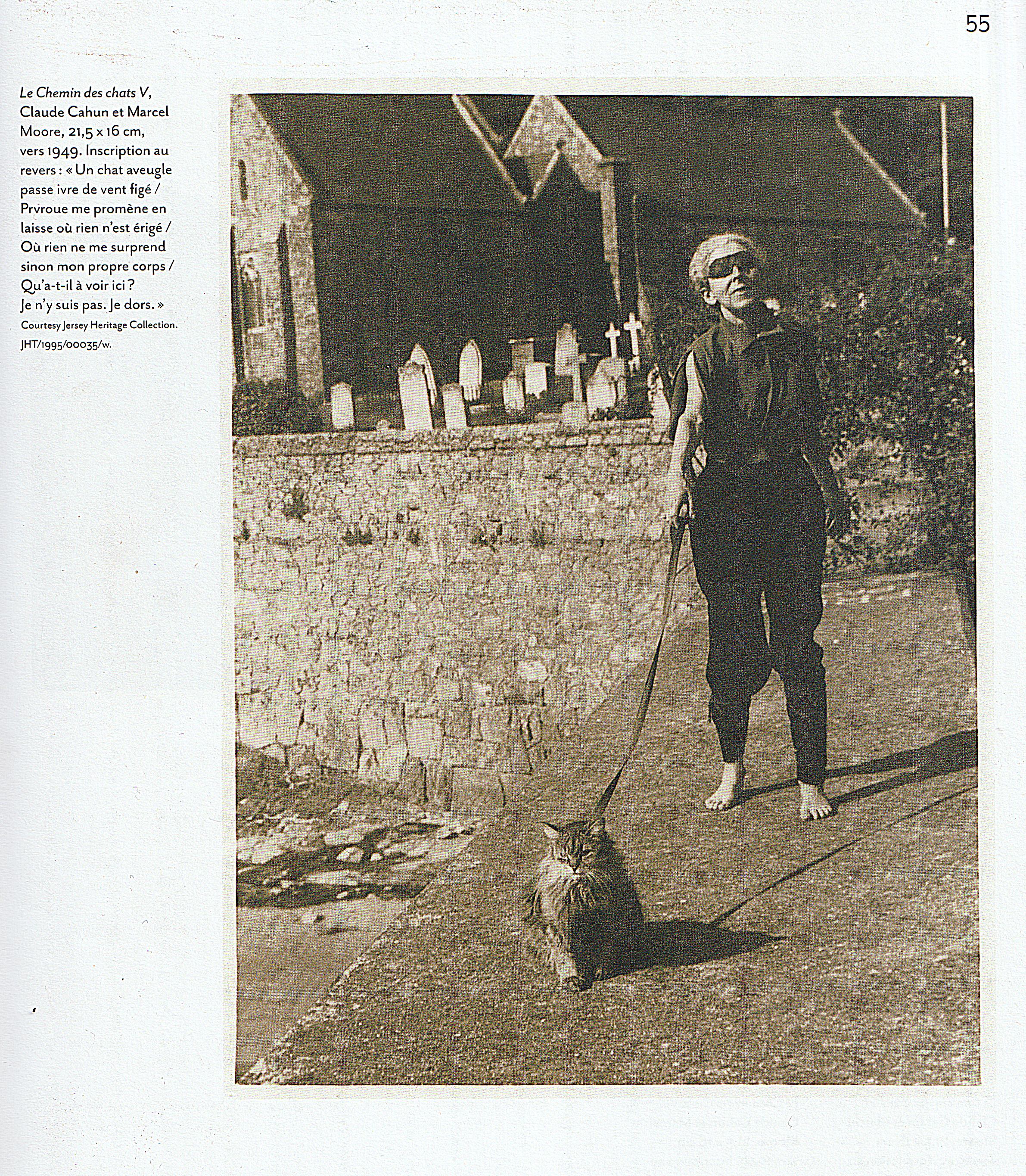
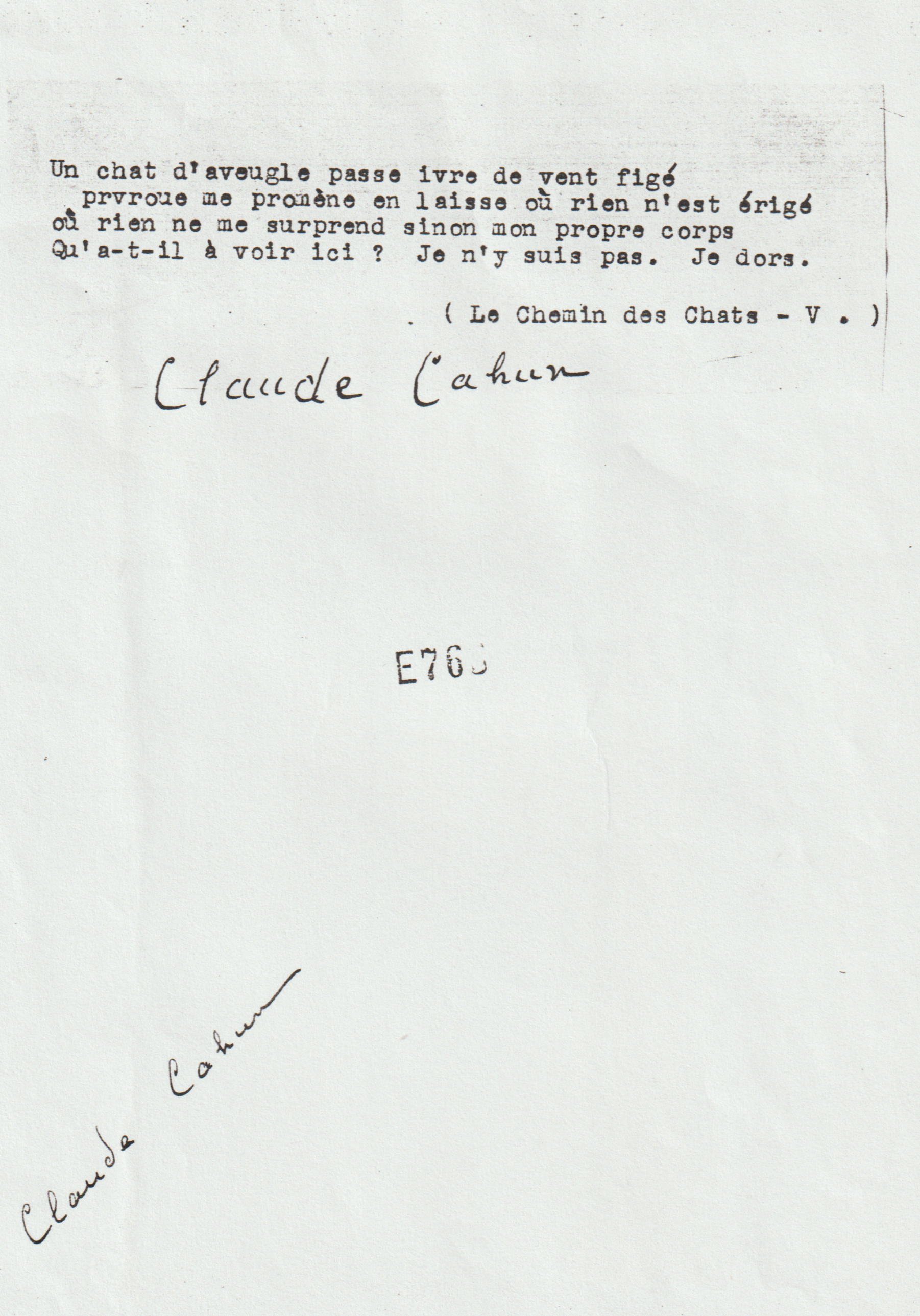
Claude Cahun does not appear to have used a timer or flexible shutter release, and for the self-portraits, a third party had to operate. This was, essentially, Suzanne Malherbe. There is no point wondering if her shadow, when she had the sun at her back, accidentally appears on the print… Their collaboration fit into the “natural course” of their affective and intellectual life. We know there was another operator, a skilled photographer, Lucien Grimaud, who took many shots, including self-portraits under glass globes. He was unequivocal on this point: not only was Claude Cahun the initiator of the sessions, but she controlled the execution from start to finish. There may have been other occasional operators, in a theatrical context. Claude Cahun would later intervene on these stage shots to incorporate them into photomontages (5).
No one ignores that the photographic self-portrait is not a matter of equipment or assistance, but of approach. And there is no reason it should differ in this regard depending on whether those present were lesbians, heterosexuals, neutrals, or whatever. All photographers who have resorted to assistants for their self-portraits will agree that the author is not the one behind the camera but the one who chose to stand in front to invent and produce an image of themselves (6).
Not only has no photograph been found under both names—it is astounding, and unacceptable, to literally append “Claude Cahun and Marcel Moore” when this dual signature appears nowhere (7)! And none is signed “Suzanne Malherbe,” “Marcel Moore,” or “Moore.” A single exception: a photomontage, the first plate in Claude Cahun’s book Aveux non avenus, signed “Moore,” which would moreover be its final appearance. As clearly stated on the title page, the book is “illustrated with heliogravures composed by Moore from the author’s designs” (8). Indeed, several preparatory gouache drawings in Claude Cahun’s hand are known. They indicate the choice and layout of the images—the vast majority of which come from autobiographical documents and have a highly elective character. In Suzanne’s signing of this first plate, it is not hard to see Claude Cahun’s attention to distinguishing her companion’s contribution to the “composition” of these images, especially this frontispiece. But here again, the respective contributions were announced (9).
II.
Whatever the degree of complicity with the operator, everything attests to Claude Cahun’s intention, determination, and continuity of her own inspiration. For instance, among many others, the 1928 profile self-portrait where she exactly replicates her father’s pose (1917). Or when she speaks, in a letter to Jean Schuster (1953), of two “self-portraits with cat” as “the realization of one of her dreams.” The reference images, with their evident powerful impact, bear witness to an imaginary, poetic, and speculative universe where literary and familial references, gender transmutation and self-staging, the relation to mask and mirror, cross-dressing and play of doubles, symbolic object scenography, metamorphosis of the real, are omnipresent. These are both elective concepts and inner images, obsessive metaphors, found everywhere in her autobiographical writings, essays, correspondence, deployed in a formal language of great coherence, unmistakable among all. These are precisely the conditions for judging and deciding the specificity of a creative adventure and the continuity of a body of work. Did Suzanne Malherbe share them, and to what extent? She encouraged them, evidently, but she was far from being possessed by them to the same degree. She remains at a distance, even if she appreciated it, from the surrealist plastic imaginary, and nothing in Moore’s graphic expression—marked by cloisonnism, Art Nouveau, and Art Deco—leads spontaneously to the surrealizing photomontages of Aveux non avenus.
Finally, the few photographs taken by Suzanne Malherbe in her immediate surroundings, especially after Claude Cahun’s death, in no way match the spirit animating her companion’s poetics. As far as one can judge, they show no particular ambition, no formal or distinctly artistic research. I was pleased that James Stevenson independently confirmed my own conclusions absolutely (10).
It is in no way to diminish Suzanne Malherbe’s role—and no one could dispute it from her—that to strive to understand and situate it based on what we know, and we know much. Suzanne, an exceptional personality and eminently talented draughtswoman, was an incomparable collaborator because she was an incomparable interlocutor, and the love of a lifetime. She supported Claude Cahun’s approach, bringing her suggestions and expertise, even as she gradually, then definitively, turned away from her own work. Rare confidences from one or the other shed light on the intimate meaning of this disaffection. Not only does Suzanne express perfect indifference to professional aspirations, but though aware of her real graphic talents, she associates them with a certain lack of personal passion. She confided to Charles-Henri Barbier, speaking of one of her daughters’ artistic inclination: “That’s how it should be—one of the four had to paint. What I find astonishing is having a vocation. Sometimes I think my only natural tendency is to look and listen—and that I have never acted except pushed from outside” (11). Indeed, most of Suzanne’s works under the name “Moore” were commissions, or at least solicitations, from family or friendly circles. Claude Cahun’s affectionate and insistent encouragement was surely decisive. She would tell Charles-Henri Barbier, who had offered his journal (Coopérations): “[…] seeing well that Suzanne could only desire to paint to please us—you, me—and not at all for herself. You will approve, I am sure, that I no longer insisted at all from then on (12).” To these intimate reasons must probably be added a perfect clarity of mind. Well informed about the achievements of the art of her time, the high technical skill of Art Deco draughtsmen and the boldness of the avant-gardes, even as she placed her works in the realm of decorative aesthetics and illustration, did she judge what she saw as her limits? “It’s a shame,” Claude Cahun would point out, “that Suzanne no longer draws, never gave her full measure… Did I leave her the leisure for it?” (13)
While Claude Cahun spoke of Suzanne Malherbe’s love, support, and assistance, she knew that the creative approach, like any existential commitment, can only be a personal matter: “Individualism? Narcissism? Certainly. It is my best tendency, the only intentional fidelity I am capable of,” she insists in Aveux non avenus. Claude Cahun gives much, takes much, she shares little. “I cannot conceive of going out of oneself.” “Moreover driven by a selfish interest. – An interest nonetheless, please believe it, of what is best in me” (14).
We are far from the edifying novel revolving around the illusory duo, the “work, or performance, à deux,” the “two-in-one,” the “four-handed photography” (sic), when Claude Cahun had already provided all the themes (just read Aveux non avenus). Certainly, the “we” is justified, but only if its meaning and relevance are specified (15). We have given some elements on Suzanne Malherbe’s role. If there are others, we still await the projective intentions, anachronistic and revisionist stances, and institutional fabrications to yield to evidence. What exactly does one mean, concretely, by claiming a “shared work”? Who does what, who premeditates what? Does one think to get away with saying it is indistinguishable, a jumble? What Claude Cahun and Suzanne Malherbe did “together” is in no way assimilable.
Have we entered, here too, the era of post-truth to which the epigones of “deconstruction” have contributed many ideological expedients, even as Claude Cahun placed above all what she called the demand for “truthfulness”?
* * *
One final remark. The question of “invisibilization” recurs often in this issue, most often applied to Suzanne Malherbe—it is true that it would take much bad faith today to conclude that Claude Cahun is “invisibilized” (still underrecognized, certainly!). But before considering this or that one a victim of this unfortunate invisibilization, one forgets something very simple: their own will not to “appear,” not to occupy at all costs this supposedly enviable position that they despised. There is even in Claude Cahun a strategy of the “invisible adventure,” of the “unknown heroine,” in her own terms. They are not to be pitied! However, if one wished to highlight Suzanne Malherbe’s specific work, signed “Marcel Moore” or rather “Moore,” it required a substantial, richly illustrated dossier, or an impetus for a retrospective exhibition, as we had planned with Patrice Allain in Nantes (16).François Leperlier
[1] After having published the opposite in previous issues. See 303, no. 43, 1995 and no. 113, 2010, to which I contributed.
[2] The following observations do not directly concern the texts by Patrice Allain, Damarice Amao, Marion Chaigne and Claire Lebossé, or Junko Nagano.
[3] See François Leperlier, “La réception de Claude Cahun et la querelle des interprétations,” in Claude Cahun l’unique en son genre, Jean-Michel Place éd., 2025; Claude Cahun. L’exotisme intérieur, Fayard, 2006, pp. 439–445. “Claude Cahun. Un sujet intempestif,” Europe, no. 1056, 2017.
[4] This work would incidentally continue after the war, as Suzanne Malherbe again testifies: “[…] Lucette (Claude Cahun) planned to make this corrected page on an old issue of D.M., in photo and typomontage, and in such a way that at first glance it would be indistinguishable from a real newspaper issue the kind of work she did during the Occupation on German illustrated magazines.” Suzanne Malherbe to Charles-Henri Barbier, November 1, 1951.
[5] I refer to the remarkable work by James Stevenson (Photographic Manager at the Victoria and Albert Museum), who examined the photographic holdings at the Jersey museum: “Claude Cahun: an analysis of her photographic technique,” Don’t Kiss Me: The Art of Claude Cahun and Marcel Moore, Tate Publishing, 2006, pp. 46–55. – “Whether her artistic intentions were derived from a performance or theatrically based form of creation does not really matter, as the resulting pictures are some of the best examples of the self-portrait in the history of photography,” in James Stevenson, op. cit., p. 55.
[6] James Stevenson can conclude: “Regardless of who then pressed the shutter, we can conclude that Cahun was the artist and the works can rightly be considered to be self-portraits” (55), op. cit., p. 55.
[7] One even tries to impose this impossible semantic contortion, in so many words: “(Self)portrait of Claude Cahun (by) Claude Cahun and Marcel Moore”!
[8] Éditions du Carrefour, May 1930.
[9] The same held for Claude Cahun’s writings illustrated by Suzanne Malherbe, under the name “Marcel Moore”: Vues et visions (1919), or under “Moore,” the fashion chronicles (1913–1914). I recall the publication of all of Suzanne Malherbe’s graphic contributions, signed Moore, to Claude Cahun’s fashion chronicles. See Il y a mode et mode, presented by E. Gianoncelli and F. Leperlier, Jean-Michel Place éd., 2022.
[10] “The most interesting characteristic of these negatives, which we can assume were made by Moore after Cahun’s death, is that they have absolutely no artistic merit whatsoever. Indeed, they show poor landscapes and photographs of the house at Beaumont. This suggests that Moore was lacking in photographic artistic skill, which in turn would imply that the artistic photographs were totally the inspired work of Cahun,” op. cit.
[11] Suzanne Malherbe to Charles-Henri Barbier, December 22, 1958.
[12] Claude Cahun to Charles-Henri Barbier, June 17, 1952.
[13] Claude Cahun to Charles-Henri Barbier, October 25, 1951.
[14] Letter to Adrienne Monnier, July 2, 1926.
[15] Thus, when Claude Cahun evokes, in a letter to Charles-Henri Barbier, a photographer “asking us questions about our ‘innovations’ (!) technical (!), regarding our amateur attempts dating back over a quarter century…,” it is clear she is not targeting the “content” or poetic approach, but the concrete qualities of elaboration, the relatively complex processes to which she and Suzanne had arrived…
[16] This issue rightly pays homage to Patrice Allain, while striving—unclearly—to bring him back to the symbiosis thesis labeled “Claude Cahun = Marcel Moore,” a thesis I did not know him to hold (he rejected it), after thirty years of close companionship and joint work. Unless a sudden conversion I was not informed of.