LA BELLE CHEVAL
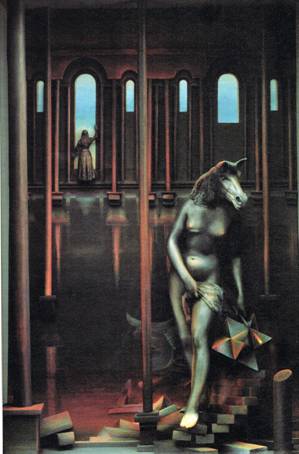
Daughter of a wealthy English industrialist and a whimsical Irishwoman, born in Lancashire the year Picasso painted a winged mare for the curtain of Parade ↑, Leonora Carrington (1917-2011) rebelled against her conservative education from early childhood: she sought the company of animals, especially horses, became an accomplished rider and practiced mirror writing. Her artistic and literary talents manifested very early, under the sign of Celtic myths transmitted by her mother, grandmother, and Irish nanny, including that of Epona, the horse goddess. Expelled from several schools for indiscipline, then presented against her will to George V's court, Carrington aspired only to paint. In 1936, she finally obtained permission to be sent to Amédée Ozenfant's art academy in London. There, she had the revelation of surrealism and admired Two Children Threatened by a Nightingale ↑ by Max Ernst, whom she later met at a London soirée. It was mutual love at first sight, mad love, osmosis. Max was 45, Leonora 19. Both artists, of the Aries sign, they communicated through their imagination and through animal totemism, the horse for her, the Loplop bird for him. Carrington joined Ernst in Paris in 1937, escaping her family's vigilance. Fleeing the scenes of Ernst's wife and the internal conflicts of the surrealist group, the couple soon settled in Saint-Martin d'Ardèche, where they restored an old bastide and sculpted mythical animals 4, which Lee Miller photographed in 1939. Leonora drew and wrote tales, Max illustrated them. The representation and self-representation of horses and birds then marked their pictorial production and they painted together the fantastic tableau Meeting (c.1940). Artist friends visited them, notably Leonor Fini, André Pieyre de Mandiargues, Roland Penrose and Lee Miller. Although she did not like to evoke this period brutally interrupted by the war, Carrington later confessed to Marina Warner that "it was a paradisiacal moment 5". As Susan Rubin-Suleiman said, "their love story would make a wonderful film 6" and Julotte Roche, a resident of Saint-Martin, immortalized the three years of creative happiness of the bird and the mare through her poetic and imaginative book, Max et Leonora 7. According to Chadwick: During their life together, Leonora Carrington and Max Ernst were led to deepen the relationships they had with nature. [...] Leonora's paintings from this period are populated with magical animals at the center of which the image of the white horse is almost always found.8
This description evokes two canvases from 1938, exhibited in 1991 at the Serpentine Gallery in London, The Horses of Lord Candlestick and The Meal of Lord Candelstick 9. The first shows horses "in the wild state," frolicking in nature and the parodic scene of the second takes place in a "civilized' interior, where a white woman/mare presides over an orgiastic and barbaric meal, a subject found in the tale "The Sisters' ↑10. In two texts from this period, the novella The Oval Lady11 ↑ and the play Penelope (ibid. p. 114-182), Carrington's adolescent protagonist, Lucretia-Penelope, is in love with and loved by Tartar, her rocking horse, at once toy, domestic animal, and fabulous creature. Threatened by her father, the young girl transforms into Pegasus and flies away with her unusual lover. As Gloria Orenstein explains: The name Tartar, derived from Tartarus, the underworld of Greek mythology, is also related to a Celtic deity, white and equine, Epona. Tartar also constitutes an anagram of the word ART and implies that through ART, one can access divine and occult knowledge 12.
In the manner of her favorite animal, the young Leonora Carrington led a very eventful life until she settled in Mexico in 1942 and her passage from her Celtic origins to Mayan culture enriched her creative bestiary. Meanwhile, from her first works, she sought, in her pictorial and literary universe, to abolish any difference between human and animal, even in love. She also declared to Germaine Rouvre: In passionate love it's the beloved, the other who gives the key [...] It can be a man, or a horse or another woman we don't know [...] personally I like men but I have no preference for the others [...], I mean the beloved that's what's important in this 13.
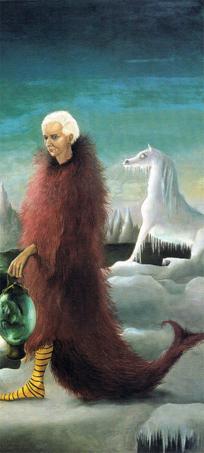
Man, bird and sometimes horse, Max Ernst was the first to give a key to Carrington. The painter with the already white mane embodied the white horse that helped the young woman flee her snobbish and suffocating British family, and the white rabbit that introduced this Alice to the Parisian surrealists. Ernst had already created a totem and legend for himself with Loplop, the Superior Bird, reborn after "the death of Max Ernst in 1914 14". Carrington represents and brings together their two totems in three portraits, at the time of their liaison and artistic collaboration in Saint-Martin: first in Woman and Bird (French title, c.1937), humorous self-portrait, a small black and white bird observes the head and neck of a beautiful chestnut mare with a shaggy mane and Leonora's features, framed by an open window. The other two, better known, constitute twin portraits:
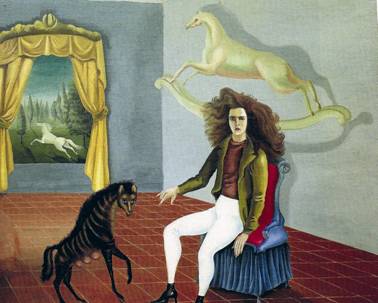
This last self-portrait already lays the groundwork for the code of magical symbols and alchemical colors that Carrington would develop in her future work. In the foreground, a young girl (Carrington), whose brown hair evokes a mane, is seated on a red and blue chair; she wears white riding breeches, a brown blouse like the floor tiles and like the earth, a green jacket, black ankle boots with heels and extends her hand to a female hyena, also black, who trots toward her (doubtless the same one as in the fantastic tale "the Debutante 15", where she replaces a young woman at a ball, after devouring the maid and donning her face) and both look toward the spectator. To the right, behind Carrington, a white rocking horse (Tartar) in levitation, its head directed toward the window surrounded by golden yellow curtains, creates the link between the motionless woman in white jodhpurs and a real horse, also white, seen through the window galloping away in a green landscape, at the edge of a forest. The window wall is blue, the color of the imaginary and the other side of the mirror, like the protagonist's chair and the sky outside. Time and space become those of surreality: the wooden horse, alter ego of the young girl, transforms there into a living animal when it escapes from the constraining reality represented by the interior where she finds herself. The green color of nature visible through the window echoes the tone of Leonora's jacket, this transitional color of alchemy is also that of the Ireland of the artist's ancestors and the renewal of the plant world. The gold of the curtains indicates the cycle of seasons and fertility, as well as the celestial light of knowledge, to which the alchemists' quest was supposed to lead. The three main colors of alchemy, which are also those of the Moon goddess, manifest here: black, white and red. Abraham the Jew shows three riders riding three lions, a black one representing gold in maceration, a red one for internal fermentation and a white one for the defeat of death 16. The New Moon embodies the White Goddess of birth and growth, the Full Moon the Red Goddess of love and war, and the Old Moon the Black Goddess of death 17. The two animals of Carrington's self-portrait, the white horse and the black hyena, represent the duality of the goddess, good and evil, life and death. The painting suggests the initiatory journey of a young woman about to leave the world of childhood and creates a visual synchronization of the past (the rocking horse), the present (the rebellious young girl and accomplice of the negative hyena) and the future (the horse galloping toward new adventures). Now, initiation is above all the discovery of love and the rocking horse also represents the beloved object, in this case Ernst, with whom Leonora had fled to France, like Lucretia-Penelope with Tartar. Painted at the beginning of their relationship, this self-portrait, like Woman and Bird, celebrates their love. Moreover, the figure of the rocking horse embodies the osmosis between the two artists, which Leonora did not know at the time. Much later, in 1984, Jimmy Ernst, son of Max and his first wife Louise Straus-Ernst, reveals in his autobiography the origin of his father's totem bird's name, as the latter had told it to him from his hospital bed in 1975, a little less than a year before dying, as a good joke; with respect to Carrington, it is in retrospect an astonishing example of objective chance: ...Everyone always wants to know who or what Loplop is [...] Well! When you were still much too small to sit without assistance on someone's lap, an idiot offered you a wooden rocking horse instead of buying one of my paintings. It was horribly boring to hold you on it while repeating: "Gallopp... gallopp... gallopp." You adored your Loplop. I hated it. [...] When I invented this emblematic creature as presenter of smaller works, Paul Eluard pointed out to me that it needed a name and I remembered your damned Loplop. No matter that mine was more a bird than a horse. [...] I never said it was your Schaukelpferd [...] Yes, Loplop is none other than your rocking horse. 18
The Portrait of Max Ernst is immediately situated on the other side of the window, in the outside world, because it is the portrait of the other and a certain disenchantment emanates from it. Max is represented there as a hybrid creature, with his quite recognizable head and pinched air, a hand and foot also human. A yellow and black striped sock evokes a wasp and his strange fur garment (or is it Loplop's down?) literally ends in a hairy fish tail, while his silhouette resembles that of a seahorse and he is surrounded by a sinister and deserted arctic landscape, all in blue and white. Behind Ernst, in symmetrical position, stands a white horse, frozen and covered with stalactites, doubtless Carrington, the abandoned companion or about to be. With his only visible hand, the painter holds an oval glass lantern, a sort of alchemical egg, adorned with a fiery little horse, which gives the impression of being imprisoned there. Max walks toward the edge of the ice floe, as if he wanted to throw everything into the icy water. The evoked abandonment refers to a long novella by Carrington, The Story of Little Francis 19, a tragic-comic and transparent transposition of the 1938 episode in Saint-Martin, where Ernst abandoned Carrington for a time, to settle his affairs with his hysterical wife, Marie Berthe Aurenche. Carrington represents herself there as a little boy (Francis), in a fusional relationship with his uncle Ubriaco 20 (Ernst), and who dies, murdered by Amélie, the latter's daughter (Marie-Berthe) in his absence 21, not without having acquired, he too, a horse's head.
The fall of the Eden of Saint-Martin, precipitated by the war and Max Ernst's arrest, was cruel. Carrington succeeded in having her incarcerated lover released a first time from Largentière in 1939, but when he was sent in 1940 to the Milles camp, there was nothing to be done. Leonora abandoned the house, crossed the Spanish border with friends, fell into madness for a time and was interned for nearly a year in the psychiatric clinic of the Morales in Santander, at the instigation of "Papa Carrington" (of whom Lord Candlestick was a caricature) and the British consul of Madrid. Carrington recounts this traumatic experience in her famous narrative Down Below ↑ 22, a moving testimony and remarkable surrealist text, which has inspired a great number of critics (see, for example, the article cited in note 21, on which I will not dwell here).
Max and Leonora succeeded in escaping from their respective prisons, they both married people they were not in love with (he Peggy Guggenheim and she Renato Leduc), but who saved their lives by allowing them to reach the New World. They saw each other again, first in Lisbon, then in New York, but Carrington, strong from having won her battle against the psychiatrists, local authorities and her father's henchmen, did not want to sacrifice her new artist's independence so dearly acquired, and refused to resume life together, despite the heartbreak this implied. Jimmy Ernst describes the torture of the meetings in New York: I don't remember ever seeing such a strange mixture of desolation and euphoria as the one I deciphered on my father's face after his first meeting with Leonora in New York (op. cit. p. 279). Peggy Guggenheim explains Leonora's decision from a feminine point of view: She understood that her life with Max was over because she could no longer be his slave and that she could not live otherwise with him.23 In New York, the two artists undertook a mutual cure, not through words, but through brush and pen, producing a series of texts and canvases constituting what Sarah Wilson calls "an open, but extraordinarily intimate and intense dialogue 24". This beginning of feminist impulse allowed Carrington to acquire a certain maturity and to flourish subsequently as a woman and as an artist in Mexico, where occurred in her "that alchemy which leads to becoming what one is25".
On a sadder note, Julotte Roche recounts at the end of her book how the superb sculptures, with which Ernst and Carrington had adorned the house in Saint-Martin, suffered a fate similar to that of the love that had inspired them.
Leonora's equine character seems to have disappeared from her work after her departure for Mexico in 1942. A last canvas, Horses ↑, was executed in the same colors as the 1937 Self-Portrait. This utopian painting represents the noble beasts in freedom in a brown and reddish landscape, without any human element: the world belongs to them. The background resembles a western set and in the foreground a black and white stallion and a golden mare wrapped in a green blanket copulate merrily; further away, other horses go about their business; behind them, a blue lake with mirage-like airs recalls the unreality of this idyllic universe.
Even though she no longer privileged horses, Carrington continued to elaborate her magical universe, where her immense bestiary, composed of familiar animals and fantastic creatures, plays a central role. She never ceased creating hybrid beings, in whom the human (generally feminine) becomes inseparable from the animal, vegetable, mineral, myth and imaginary. The great sorceress that was Leonora Carrington has left us26, but her vast and varied work transcends her death and will transmit the marvelous of her surrealist and feminine universe to future generations. Let us therefore conclude, with the description of Virginia Fur, unusual creature and heroine of the tale "When they passed': It was something to see: fifty black cats and as many yellow ones and then her, and it wasn't sure that she was human. Her smell alone made one doubt, mixed as it was with spices and game, stables, and the fur of herbs [...] This one was called Virginia Fur, she had meters of hair and enormous hands with dirty nails; yet the citizens of the mountain respected her [...] It is true that the people up there were animals, plants, birds, otherwise things would not have been the same...27
Paris, March 2008, June 2011
Title of a 1982 painting by Mimi Parent, representing a woman with a horse's head.
Marianne van Hirtum, opening of an untitled poem, Les Insolites, Paris, Gallimard, 1956, p. 87.
Famous avant-garde ballet ↑, by Cocteau, Satie, Picasso and Leonid Massine.
See Whitney Chadwick, Les Femmes dans le mouvement surréaliste, Editions du Chêne, 1986, p. 74-80.
Marina Warner, introduction to Leonora Carrington, The House of Fear (La Maison de la Peur), New York, Dutton, 1988, p. 152.4. In Leonora Carrington, La Débutante/Contes et pièces, translated from English by Yves Bonnefoy, Jacqueline Chénieux & Henri Parisot, Paris, Flammarion, 1978, p. 31-37.
Susan Rubin-Suleiman, "Artists in love (and out) : Leonora Carrington and Max Ernst", Risking Who One Is, Cambridge , Ma., Harvard University Press, p. 89-121.
Julotte Roche, Max et Leonora, Cognac, Le temps qu'il fait, 1997.
Chadwick, op. cit. p. 78.
See the catalogue of the Leonora Carrington exhibition, established by Andrea Schlieker, London, Serpentine Gallery, 1991, p. 52-53.
La Débutante (48-57). See also my article on this tale, "Magie, mangeries et métamorphoses", in Parallèles/Anthologie de la nouvelle féminine de langue française, Québec, L'Instant-même, p. 93-110.
La Débutante : p. 31-37.
Gloria Orenstein, The Theater of the Marvelous, New York , New York University Press, 1975, p. 132-133, my translation.
Interview with Germaine Rouvre, Obliques n° 14-15, La Femme surréaliste, 1977, p. 91.
View 2, New York, 1942.
Eponymous book, cit. p. 21-25.
See Grillot de Givry, Witchcraft, Magic and Alchemy ↑, New York , Dover Publications, 1971, p. 362-63.
Robert Graves, The White Goddess [1949], New York , Farrar, Strauss & Giroux, 1986, p. 70.
Jimmy Ernst, L'Ecart absolu, souvenirs d'un enfant du surréalisme, translated from English by Nicole Ménant, Paris, Balland, 1986, p. 344. (Original title : A Not-so-still life — 1984).
Leonora Carrington, "Histoire du petit Francis", written in Saint-Martin d'Ardèche in 1940, in Pigeon vole : contes retrouvés, Cognac, Le Temps qu'il fait, 1986, p. 63-148. See also the preface by Jacqueline Chénieux Gendron.
Ubriaco means 'drunk' in Italian.
See also Georgiana Colvile : "Hystérie de l"Histoire et histoires d"hystérie : En-Bas de Leonora Carrington", Mélusine n° XXIV, 2004, p. 277-291 (analysis of Little Francis, p. 288-89).
Leonora Carrington, En-Bas, Paris, Eric Losfeld, Le Terrain Vague, 1973. There are several other editions, in French and English, from 1941.
Peggy Guggenheim, Out of this Century, New York , The Dial Press, 1946, p. 275, my translation.
Sarah Wilson, "Max Ernst and England", Cat. From the Max Ernst exhibition, Tate, London ↑, Munich, Prestel, p. 363-72, my translation.
Jacqueline Chénieux-Gendron, "Avant-propos", La Débutante, p. 14.
The artist died in Mexico on May 26, 2011, and rests there in the English cemetery.
Extract from the first page of this particularly imagistic text, from the period 1937-1940, established by Jacqueline Chénieux-Gendron, Pigeon vole, p. 33-46.