ANDRÉ BRETON'S HIGH PLACES, BY BRUNO GENESTE
Compte-rendu par Françoise Armengaud
Bruno Geneste, André Breton's High Places, foreword by Paul Sanda, afterword by Patrick Lepetit)
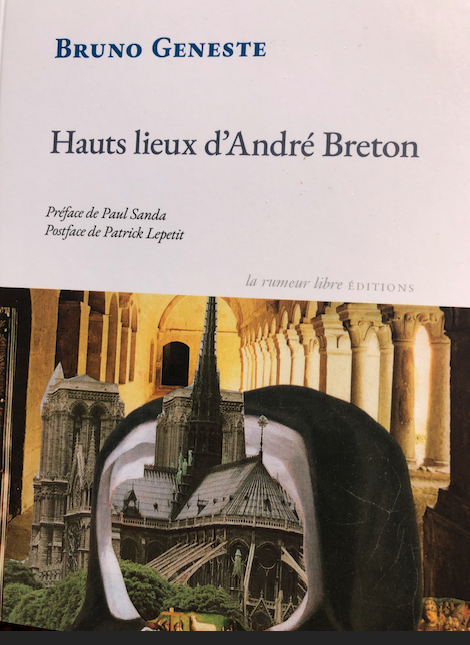
Bruno Geneste, André Breton's High Places, foreword by Paul Sanda, afterword by Patrick Lepetit, with a cover illustration collage by Rafael de Surtis, Éditions la rumeur libre, Noces collection, in co-production with Espace Pandora, 2025.
One of the originalities – and one of the charms – of this new study of André Breton's thought and work lies in the fact that it takes the form of a journey, to which we are generously invited by the poet, essayist, and novelist Bruno Geneste. It is a path of about thirty chapters – relatively brief, each usually two to three or four pages – which borrow their titles from the denomination of a high place, which is variously and always poetically qualified as well as lyrically commented on. Geneste sometimes uses a physical, spatial, or geographical qualification, sometimes a conceptual one, and sometimes he does not hesitate to use the very titles of André Breton's works. This makes the table of contents a sort of enchanting litany of Bretonian high places. But what is a high place? One understands that if to be "high" according to Geneste, a place must be marked by a historical event, collective or individual, it must above all have a spiritual significance and be capable of generating singular events. This is well summarized by Patrick Lepetit in titling his afterword with a masterful shorthand: "Genius of places," a direct allusion to the genius loci of the Latins.
Here, then, is "Paris, high place of the birth of surrealism." A little further on in the book, we encounter the "High Place of the Pont-Aven School." We are then called to remember that there is a "Nantes High Place" and that Nantes was a high place of surrealist imagination, and that in Nadja, Breton writes: "Nantes: perhaps with Paris, the only city in France where I have the impression something worthwhile can happen to me" (p. 72). There is also a "Martinique High Place," which we will mention further on. Saint-Cirq-Lapopie is of course part of the group, Saint-Cirq, where André Breton "ceased to desire himself elsewhere." As well as the Teide Peak in Tenerife, the "poetic point of Spain," a tribute to the dark volcanic lands. More thoroughly evoked is the "Blue House," the Casa Azul, in Mexico. And more suggestive appears the opening of the "New Yorkers toward elsewhere"... Such are, one might say, the geographical places marked by events or historical circumstances carrying spiritual meaning. Others are of a conceptual order: let us name the "High Place of minerality," the "High Place of Alchemical Hermeticism," or the "High Place of Beauty," as well as the "High Place of Insularity." Finally, some take their denomination from titles of literary works, of course those of André Breton: "High Place of Mad Love," "High Place of Sky and Soluble Fish." Not forgetting those that take a deliberately partisan stance: "High Place of a Surrealism of the Shore," "High Place of Celtic Wonder," "High Place of the Arthurian Quest."
To address more precisely this question of places, it will be useful to recall that surrealism was defined in 1924 by Breton as the search "for a certain point of the spirit where life and death, the real and the imaginary, the past and the future, the communicable and the incommunicable, the high and the low cease to be perceived contradictorily." Thus is the case of the "Sublime Point." A site in the Verdon gorges bears this name. And also this work by Georges Sebbag published in 1997 entitled The Sublime Point. However, while one cannot truly define the high places, one can at least try to characterize them. It is this task that Bruno Geneste tirelessly pursues. Thus, when he states: "The high places of André Breton are surges, powerful moments of analogical incandescence, elevating reality to a high level of perception discovering in the in-between the right note, the magical definition of an enigmatic outside..." (p. 89). They know how to make arise a world conducive to the resolution of opposites. It is not surprising to find many similar formulations, exceptionally rich, that mark a tirelessly repeated search in multiple variations where one can read so many approximations calling for their own surpassing. A repetitive quest, certainly, but progressive, of more accurate formulations, reiterated attempts to approach exactness. The characterization of the high place comes to merge with the surrealist project, if it is true that surrealism "proposes a total transformation of the objective world" and that its project "is to found a land of emergence, an invisible place to 'mobilize all the powers of the imagination'" (p. 113). Patrick Lepetit joins Sarane Alexandrian when he writes that Breton's poetic approach "will often consist in imagining a place so extraordinary that only marvelous events can occur there" (p. 68). For Kenneth White, the places of Breton "were strategic points where he sought the elements of a 'disorder,' where he felt 'becoming other,' and where he sketched in his mind a mental landscape" (p. 71). Height sometimes rhymes with depth. So too when Geneste writes: "It is into a beyond of the surface of things that Breton takes us, so that only the depth of places remains in us, this in-between traversed by magnetic fields, invisible magnets working toward an excess of reality" (p. 113).
Brittany, and with it the ocean, opens an abyssal field in the perspective of surrealist creativity. He explains to us how much the surrealists were able to travel these territories of the unknown, pushing their own perceptual boundaries, and thereby forcing themselves to great inventiveness to translate its unfathomable vertigo. The islands often were for Breton and the other surrealists he led into his archipelagos, sublime mirrors, largely allowing surprising poems to spring from the unconscious (p. 8). These lines should not astonish us from the author of the works co-written with Bruno Geneste: The Surrealists and Brittany, in 2015, and Ouessant, the (H)ermitage of the Great Winds, in 2014. The chapter devoted by Geneste to Arcane 17 is the occasion to mention "a narrative pierced with strange dreams, with reveries opening onto the vastness of 'great sanctuaries of seabirds,' where the poet of the confines observes 'the abrupt wall of the island, fringed step by step by a living snow foam' […] the high sea wrack 'which he likes to stroll along in search of pebbles or wood and objects sculpted by oceanic force'" (pp. 49-50).
The high place is a place conducive to alchemical practice. In his book Surrealism and Alchemy, Patrick Lepetit notes that alchemical literature is "an initiation to transmutation, just as the surrealist manifestations of poetry are an initiation to the metamorphosis of relationships between man and the universe" (quoted p. 76). Thus the high place becomes "the one where alchemy and poetry knight each other" (p. 79). Breton's work consists in spotting signals to decode their hidden meaning. For him, it is "to decrypt the great book of the world, to infuse an energy conducive to endowing it with a force opening to more reality" (p. 93). Probably the reason why the chapter "High Place of The Key of Fields and Objective Chance" is devoted to the marvel of the everyday. According to Geneste, the poet "in a process of sublimation of the real 'forever locked in its crystal labyrinth' creates a mineral imaginary where a reading of the world appears […] giving the strength of transparency toward extreme poles" (p. 92).
Now should we see a paradox in the fact noted by Kenneth White that in Breton there is "the search for an atopy, that is, apart from common topology, a more radical space" (p. 81)? Or shall we say perhaps that the high places prove to be first and foremost places of human encounters? This is evidenced by Breton's activities when in 1938 he landed in Mexico, which he considers "the surrealist place par excellence." He writes: "Mexico overwhelms us terribly, painfully, infinitely…" It is there that he discovers painters Diego Rivera, Frida Kahlo, and that he has the opportunity of fruitful contact with Leon Trotsky. In the United States, in Nevada, Arizona, he continues his quest for encounters and exchanges; in New York, the artists Yves Tanguy, Roberto Matta, Max Ernst, David Hare, André Masson, Marcel Duchamp. In Haiti, Wilfredo Lam. Breton is passionate about the anti-colonialist revolt. In Martinique, he meets Aimé Césaire, whom Geneste calls "the poet of surrealist creolity," while Aimé Césaire seems to André Breton the "worthy heir, in the Caribbean, of the great black Jacobin Toussaint Louverture." We leave the last word to Patrick Lepetit who concludes that the highest of the "High Places" of André Breton, except for the Sublime Point, remains ultimately the studio at 42 rue Fontaine, a profusion, as James Lord says, "of heteroclite objects, paintings, sculptures… which strangely compose a whole" (p. 137).
Françoise Armengaud