JACQUES BARON, THE FOUND CHILD OF LA NOUVELLE REVUE NANTAISE
Review par Luc Vigier
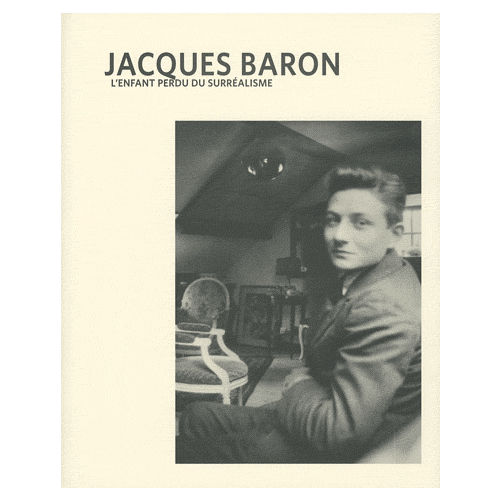
For the neophyte, Jacques Baron is part of those opaque names that appear furtively in the lists of general works on surrealism: a shadow, a memory perhaps, an allusive stela, like many others, too distant from Breton's nuclear heart (radiation and devastation) to have truly made their place in collective memory. Crushed by the tutelary figures and works of Tzara, Breton, Aragon, Soupault, Eluard and Artaud, poets and writers like Jacques Baron, quicksilver of the Twenties, nourishment and witnesses of the political and literary upheavals of surrealism, are the victims of a rather selective literary memory.
It is indeed an act of restoration, or literary exhumation, which is valuable not only for the history of the surrealist movement in Nantes, the other beacon city of the movement as we know, but for the history of surrealism tout court, and more especially no doubt for the study of the intersections of the political and the poetic, and finally for the very work of Jacques Baron, today disappeared from minds. This issue of La Nouvelle Revue Nantaise, of very beautiful making, underlines to what extent this forgetting is unjust. Drawing on both the resources of the Jacques Baron Fund of the municipal library of Nantes (manuscripts and drawings, correspondence) and on the Jacques Baron Fund of the university library of Ottawa where the major part of the documents is gathered, the authors of this issue all seem animated by genuine affection and respect for their subject, thus constituting an essential sum of references and analyses for passionate readers as well as for academics.
The volume opens with a very precise presentation of the constitution of the Funds, living sources of research, by the director of the Municipal Library of Nantes (Agnès Marcetteau-Paul) who inscribes this series of studies in the logical continuation of the exhibition "Dream of a City" on surrealist Nantes then by Lucie Desjardins, archivist of the University Library of Ottawa, the latter emphasizing that "Jacques Baron left behind him a treasure still little known to the community of researchers" (9). A glance at the list of the Nantes Fund and at the online catalogs in Canada (Catherine Ahearn Fund, who supported both the first thesis on Baron and was also his first archivist, French manuscripts Fund) suffices to understand the scope of the intellectual and biographical material in question: notebooks, manuscripts, letters, articles, drawings, watercolors, various documents have been classified and made accessible.
The "Biographical references," proposed subsequently by Patrice Allain and Gabriel Parnet, present the immediate advantage, even if one might have dreamed of having more details on Baron's long journeys, of very precisely clarifying the points of contact between this Nantes will-o'-the-wisp and the surrealist group, first with Aragon, who took him in and helped him when he was still a young sixteen-year-old high school student in revolt, then with Breton who perceived him, as he perceived at the time all those he immediately loved as a fragment fallen from the memory of Jacques Vaché, then his relationship to Jacques Doucet. One follows step by step the emancipation that was his, the failure at the baccalaureate, the nascent legend of a new Rimbaud, the link nevertheless maintained with the Nantes family, the first works marked by Apollinaire's influence (L'Allure poétique, 1924, the same year as Aragon's A Wave of Dreams and Breton's first Manifesto of Surrealism), his texts given to La Révolution surréaliste, the beginnings of a political and aesthetic engagement, whose motivations remain obscure but where one senses Aragon's influence, the friendship for Crevel and for Drieu, then the rupture, violent, with Breton, after some slaps, his passage to the enemy (Les Cahiers du Sud) and his collaboration on the anti-Breton pamphlet A Corpse, in 1930. From this rupture point of which memory has been kept, the biography, very detailed, recalls the importance of the subsequent critical work, the considerable number of articles taking up the Marxist vulgate (he was not the last to do so in the thirties) in La Critique sociale with Boris Souvarine for example, but also the prestigious collaborations (with Georges Ribemont-Dessaignes for Le Phare de Neuilly), the first novel, Charbon de mer, in 1935, André Masson's friendship, the war, his contacts after demobilization with cinema (he was assistant director), his evolution (or his involution) toward more anarchist than Marxist theses, his travels, his passions, the years of retrospection, in poem in 1952 with Je suis né, and much later in essay form in 1969 with L'An I du surréalisme. The last years are marked by particular attention paid to the history of surrealism in Nantes, which the NRN prolongs in its own way.
And this is done first concretely through a very tight investigation of Jacques Baron's Nantes places, through which Jean-Louis Liters also reaches the other Jacques (Vaché) and crosses the paths of two revolted adolescences. But it is especially Baron that Liters follows with minuteness between the lines of his notebook and his journal, detecting both a certain contempt for the Nantes bourgeoisie, the instituted Catholicism of certain neighborhoods and a complex attachment to his family. It is more as one of the roots of surrealism and therefore as one of its first births as a poet, that Nantes will interest Baron and it is to it that he will devote, in 1972, paying homage to Vaché's spirit a "Week" that was very agitated. Baron's trajectory, broken line, erratic and creative, thus seems to find a form of coherence, or confession, in this return to the Passage Pommeraye, echo of all those Parisian passages once celebrated by The Peasants of Paris, in the fantasy of the other Jacques, twin whose heritage was perhaps heavy to bear, and to whom he gives voice, facing Breton, in a "scenic arrangement" of 1972.
At this stage of reading, we are quite sensitized by the initial references, the photographs and the very useful reproductions of correspondence (a beautiful letter from Aragon, but also other missives from André Masson, Michel Leiris, René Crevel, Max Jacob... milestones of fragile friendships that give the desire for a specific edition of the correspondence) pertinently disseminated between the articles, to enter into Yves Thomas's analyses which are devoted to Jacques Baron's poetic work in the 1920s, marked by arborescent research and the charge of poetic heirs, Baron's "Virgin Forest" joining Breton's "Black Forest," just as Baron joins his elders in the thematic of wandering, the mixture of action and decor, the structural and magical synesthesias of the city-forest, the heavy eroticism imitated from Apollinaire's Eleven Thousand Rods, so many motifs that do not belong to him alone and that place him in 1924 in a situation of "imbalance" vis-à-vis the nascent movement that the author of this study later qualifies as a "double movement" of attachment-detachment with regard to surrealism. Thus Yves Thomas can write that Baron always remains "bearer of the signs of his dispersion." The transcription of the "first writings 1921-1927," unpublished youth poems preserved in the Funds we evoked above, attests to the searches of the young rebel in full dadaist period, the influence of Apollinaire's, Breton's, Soupault's, Reverdy's fulgurations and perhaps before Aragon attempts at "revolutionary poems" that would not have sounded false in the years of Red Front. What strikes in these poems and unpublished texts is precisely the search for a vibration of counted or free verse, at the limit of song, always threatened with cutting, interruption, renunciation ("I think that she will no longer think of me / And that all in all / She will not die from it. But this is the subject of another poem / that I will make later," 144), which are not without sometimes evoking rhythms that one will hear later in Aragon ("Blasphemies have bled for a long time under my nails / and those who disheveled ran in the light / pale young men because they lied / and places in the heart open for the night / to love slowly slowly to love," "Byrrh," 141; or again: "The sailors on the port plotted rigging and nets / heavy like years like thoughts like storms / or else / Like girls from dance halls," "Three Marine Poems," 150). Issue 5 of La Nouvelle Revue Nantaise also proposes prose pieces, unpublished short stories, where one finds a chopped, restrained, and sometimes cooled symbolism, at the cost of a frozen oneiric lyricism, from which sometimes scintillating crystals emerge: "heartrending cries pushed in shipwrecks by splendid scatterbrains," 156).
The works of Patrice Allain and Gabriel Parnet on "the review itinerary of a poet in the inter-war period" rightly emphasize, through exploration of the remarkably dense tissue of avant-garde reviews of the period, the influences lived during his "poetic conversion" where the image of a poet no doubt too quickly rimbaldized or associated with Vaché is slow to find his soul, in favor of a poet-image, undergoing surrealism as object, and not as subject or actor. No doubt this capture, this intellectual and affective abduction partly explain why Baron threw himself into excesses, provocations, reversals. One easily imagines how difficult it must have been to exist, simply to exist facing Tzara, Breton or Aragon, one senses that he was used as a luminous sign of the movement but the study also highlights his resistance and his rise to power thanks to reviews, notably in the political domain. Total conversion is succeeded by the state of the "defrocked" surrealist, still in contact however with former members of the group, in the extension certainly of the dialectical materialist line defended by Aragon at the end of the Twenties (collaboration with La Revue marxiste), but also plunging with both hands into the utopias of early socialisms (Fourier). The beginning of the Thirties is for Baron a strongly worldly period, marked by the meeting with Florence Gililiam who introduces him into the milieu of American writers of Montparnasse, at the moment when moreover he actively collaborates with La Critique sociale which will be the medium of his passion for New World literature (Dos Passos and Hemingway notably). This ensemble of great density ends with a tender homage, mixing through the title, "Jacquot de Nantes," and through various allusions the figure of Jacques Baron with that of Jacques Demy then with that of Jacques Vaché, as if despite the brilliance of this incarnate humanity that was Jacques Baron, one could only think of him with all his cast shadows.
This issue 5 of La Nouvelle Revue nantaise, where one will still appreciate the quality of realization, the precision of historical and biographical references, the importance of bibliographies, is thus read as a double invitation to the reading of Jacques Baron but also to the deployment of university research around a work that should perhaps henceforth be thought as such in itself, in its impulses, involutions and waves of dreams.
Jacques Baron, the Lost Child of Surrealism
Dilecta Editions
ISBN 978-2-916275-58-1
240 p., October 2009.