The visit of the Parisian Surrealists to the Canary Islands is generally considered from a single perspective: either that of the participants themselves, who recall it with emotion, as a kind of parenthesis in a primordial world, untouched by the excesses of modern civilization; or that of Surrealist historians, who mention it only in passing, as a mere stage in a broader journey; or, finally, that of the islanders, who often see it as a form of appropriation of their own avant-garde efforts—a form of neocolonial provocation, to put it bluntly. Here, I would like to attempt a different approach to the phenomenon, proposing a binocular perspective, based on available French and Spanish documentation, and by placing the encounter back into its historical context.
The pun in the title of this paper on the term "désespérides"—which should be understood as a single utterance—was already employed by Maurice Mourier in relation to the film L’Âge d’or. According to this film critic, the Surrealists gravely misunderstood the actual meanings of the scenes Buñuel presented (1). But I am also thinking of “désespéranto,” the title of a section in L’Antitête by Tristan Tzara—a neologism coined by the poet to express the agony of existence (2). In this case, it seems to me that the trip to Tenerife, undertaken under very favorable auspices in May 1935, left a bitter taste for those who took part in it—as though they had indulged too deeply in the forbidden fruit from the tree of knowledge of good and evil.
I. Internationalization of Surrealism
By definition—and particularly due to its Dadaist heritage—Surrealism was, from its inception, an international movement. However, for about a decade, its epicenter remained resolutely Parisian, and even after the Second World War it would return to being so, at least as long as Breton lived in Paris and set the tone for the group as a whole. That said, many foreign artists joined the movement, and at a very specific moment, its leaders deliberately organized a policy of internationalization aimed at countering the various nationalisms dominating Europe, particularly in the cultural sphere.
A. The Spanish Inn
Surrealism can be credited with never having sought to inquire into a member’s nationality, as long as they shared its ideas—making it quite difficult to determine exactly how many foreigners belonged to the movement at any given time. A number of collective tracts explicitly state that the names of “foreign comrades” were intentionally left out, in order to protect them from potential police expulsions. This was the case, for example, in the tract “Au feu”, which celebrated the anti-religious struggle in Republican Spain in 1931, as well as in several libelles against the colonial exhibition of the same year, and the text protesting Trotsky’s expulsion in 1934, among others.
Just like the “École de Paris,” which was largely composed of foreign-born artists, there is no more welcoming movement than Surrealism. To avoid an inappropriate headcount here, I will merely name a few Spaniards who were part of the Parisian group in the 1930s: Buñuel, Dalí, Domínguez, Miró. With the possible exception of Picasso (claimed by the movement at the time, especially for his poetry), none of them were writers—likely for practical reasons: the unconscious expresses itself in a native language. That is also why, from the very start of the movement, Belgian Surrealists published just as easily in the Parisian journals as in those of Brussels.
B. Foreign Policy
Indeed, this was also the period when the Surrealist movement—which had never refrained from expressing its opinion on world affairs and had, since early 1927, proclaimed its (critical) adherence to the Communist Party—began to wonder whether it might be wise to encourage the formation of groups similar to its own elsewhere. Domestically, as a prelude to the Popular Front policy, it sought to build a common front of left-wing artists and intellectuals. Internationally, the movement aspired to attain an international stature, modeled, in its own way, on the organization of the Comintern. Additionally, it needed to organize in response to the antagonism of the Association des écrivains et artistes révolutionnaires (AEAR) after Breton’s expulsion. Finally—though this is less clear in their manifestos—it was necessary to prepare for welcoming German intellectuals exiled by Hitler, and, by the same token, to resist all forms of fascism.
Added to this, having lost the means to publish their own outlets, such as La Révolution surréaliste or Le Surréalisme au service de la révolution, the Surrealists had every reason to diversify sites of publication both within France and abroad.
It is within this broad context that we must view the official travel of Breton and his associates abroad. From January 15 to 28, 1935, an international exhibition dedicated to Cubism and Surrealism was held in Copenhagen. Breton, unable to attend, wrote the catalogue preface. His text would be reused in lectures he gave in Prague and Santa Cruz de Tenerife. At the end of March, Éluard and Breton were invited to the inaugural exhibition of the Czechoslovak Surrealist Group. They found themselves in complete harmony with Karel Teige, the theorist, and Vitezslav Nezval, the poet. The latter had, in the name of Czech Poetism, addressed a collective letter of membership to the Surrealists. Its members shared views on the crude Marxism of Kharkov and the absurd policies of worker-correspondents. For a year, the Prague Surrealist group had been a reality: publishing lively discussions, embracing everyday marvels, and dedicating itself to humor. Like its French counterpart, it included painters, such as Jindrich Štyrský, the brilliant collagist, and his friend Toyen, whose canvases foreshadowed the fissures of history. Nezval went to great lengths to fund Breton’s trip and awaited him “with fanatical enthusiasm.” Above all, in the eyes of the French group, Prague offered potential access to Moscow (3). The Czech Surrealists enjoyed solid standing with the local Communist Party and were regularly consulted on cultural policy, even publishing in the Party’s official journal, Rudé Právo. At that moment, Surrealism had not abandoned the idea of political alignment with the Communist Party—but intended to do so directly and at the highest level with the Soviets, bypassing the more timid representatives of national parties whose cultural policies they disapproved of.
Following this trip, the Czech Surrealists would publish an International Surrealist Bulletin in two languages, reporting extensively on Breton’s and Éluard’s lectures and interviews, signed by all Czech Surrealists and dated Prague, April 9, 1935.
A tour of the Canaries obviously did not offer the same opportunities, but it was nonetheless worthwhile to make contact with artists and intellectuals who had demonstrated independence from Madrid academism and to reach a similar type of agreement.
In an article published immediately after his trip to Tenerife, Benjamin Péret described very clearly the objectives of these visits undertaken by members of the Paris group to foreign comrades: “Surrealism, having established itself [in France] as the only progressive movement to emerge since the war, needed, to avoid withering, to step outside the narrow confines of this country and achieve an international dimension. Being revolutionary, Surrealism seeks to spread to every country, just as the materialist dialectic with which it is intimately linked. After Belgium, Yugoslavia, Czechoslovakia, Japan, Denmark, we now have Peru, where a Surrealist group has recently formed and held an inaugural exhibition [...] In England, a Surrealist manifesto has just been published under the signature of David Gascoyne; some excerpts are reproduced here and suggest that a new Surrealist group will soon be formed... (4)”
C. A go-between: Dominguez in Paris
As often in such cases, the Parisian Surrealists’ contact with Canary Islands artists occurred through a single intermediary: the painter Oscar Dominguez. Born in 1906 in La Laguna, the intellectual capital of the island of Tenerife, he was the son of an agricultural landowner who exported fruit to Europe. He spent his childhood on the black-sand beaches of Tacoronte, scenes that would later appear in his painting. Self-taught, he learned from his father, himself a Sunday painter. His first painting was a self-portrait with a pipe. He was sent to France in 1927 to oversee the family’s export business. In 1928, he had his first show in Tenerife, with the French artist Lily Guette. Back in Paris, he mingled with the artistic bohemia before connecting with the Surrealists. In 1933, he returned to Tenerife, where friends from Gaceta de Arte organized his first solo show at the Circulo de Bellas Artes. By summer 1934, he contacted Éluard and Breton, inviting them to give lectures in the Canaries and to present Buñuel and Dalí’s films—An Andalusian Dog or, even better, L’Age d’or (5).
The painter and Surrealist historian Marcel Jean, whose studio was near Dominguez’s in Montmartre, was likely the group member who knew him best. In his autobiography, he described their contact as follows: “Oscar Dominguez arrived at Place Blanche in December 1934, wearing an enormous shaggy overcoat that made him look like a bear—the Parisian climate always somewhat depressed this native of the Fortunate Isles, where the temperature never drops below 25°C. Massive and stocky, dark-eyed and dark-haired, indolent, good-humored, and friendly, he evoked, rather than a polar bear, a descendant of the old Guanches, those original inhabitants of the Canaries thought by the dictionaries to be related to the Berbers and perhaps to the prehistoric race of Cro-Magnon (6).” Dominguez became deeply involved in the making of Surrealist objects, and codified the practice of Surrealist decalcomania. Every child knows the basic principle, but here the goal was to amplify desire. “In 1935, he invented the technique of ‘decalcomania without a subject,’ a mode of expression already used by Victor Hugo, contributing to the pursuit of expanding the field of knowledge, the central aspiration of André Breton’s movement (7).”
For Breton, decalcomania was a discovery that “concerns the method one should follow to obtain ideal fields for interpretation. Here, in its pure state, is the charm that, as children, we found in the rocks and willows of Arthur Rackham. Once again, this is a recipe accessible to everyone, one that ought to be incorporated among the ‘Secrets of Surrealist Magical Art’ (8).”
One thing is certain: even if Dominguez struggled to free himself from certain influences (de Chirico, Dalí, Tanguy, Magritte), the Surrealists admired his paintings, which directly expressed the ruses of libido: Désir d’été, Machine à coudre électro-sexuelle, Le Lion du désert, etc.
Óscar Domínguez thus maintained steady relationships with the Gaceta de Arte group since his military service on the island in 1928, when he met Westerdahl. He created several vignettes and covers for publications, shared addresses, and facilitated connections among artists. On the occasion of a Dalí exhibition in Paris, he published an interview with the Catalan painter in the now-internationally expanding journal. He introduced him as follows: “[...] His canvases are above all psychic documents. He has put aside his earlier imagery—woman’s head, pitcher, infinitely long-handled spoon, etc.—and is beginning a new manner: scenes of cannibalism (faces with pieces of meat on the head and forks supporting a heavy table). He never recalls the origin of these images, though once psychoanalyzed he can say whether or not they originate from dreams, if they result from the quickness of paranoid thought, etc. He believes some predate his birth. Here, he tells me, is my father (Lenin), Guillaume Tell, and I am that child. Exceptionally, I recall that beach scene from childhood... (9)” Contacts intensified when Dominguez officially joined Surrealism, facilitating the organization of the Second International Surrealist Exhibition in Santa Cruz de Tenerife and arranging the journey for its representatives: André and Jacqueline Breton, Benjamin Péret (in place of Éluard and Dalí, who were initially expected).
II. The Stay in Tenerife
A. Preparations
The situation in the Canary Islands in the 1930s was nothing like what today’s visitor might observe. In decline since the First World War—Britain had severed their maritime routes—the islands were experiencing a major drop in agricultural exports and, consequently, rising emigration. The dictatorship of Primo de Rivera divided the archipelago into two provinces wholly dependent on the central government in Madrid. In 1931, the proclamation of the Second Spanish Republic raised hopes for a federation of provinces, in which the Canaries would find their own specific place through relative autonomy. All these hopes, alas, would be swept away by Francoism.
On the cultural front, the islands’ artistic and literary life was largely driven by Gaceta de Arte, which functioned both as a journal and a small publishing house. It had been preceded by Cartones and La Rosa de los vientos. Its leading figures were two friends: Eduardo Westerdahl and Domingo Pérez Minik, both associated with the Círculo de Bellas Artes.
Eduardo Westerdahl (1902–1983) was born on May 2, 1902, in Santa Cruz de Tenerife, to a Swedish father and a mother descended from the Guanches. After briefly attending business school, he found work in an import-export company, then in customs. A self-taught intellectual in art and literature, and a close friend of Domingo Pérez Minik (whose life followed a similar path), he began by publishing Tales (1922), became editor-in-chief of the journal Hespérides (1926), contributed to La Rosa de los vientos (1927), and published Poemas de sol lleno that same year—a pamphlet with Futurist inspiration. He debated with journalists about control over the avant-garde, took part in founding the Círculo de Bellas Artes (inaugurated May 12, 1927), and in 1930 reviewed the exhibition of the Lujano Pérez School in Las Palmas and Santa Cruz, before contributing to Cartones, edited by García Cabrera. Uninterested in the administrative strictures of the arts circle, he formed, with a few friends, the group Las Pajaritas de Papel [Paper Cranes], which, being private, avoided bureaucratic formalities.
In July 1931, a three-month trip through Northern Europe—visiting the Netherlands, Germany, Czechoslovakia, and Paris—allowed him to visit the Bauhaus, deepen his understanding of Le Corbusier’s functionalist architecture, attend theatrical productions directed by Erwin Piscator and Max Reinhardt, and enjoy Le Million by René Clair as much as Charlie Chaplin films. All this convinced him that he needed to start his own journal, as he wrote to Pérez Minik on September 17, carrying with him material gathered along the way and contacts to maintain with Prague, Dessau, Berlin, and Paris:
“A small journal, well-conceived, with a direction, made by people who feel all this [modernity]. There are not so many in Europe, and the few that do exist remain modest. The Canaries will launch their contribution. And we will be ourselves. I’m counting on you, Perico [García Cabrera], Domingo [López Torres], and all those who feel connected to these movements…” (10)
Domingo Pérez Minik (1905–1989) was regarded by his peers as the Don Quixote of the island, both in appearance and in his battles against windmills (11). Also self-taught, like his friend Westerdahl, he held a bureaucratic post at Mobil. His literary beginnings were in the journal Hespérides, and he played a pivotal role in founding Gaceta de Arte. He was a confirmed free thinker and made no secret at the time of his socialist ideals—for which he was briefly imprisoned at the outbreak of the Civil War. A prolific columnist, he later wrote for several national and international papers. His critical essays on modern literature include Facción surrealista de Tenerife (1975), a distanced, even ironic account of the Parisian Surrealists’ stay in Tenerife and Gaceta de Arte’s involvement on their behalf, followed by a rich poetic anthology.
Let us return to the beginning: to the debate on modernity and the founding of their shared journal. In 1928, La Prensa of Tenerife published the initial manifesto of La Rosa de los vientos. It proclaimed the superiority of universalism over regionalism. “We are sailors,” they declared, “and we must raise a signal station on every island.” Among the signatories: Agustín Espinosa, Rafael Navarro, and Carlos Pestana (12). Following the exhibition of the Lujano Pérez School presented by the Círculo de Bellas Artes in Santa Cruz, Westerdahl stated:
“We must openly declare ourselves Europeans and transcend the trends shaking the Canarian scene, aiming not for local color but for transatlantic participation. The youth must also take political action to truly modernize and organize the islands.” (13)A few days later, at the same exhibition in La Orotava, on June 22, 1930, he ended his speech with a passionate tribute to Canarian modernity (14).
Pedro García Cabrera followed suit, advocating universalism over regionalism:
“The popular is not always the universal [...] Goethe’s Faust—a synthesis of Northern culture—is universal, but certainly not popular, like most of that author’s work.” (15)It was no surprise that, in the following year, they launched—still at the Círculo de Bellas Artes in Santa Cruz—the RYD program [Rebellion and Discipline], which, as a prelude to a contemporary book exhibition, aimed “to set forth a contemporary intellectual position, to clarify the chaos characterizing our time.” (16)
During his European tour, Westerdahl had advocated—clearly—for the creation of a journal to express these views. The following year saw the birth of Gaceta de Arte, a four-page tabloid with modern typography, excluding capital letters (like Hans Arp), somewhat in the style of the Viennese journal G, or Cercle et Carré, and the pamphlets produced at the Bauhaus. The first issue proclaimed:
“Connected to Western culture, we want to immerse ourselves in all its problems, in the universal contagion of the age, without fleeing thought, without seeking refuge in historical considerations in order to explain contemporary phenomena.” (17)In short, the insular position should allow its editors to promote a universal culture that would benefit Spain. Later, Westerdahl would declare that his intention was to launch a cultural revolution to accompany the Republic (18). He reaffirmed that in 1935, stating that his way of combating reaction was to publish books, organize exhibitions—which he proudly listed (19).
At the same time, Domingo López Torres, whose commitment to Surrealism and socialism was well known, launched the journal Indice, which would publish a single issue in March 1935. The editorial clearly stated:
“If this young journal manages to set forth on these pages the urgent problems confronting humanity today, and lightly sketch out possible paths, it will have fulfilled its task: to stand at the dawn of a new world, alongside those laying the foundations of a new culture.” (20)
Meanwhile, Gaceta de Arte established itself as a journal open to modern art, aesthetic rationalism, functionalist architecture, photography, Le Corbusier’s “Esprit Nouveau.” Early on, however, it was open enough to include other tendencies, and to inform readers about Surrealism, which several of its contributors were already practicing independently.
This is how André Breton’s movement was introduced in the journal:
“Surrealism does not fear breaking away from art, because then it enters the realm of experimentation, of science—which is how it best serves scientific materialism as a document useful for structuring the new culture. […] We workers of the world constantly struggle to assert our principles, to destroy a depleted system. How can we not sacrifice everything for the success of our ideas? Later, when the world begins to trust the new cement, once class struggle disappears, with no more proletarians or bourgeois, on the first morning of a better world, cultural preparation will begin anew. At a certain level, it will create its art and its artists—and, in turn, the artist will create his people—and through this perfect correspondence, culture will reach its highest heaven.” (21)
In issue no. 13 (March 1933), Dominguez provided a report on Parisian exhibitions, singling out Picasso and Miró. Though he did not yet identify as a Surrealist, he was clearly on the right path. Under the pen of López Torres, we read a tribute to the Surrealists:
“Dalí, Miró, and Max Ernst bring extensive records of their subterranean investigations, while Breton, Aragon, Tzara, Éluard […] provide the most compelling inner notes. What stands out—this is the brilliance of the French Surrealist movement—is that all of this is propelled in a defined direction, linked to the materialist concept of history, to the Marxist theory of knowledge.” (22)
A few months later, he could not hide his enthusiasm:
“This is how a Surrealist painting is crafted. One takes an object as stimulus, for example an inn (see L’Auberge by Miró), and immediately various representations begin to swarm, covering it completely—like shells covering rocks, like unexpected associations cling to Guillaume Tell (see Dalí’s painting)—without distinguishing moral from immoral, good from evil, beautiful from ugly: these are pure expressions. For, in the end, what is moral, beautiful, or good for a Surrealist?” (23)
In Gaceta de Arte, no. 15 (May 1933), an anonymous columnist reported on “the Surrealist exhibition of painter Oscar Dominguez” hosted by the journal at the Círculo de Bellas Artes from May 4 to 15. The tone—unsurprisingly—is one of total sympathy.
Finally, in December 1934, the last page of issue no. 32 was entirely devoted to a review of recent Surrealist publications by Domingo López Torres. It opened with Contes bizarres by Achim von Arnim, illustrated by Valentine Hugo and presented by Breton, and continued with an overview of the Surrealist intervention in Documents 34, a brief piece on Paul Éluard’s La Rose publique, Georges Hugnet’s Petite Anthologie du Surréalisme, Breton’s Qu’est-ce que le surréalisme and Point du jour, poetry by Benjamin Péret (De derrière les fagots), and René Char’s Le Marteau sans maître.
Among all these warmly reviewed works, one perhaps unexpected inclusion: Crimen by Agustín Espinosa, published by the Gaceta de Arte press. The review opened with a quote from Lautréamont and concluded with a passage from the book itself:
“In the face of all the crimes of my personally invited guests for the night, there remained in its place one sensational crime, unique and grand: a crime of passion. A model crime. A novelistic rather than a real crime. May upon it—and my readers—fall now my future curses and persecutions, today’s poverty and the favored pustules of my aging body, that narrator so moved by the murder of another and by his own.”This alone indicates how much this unclassifiable work—dream narrative, poetic prose, humoristic reflection—was already paving the way to Surrealism (24).
As one Spanish critic astutely observed, the articles in Gaceta de Arte and its surrounding publications enabled the radical expression of Surrealism on this mythical island (25).
B. The Imaginary Is What Tends to Become Real
Inspired by Dominguez’s stories and descriptions of his native island, Breton composed a poem later included in L’Air de l’eau, published in December 1934: “They tell me that over there the beaches are black/ with lava having reached the sea/ And stretch out at the foot of an immense peak smoking with snow (27)...” The island’s imaginary is so precise that one might think the poem was written after the stay in Tenerife, when in fact the opposite is true. Breton actually drew as much on Dominguez’s verbal evocations, the images and postcards he shared, as on scenes from the film shot in Tenerife by Yves Allégret (28). What matters, and this cannot be emphasized enough, is that this reverie—shared with Jacqueline—would be confirmed, word for word (at least this is what the poet himself always insisted), by the real journey accomplished a year later, as if the future were written by automatic poetry, as if one could physically verify “the nonexistence of evil” in this truly earthly paradise. It is as if the premonitory events of “the Night of the Sunflower” were replayed for the occasion with the same companion, just as Max Ernst, the hawk-faced artist, painted the “plane-eating gardens” two months before the couple set off for the Canaries. At the end of his stay, Breton explained to a journalist:
“When, in my latest collection of poems L’Air de l’eau, I very ambitiously set out to provide a modern response to that great nostalgic call which echoes through Goethe’s verse: ‘Kennst Du das Land, wo die Zitronen blüh’n?’ (‘Do you know the land where the lemon trees bloom?’) and through Baudelaire’s lines: ‘My child, my sister, / Dream of the sweetness / Of going there to live together! / To love at leisure, / To love and to die / In the land that resembles you!’, it was the Canary Islands I had in mind; what I found myself writing was an ‘Invitation to the Voyage’ to the Canary Islands (29).”
In the Fortunate Isles, as they were called in antiquity, not all paradise is lost. Thanks to the intervention of painter Oscar Dominguez and the invitation of the director of Gaceta de arte, Jacqueline and André thus left Paris at the end of April, boarding a Norwegian banana boat, the San Carlos, with Benjamin Péret. Lacking funds, Éluard could not join them. They were to open, on May 10, a major Surrealist painting exhibition (seventy paintings), for which Breton wrote a preface partially adapted from his lecture on the Surrealist object (30).
The entire Gaceta de arte team came to welcome them at the Santa Cruz quay. Domingo Pérez Minik recalled them as follows:
“André Breton, upright, imposing, his movements majestic, hieratic, perhaps in a studied fashion, his head held high with an air that unmistakably surprised us, given the grand image he represented as the high priest of Surrealism, his prophetic presence, his captivating speech. [...] Beside him, Jacqueline, his wife: blonde, slender, beautiful, her quick blue eyes giving the impression of both a classical dancer and a champion swimmer or a poster-woman from the boulevards, deploying all her feminine wit to charm these islanders. Slightly aside, Benjamin Péret, half-bald, with a typically Parisian, nervous, lively face, always on guard, speaking a semi–South American Spanish, agitated, animated, passionate, argumentative, performing his role as indefatigable secretary (31).”
Péret’s initial impression was one of enthusiasm, quickly tempered by the prevailing Catholic atmosphere:
“We arrived here on Saturday. The country is wonderful. The streets are filled with stunningly beautiful women, in impressive numbers. Alas! It is very difficult to connect with them, as they are more enslaved here than anywhere else and the priests are rampant. Tomorrow, I am to speak on the radio with A.B., to announce the opening of the exhibition this Saturday. (32)”
Breton’s own statement focused entirely on desire for regeneration:
“Upon arriving in Tenerife, I washed my hands with a common soap, blue as lapis lazuli. I washed my hands of Europe...” (OC II, 582).
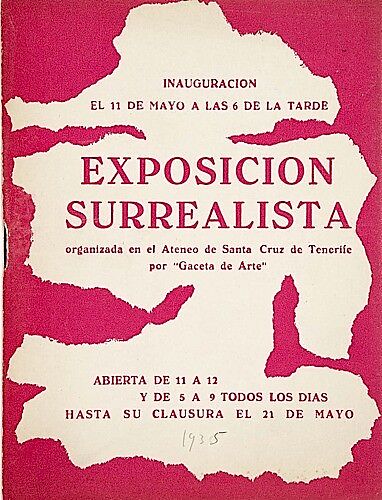
The opening (33) was accompanied by a Breton lecture at the Ateneo of Santa Cruz, based on “The Surrealist Situation of the Object,” with additional lines dedicated to the Spanish painters of the movement. This large establishment, a symbol of the real strength of freethinkers in the first Spanish Republic, was built in 1934 and presided over by Agustin Espinosa.
Breton repeated this lecture in Puerto de la Cruz, in the north of the island, under the auspices of the Cercle d’Amitié du XIV avril. The invitation was generous, in the Spanish style. The locals were so warm that their formalities could easily be forgiven! In his manuscript, translated into Spanish by Agustin Espinosa, Breton lashed out at the metropolis:
“...At this poetic outpost of Spain-Tenerife, we now establish our position for future action, with its concrete conclusions: this position is a function of the overall tone of intellectual values. Literarily and artistically, Madrid has done nothing but splash its confusion, disarray, unconsciousness, and parlor illiteracy onto the intellectual small-mindedness of the provinces. All the dealers of old junk have gathered in the capital of Spain (34)...”
He did not spare the authorities for having banned the screening of L’Âge d’or on supposedly moral grounds, all the more so since sensitive audiences had been warned in advance by Espinosa:
“Given the nature of the film and the moral and sexual violence of many scenes, the organizers advise ladies and young women not to attend, in order to spare them the discomfort of having certain feelings and moral prejudices wounded. (35)”
On May 15th, Breton gave another lecture at the Ateneo on “Art and Politics.” It would be published in Gaceta de arte: it was a translation of “Political Position of Contemporary Art.” However, the lecture by Benjamin Péret scheduled for the same place on May 20 does not appear to have taken place; he was expected to address the Marxist analysis of religion for the socialists of Puerto de la Cruz (36).
Like any conscientious tourist, Breton attended a bullfight, keeping his thoughts to himself. He later wrote about the experience in L’Amour fou, describing that moment of truth when the matador faces the mythical beast: “that minute when man, in order to concentrate upon himself all the pride of men, all the desire of women, needs only to balance on the tip of his sword the bronze mass with luminous crescent which, suddenly, stamps the ground—the splendid bull with astonished eyes (37).” He lamented that children were brought there to grow accustomed to the sight of blood, thus being prepared for war.
According to D. Pérez Minik, the Cañadas of Teide, with their lunar landscape and basaltic soil, elicited this exclamation from Breton: “this is Surrealism in its purest form!” That was all it took for him to declare the island Surrealist (something he would repeat for Mexico in 1938).
Breton would convey his emotion in two prose poems: Au lavoir noir (printed in seventy copies by Guy Levis-Mano in January 1936) and the fifth chapter of L’Amour fou (OC II, 763). Alas, it was necessary to leave those hills and valleys where the gods had made their mark and, on May 27th, return by the same ship, laden with fruit and tobacco, to Paris, where an international gathering of intellectuals was being organized.
Knowing the happiness André and Jacqueline experienced on this island, it would be a mistake to think that for them it was simply a tourist discovery, a stop in an earthly paradise. As a Spanish province, the Canaries had long been a site of important scientific discoveries, notably in botany, but also of cultural inquiry—as shown by the internationally renowned Gaceta de arte. Freethinkers fought there fiercely against religious control, and socialists were at the forefront of progressive ideas, as evidenced by the organizations that hosted the lectures by Breton and Péret. Ironically, it was from Santa Cruz de Tenerife that, on July 17, 1936, under the initiative of General Franco, the insurrection was launched that would bring down the Republic.
When it came time to leave this enchanting stay, André Breton and Benjamin Péret followed the ritual of sharing their impressions in the press, the former in La Tarde and the latter in La Prensa. As it is little known, I permit myself to reprint Péret’s reflection here:
“Everyone knows that anxiety at moments of parting, when—along with the smoke of the train—the platform vanishes, concealed behind a woman’s handkerchief flying away like a frightened bird. This is how we left Tenerife, last night, André Breton and I. The island, which we did not see disappear over the horizon, entered our dreams and bled itself white like the hair on the cactus of your mountains; henceforth, the island will be a lover, a place where all my desires will try to take root. The three weeks I have spent among you are for me like the rainbow for the landscape that remembers the shower it has just received. My dear friend Oscar Dominguez often spoke to me of your country, which I already knew to be marvelous and which I admire even more now that I know it better. But I also take back to Paris a magnificent memory of the people I met here, the friends of Gaceta de Arte and of the Ateneo of Santa Cruz de Tenerife, and I do not want to forget the press, whose cordial welcome reflects an independence in stark contrast with the venality of French newspapers. And when, already caught up in a new storm, I think again of those sunlit days, it is of Tenerife I will think, of its sky, its flowers, and its women, who vie with them in beauty. (38)”
C. Favorable Reactions to Surrealism
Did Breton and Péret’s visit to Tenerife lead the editors of Gaceta de arte to convert to Surrealism? One might think so, judging by certain subsequent publications.
Shortly after their stay, Gaceta de arte inserted a blood-red leaflet into issue no. 35 (September 1935), a pre-publication of the text that would later appear in Cahiers d’art under the title “Déclaration.” After outlining the journal’s international ambitions, the editors declared that they had welcomed the main aesthetic movements of their time and explained why they were now focused on Surrealism:
“In Surrealism—through its use of subconscious materials, in the energy of which lies the very process by which culture develops—we have from the beginning seen one of the most powerful tools available for carving a path forward amid the constant threats that loom over intellectual independence, amid coercion and artificial, dishonest productions through which capital, the state, religion, morality, homeland, family, etc., channel human aspirations, erecting conventional edifices in the service of their selfish interests. What initially unites Gaceta de arte and Surrealism is its anti-capitalist and universal foundation—its drive to destroy bourgeois society and its decorative institutions that suppress and negate every free act.” (39)
What follows is a declaration of commitment to the movement and, after an analysis of recent events in France, a justification of the alliance announced in the International Surrealist Bulletin, here reaffirmed.
This issue of Gaceta de arte is entirely dedicated to Surrealism, with texts by Breton (“Political Position of Contemporary Art”); by Éluard (“The Poetic Evidence”); by both authors (“Attempt at Simulating General Paralysis”); another text by Breton (“The Free Union”, and his "Address to the Congress for the Defense of Culture"). It also includes a poem by Dalí; illustrations such as Max Ernst’s The Bride of the Wind; Picasso’s Crucifixion [after Grünewald]; Dalí’s Dalí and Gala and Millet’s Angelus, anticipating his conical anamorphoses; a composition by Miró; Figure at the Window by Picasso; and a photograph of Giacometti’s studio. The issue concludes with an anonymous article, “Activities of the Surrealist Group in Tenerife,” which faithfully recaps the activities of Breton and Péret during their stay (and goes further, mentioning Crevel’s suicide and the Writers’ Congress), accompanied by a photographic report.
The following issue, published in October, anonymously recounts the efforts made by the editors to screen the Surrealist film L’Âge d’or and the Catholic campaign that resulted in its ban. On the next page, under the title “In the Days When the Surrealists Were Right,” Domingo Pérez Minik discusses the brochure published by the Parisian Surrealists following the Writers’ Congress, where, in his view, they had nothing to gain from participating in an operation intended to lend cover to the Franco-Soviet non-aggression pact aimed at isolating Germany:
“We had to watch in sorrow,” he writes, “as Surrealist poetry and art—the only truly revolutionary contribution to European culture—were cast out into the street from the dimly lit halls of the Mutualité.”A highly favorable commentary on the pamphlet follows, including a decisive excerpt. The final page presents, in translation, five poems by Benjamin Péret and one by Éluard (40).
In retrospect, D. Pérez Minik (op. cit.) observed that while the visit was quite successful—largely thanks to Westerdahl’s diplomatic finesse—Breton came across as quite uncompromising. For example, when Minik shared his admiration for Malraux’s La Condition humaine (Goncourt Prize, 1933), Breton responded violently; the same was true for classical music and even for Artaud.
III. Consequences
There’s no doubt that, for the Surrealists, this stay in the Canary Islands was overwhelmingly positive. Their contributions to issues 5–6 of Cahiers d’art bear witness, featuring a joint declaration signed by Eduardo Westerdahl, Domingo Pérez Minik, Pedro García Cabrera, Domingo López Torres, and Agustín Espinosa, along with this excerpt from the already cited article by Benjamin Péret on international Surrealism:
“Last spring, a series of Surrealist interventions took place in the Canaries, in Tenerife, where Eduardo Westerdahl edits the journal Gaceta de arte. For the first time, a collective Surrealist exhibition was mounted and received a warm welcome from the Spanish public and press. Breton and I gave lectures—one on Surrealism and the relationship between art and politics, the other on religion—in front of a large audience deeply concerned with the problems of our time. The editors of Gaceta de arte offered their full support for our efforts. Domingo Pérez Minik writes: ‘We must admit, in the West, that among all avant-garde movements, one remains essentially alive, fertile, and subversive: the Surrealist movement.’ Elsewhere, Eduardo Westerdahl states: ‘It is a powerful and strange art, and we had the great joy of seeing it and, for the first time in Spain, having it explained to us.’ Pedro García Cabrera, Domingo López Torres, and Agustín Espinosa have all expressed similar support and signed with us a manifesto forming a common platform for action, published as issue no. 2 of the International Surrealist Bulletin. Its imminent release will be a resounding answer to those who still doubt the vitality and forcefulness of Surrealism—though, in truth, these are abundantly demonstrated by our adversaries themselves. In fact, in Tenerife, the mere announcement of a screening of L’Âge d’or provoked the island’s religious reaction into a fit of epilespy and, through a campaign of provocation and slander, they succeeded in getting the screening banned. But there is no doubt that this act of censorship will immediately attract new sympathizers to Surrealism among revolutionary Spanish intellectuals—and will strengthen all those who align with it in opposition to the bourgeoisie.” (41)
A. B.I.S. No. 2
As in Prague, an International Surrealist Bulletin (Bulletin International du Surréalisme) was produced in both French and Spanish, signed by the members of the new Canarian group: Espinosa, Cabrera, Lopez Torres, Pérez Minik, Westerdahl, and, of course, Breton and Péret. The bulletin described the cultural situation in Spain, and even more bleakly, that of the Canaries. It attacked conservatives and reactionaries such as Gimenez Caballero, but also avant-garde figures outside the revolutionary field and opportunistic communists, lumping together Aragon and Rafael Alberti. The bulletin reproduced at length Breton's responses to Indice, the aforementioned socialist cultural journal (42), covering social painting, the reasons for his break with Aragon, and the necessity for revolutionary art to retain its independence from political power. Adopting Breton's own phrase, the Canarian group proclaimed itself “at the poetic vanguard of Spain.”
The brochure was published only in October 1935 in Santa Cruz de Tenerife (following issue no. 3, which appeared in Brussels), under the patronage of Gaceta de arte and the “Surrealist Group of Paris,” in parallel columns (Spanish and French) and featured illustrations by Dominguez (El Cazador); Picasso (La Mort de Marat); as well as three photographs from the stay of Jacqueline, André, and Benjamin Péret, including images from the exhibition[1][2][3][4][6][9].
Was this the result of a full conversion to Surrealism, or simply a circumstantial alignment? For my part, as so often in such cases, I see it as the product of compromise—shaped by the objective of affirming unity between participants, each facing their own particular contexts. Thus, the Spanish editors, analyzing the country's cultural landscape, denounced avant-garde movements that had failed to recognize Surrealism's specificity among the various “isms” facing liquidation, and adopted the arguments of their partners, for whom “all those who, with insight, were active in this movement had already, by 1924, given it its true meaning by incorporating it into dialectical materialism and contemporary philosophy.” Later, they reiterated Breton's alternative, even as they acknowledged it was no longer sustainable: “We affirm the necessity of maintaining art on its own plane, where it obeys its own historical determinations during the pre-revolutionary period. The artist, the writer, must nonetheless take up the vanguard of the working class, enlisting in the ranks of those who struggle for this essential goal: the liberation of humanity.” Finally, all agreed on a concluding resolution:
Against war as a capitalist solution to resolve its economic and social contradictions.
Against fascism, the political form taken by the bourgeois class in the stage preceding its final collapse.
Against the homeland, which divides men, setting them against each other as enemies and destroying human fraternity.
Against religion, a spiritual and economic tyranny, serving exploiters to postpone the arrival of a new collective era.
Against propaganda art, put at the service of any political idea. Art has a revolutionary mission to accomplish on its own ground.
Against the political indifference and social inertia of writers who help enslave mankind by refusing to take a stand for its liberation.
Against all art resurrecting dead values, the neos and all the other labels used to hide doctrinal poverty.
One thing is clear: in the March 1936 editorial, the director of Gaceta de arte essentially reasserted the principles he had endorsed in the B.I.S., especially the necessity of a common front uniting all rebellious groups, though without specifically naming Surrealism (43).
B. L’Amour fou
From our perspective, the principal consequence of this visit to Tenerife is chapter V of L’Amour fou, published by Breton in 1937. He had first released it in Minotaure, no. 8, in June 1936, and as a translation in the Buenos Aires review Sur under the title “Le Château étoilé,” a reference to the monumental Prague diamond with which the chapter ends. His memories of Czechoslovakia mingle here with the enchanted discovery of the Canaries, as for him the two journeys become fused, since Jacqueline accompanied him on both. Breton wrote to Eduardo Westerdahl: “My dream would have been for this text—which I regard as particularly important—to appear as a booklet in Tenerife, illustrated either by Dominguez or photographically by one of you. Is that entirely impossible? (44)”
This brilliant and at times demanding text is, in its entirety, an epithalamium—a love song addressed to his muse whom he wants to believe bound to him forever, and equally to the island whose geography, geology, and botany fill him with absolute wonder. Composed on returning to France, the chapter synthesizes the impressions and reveries inspired by the Tenerife landscape and demands close and careful reading.
With the characteristic circular motion of Breton’s thought, adapted to the physical geography, the narrative ascends from the peak of Teide—its volcanic mass dominating the island—back down to the Orotava valley, with its botanical garden that brings forth idyllic dreams, then ascends again in a dizzying journey through the clouds, culminating in a heartfelt invocation: “Teide admirable, take my life!”
At first, the mountain’s silvery sheen reminds him, by analogy with a reading of Théophile Gautier, of the “little dagger of pleasure” held by the women of Toledo. I confess I do not understand the initial reference to “an elevator lasting several hours” (736) that is supposed to reach the summit of Teide. In any case, through progressive elevation, Breton surveys lunar plazas, recalling the young women glimpsed in the streets of Santa Cruz—reminders of those Picasso once painted. Here is the spark of sexual incandescence that infuses the text. At a higher level, above the flame-touched flamboyant trees, he again sees young women at their windows, prompting the poet to ask: what does the future hold for love? They pass the arena where, the Sunday before, Breton attended a bullfight. The children, absorbed by the spectacle of blood, compensate by shattering cacti with stones. The euphorbia plants eject latex, like milk or sperm, which leads him to observe that the feeling of guilt is never far away (738). Higher still, isolated houses alternate with ships in the harbor, with banana plantations and black, volcanic beaches. This is the antithesis of his adolescent dream, in which—like Chaplin—he walked along a white road with an unknown woman at dusk; here, he strolls with his companion across a bed of tuberose with black flowers!
Following the veins of black sand climbing up the peak, the mind turns inward, as God did, according to the Zohar, in creating the world (739).
A blank space marks the second stage: a visit to the Orotava botanical garden, guarded by the world’s oldest and largest dragon tree. Here the desire—present from the very start—bursts into the open. Guided by a scholarly botanist, the poet and his partner become, like Alice in Wonderland, or, more cryptically, Adam and Eve in Eden. They have reached the end of their quest—nature is as unique as love. The flamboyant, the euphorbia, the dragon tree, the pitanga, the sempervivum, the datura, the retama, the mimosa—all these species punctuate the exultation of lovers at the world’s dawn. More than that: is not one of them the symbol of Surrealism itself, in its will to synthesize the rational and the real? (743)
How not to recall universal harmony, Orpheus, or the myth of the Golden Age where the lion dwelled beside the gazelle? Even the serpent, the idea of evil, the toxic scent of plants participate in this reconciliation; the mangrove reproduces endlessly, the datura inspires an act of faith: “Love, the only love that exists, carnal love, I adore you, I have never ceased to adore your poisonous shadow, your mortal shadow.” (744). Returning to the origins of the world, Breton recognizes good and evil, a dualist morality learned in catechism class, but does so only to embrace it through unique love. Hence the somewhat heavy reference to Engels, to The Origin of the Family, which treats monogamy as a moral advance—corroborated in this by Freud (745). The unique spectacle at Orotava enables him to demarcate himself from superficial pleasure-seekers, in gratitude to the Undine who sustains him.
Hence his praise for L’Âge d’or, the film stupidly banned by Spanish censors. As I noted in the introduction, Breton misread it. Maurice Mourier has definitively shown, in my view, that the film explored the theme of impossible love: “Where are the rosy tomorrows in L’Âge d’or? Where is the Edenic garden that Breton sees pulsing in it? If this strip of celluloid still has the power to shock, it is because Buñuel’s wit first mocks the discordant duo of Adam and Eve, and then, in mounting disgust for humanity, takes down the entire universe, that futile creation (45).” Nevertheless, for Breton, it was “the only enterprise exalting love,” and he laments that the filmmaker agreed to release an expurgated version under the Marxist title “In the Icy Waters of Selfish Calculation,” against which he protested in the name of love itself.
Indeed, this garden does away with the idea of material necessity (747), in favor of a nominalist reverie. As Raymond Roussel once invented new images by linking two terms with the preposition à—and beginning from the bread tree, Breton sees the butter tree, the soap tree, the sausage tree, etc. It’s the “good inn” of Rimbaud, he says, and the place where the pleasure principle meets the reality principle (748). He then proclaims the unique, ever-renewed love inspired by Jacqueline, the lovers slipping together over a prairie of sensitive plants—the bashful flowers of sensation. This leads to an entire discussion of the Surrealist relationship to science.
Above fifteen hundred meters, they pass infallibly through the clouds. Baudelaire and Shakespeare, Freud and Leonardo are invoked in turn, leading to a meditation on the objectivization of subjectivity—yet another Surrealist aim—resulting in the objective chance and manifestation of desire. The text references the paranoiac-critical method, though Salvador Dalí is not named; he had shown too little deference to the Surrealist group. Nonetheless, reading the clouds reveals a single truth: “I desire you. I desire only you.” (756) Once the clouds have parted, Breton glimpses the retama—the white broom Max Ernst painted in front of him shortly before departure, creating an illusion of déjà-vu, the never-seen-already-seen effect.
A leap in space brings him to reject that old sophism that love is exhausted by use. He sees two causes for this: one social, one moral. By association of ideas, the volcano Teide makes him think of Etna in Sade’s La Nouvelle Justine, of the executioner of nature, of the problem of evil, already touched on, and of loving only one being. On such a level of passion, of fusing love, there is no way out but to be annihilated in the mountain: “Teide admirable, take my life!”
I know of few geographical sites that have prompted such a declaration—one that deserves to be inscribed in letters of fire on the snowy side of the peak.
C. The Aftermath of the Visit
Beyond the political and artistic aims that Breton and Péret envisioned for the trip, it had three specific objectives: the exhibition of Surrealist paintings, the screening of Buñuel and Dalí’s film, and, finally, the establishment of ties with the Gaceta de arte team.
The first of these goals was achieved to everyone's satisfaction, except for the fact that, since no artworks were sold, the organizers had to spend several years repaying the costs they had incurred[1][3][6].
Paradoxically, the film screening—which seemed the easiest to arrange, since it was the work of Spanish artists—never took place. Following a wave of protests, likely provoked by Catholics forewarned by French leagues, the civil governor of the Canaries prohibited the screening of the film that Breton and Péret had brought in their suitcases. This led to a flurry of articles and clarifications from Gaceta de arte contributors and their allies. As often happened at the time, and just as with the Paris screening of L’Âge d’or, the scandal arose around cinema—with the public denied any chance to form its own opinion, not even through a private screening which the authorities had initially permitted. In this, it was plainly shown that the Madrid Republican government was no more liberal than others[3][1].
What remains are the friendly relations forged with their Canarian hosts. For the Surrealists, it was clear they had found essential support in Eduardo Westerdahl, director of an international journal, so much so that in 1938, Éluard and Breton’s Dictionnaire abrégé du surréalisme described him as: “Writer, leader of the Surrealist Movement in the Canary Islands. Director of Gaceta de Arte until the fascist uprising of 1936.”
Conversely, a letter (46) from Dominguez to Westerdahl testifies to the positive reception Gaceta de arte received in France:
“[...] The issue of G.A. made a great impression, both in Surrealist circles and among Picasso, Zervos, etc. All have applauded this work with enthusiasm and recognize its positive value.”
Nevertheless, the process of seduction (in the etymological sense) was never completed. According to Domingo Pérez Minik—who, in retrospect, would call himself a “second-rate Surrealist” (La facción española surrealista de Tenerife, Tusquets, 1975)—the Gaceta de arte team declined to become a branch office of Surrealism, thanks especially to the joint stance of Westerdahl and Minik.
* * *
For the Surrealists, this trip to Tenerife was entirely positive: they expanded their network among Spanish intellectuals and creators, and even reached agreements for joint publications[3][6]. Their socialist friends provided a valuable counterweight in their complicated relations with the Communist Party, as would be demonstrated by subsequent issues of Gaceta de arte[6][9].
That same journal would enable them to amplify their international reach, supporting the exhibitions in Brussels and London, both of which were followed by the publication of an International Surrealist Bulletin[9]. In short, for all its limits, Surrealism now had no borders! Its worldview, its works, and its activities could stand proudly in opposition to the artistic poverty promoted by socialist realism’s supporters.
On a personal level, Breton experienced perfect harmony in the exceptional natural setting of Tenerife and, a few months later, would have the joy of welcoming the daughter, deeply wanted and claimed through shared love, whom he would call Écusette de Noireuil. This magical sojourn—paradise on earth for Breton—would soon become inaccessible[5][9].
Upon their return to France, dark clouds quickly gathered. The suicide of René Crevel and the humiliations surrounded by the Congress of Writers for the Defense of Culture in June 1935 led the Surrealists to break completely with the French Communist Party. More seriously, they had forever lost the opportunity for direct discussion with Moscow—radically undermining their previous decision to link artistic creation to a political party. All hope of an alliance with the proletarian masses, or of influencing Soviet cultural policy, had vanished. Soon, they would have to openly oppose the head of the Soviet Union—the very organizer of the infamous Moscow Trials[4][6].
As for the Canaries, Gaceta de arte would refuse to become a Surrealist organ, instead returning to its original character. From Lorient, where, as every year, Breton spent a few short weeks with his parents, he wrote on July 15, 1936 to Eduardo Westerdahl:
“I’ve been a long time without news from you or our friend Oscar D., who had promised to write but now encloses himself in the most disdainful silence. I imagine you heard that the International Surrealist Exhibition in London received a triumphant welcome (25,000 paid entries). Did you get the program? I’d love to know your thoughts on our recent publications (Cahiers d’art, Minotaure, etc.) [...] When will the second issue of ADLAN appear? And will Gaceta de arte never be republished (47)?”
This letter likely arrived only after the generals’ rebellion[4].
The Francoist coup d’état, launched from Tenerife on July 17, 1936, would put an end to all initiatives. Domingo López Torres was executed by firing squad, Pérez Minik imprisoned, and all contributors to the journal came under suspicion, such that it would never reappear. From Paris, where he had taken refuge, Oscar Dominguez wrote to his sister:
“[...] These past days, I’ve lived through so many emotions that I feel dazed, incapable of reasoning. Paris is for me at this moment the most beautiful dream, but the memory of our ruined Spain and the dear ones I left behind cast a veil of sadness over the happiness that Paris represents for me, along with all my loves and my fondest memories...”
Even Jacqueline’s behavior would eventually make life as a couple more difficult, such that the song of L’Amour fou now seems more like a desperate attempt to hold onto the ideal of elective love—against all odds.
See photographs: "Surrealistas de Tenerife" by Eduardo Westerdahl
Notes
- Maurice Mourier, “El Dorado, tentative d’évaluation subjective de l’Age d’or aujourd’hui,” Mélusine, no. VII, 1985, p. 142.
- Tristan Tzara, Œuvres complètes, vol. II, Flammarion, 1975, p. 355.
- Éluard to Gala, April 7, 1935: "I believe that Prague is for us the gateway to Moscow. But people here think we must wait a year." Lettres à Gala, Gallimard, 1984, p. 253.
- Benjamin Péret, “Le surréalisme international,” Cahiers d’art, no. 5–6, 10th year, 1935; reprinted in Œuvres complètes, vol. VII, p. 139.
- Letter from Paul Éluard to Gala, [around August 15] 1934, op. cit., p. 247.
- Marcel Jean, Au galop dans le vent, ed. Jean-Pierre de Monza, 1991, p. 44.
- Gérard Xuriguera, Oscar Dominguez, Paris, Filipacchi, 1973, p. 65.
- André Breton, Le Surréalisme et la peinture, revised and corrected edition, 1928–1965, Paris, Gallimard, 1965, p. 129.
- Óscar Domínguez, “Carta de París. Conversación con Salvador Dalí,” Gaceta de arte, no. 28, July 1934. All Spanish texts hereafter are translated by the author. The journal is available in image format on the Memoria digital de Canarias website.
- Letter fully reproduced in Pilar Carreño Corbello, Eduardo Westerdahl, suma de la existencia, Tenerife, 2002, pp. 84–86.
- See the tribute volume published for his centenary by Juan Cruz Ruiz, Un gallo al rojo vivo. En busca de Domingo Pérez Minik, Santa Cruz de Tenerife, Tauro ediciones, 2003, 208 p.
- Primer manifiesto de "la rosa de los vientos", La Prensa, February 1, 1928, in Pilar Carreño Corbello, Escritos de las vanguardias en Canarias, IODAC, 2003, pp. 47–48.
- Eduardo Westerdahl, La Prensa, June 3, 1930, ibid., p. 88.
- Ibid., pp. 91–92.
- Pedro García Cabrera, “Regionalismo y universalismo,” La Tarde, Santa Cruz, August 16, 1930, ibid., pp. 95–96.
- RYD, Círculo de Bellas Artes de Tenerife, Santa Cruz, April 5, 1931, ibid., p. 107.
- Posicion, Gaceta de arte, no. 1, Tenerife, February 1, 1932, ibid., p. 112.
- See [Eduardo Westerdahl], “8º manifiesto de GA, tema: la expresión plástica de la república,” Gaceta de arte, no. 17, July 1933, ibid., pp. 139–142.
- See [Eduardo Westerdahl], “Position 1935,” Gaceta de arte, no. 34, March 1935, ibid., pp. 158–159.
- [Domingo Pérez López], “Itinerario,” Indice, no. 1, March 1935, ibid., p. 161.
- Domingo López Torres, “Surrealismo y revolución,” Gaceta de arte, no. 9, Oct. 1932, p. 2.
- Domingo López Torres, “Psicogeología del surrealismo,” GA, no. 13, March 1933, p. 3.
- Domingo López Torres, “Aureola y estigma del surrealismo,” GA, no. 19, Sept. 1933, p. 1.
- See Emmanuel Guigon, “El surrealismo a 28°–7°,” in El surrealismo entre viejo y nuevo mundo, Las Palmas de Gran Canaria, 1990, p. 26.
- See Nilo Palenzuela, “Algunas reflexiones: Gaceta de arte y el surrealismo,” in Ma Isabel Navarro Segura (ed.), Internacional constructivista frente a internacional surrealista, Cabildo de Tenerife, 1999, pp. 53–65.
- André Breton, Clair de terre, Poésie/Gallimard, p. 100.
- Georges Sebbag identifies “on” with Dominguez in his article “Le chapiteau étoilé,” Mélusine, no. XVIII.
- Fernando Gabriel Martin suggests that Breton had previously seen the film Tenerife, by Yves Allégret and Eli Lotar, filmed in spring 1932 (“El cine y la izquierda en Tenerife durante la república,” in Navarro Segura (ed.), Internacional constructivista frente a internacional surrealista, Cabildo de Tenerife, 1999, p. 91).
- "Hoy regresará a París el grupo surrealista," La Tarde, May 27, 1935; cited by Marguerite Bonnet in the notes to Œuvres complètes of André Breton, vol. II, p. 1561. This is a reference to his speech in Puerto de la Cruz (OC II, 583).
- Tenerife exhibition held from May 11–21, 1935 at the Ateneo of Santa Cruz; extended by three days. Breton’s preface reused material from his Political Position of Surrealism.
- D. Pérez Minik, Facción española surrealista de Tenerife, cited by Juan Cruz Ruiz in Un gallo al rojo vivo, Tauro ediciones, 2003, p. 94.
- Benjamin Péret, postcard to Marcelle Ferry, Tenerife, May 19, 1935, OC VII, p. 334.
- Exposición Surrealista. Santa Cruz de Tenerife, 1935; square octavo, stapled. Original exhibition catalogue organized by Gaceta de arte at the Ateneo of Santa Cruz. Includes a Spanish text by André Breton and reproductions of works by Styrsky, Tanguy, Magritte, Miró, Dominguez, Valentine Hugo, Arp, Picasso, Duchamp, Ernst.
- These notes appear in Breton’s manuscripts, available online via Atelier André Breton.
- Agustin Espinosa, “Hacia una moralización de la moralina. La Edad de oro, film surrealista,” La Tarde, May 30, 1935; presented and translated by Emmanuel Guigon in “Autour du château étoilé,” Docsur, no. 7, March 1989.
- For a precise chronology, see the press dossier by Emmanuel Guigon, in Docsur, no. 7, March 1989.
- André Breton, L’Amour fou, in OC II, p. 737.
- Benjamin Péret, “Adieu à Tenerife,” La Prensa, Saturday June 1, 1935; OC, vol. VII, pp. 138–139.
- Gaceta de arte text published in French in Cahiers d’art, no. 5–6, 1935, p. 112, signed by Eduardo Westerdahl, Domingo Pérez Minik, Pedro García Cabrera, Domingo López Torres, Agustín Espinosa; ibid., pp. 165–166.
- From Péret: La sangre derramada (“The Spilled Blood,” from Le Grand Jeu), Cuatro años después del perro (“Four Years After the Dog,” from De derrière les fagots), Fuente (“Spring,” from Je sublime), Holà! (“Hello”), Háblame (“Speak to Me”); by Éluard: La frente cubierta (“Covered Forehead”), before appearing in Arts et Métiers graphiques, April 1936 (later included in Les Yeux fertiles).
- Benjamin Péret, “Le surréalisme international,” Cahiers d’Art, no. 5–6, 10th year, 1935.
- In fact, this interview, given in French by Breton at the end of Position politique du surréalisme (OC II, 445–450), was never published by Indice, which had disappeared before it could do so. It was thus known only through fragments used in the B.I.S.
- Eduardo Westerdahl, “Posición,” Gaceta de arte, no. 37, March 1936, ibid., p. 199.
- André Breton’s letter to Eduardo Westerdahl, July 15, 1936 (E.W. archives), reproduced in Pilar Carreño Corbella, Eduardo Westerdahl, suma de la existencia, Tenerife, p. 109.
- Maurice Mourier, “El dorado...,” art. cité, p. 143.
- (to Eduardo) Paris, April 4, 1936. "(...) The issue of G.A. caused a sensation, both among Surrealists and with Picasso, Zervos, etc. Everyone applauds this work with enthusiasm and recognizes its positive value." – Oscar.
- Continuation of the letter cited in note 41.