"Tzara, Dada and Surrealism", Itinéraires et contacts de cultures, No. 29, Tristan Tzara, Surrealism and the Poetic International, 2000, pp. 13-19.
Teacher-researchers at the University of Villetaneuse, the animators of the journal Itinéraires et contacts de culture are accustomed to convening each year a colloquium whose proceedings constitute an issue of this publication. For 1999, they had the idea of examining Tristan Tzara's place in contemporary French literature. I had known Bernard Lecherbonnier for a long time, before his publication of surrealism. Theories, themes, techniques with G. Durozoi (1972) and I had attended the defense of his thesis: The Flesh of the Verb. History and Poetics of French-Language Surrealisms (1992), and I was very happy that he had thought of organizing this day devoted to Tristan Tzara. At his request, I therefore prepared an intervention making the point, once and for all, on the poet's relations with surrealism. What was my surprise to hear his comrade, G. Durozoi, denigrate Tzara's writings on the plastic arts! The reason was his adherence to the Communist Party. Obviously, I did not fall into the trap, knowing that Tzara had never subscribed to the notion of "circumstantial poetry" and that he had defended artists because of the interest he had in their works, and not in their political ideas. I refrained from any contestation. It was enough, in my eyes, to refer to volume V of his Complete Works, which I had established at Flammarion, to be convinced of his active role in this field, and of his discoveries, starting from Dada. Fortunately, the official presentation of the Tristan Tzara Prize to the young Olivier Barbarant came to warm the atmosphere, all the more easily as the other contributions were more nuanced and, overall, situated Tzara at the heart of the literary and intellectual activity of his time.
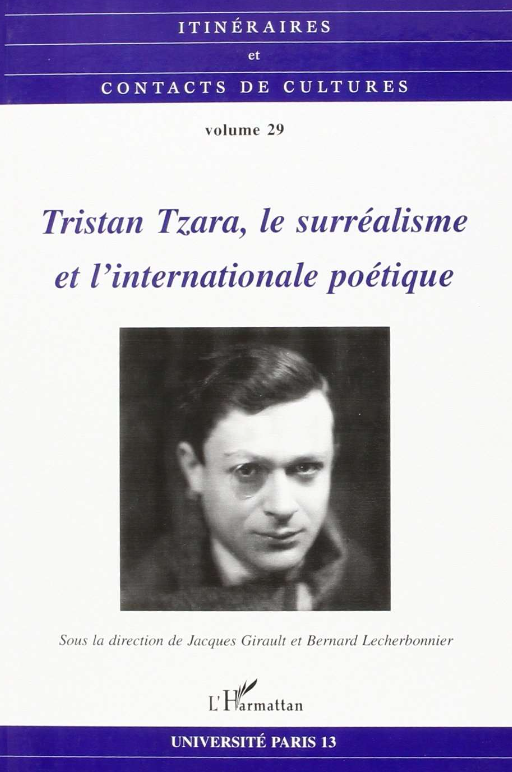
A set of contributions to examine the journey of a contemporary poet whose trace has marked literature but also the history of ideas: Tristan Tzara. He is notably the inventor of the Dada movement, this bomb that exploded traditional art and poetry. In the contents notably: Tzara, Dada and Surrealism (Henri Béhar); Tristan Tzara and the Surrealist Group from 1924 to 1929 (Norbert Bandier); Tristan Tzara and the Visual Arts (Gérard Durozoi); Tristan Tzara's Political Commitment from 1944 to 1963 (Alain Cuénot); Identity of Franco-Romanian Literature (Bernard Lecherbonnier); Tzara and Isou (Bernard Lehembre)… Download my contribution PDF Read the Complete Works of Tristan Tzara, volumes I to VI
Read his Complete Poems in digitized version by me: Tristan Tzara, Complete Poems
Colloquium report by Catherine Dufour Tristan Tzara, Surrealism and the Poetic International, such was the title of the "poetic spring of Villetaneuse" organized in May 1999 at the University of Paris 13 by Jacques Girault and Bernard Lecherbonnier. The colloquium took place under the good auspices of Madame the cultural counselor at the Romanian Embassy and Monsieur the Ambassador himself, judging his presence in these places... very "dada". It will be understood, Romania was in the spotlight, with some social events, since it was a question of presenting the Tristan Tzara prize to its laureate of the year, the young poet Olivier Barbarant. The debates were partly devoted to Tzara's Romanian origins, and to questions that he himself, devoted to a cosmopolitan destiny, had hardly asked himself. Was Tzara a Romanian writer, French, or a Romanian writer of French expression? Did he deserve the francophone label? Bernard Lecherbonnier tried to answer these questions, recalling that the French language and Romanian culture are historically so closely intertwined that they end up merging, making classifications difficult. Should we look for a specifically Romanian influence in Tzara? Yes, if we believe Petre Raileanu, describing the two sides of Romanian literature, one that still resonates with the lamentations of the Greek tragedy chorus (Cioran), and the other imbued with absurdity, derision, deconstruction and tragicomic. This Romanian Absurd, which goes back to folkloric cosmogonies, runs through the great burlesque epics of the 18th century, inhabits the off-kilter characters of Caragiale, the unheard-of ferocity (Ionesco) of Eminescu and the ubuesque phantasmagorias of the pre-surrealist Urmuz, would be at the origin of Tzara's existential boredom. In the chapter of play and alliterative passion, Bernard Lehembre leads us towards the whimsical Isidore Isou who, in 1945, thirty years after Tzara, Jewish and multilingual like him, left Romania for a Europe ravaged a second time by war, in which he was going to, following in Dada's footsteps, sow the terror of his letter poetry. Isou the imprecator accused Dadaism of being a white revolution, and Tzara a lukewarm one, who had remained at word poetry, refusing the integral assassination of meaning. But Isou was grateful to Tzara for having demonstrated the uselessness of words, and for having scuttled his movement before approaching the dry lands of dogmatism. Little inclined to nostalgia, Tzara practiced the French language with jubilation, without knowing linguistic uprooting. This was not the case with Ghérasim Luca, evoked by Jean-Louis Joubert, animator of the Romanian surrealist group at the end of the war, producer of book-objects, poem-drawings, and other bizarre objects, nomadic spirit to whom Gilles Deleuze granted the true merit of style, that of stuttering in his own language, in the manner of Beckett or Kafka. Incapable of inhabiting an intimately foreign language, which he tried to exorcise with slips, puns, layering, thicknesses, networks or rhizomes, Luca threw himself into the Seine. His compatriot Cioran, the Diogenes of the Carpathians, whose obstinate enterprise of deterritorialization (Deleuze) Jacques Lecarme describes to us, was more skillful. Resigned to living in universal discomfort, ruminating on exile, he will have ensured a very long career on an endless meditation on suicide. Haunted by the complex of the provincial from a small nation, obsessed with a language purified to the point of academicism, he found some remedies for the inconvenience of being Romanian, becoming according to circumstances the least anti-communist of Romanian fascists, but not the least anti-Semitic at the end of the 1930s. Tzara, meanwhile, was a foreigner without regret, despite the ambient xenophobia. Henri Béhar recalls that his famous Dada epic too often makes us forget that it represents only a sixth of his work, and that Tzara made a major contribution to French surrealism, with which he maintained complex relations. Norbert Bandier, in the light of Pierre Bourdieu, analyzes a crucial stage, the dark year 1924, date of publication of the Seven Manifestos, but also of Tzara's ostracism, at a time when the symbolic and editorial capital that was being woven around the surrealists and the growing visibility of their practices and productions were invading the literary field, and contributing to isolating him in his radical individualist requirement. Accused of having sold out to a worldly aristocracy frequented by Cocteau, excluded from the young surrealist guard despite his notoriety in the international avant-garde and his publications in journals throughout Europe, Tzara had no other way out, once again, than cosmopolitan, turning his gaze towards Belgium and the Dadaist Mesens. History was to give him a second wind: his thirst for revolt, brutally confronted with the triumph of fascism in Europe, transformed him into a Marxist revolutionary. Alain Cuenot traces the vicissitudes of his militancy, since his commitment alongside the anti-Francoists and the French Resistance. Theorist of relations between Poetry and Revolution, singer of assassinated poets, ally of the oppressed against American imperialism, Tzara alas became a communist intellectual at the service of the Party, warring against the surrealists, armored with certainty, victim of a spontaneous revolutionism, of an instinctive and generous proletarian idealism, devoid of real doctrinal bases. The rupture of 1956, at the time of the invasion of Hungary, was at the origin of a moral crisis which rallied him to progressive intellectuals against the communists, and incited him to reconnect with the surrealists, during the "manifesto of the 121" notably, then to withdraw definitively from the public scene. An enigmatic silence accompanied the last ten years of his life, devoted to the meticulous deciphering of Villon's anagrams, whose riches Jacques Verger explored, but also the incontestable weaknesses. Meanwhile Tzara had devoted a large part of his work to commenting on the artists of his time. Was he for all that an art critic? Taking the fierce counterpoint of René Lacôte's essay on Tzara in 1952 and an article by Daniel Leuwers in the journal Europe in 1975, Gérard Durosoi considers that Tzara contented himself with commenting on works likely to confirm the status he accorded, in general, to the work of art. This status, defined as early as the Dada Manifesto 1918, would only have produced poetic equivalents of the evoked works, by Arp, Man Ray, Schwitters or Ernst. Tzara was to refine his aesthetic criteria in two articles of 1928 and 1929 devoted to pre-Columbian art and Oceania, where he recognized in primitive art the essential qualities of a work. These criteria took on a Marxist coloring in 1933, until the reductive drifts and conceptual slippages in which Tzara often got bogged down, prisoner of a rigid ideology. Romanianness, primitivism, Dada cosmopolitanism, international communism, perhaps this panorama was missing a more precise evocation of what the Poetic International really was – didn't the title announce it? –, this insane activity of Tzara between 1915 and 1925, corresponding and collaborating with the greatest writers and artists of all Europe, Italian futurists, German expressionists, French cubists, in the mad attempt to constitute an anti-art, beyond wars and borders, territorial and aesthetic?