"Tristan Tzara si inventia grafica: secretul lui Villon" [Romanian translation], Caiete critice, n° 4-5, 1996, pp. 71-78.
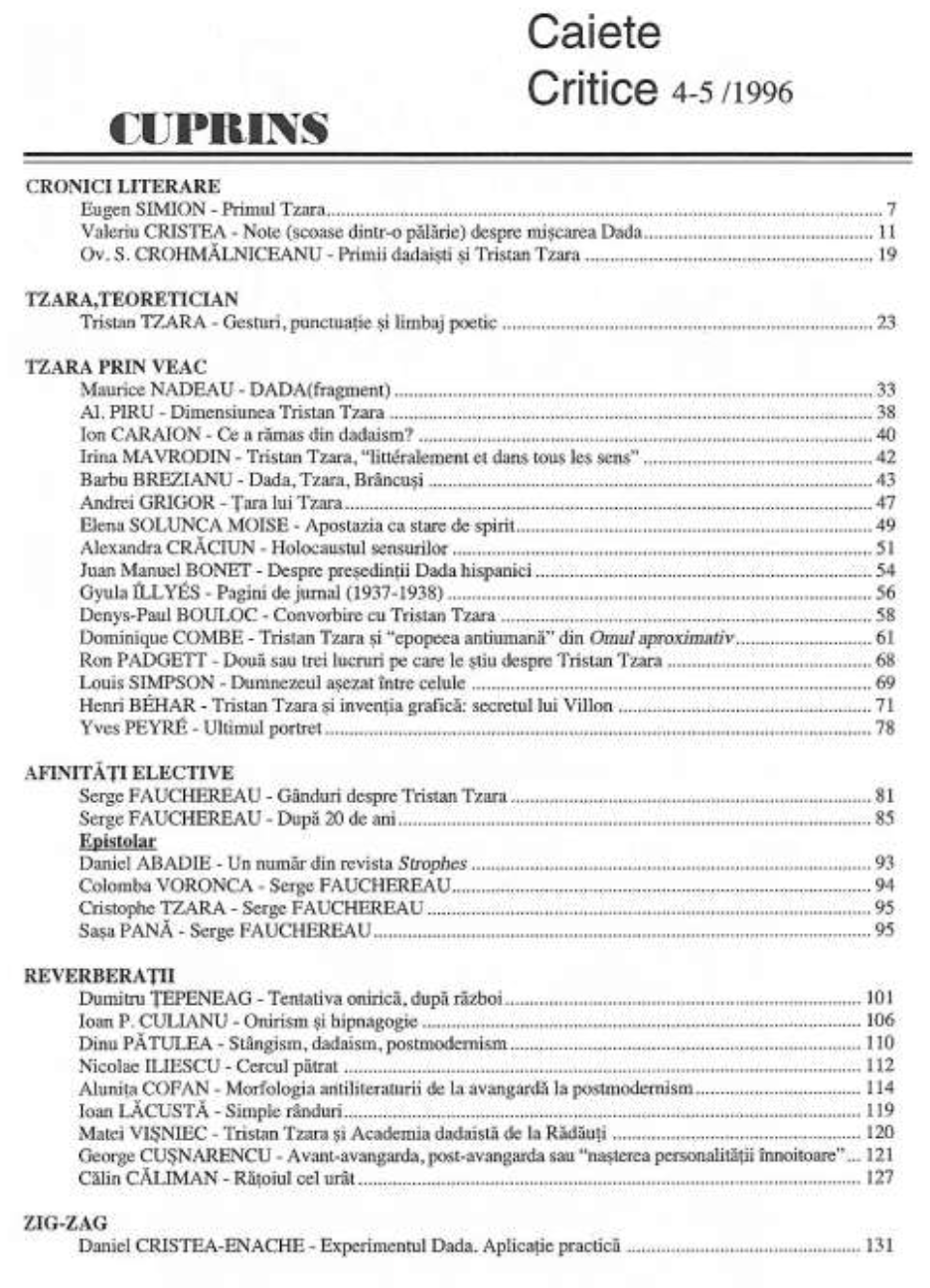
With the exception of the staging of The Gas Heart by Sylvain Dhomme and issue XVII of the Mélusine journal whose main theme was devoted to the Breton-Tzara cross-chase (cf. Figures of the Cross-Chase, Mélusine, n° 17, Tzara-Breton Cross-Chase), it must be admitted that in France the centenary of Tristan Tzara's birth did not clutter the pages of the French press. It was fortunately in his native country that it was commemorated by this special issue of the monthly journal Caiete critice, published by the House of Press and Culture of Bucharest, whose table of contents can be read below. Its director, Eugen Simion, asked me to evoke the poet's last writings, and particularly the ten years he spent researching anagrams in the work of François Villon, by which he showed his attachment to an unrecognized practice of poetic tradition as much as to a representative poet of our tradition, to whom he had attempted to devote a biography.
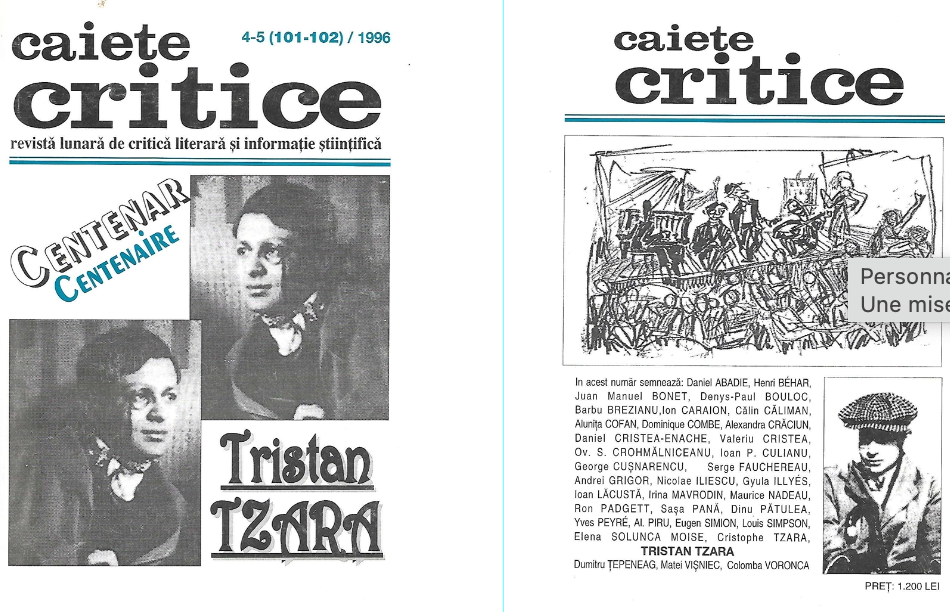
Caiete Critice nr.4-5(101-102)/ 1996 - Tristan Tzara Centenary Monthly Journal of Literary Criticism and Scientific Information Journal published by the National Press and Cultural Publishing House in collaboration with the Romanian Academy, 132 p.
Table of contents:
Download the article in Romanian PDF
Download the article in French PDF
Read Tzara's text on Villon's anagrams
Summary That the man who, nearly half a century ago, founded the Dada movement, should today be this researcher who, from Villon to Rabelais, strives to demonstrate that the obscurity of texts stems essentially from our ignorance of both the social conditions of writers and their biography, will one day be a great subject of astonishment and study declared Aragon in 1963, two months before Tristan Tzara's death. This sixth and final volume of the Complete Works presents, according to his unpublished manuscripts, the totality of the research he conducted for ten years on the use of anagrams in poetry and which he planned to publish under the title The Secret of Villon. Besides new attributions and biographical details, one will read there, for the first time decrypted in its entirety, Villon's "novel", the story of his thwarted loves, the way in which he avenged himself on his adversaries as a poet, by means of a work with double meaning. One of the most beautiful poems of our literature, one of the most obscure and least known, is thus masterfully interpreted by a poet, by virtue of what we know today about the poetic act and its triple narrative, analytical and playful function. Henri Béhar. Volume VI, Flammarion, 1992, 692 p.
Locate this volume in Tzara's life and work, Oxus, 2008, 258 p.