TRISTAN TZARA, OF A CERTAIN AUTOMATISM OF TASTE
There exists, beyond the worlds and fortifications of human brains, opposing the thirsts that assail us from all sides, between the granite debris and vegetable waste, the slag and detritus of all sorts of fragmentary and angular knowledge, pebbles unadaptable to the universal order, larval feelings on which superstitions graft themselves, there exists an immense consolation, it is to discover in the so-called small passing events the confirmation of certain general perspectives that one has arranged for oneself in favor of life. Between what is small and great, without losing sight of the irreplaceable and indivisible charm that puts you on the path of discovery, there is the entire graduated scale of the imponderable hunger for continuity, the fire that could not, neither before nor beyond birth and death, stop at the fiction of a few punctuation marks. At first glance appears to the one who constructs for himself a method from which the arbitrary is not only not excluded, but on the contrary accentuated and highlighted, the necessity of declaring that the goal he imposes on himself could in no case be limited, under cover of a prestidigitator's truth, to convincing his readers or contenting himself with a simulacrum of signs on their part. It is a question of the slow edification of a system of hypotheses, of a reasoning valid for a certain category of freely limited notions, capable of engendering the possibilities of germination and development within the frameworks imposed by current society, according to a well-defined will, that of getting out of it at all costs. Just as, in the modern conception of the universe, the frontier between the peripheral domain which is content provisionally with mechanical interpretation and that whose explanation is of a purely mathematical nature is not strictly delimited (see the relations of interdependence between formal logic and dialectical thought, not yet sufficiently defined, and the concept of economy which presides over all explanation), the relationships, on the plane of psychic life, between sensations and a whole series of mental phenomena find themselves, at least in appearance, in a strangely similar situation. Perhaps it is there, in these still little-known spheres, at these fallow confines, that the domain of poetry should be situated, if it were a question of assigning to it a place among the disconcerting procedures of human understanding. For, more pressing than ever, the need is felt to defend poetry from improper influences that want to make it pass for a convenient channel, a means of expression apt to transport ideologies and opinions toward the mass which, moreover, knows too well what to think about the moralizing value of La Fontaine's fables and about the barnyard enthusiasm aroused by patriotic songs.
Through analogies and hypotheses of a scientific order, among the means of investigation of nature and human destiny, the character of innate charlatanism of thought helping (I do not say this in a bad sense) as well as that of a certain automatic hermeticism of symbols proper to each pure science resulting from their deepening — flagrant hermeticism for the one who remains outside of this deepening —, poetic invention will find its place, despite the arbitrary appearances it presents at first sight. As the irrational tends to become rational insofar as the laws that govern it are more accessible to us, the poetic act will no longer escape analysis, and, when it is established that the symbolism of poetry resides in the mechanisms of thought, in certain procedures or turns independent of language and yet contained in it, often surpassing it and denying it as common sense, the time will be ripe to determine the complex system to which poetry is linked, on the plane of knowledge and the continual becoming of things and beings.
Man will be placed at the center of all preoccupation and his preeminence over activities and problems that can only proceed from him and return to the knowledge of his nature will never be lost sight of. He will be the starting point as well as the arrival point of research and conclusions as life and death join and follow each other, oppose and merge, on this marvelous trajectory of temporal continuity.
Troubling fumes of universe that traverse the memory of men, women in the street and in the woods, dressed in the most beautiful vegetation of present times and changing the hour hung on the flying buttresses of joys stretched on earth into a sign of infinite possibility of living, the promise cascading down the lips and the crenellated structure of prohibitions that confront each other, women dressed in provisional, you walk on a spider's web and it is from you, fragile beings woven in unfathomable hope, that we await the irrational movement, in the sure lightness of its own nature, which will smooth out the tumultuous contradictions of which we are the familiar ramparts. Each sign with which you adorn your passing appearance, like a series of indelible images that accompanies your steps, serves, by means of a magic long experimented through the centuries, to make you fully recognizable to our mind. For, evidently, according to characters still difficult to elucidate, you belong to determined spheres of correspondences, and your world of psychic activity coincides with destinies running their chance, with the sentimental figurations of certain modes of desires and certain conglomerates of human faculties, radiating with a uniform breath, but variable to infinity. The assonances of disparate events of a life sound full noon at the passage of one of these extreme expressions of the law of mathematical combinations applied to the dream on earth, marvelous lesson of adaptation to natural kingdoms, where the vigor of eyes meets the tenderness of skin and where nothing ceases to arrange itself contradictorily in the order, at each newly acquired step, of universal necessity to palpitate.
Summer 1933. Women's hats make me rediscover the time when the implausible invasion of flowers brought me, with the freshness of youth and desolation, the sense of a tactile and visionary voluptuousness that I had to regard as the confirmation of my nature in its most secret form, that of sexual representations. It is under the bark of latent symbolism which, little by little, hardens on the consciousness of individuals that one will have to seek the attractions exercised on them by the avowable and unavowed data of explorations of all sorts, of readings, of anguishes and events, if events are not invented subsequently. To respond to desires, one superposes on them the image of the determining encounter of a fortuitous portion of his life which is henceforth subjected to them. It is therefore by making the subtraction that imposes itself on each writing of the obsessive part of the author that one will arrive at determining the residue of objectivity of a work. Logic is no longer of great help for operations of this kind, and observation only comes into account as an object of polarization of a whole world of desires and perversions.
It seems that the marvelous world of the most remote sexual representations in the psychic structure of human beings, more particularly that of women, submitted to a strange law of surpassing and opposition, law of continual mobility, verified by acceptance or repeated by the mass and called fashion, it seems that this world which responds to an ineluctable necessity, partially governed by instincts — that of embellishing oneself, in the female, from relatively low zoological levels — and partially perfected according to the needs of a more refined cause, it seems that this world is characterized by a valorization of the different parts of the body for which embellishments serve at the same time as sign and call.
It is, so to speak, the unconscious interpretation of a series of representations, remained hidden to the subject, which expresses itself by a symbol whose characters are drawn from everyday life. It is difficult to say exactly what pushes the human being to express himself in this manner, but everything leads one to believe that it is the libido; the slowing down, by old age, of the amorous élan, accompanied by the loss of the need to please, is sufficient proof of this. Sexual symbols have been amply studied by psychoanalysis, it will be for me to indicate in their light to what extent taste can assimilate aesthetic criteria and the possibilities offered to us to find in the latter the fundamentally human roots.
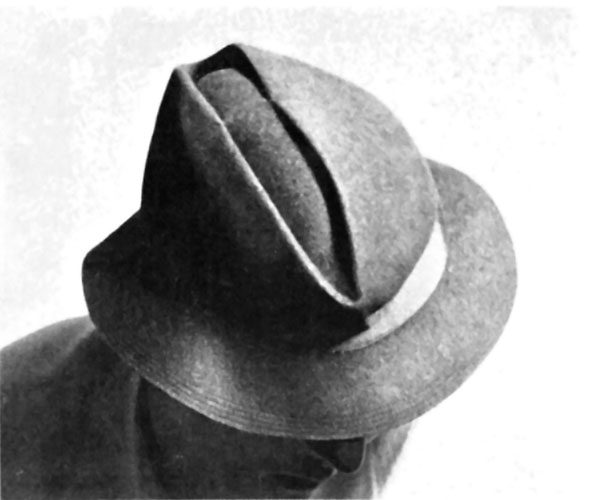
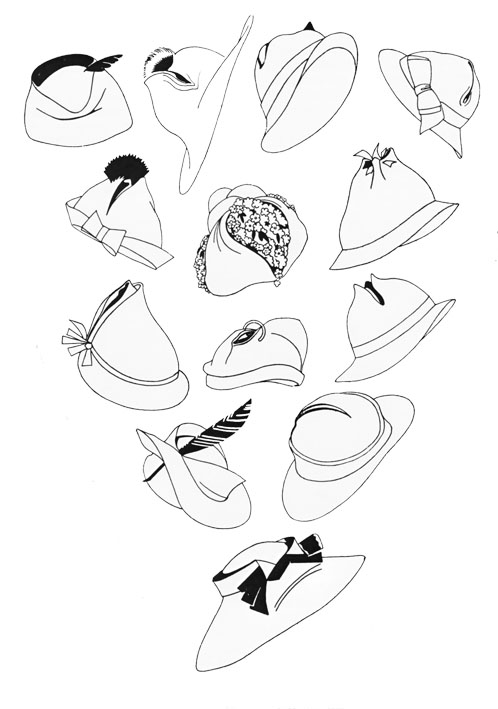
The hats that, until recently, women wore, the hats with a folded crown in the shape of a slit which, at their beginning, were supposed to imitate those of men, the hats whose resemblance to the female sex has become, in the course of their evolution, not only striking, but significant in more than one respect, have finally confirmed in a striking way what I advance by the example of two characteristic specimens: the hat executed in sock garter elastics and that whose crown is surrounded by a trimming imitating a false collar with broken corners provided with its tie. In the very manner in which these two attributes, the most marked of masculine costume, the stretched sock garter appealing to an image of virility and the tie whose symbolic role is known, in the very manner in which they surround the reproduction of this female sex that women wear on their heads, one must be blind not to see, not solely an effect of fantasy which, itself, only plays the role of ingenious go-between, but a real force of justification that the creators of these models have given to their works.
One must not believe in a blind submission of women to fashion. One must not either underestimate the role played in it by economic and social factors. The importance of these once admitted and the mechanism of adaptation to the dominant fashion (which acts on the woman rather as a force of suggestion) put down to a phenomenon of psittacism and the power enjoyed by capitalism to impose the commodity with the help of advertising, fashion, patriotism, etc., there always remains to the woman the possibility of choice and it is there that will develop the differentiations that are the object of my observations. It is not enough for a fashion to be launched for it to succeed in imposing itself. An anonymous and invisible majority exercises a constant control, by elimination, on the effectiveness of fashion as responding to the possibilities of transformation and appropriation by a maximum of representative forms with sexual functioning.
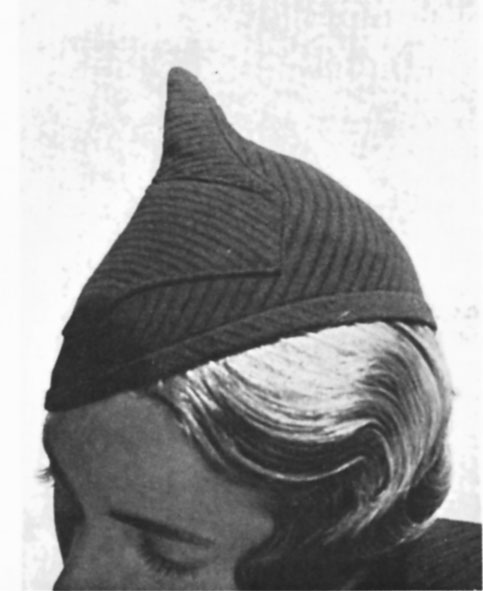
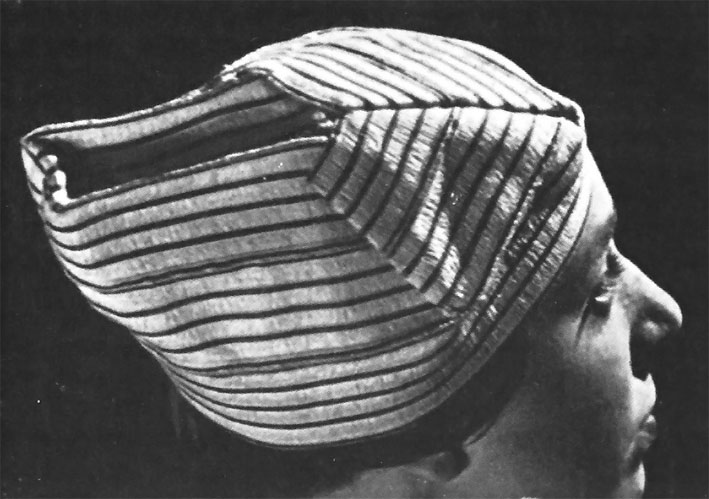
Immediately preceding the fashion of slit-shaped hats and in opposition to it, the chechia, whose masculine sexual character is not doubtful, made a short-lived passage. It is to the failure of this fashion that we owe the appearance of the hat that concerns us and which was definitively fixed under the described form, the white or cream color that it favored at the beginning increasing still the resemblance to flesh. Unless the white color should be interpreted as a symbol of intentional virginity, of candor, by contrast to the cynicism of the form? Through innumerable intermediate varieties, passing through more or less imitative and realistic phases, the lips of these slits went from the widest gaping (one could encounter truly debauched hats) to the fine openings inviting the most delicious conceptions to a dream of fragility and delicacy. The extreme point of the narrowness of the slit is given by the hat whose lips are sewn so as to leave visible only a suspicion at their commissure. Should one believe that there exists in each woman, in the form of psychic representation, a state of backward virginity at different degrees, purely subconscious representation without relation to the real morphological state of the correlative organs? If one takes into account certain cases of inferiority complexes where the desire for castration manifests itself by the inconsiderate love of scars and tends to degradation, the wearing of these hats would constitute a serious corrective that would act as an act of compensation. Or would this be the idealized representation of the powers of accessing sex, representation parallel to mental functioning having its root in the repressions, prohibitions, overcome or not, of the subject? Let one imagine what can determine, among dozens of models, the choice of one hat rather than another. It corresponds infallibly to a precise human desire of the woman, and, through hesitations and fluctuations, the aesthetic law that she has created for herself will transform into pretext and necessary mediator, soon systematized to the point of becoming automatic. In the series of slit hats, according to their degree of opening, one finds either the pure, imaged and schematized, so to speak ideally sculptural sexuality of women, or the crumpled of bruised flesh (see mourning hats, where the representation of painful and black, dead sexes hang in tatters to the flesh tears to join desolation and suffering and respond to masochistic desires for displayed pain) or simulacra of complete reversal, where the content of the slit, instead of indicating the void, is entirely turned over with respect to the visible surface (anal character). Certain of these head coverings are adorned with buttons, ribbons, scarifications (remarkable), indications of sewing figuring the possibility of increasing or reducing at will the width of the slit (the laces not being pulled to completely recall the edges of the valves), metal rings passed through the lips — oh involuntary chastity —, a mass of pale and opalescent colors, with barely indicated decorative motifs, of viscous, coagulated and translucent substance, vaguely evoking plants, fruits and flowers, overflowing the edges of the slit as if flowing from the inside.
In the course of my investigation, I was given to observe that a real opposition was presented in certain cases as to the very possibility of following this fashion. Although the reasons invoked were always of the order of taste and aesthetics, it is undeniable that the determinants of these are to be sought in simple inhibitions, most often the refusal to envisage under a public form sexual life. The hats with wide opening being the most difficult to wear, I hold the information from a large store, are the best bargains (at equal condition of material and work). It must be concluded that the number of women with wide vaginal representation is the most reduced. My personal experience taught me, on the contrary, that women, very repressed in this respect, also wore hats with large opening; the explanation is to be sought in an identity, on a given plane, of contraries that join apparently.
It seems to result from this rapid account that, independently of the fashion of the moment — this question particularly interesting economic laws and the alternation of masculine and feminine sexual symbolisms —, the woman placed before the necessity of choice takes refuge in considerations invented to mask her intimate motives (intra-uterine desires, exhibitionism of erotic faculties, etc.) in a theory of taste and aesthetics that she fabricates unconsciously, but with ingenuity to this intention. That a woman never makes a mistake in her tastes means solely that the determinants of her sexuality always find their expression, the most direct and sincere, in the object of her choice of clothes and ornaments. The automatism of taste acts in her outside of all reason and the transformation of desires into existing symbols, by means of transfer, operates with supreme skill.
That aesthetics does not have a proper and independent existence, there are only low art critics (particularly gelatinous species) who do not notice it. Nothing could exist outside of human characters, the representation of the external world itself must bend to this requirement. I am willing to admit that, in the evolution of art forms, economic and social determinism predominates, while the human reveals itself more powerfully in its content and that the reciprocal influences of forms on contents can, at a given moment in history, arrive at summarizing it. But the residue of a work of art, at any moment of its evolution, will always remain a constant quantity and it is it that we have in view when we speak of the work of art. To the attachment to the latter, presides the desire for return to pre-natal life: the feeling of effusion, of total and absolute, irrational comfort, of the absence of consciousness and responsibility. This desire is of an emotive nature, linked to the anguish of the opposite feeling, post-vital, represented by the tragic, accidental loss of consciousness. As much as it is sweet to be able to take refuge in the first in security, as much the fear of the second is linked to the idea of violence. In the appreciation of the work of art, this pre-natal memory which is almost always the same in all individuals (linked to the satisfactions given by substances to touch, to lick, to suck, to crunch, to eat, to apply against the skin or eyelid, the warm, obscure, humid substances, etc.) is corrected by childhood memories, which themselves impregnate with their great variety tastes and gifts of observation, that is to say the specialization and fixation of obsessions. Those who have occupied themselves with primitive art objects know that the beautiful pieces present a wear due to prolonged touching which adds to their price and beauty (patina spread more or less uniformly over the entire surface, consequently not solely provoked by practical reasons of transport or displacement), touching that the savage does not exercise to evaluate aesthetic factors of which he has no use, but to respond to a real necessity, desire that often takes the collective and policed form of some magical usage. (Counting rosaries, carrying canes, etc., sleeping, in children, with objects with totemic characters, sucking certain toys, etc. are well-known phenomena.) What is therefore called the patina of objects is an infinitely precious property, for it is the confirmation that the object has already responded to the intra-uterine desires of a whole series of individuals and that, for the satisfaction of these, it is really effective. Man needs, to appreciate a work, to verify the previous tactile experiences exercised on it, experiences which are the concrete forms of intra-uterine representations. It is evident that this practice brings a perfection of the process of transfer by which tactile and gustatory sensations make themselves experienced visually. (The most subtle of these transfers is exercised on the flat surfaces of paintings, simulacra of sensation objects.) What would distinguish evolved man from the primitive would then be, sensibly developed, his faculty of transfer whose role remains to be studied historically and, above all, the role of the latter in the elaboration of metaphor. One can attain universality in this domain of transposition by touching or looking at the greatest quantity of objects, by experiencing experimentally their evocative virtue with respect to desires obscured or veiled by consciousness.
Materials play an important role, it would be curious to compare the magical power that astrological symbolism attributes to them with their "recall quality" which activates the blossoming of desires. The long popular and empirical tradition attached to them by occult sciences or superstitions (touching wood, walking in fecal matters, etc.) is in all points similar to those of dream keys in which Freud saw the rudiments of oneiric symbols. At first sight, to respond to the representations of pre-natal memory, the apparently hard materials, but easily transformable, the softening materials, of dark colors, those that evoke sensations of warmth or humidity, the night materials, wood, coal, semi-hard stones (with lunar symbolic functioning), ivory, velvety fabrics, skins, gold, pottery, straw, etc., seem to me quite indicated, while crystals, polished metals, marble, chalk, porcelain and generally everything that needs the sun's rays to assert itself, indifferent or unpleasant materials, are day objects, cold. These can be troubling, they are only attaching insofar as childhood memories have depreciated the first and precise vision of pre-natal comfort. Olfactory, gustatory and auditory sensations must also serve to determine the day or night character of objects, they will create, with the examination of qualities of polish, roughness, etc., the new criteria of an aesthetics more particularly emerged from man and finally capable of being truly useful to him.
One realizes the difficulties there are in studying a phenomenon as mobile as fashion, of seizing in its passage a few scraps of information. Women, as their age advances, carry their handbags hung on straps, one would say that their horror of touching them keeps them at a distance from their hands. What to think also of the hanging forms of these dilapidated and debased bags, of their dark colors (representation of sado-masochism with scatophagic character in brown — brown shirts — and of self-punishment in the black of mourning)? Of sagging shoes, of the increasingly frequent wearing of the umbrella with age, becoming an inseparable instrument which, outside the service it renders as evocative symbol, proves the constant anguish of "getting wet" and, generally, of customs in use and their development?
Too much inestimable human material that is lost (and the thousand small objects in the process of disappearing) for the history of desires. The reorganization of ethnography museums becomes an imperative necessity.
The current classification by series, this dangerous myth in more than one aspect, proceeding from the preconceived idea, dear to positivists, of the formal development of objects from simple to complicated, when daily observation brings a denial to this childish idea of progression (perfection occurring especially on a plane other than that of current utility), the classification of ethnographic objects according to the scientific data of the first half of the 19th century neglects our current mores and usages which, to the same title as those of savages, constitute the necessary links of the history of man.
The only utility of a museum must be to facilitate the study of desires which, themselves, form the base of mores and the stable element throughout their transformations. Beside primitive objects will take place those that have replaced them through the ages, responding to the same subconscious requirements of human desires.
The evolution of objects of material civilization will be shown according to their characteristic symbolism (it will go from innumerable buttons to ways of making beds, from egg cups to harnesses, from corsets to children's toys) and will allow rationally creating necessary objects as well from the point of view of their functional utility as — and especially — from that of the secret demands of psychic representations.
"Modern" architecture, however hygienic and stripped of ornaments it wants to appear, has no chance of surviving — it will be able to vegetate thanks to the passing perversities that a generation believes itself entitled to formulate in inflicting on itself the punishment of who knows what unconscious sins (bad conscience perhaps due to capitalist oppression) —, for it is the complete negation of the image of the dwelling. Since the cave, for man inhabited the earth, "the mother," passing through the Eskimo yurt, intermediate form between the grotto and the tent, remarkable example of uterine construction to which one accedes by cavities with vaginal forms, up to the conical or semi-spherical cabin provided at the entrance with a pole with sacred character, the dwelling symbolizes pre-natal comfort. When one gives back to man what one has robbed him of during adolescence and that as a child still, he could possess, the kingdoms of "luxury, calm and voluptuousness" that he constructed for himself under the bed covers, under the tables, crouched in the cavities of earth, those with narrow entrance especially, when one sees that well-being resides in the chiaroscuro of the tactile and soft depths of the only possible hygiene, that of pre-natal desires, one will reconstruct the circular, spherical and irregular houses of which man has preserved the memory from the caves to the cradles and to the tomb, in his vision of intra-uterine life which, itself, does not know the aesthetics of castration said to be modern. It will be, in making these arrangements valuable the acquisitions of current life, not a step backward, but a real progress on what we have taken as such, the possibility that one will give to our most powerful desires, because latent and eternal, to liberate themselves normally. The intensity of these has not had to greatly change since the stage of man's savagery, the forms of satisfactions have only fragmented and dispersed on a larger mass, and, weakened to the point of losing, with their acuteness, the sense of just reality and tranquility, they have, by their very degeneration, prepared the way for the auto-punitive aggressiveness that characterizes modern times. The architecture of the future will be intra-uterine, it will know how to resolve the problems of material and sentimental comfort and well-being, by renouncing its role of interpreter-servant of the bourgeoisie whose coercive will can only separate man from the paths of his becoming.