"ON AN AUTOGRAPH PAGE BY JARRY", LITERARY HISTORIES, TRIBUTE TO JEAN-JACQUES LEFRÈRE, JULY-SEPT. 2015, VOL. XVI, NO. 63, P. 4-9.
Henri Béhar, 2015, HL63, On an autobiographical page by Jarry, Tribute to Jean-Jacques Lefrère.

Issue coordinated by Jean-Paul Goujon Henri Béhar – Patrick Besnier – Chantal Bigot – Julien Bogousslavsky – Anne Borrel – Philippe Chauvelot – Alain Chevrier – Bertrand David – Sylvain-Christian David – Jean-Louis Debauve – Catherine Delons – Philippe Didion – Jacques Duprilot – René Fayt – Patrick Fréchet – Jean-Paul Goujon – Roger Grenier – Jean-Marc Hovasse – Maurice Imbert – Nelly Kaplan – Jean-Pierre Lassalle – Claude Makowski – Bertrand Marchal – Jean-Louis Meunier – Laure Murat – Steve Murphy – Eric Nicolas – Benoît Noël – Jean de Palacio – Marie-France de Palacio – Gilles Picq – Michel Pierssens – Olivier Roussel – Claude Schopp – William Théry – Daniel Zinszner
Cover illustration: Jean-Jacques Lefrère by Bertrand David
On an Autograph Page by Jarry When announcing the creation of Literary Histories to me, Jean-Jacques Lefrère asked me to send him some surrealist unpublished work or of the same ilk. I didn't have any at hand. Every time we met, he renewed his request, always unsatisfied, alas for both of us.
To make amends, if it's still possible, here is what cannot properly be called an unpublished work, since the text has been printed for a long time, in 1902 exactly, but the facsimile of a first-draft handwritten page of: The Supermale, a modern novel by Alfred Jarry. The existence of this manuscript had been brought to the public's attention during the Expojarrysition, in Paris, in May-June 1953. It was described as follows:
"This bound manuscript, in perfect condition, comprises 337 folios 20 X 15 format. Signed. The page numbering has been modified at least twice by Jarry himself (blue and red pencil figures). Obviously several folios have been added after a first elaboration. Jarry takes care to signal on page 163 (become 181) then in the table of contents: 'There are 324 manuscript pages (there are 7 bis from page 161).' In reality finally, it is indeed 337 folios that are found there, following in order. The text is thus quite complete."
Followed the mention "Coll. Bérès", which means that this manuscript was then the property of the bookseller-collector-bibliophile Pierre Bérès.
Happy the visitors of this historic exhibition, at the Jean Loize gallery in Paris, who could admire this manuscript directly used by the printer, as attested by the name of the worker in charge of composition, at each change of typographer, and blue and red printing pencil marks!
Frustrated the visitors of this historic exhibition, as indeed of any book exhibition, since they had to content themselves with contemplating a binding placed under glass or, at best, an immovable double page!
Frustrated the amateurs of Jarry, and especially his successive editors, who hoped to hold this document in their hands, without succeeding.
However, I don't think Pierre Bérès would have refused it to them, if they had argued. In truth, he got rid of it on March 25, 1991, during a sale at Drouot, where the Laval library had become the purchaser. It is therefore from that year that amateurs could have become acquainted with the content, if they had gone to Jarry's birthplace. A little later, they didn't even need to travel, since the entire document was digitized and installed on the city's server, itself accessible via the network1.
We know, roughly, the subject of this novel. After having proved in Messalina, by incontestable historical references, that human desire only increases each time one practices the sexual act, only being able to be extinguished by the death of the subject, Jarry wants to operate the same demonstration, set in the future, about a man. As his qualifier suggests, the Supermale is capable of surpassing "the Indian so celebrated by Theophrastus", of whom Rabelais tells us, and who did it 70 times in 24 hours.
Magnanimous, I chose to reproduce folio 276 of this set which comprises 337. It is part of Chapter XII, entitled "O beautiful nightingale". This is the moment when the seven women, mobilized for the experiment, and locked up by the heroine who has substituted herself for them, have finally been able to free themselves. Convinced that nothing has happened between the two lovers before their own irruption, they witness, as a foretaste (if I may say so), a fellatio scene.
Here then is the handwritten page, followed by its diplomatic transcription, such at least as our current word processors allow us:
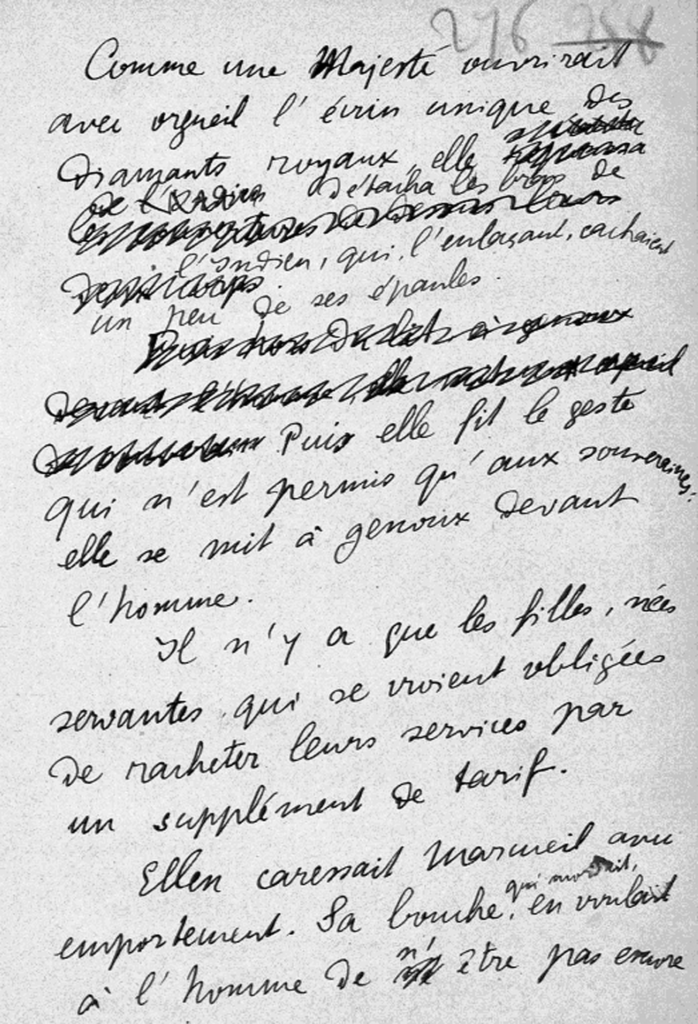
216
Like a m Majesty would open
with pride the unique casket of
royal diamonds, she she pushed back
of the Indian detached the arms of
then out of bed on her knees
before the man she swallowed a pride
of sovereigns
the arms
the Indian, who, embracing her, hid
half body
a little of her shoulders.
Then out of bed on her knees
before the man she swallowed her pride
and nobly Then she made the gesture
which is only permitted to sovereigns,
she knelt before
the man.
There are only girls, born
servants, who think themselves obliged
to redeem their services by
a supplement of tariff.
Ellen caressed Marcueil with
who bit,
impetuosity. Her mouth, wanted
not
the man not to be yet
What are the teachings of such a document?
First, and this is not useless when one knows the gossip that circulated about Jarry's relations with Rachilde, the author of Monsieur Venus (1884), the same one who would qualify him as Supermale of letters (1928). Wasn't it said that besides this little service she rendered him on request, she substituted herself for him to write entire passages of his novels, to show him how to "write like everyone else"? Now, there is no doubt about the authenticity of the handwriting, at least for those who have read hundreds of handwritten pages by the author or his official papers.
Then, but this is not necessarily in chronological order, we see Jarry at work, as if we were attending a kinetics of writing. Such a word, such a proposition, barely posed, are erased, to be copied identically a few lines further on, and this not during a rereading, but indeed in the very movement of writing.
Contrary to what one imagines when reading a scabrous passage, the deletions conceal no enormity, no term that morality disapproves of and that the author would be obliged to suppress with a view to publication.
In conclusion, this page gives a visual representation of Jarry at work, of his control of the text, of his speed of writing.
Since the entire manuscript is available on the Internet, that it is possible for anyone to compare it to the printed text, is it still appropriate to publish it in complete facsimile, as has been done, with classical means, for other works2?
This is obviously indispensable for the amateur, and even the scholar, who will rejoice to be able to hold in his hands a document similar to the original working manuscript, with its true dimensions, its texture, its stains and its erasures, and, as an addition to the program, its literal transcription.
Alas! it is less so for the general public, who is not used to handling such documents. Not that one should create a hierarchy of manuscripts, based on the quality of the final text, its reputation, its ranking in public opinion, or even the relative difficulty that each autograph manuscript presents, but, more simply, because the overall study of this one, which proves very interesting for Jarry's attitude at work, does not leave hope for any revelation, any repentance other than what the catalog author and, more recently, Henri Bordillon3 had been able to note about the change of paper, the two writings, the particular attention paid to chapter titles, the proliferation of Marcueil's name.
In short, the current readership relies on the conclusions of scholars, and does not ask to go and see for itself. Regrettable attitude, yet quite understandable. Similarly, it asks for a good quality robot, safe, obeying human injunctions, and does not care to procure the engineers' blueprints or the reports of the various tests to know how it was designed.
We will therefore stick, today, to this complex: original edition (or reproduced identically) + digitization of the manuscript + critical edition containing an examination of variants.
Just as our elders, in the 19th century, took years to accustom us to the editing protocol they had fixed, it will take us as much to integrate the means that technological progress gives us.
See the complete text of The Gestures and Opinions of Doctor Faustroll, Pataphysician, established and annotated by Alain Chevrier in The Complete Works of Alfred Jarry, Classiques Garnier, volume III, p. 45-212.
Jean-Jacques Lefrère, co-founder of the journal Literary Histories, biographer of Lautréamont, Rimbaud, Laforgue, etc., died on April 16, 2015. The journal he directed with a master's hand intends to devote a tribute issue to him. While waiting for its forthcoming publication, I found this review of his Arthur Rimbaud, Fayard, 2001. Destined for the journal Europe, which had commissioned it from me, it did not appear, for obscure reasons relating to the location of the Rimbaud house in Aden. And Jean-Jacques, who had read it, was saddened by it. Here it is as it was composed, without any modification, as a personal tribute to this boiling defender of Letters."
Jean-Jacques Lefrère, Arthur Rimbaud, Fayard, 2001, 1248 p.; Rimbaud in Aden, photographs Jean-Hugues Barrou, texts Jean-Jacques Lefrère and Pierre Leroy, Fayard, 2001, 168 p.
Of course, the reader will begin by leafing through the photographic album supposed to show Rimbaud in Aden, so powerful is the attraction of photography. The authors are sure to recognize the poet among Hassan Ali's guests at Sheick-Othman. Is this Rimbaud this stiff young man, with tanned leather, short hair, white drill clothes, leaning on his rifle with the butt at his feet? Let's suppose so and contemplate Aden from the time when he was a merchant there, thanks to this set of photos taken around 1880, confronted, at some distance, with the same view taken today, in black and white to stay in tone. We no longer see camels, constructions extend anarchically, dominated by a few minarets, César Tian's house (who was the first French merchant to establish himself there in 1869) is abandoned, and Bardey's, who employed Rimbaud, has disappeared, replaced by an anonymous building, enhanced with a few disparate air conditioners. And the former French Cultural Center opened on the very site where Rimbaud lived, has become the "Rambow Tourist Hotel". With photos to support it, Lefrère establishes that we were mistaken by a few dozen meters when inaugurating with great media effects this ephemeral Arthur Rimbaud House, for the centenary of his death, in 1991. Be that as it may, sadness dominates, and we understand the young man's exclamation writing to his family: "One must be well forced to work for one's bread, to be employed in such hells!".
But is this young man I speak of the same as the poet? Yes, affirms Lefrère without hesitation in the second work which claims to be a strictly factual biography, conducted in chronological order, with as little anticipation as possible. It's the end of the dual opposition system concerning Rimbaud: seer or thug, cursed poet or mystic in the wild state, slaver or saint martyr, solar system or black hole. As the other poet of revolt, Tristan Tzara, had advocated for the centenary of his birth, it is the unity of a life that Lefrère considers, without erasing oppositions and renunciations.
An observation, first of all: during his lifetime, Rimbaud only published or allowed to be published six writings ("The Orphans' New Year's Gifts" in La Revue pour tous, Jan. 1870; "Three Kisses", in La Charge, Aug. 1870; "The Crows", in La Renaissance littéraire et artistique, Sept. 1872; the collection A Season in Hell printed at his own expense in Belgium, October 1873; the report on the Ogadine, in the Proceedings of the sessions of the Geographical Society, February 1884, notes on an expedition to Choa in Le Bosphore égyptien in August 1887). Moreover, he marked with his disdain the publication of certain Illuminations and "New Verses" in La Vogue in 1886, gathered in a booklet the same year by Verlaine. This is to say from the outset his ambivalence towards the literary thing: he wants to be published, whether as a poet or as an explorer, then loses interest in his work, as if, having gone to the end of an experience, he left it to others to draw the conclusion for the future.
Rimbaud practically did not know his father, an infantry captain, former head of the Arab bureau of Sebdou (Algeria), who would abandon the conjugal home around 1860, at the birth of his fourth child, Isabelle. His absence seems to have given rise to an idealization, on the part of the son, and a partial identification, at least through the quest for desert countries and knowledge of oriental peoples. His mother, Vitalie Cuif, draped in bourgeois dignity, will manifest very great authority over her children. But, contrary to the simplistic image spread about her, she always remained very close to Arthur, tolerating all his deviations, however incomprehensible they were to her eyes.
From school age, Arthur shows himself to be a schoolboy gifted with great facilities. Like all his peers of the same social condition at the same age (see Flaubert or Jarry) his personal productions perfectly illustrate the potach culture, compromise between the classical culture of parents and school, and the popular culture of the circles frequented during holidays.
Rimbaud skips the 5th grade. Virtuoso in Latin verses, he addresses a letter to the Imperial Prince on the occasion of his first communion; he obtains the first prize at the academic competition in 1869, and his masterpieces are regularly published in the Bulletin of the Academy of Douai. His school compositions show in him a very great facility but also a certain originality, his tastes, his ambitions, his desires expressing themselves through the conventional game of verses.
In 1870, in Rhetoric class, the meeting with a young substitute professor of Letters, Georges Izambard, leads him to the most modern literature and leads him to want to acquire literary glory. By aging himself a little, he writes to Théodore de Banville, the leader of the Parnassian School, and sends him three poems of perfect workmanship, the content of which is made to suit the contemporary Parnassus where he hopes, vainly, to be published.
First runaway: at sixteen, in the midst of the Franco-Prussian war, Rimbaud goes to Paris by train. Without a ticket, he is arrested and thrown into prison at Mazas on the 31st of August. Izambard has him released and welcomes him to Douai. It is there that he recopies for a local young poet, Paul Demeny, his first poems, with a view, again, to prompt publication. A week after his return to his maternal home, second runaway: he takes to the road again, on foot, to Brussels. Back in Douai, he completes the Demeny notebook with regular sonnets composed on the way: "The Maline", "At the Green Cabaret", "My Bohemia", which say in a familiar tone "the ease" of this autumn vagabondage, the poetry of walking, always further, the heart full of this nature that penetrates him through all the senses.
The Prussian occupation causes prolonged holidays for schoolchildren. Rimbaud takes long walks in the forest with his friend Ernest Delahaye, to whom he would have drawn a future society: "Every valley shall be filled, every hill shall be brought low, the crooked paths shall become straight and the rough shall be made smooth. Fortunes will be razed and individual prides will be brought down. A man will no longer be able to say 'I am more powerful, richer'. We will replace bitter envy and stupid admiration... with peaceful concord, equality, the work of all for all". Then, it's his third runaway, he stays in Paris, from February 25 to March 10, 1871, in miserable conditions, presenting himself to journalists. He is back in Charleville before the proclamation of the Paris Commune, for which he immediately takes sides.
Nothing says that he returned to Paris to enlist in the free corps. At least, his contemporaries believed so. While citing the abundant literature relating to this supposed fourth runaway, Jean-Jacques Lefrère doubts it, insofar as Rimbaud himself never breathed a word about it (p. 247).
In any case, he is in Charleville during the Bloody Week (May 21-28). Besides a hypothetical communist Constitution project, he writes in quick succession, to Georges Izambard on May 13, to Paul Demeny on the 15th, the letters now known as the "Seer letters", which enunciate his new poetics, accompanied by the poems "The Tortured Heart", "Paris War Song", "My Little Lovers" and "Squatting", by way of illustration. As if crossed by a sudden illumination, Rimbaud expresses himself in haste, in a disorderly way, following the movements of his heart and soul, to say the function of the poet to come, charged, by election, to cultivate this innate gift that is inspiration. The second of these letters specifies: "The first study of the man who wants to be a poet is his own knowledge, entire [...] The Poet makes himself a seer by a long, immense and reasoned derangement of all the senses." It must be understood that the poet considers himself as "the supreme Scholar", the one who methodically explores the unknown, by irrational paths. After having been a means of expression, poetry is therefore an activity of the mind and an instrument of knowledge, projection forward, march to progress. And Rimbaud announces a universal language, which would be understandable by all: "This language will be of the soul for the soul, summarizing everything, perfume, sounds, colors, of thought catching thought and pulling". To woman he predicts an eminent role, when she will be emancipated, and distinguishes some of his predecessors who were true seers: Baudelaire and Verlaine.
He writes to Demeny on June 10, 1871, asking him to burn all the verses he had entrusted to him before: "burn, I want it, and I believe that you will respect my will as that of a dead man..." Like Max Brod, subjected to a similar injunction from Kafka, the latter did nothing about it, and it is thanks to him that we can read the first Rimbaud.
The one who "works to make himself a seer" has not given up the idea of being a recognized poet. He addresses to Banville a new ironic poem where the lilies are "clysters of ecstasies": What is said to the Poet about flowers, signed with a pleasant pseudonym, and as early as September, through the intermediary of Charles Bretagne (p. 309), makes contact with Verlaine to whom he addresses his latest productions. Enthusiastic, the latter replies: "Come, dear great soul, you are called, you are expected", and offers to lodge him at his home. Rimbaud comes to Paris with, in his pocket, various poems that will ensure his reputation, notably "The Drunken Boat", and perhaps the sonnet "Vowels" which by its formal perfection and the mystery of what it designates has aroused many contradictory interpretations. Lefrère eludes them by enumerating the precursors of colored vision (p. 433).
From then on, Rimbaud is quickly integrated into the group of new poets, baptized the Ugly Good Men, become, for most of them, the Zutists. He amazes them with his facility, his excesses in everything. His contributions to the Zutique Album, revealed since 1943, show his virtuosity in the parodic, the "old-Coppée", the grainy and the obscene. Let's cite a few titles: "Bullshit", "State of Siege?", "The Remembrances of the Idiot Old Man", the "Sonnet of the Asshole" composed with Verlaine, "Our asses are not theirs...". Let's not exaggerate their importance: they confirm Rimbaud's precocity and the extent of his palette but they were not intended for publication, no more than the others, constituted in a collection despite him. More certainly, it is from his stay at the Zutistes' premises that dates his ascendancy over Verlaine and his bad reputation as a homosexual. The excesses of Rimbaud and Verlaine scandalize their family and friends, even the poets, all the more so as Verlaine is married and has just had a child. The two lovers will know two years of common life and wanderings, interspersed with separations and repentances. In the chapter entitled "the communards' meal", Lefrère devotes a long development to The Corner of the Table, Fantin-Latour's painting on which they both figure, immortalizing both the painter and his models.
In the spring of 1872, Rimbaud returns to Charleville after a detour via Arras, about which the biographer remains ignorant (p. 456). He frequents the municipal library where he reads all sorts of books: "I loved idiotic paintings, door panels, sets, acrobat canvases, signs, popular illuminations; outdated literature, church Latin, erotic books without spelling, novels of our grandmothers, fairy tales, little books of childhood, old operas, silly refrains, naive rhythms", he will write. He composes "Void Studies", which he recopies in May, during a new stay, relatively secret, in Paris. Lefrère tells us that Verlaine lodged his "Ardennes catamite" (p. 468, the expression doesn't sit well with some Rimbaldians) rue Monsieur-le-Prince. If we have been able to collect the set that editors entitle "Last Verses" or "New Verses", various texts seem forever lost: his Expression Notebook of which Richepin spoke, prose poems, and The Spiritual Hunt object of a theatrical hoax in 1949.
On July 7, 1872, Rimbaud and Verlaine flee to Belgium, where they remain two months, then "the funny household" stays in London, among the Commune emigrants, about whom the biographer is inexhaustible.
In the spring of the following year, Rimbaud retreats to the family farm in Roche, meeting Verlaine and Delahaye on Sundays near the Belgian border. He still composes verses, and the first texts of what will become A Season in Hell which he calls a "Pagan Book" or "Negro Book". It is perhaps also from this time that we must date two prose sketches: "The Deserts of Love", oniric relation of previous experiences, and an evangelical suite, or Johannine proses, rewriting the New Testament, or rather filling in the silences.
From May 28, the two companions, having passed through Belgium, meet again in London, where they try to survive by giving French lessons. After a violent quarrel, Verlaine flees to Brussels, then asks Rimbaud to join him, announcing to everyone that he is going to commit suicide. On July 10, he fires a revolver shot at his friend, wounding him in the hand. The Brussels affair "is one of the most famous news items in literary history" (p. 595) says Lefrère who returns to the police archives to tell and interpret it in detail: we will read the appalling expert report on Verlaine's bodily examination (p. 617). The latter will be sentenced to two years in prison, although Rimbaud has withdrawn all complaint. The young man sees his "pitiful brother" again when he leaves prison, and would have beaten him soundly (but Lefrère doesn't believe it) during a walk in Stuttgart, where he was learning German, which marks their final break at the end of February. Yet Verlaine, who had introduced him to the literary world, and loved him in tearing, will never cease to be concerned about his work, presenting "Vowels" and "The Drunken Boat" in the journal Lutèce in 1883, devoting an important part to him in his study on The Cursed Poets in 1884, writing the notice of the Illuminations (of which Rimbaud had entrusted the manuscript to him in Germany) two years later, then the preface to the Complete Poems in 1895, at Vanier, the publisher of the Decadents.
Back in Roche, Rimbaud completes there in a month, in fury and exaltation, the collection of prose poems, A Season in Hell, which he has printed in Belgium, having convinced his mother to advance the publishing costs. "My fate depends on this book...", he writes to his friend Delahaye, in the perspective of a literary career to which he has not given up. He withdraws the author's copies, which he distributes to a few Parisian friends. But, for lack of money, the entire print run remains in deposit with the printer Jacques Poot, in Brussels, where a collector will discover it at the beginning of the twentieth century.
At the time when Rimbaud is supposed to have completed the Illuminations, he is in England with the poet Germain Nouveau who helps him recopy some of his poems. He lives from French lessons and seeks a tutor position. At the end of 1874, he returns to Charleville. From there begins an era of wanderings and vagabondage, which has intrigued all his admirers, including Verlaine who designates him as "the man with soles of wind", by allusion to his qualities as an indefatigable walker. But above all, he definitively turns away from poetry, to become a man of action, declaring to a companion who informed him of the publication of his poems in La Vogue, in 1886, that he no longer wanted to hear about these "rinsings"!
With the same passion he devoted to poetry, Rimbaud wants to devote himself to industry. In 1875, he will consider taking the science baccalaureate as a free candidate (p. 728). He learns foreign languages. After Germany, he stays a month in Milan. Struck by sunstroke on the road from Livorno to Siena, he is repatriated to Marseille, where he would have tried to enlist in the Carlist troops and pass to Spain. And here he is back in Charleville where he places himself as a tutor and considers becoming a Brother of the Christian Schools, to teach in the Far East! The death of his young sister Vitalie affects him: at her funeral, he appears with his head shaved. Then he leaves again for Vienna, where he gets robbed. Return to Charleville, departure for Holland. He enlists there in the colonial army, goes as far as Sumatra, deserts, embarks under a false name on a Scottish ship that takes him to Liverpool via Ireland. In December 1876, he is back in Charleville. As soon as the fine weather comes, he leaves again for abroad. Recruiting agent for the Dutch, circus employee in Sweden and Norway. In autumn, he embarks at Marseille for Egypt. Illness forces him to disembark in Italy. He spends the winter again with his family. Then second departure for the Orient from Genoa in order, he believes, to save on transport. Crossing the Saint-Gothard on foot, on a snowy storm day; he hires himself as a foreman in a marble quarry in Larnaca (Cyprus). Disputes with workers, typhoid fever, he is forced to repatriate to Roche where he spends the summer. New departure attempt in autumn, new fever attack in Marseille, new retreat to Roche for the winter. In March 1880, he returns to Cyprus where he is hired as head of works for the construction of the governor's palace. In July, he resigns, perhaps following the murder of a worker, which he would have committed in a fit of anger. This episode, revisited by Lefrère (p. 778), remains just as hypothetical. It is then that he embarks for Arabia.
Aden, port on the Red Sea, sees him employed by the Bardey house, import-export trading post. From there, he is sent to run the Harar agency, in Abyssinia. He will stay there for ten years about which we are surprised to have so many details, interspersed with stays in Aden, and explorations in the then little-known territories of the Ogadine and Choa. Thirsty for knowledge, he learns vernacular languages, has the most recent technical and scientific books sent to him, a very sophisticated photographer's equipment which he learns to handle alone. He always wants to be the best at everything, and particularly in modern techniques. But, like Bouvard and Pécuchet combined, nothing he undertakes can succeed. Bad luck. In 1884, he lives maritally with an Abyssinian woman in a house in Aden. One day, at the end of 1885, he smells a good deal by reselling a batch of outdated rifles to King Menelik who disputes the throne of the Negus with his suzerain. His associate dies prematurely; the French government, concerned to maintain good relations with the English, refuses the export of arms, and finally grants it. Rimbaud attempts the adventure alone. He runs after Menelik who takes his delivery at a low price and condemns him to pay his associate's debts... After vain attempts to leave for the Far East, he returns to Harar to set up a commercial agency. "I am very bored, always; I have never even known anyone who was as bored as I am" he writes to his family. In 1891, he suffers from his right knee. Forced to stay in bed, he directs his business from his terrace. Hard to the task, he finally resolves to be treated in Aden. In twelve days, under torrential rains, across three hundred kilometers of desert, a team of porters leads his litter to the port of Zeilah where he embarks for Aden. The British doctor suspects knee cancer. He arrives in Marseille, Conception hospital where, on June 27, he is amputated. Back in Roche for his convalescence, his condition only worsens. He returns to Marseille accompanied by his sister Isabelle. The next day, he must be hospitalized. Completely paralyzed, he dictates a delirious letter to the director of the Messageries maritimes, where he asks to be carried on board the next ship departing for Aden. He dies fifteen days after confessing, to please his sister, thinks Lefrère (p. 1165).
Irony of fate, at the time of his death appears Reliquary. Poems by Rimbaud, edition provided by Rodolphe Darzens, withdrawn from sale following a conflict with the publisher and Rimbaud's family. Having turned away from poetry fifteen years earlier, had he for all that given up writing? It doesn't seem so, as proven by the numerous letters he addresses to his family, where he announces many times his desire to relate, with a view to publication, his expeditions in unknown countries. "For I am going to make a work for the Geographical Society, with maps and engravings, on Harar and the country of the Gallas" he writes on January 18, 1882. This intention will be concretized by a report published two years later, and a series of notes in an Egyptian journal. In other words, during his lifetime, Rimbaud makes himself known as much as an explorer as a poet. No more, no less. It will be up to others to collect his poems and publish them, in the same way that we will find in his personal correspondence all the elements of an adventure where "rough reality" is noted with concision and precision, without literature, if I dare say, for the purpose of knowledge. But, in both cases, isn't it the same will expressed in the Seer's letters?
Unity of Rimbaud, therefore, which does not mean simplicity. Following him step by step, without preconceived idea, Jean-Jacques Lefrère shows all his ambivalence. We will appreciate the scrupulous approach of the biographer providing all the pieces of the file, replacing them in their context by analyzing them, rectifying the legends, re-establishing the exact places with a jaculatory faconde. Making light of text theories, he returns to positive literary history. But in fact, wasn't Rimbaud a poet?
Henri BÉHAR 07/26/2001
1 See the document provided by the Society of Friends of Alfred Jarry
2 Let's think, for example, of the beauty of the autograph notebook of Arcane 17 offered by André Breton to his wife, Elisa, published by me at Biro éditeur, in 2012.
3 "Marcueil in the text", L'Étoile-absinthe, No. 132-133, 2015.