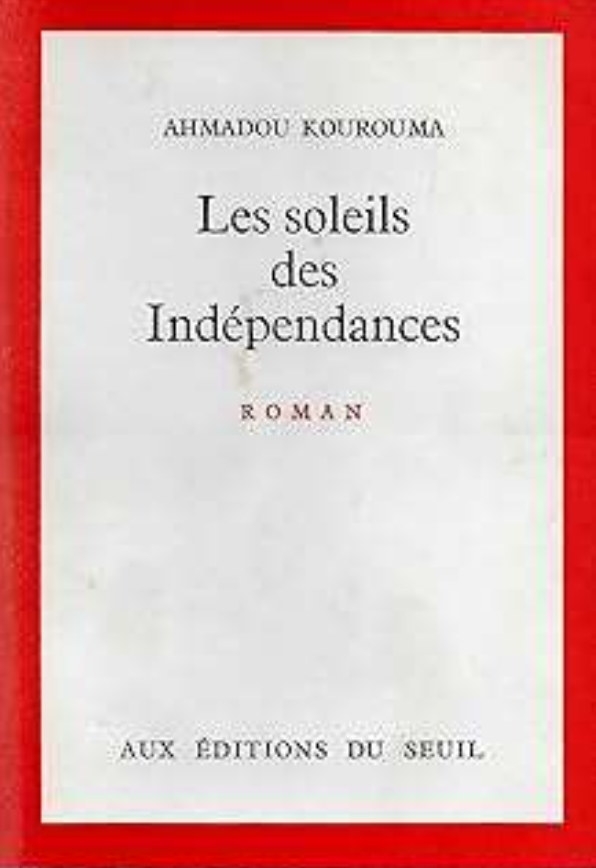
Preface to Jean-Francis Ekoungoun, Ahmadou Kourouma through his working manuscript, Paris, Connaissances et savoirs, 2013, p. 9-13.
The history of this preface is not lacking in pepper! It must be believed that I had not left a bad memory during my teaching at the National University of Côte d'Ivoire, in Abidjan, since, at the beginning of the 2000s, the Director of the French Department, my colleague Barthélémy Kotchy (1934-2019) sent me one of his students, Jean-Francis Ekoungoun, who wanted to prepare a 3rd cycle thesis on a French author of the 20th century. It was about Colette, it seems to me. However, from our first interview, I realized that he was more interested in Ivorian authors, seeking to study the passage from manuscript to final printed version. Since he was to stay in Paris, I suggested that he contact Ahmadou Kourouma, the greatest novelist of his country, who then lived most of the time in France. I had known him well in Côte d'Ivoire, and knew how open and welcoming he was. After various failures, Francis Ekoungoun managed to meet him. The latter proposed to entrust him with a copy of the manuscript of The Suns of Independence, and gave the necessary instruction to his secretary so that the young researcher could study it, with the pieces in hand. For, if one was aware of the intervention of a Quebec teacher to ensure that the manuscript was accepted by a local publisher, one had no idea of the importance of textual manipulations. This was an extraordinary gift all the more so since the author was to die shortly after, on December 11, 2003, and no one had been able, beforehand, to establish a critical edition of his founding work. Our researcher therefore initiated himself to textual criticism and genetic studies. So much so that he came to defend his work on December 5, 2006. Here is the summary of the thesis that he presented at the University of Paris III-Sorbonne Nouvelle, before a jury chaired by D. H. Pageaux, and composed of A. Grésillon, P.-M. de Biasi, J. Derive, and myself. This thesis obtained the mention Très Honorable, with the congratulations of the jury unanimously. It was then necessary to find a publisher capable of being interested in such work. To convince him, F. Ekoungoun asked me to help him by composing the preface that will be read below.
Thesis Summary (by J.-F. Ekoungoun):
Theme: The manuscript of The Suns of Independence: essay in socio-genetic analysis
Of which Suns of Independence are we speaking? Of this Text whose so distant and offset aesthetics supported the FLA device, understand: "French language of Africa" or rather of these pages devoted to the period of the Independences of French-speaking Black Africa? Be that as it may, does the reader of the "francité prize" divulged in Quebec then legitimized in Paris read the same narrative as that of Ahmadou Kourouma's draft elaborated as early as 1963? The main stake of this thesis is to have taken the bet of answering it in the negative. Also, we have been more sensitive to the traceability of Kourouma's fundamental work and less to its variant instituted in francophonie. At the confluence of genetic criticism, history (and) of the French-speaking literary field(s), our socio-genetic approach to the Suns manuscript was intended to be an original restitution of the first Kouroumian scriptural dynamic and a repositioning of this writing on its true historical genesis. Since there was no common measure between the historical aspect with the purely aesthetic requirements that ensured the main editorial arrangements of this narrative, we can only accord a legitimacy that is ultimately relative to the fictionalization of history derived from this French-speaking literary product. Moreover, in order to clarify certain commonplaces of Kouroumian criticism based on language, fiction and history, it was important to envisage these interdisciplinary relations according to a non-teleological perspective. What is more, this approach manifests, so to speak, the urgency of a posthumous and integral publication of the Suns of Independence manuscript.
Keywords: Ahmadou Kourouma, The Suns of Independence, autograph manuscript, draft, edition, censorship, self-censorship, unpublished fragment, critical edition, genetic criticism, socio-genetic, francité, francophonie, literary history
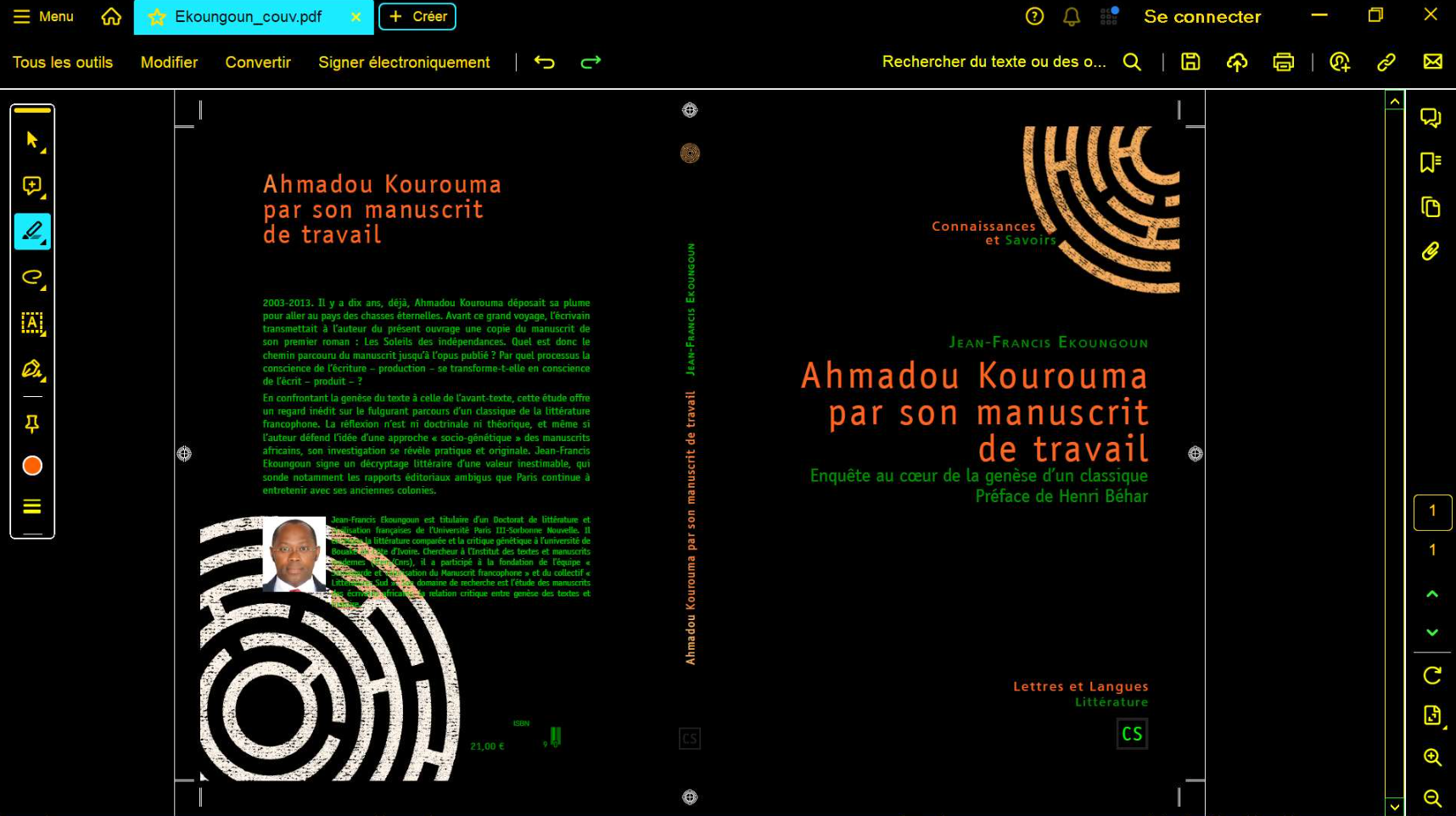
Publisher's note: Ahmadou Kourouma through his working manuscript JEAN-FRANCIS EKOUNGOUN 2003-2013. Ten years ago, already, Ahmadou Kourouma laid down his pen to go to the land of eternal hunts. Before this great journey, the writer transmitted to the author of the present work a copy of the manuscript of his first novel: The Suns of Independence. What is therefore the path traveled from manuscript to published opus? Through what process does the consciousness of writing – production – transform itself into consciousness of the written – product – ? By confronting the genesis of the text with that of the avant-text, this study offers an unprecedented look at the dazzling journey of a classic of French-speaking literature. The reflection is neither doctrinal nor theoretical, and even if the author defends the idea of a "socio-genetic" approach to African manuscripts, his investigation proves practical and original. Jean-Francis Ekoungoun signs a literary decryption of inestimable value, which probes in particular the ambiguous editorial relations that Paris continues to maintain with its former colonies. Jean-Francis Ekoungoun holds a Doctorate in French literature and civilization from the University of Paris III-Sorbonne Nouvelle. He teaches comparative literature and genetic criticism at the University of Bouaké in Côte d'Ivoire. A researcher at the Institute of Modern Texts and Manuscripts (Item/Cnrs), he participated in the foundation of the team "Safeguarding and valorization of the Francophone Manuscript" and the collective "Southern Literatures". His research area is the study of African writers' manuscripts, the critical relationship between text genesis and history.
JEAN-FRANCIS EKOUNGOUN Ahmadou Kourouma through his working manuscript Investigation at the heart of the genesis of a classic Preface by Henri Béhar Connaissances et Savoirs Letters and Languages Literature CS Publisher: Connaissances & savoirs, 338 pages
Preface
A young Ivorian presents a study on the manuscript of a famous Ivorian writer: so far, nothing surprising, even when the author in question is undoubtedly the most important of French-speaking Africa. However, on reflection, everything is surprising. At the time when Jean-Francis Ekoungoun undertook his thesis (and I believe it is still true today for other authors of the same domain), nothing of the initial proposal went without saying. It is hardly customary for a living author to make his manuscript available to researchers, beginners at that. Unless there is an explicit legacy or a particular disposition, such as, for example, the deposit of his own archives at IMEC (Institut Mémoire de l'édition contemporaine) in France, there is no public or private institution dedicated to the conservation of African manuscripts. Finally, to my knowledge, there were no genetic studies on French-speaking African literature, and it was by a hair's breadth that we did not miss this great first. Because he remembered that I had once, at the National University of Côte d'Ivoire, ages ago, given some courses on text genetics and led a seminar between teachers on rewriting, Barthélémy Kotchy asked me to share with him the direction of research of one of his most brilliant disciples. Now, the latter, coming to France, thought to tackle the genetic study of a recent text, by Marguerite Duras I believe. He was far from thinking of the most manifest herald of his own national literature. I have never thought, for my part, that one had to share the nationality of a given writer to conduct relevant studies on him. I even fought for Ivorian youth to seize Proust's work and make him a favorite author. But it seemed to me, precisely concerning The Suns of Independence, that it was appropriate to mark out the terrain, if I may say so, and to take advantage of the presence of its author among us to question him about his way of writing and, if possible, to examine one of his manuscripts in order to lay the foundations, precisely, of a genetic study applied to African texts. A rare thing in youth, Mr. Ekoungoun knew how to listen to me and, above all, to glimpse all the advantage he could draw from a thesis that would bear on the unnoticed origins of Ahmadou Kourouma's work and its transformations. What did he risk by addressing his great elder? at worst, a refusal to receive, and a slight delay in the advancement of his research. At best, an invitation to meet him, to take cognizance of one or several manuscripts. He undertook the approach. The result was beyond his expectations. He recounted in detail in his thesis how things happened and how, by misfortune, Kourouma disappeared at the very moment when both were to discuss the making of the text. The curious can refer to it. The essential thing, which it is appropriate to emphasize so much the thing is rare, is that the illustrious writer entrusted to his young brother, as he said, the photocopy of his first novel. There is no doubt, in my eyes, that, just like Victor Hugo bequeathing the whole of his manuscripts to the National Library, or Aragon transmitting his papers to the CNRS, Kourouma had glimpsed the capital role that his own manuscripts were to play for the study of his work. This is also the reason that led his heirs to deposit them, when the time came, at IMEC. If I insist on such a gesture, accompanied by great confidence in youth, it is because, as a general rule, writers do not much like to be looked over their shoulder at the moment when they are seeking a perfect adequacy between their thought and their writing. "Thought is made in the mouth," affirmed Tristan Tzara, who extended this aphorism to painting and to the hand. However exact it may be, the formula does not find its immediate mode of application, especially within the framework of a predefined genre such as the novel. Hence the plans, the multiple avant-texts preceding the delivery of a manuscript to a publisher, then the corrections, even the transformations that the latter can suggest. Experience shows that, except for external intervention, authors have sufficient awareness of the intrinsic interest that their work before publication represents to piously preserve its traces. What do they do with it? For economic reasons easy to understand, the practice has spread, since the 19th century, of trading in manuscripts. These are, for the most part, handwritten copies to which the impecunious author devotes himself to flatter the tastes of such and such a patron. Whatever their rating, all the higher as merchants foresee a preemption by the State, they are of interest tending towards zero for researchers. For them, what prevails are the working notes, drafts, more or less transformed fair copies that constitute the material on which they intend to focus, too happy when they are provided with the possibility of going through all the stages, all the transformations that lead from the first idea, the initial illumination, to the BAT (Ready to Print) carried by the author on the final proofs. Jean-Francis Ekoungoun therefore had the signal chance of receiving from the author himself the complete manuscript of The Suns of Independence. At what stage of the creative process is it? Obviously, the researcher, endowed with an insatiable curiosity, would like to have also the drafts, notes, small spiral notebooks on which Kourouma noted his projects, his thoughts. As for the reader, just as curious, he impatiently awaits a critical edition of the novel, probably established by a whole team of researchers, which should not be long in coming. For the time being, he will make his honey from the analyses developed here from the manuscript. Let him not be put off by the terminology of genetic analysis. Formerly, to transcribe the different modifications of the text appearing on a manuscript, our masters, our friends, refined the transcription rules, specifying whether such a crossed-out word was replaced by a word appearing on the same line, above or below, in pencil or ink, etc. All this carries meaning, incontestably. But the editorial revolution introduced by word processing allows us to explicitly represent the crossed-out word (single or double crossing out), italics, bold, and the position relative to the line, margin, etc. Often, it is easier to reproduce the page in facsimile, parallel to its decryption. So that one can now content oneself with a simplified transcription, such as Mr. Ekoungoun practices. Similarly, long accustomed to scrutinizing poets' manuscripts, I have come to the idea that all transformations of avant-texts can be summed up in three logical operations: addition, suppression, transformation. Stupefaction! the manuscript of The Suns of Independence is much longer than the finally published text. It was known, both through Georges-André Vachon and through Kourouma himself, that the manuscript had been reworked with a view to its edition in Montreal, the Quebec publisher being enthusiastic about the work, while wishing for some corrections, to satisfy the taste of the postulated public. But one did not think the suppressions so numerous. A quarter of the manuscript, that's not little! Ahmadou Kourouma lent himself with good grace to these amputations, not without reserving the matter, which he will reuse in Waiting for the Vote of the Wild Beasts. As which good literature is like haute cuisine, the art of using leftovers! One will therefore see, in detail, how certain characters were eliminated, how certain passages were adapted. What is remarkable is that G.-A. Vachon's intervention is never perceptible. Also he was only the discreet advisor, the reader and not a novelist concerned with imposing his own recipes. Certainly, sociological and especially political reasons prevailed, due to the historical context evoked by Mr. Ekoungoun, and notably the false plots of 1963 mounted by Houphouet-Boigny. One should not overvalue them to the detriment of critical feeling. Quasi contemporary of the author he had just discovered, good connoisseur of modern literary aesthetics, Vachon had, at least intuitively, the sense of public expectations, in the most general sense of the term. In this case, the French-speaking space. It is indeed he who pushed the author of what was intended to be a "narrative", and even, more precisely, testimony, to prune everything that was reportage to concentrate on what became "novel", and what a one! Which, moreover, does not exclude the denunciatory value of the work, but carries it to a universal level. By relying on the manuscript, by referring to the historical context, Mr. Ekoungoun gives back to the text all its factual thickness. He establishes the soil on which the novelistic narrative takes root, by specifying the events lived in his flesh by the author as by his hero. It is not indifferent that it is Kourouma, the truth-teller, who opened the trail himself to his little brother, thus associating, very concretely, research with creation. From which all hopes are permitted. Thanks to Mr. Ekoungoun, we know that Kourouma kept the preparatory files of most of his works. Beyond the sociogenetic perspectives explored here, one can dream of other studies that would reveal to us how the author forged his language, day by day and step by step, which was to lead him to this reviviscence of the French language for which we are all grateful to him.
Henri BÉHAR Professor Emeritus at the Sorbonne
This same text was taken up in: Henri Béhar, History of Literary Facts, Classiques Garnier, 2023, p. 131 sq.
See: Genesis, The avant-text of The Suns of Independence, by Patrick Corcoran and Jean-Francis Ekoungoun: https://ia801403.us.archive.org/17/items/sleiindp/sleiindp.pdf
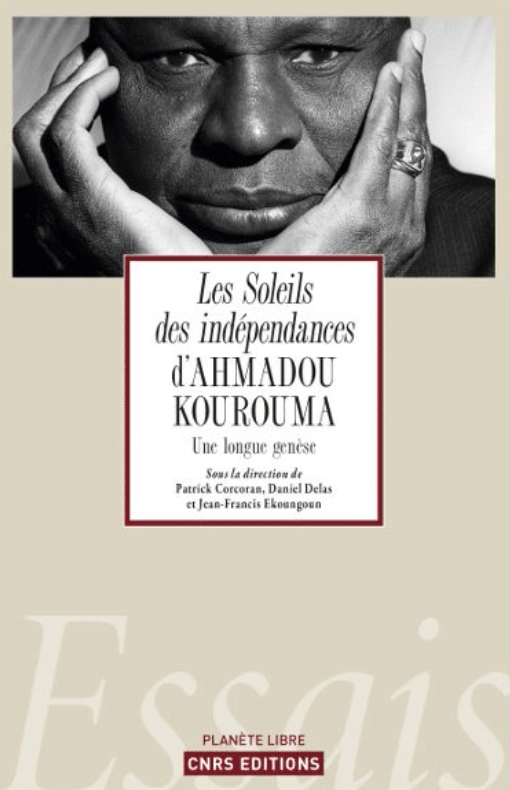
- A long genesis - CNRS Editions
The Suns of Independence by Ahmadou Kourouma is one of the most striking novels of French-speaking African literature of the 20th century. Celebrated by critics from its publication, the novel has known an immense success that has never wavered, due to the formal qualities of its writing and the power of the narrative. But it is also a work that is debated, due to the political dimension of its subject: the narrative draws up an uncompromising indictment of Ivorian society and governance in the post-independence period. Kourouma is not a simple chronicler. His ambitions exceed the conjunctural framework in which one might have wanted to confine him. Opting for a resolutely hybrid style and speech freed from any wooden language, he bets on a new novelistic aesthetics that makes culture and language solidary, and that multiplies innovations at the risk of upsetting the French written tradition. His audacities, both linguistic and political, enchant many readers but also disturb many others. That is why, despite its masterpiece appearances, the text experienced such serious difficulties before being able to appear. Rejected by French publishers, initially published in Canada but subject to revisions imposed on the author, The Suns of Independence is a work that deserved more than any other to be reread in the light of its genetic journey. This is what the contributions gathered in this volume propose: to plunge into the history of the text both to understand the conflictual genesis of the work, the new novelistic poetics it invents and the difficult emergence of a creator who now counts among the great contemporary writers.
Extensions:
Ahmadou Kourouma: living memory of geopolitics in Africa - Introduction - Presses Universitaires de Bordeaux (openedition.org)
CORCORAN (Patrick), DELAS (Daniel), EKOUNGOUN (Jean-Francis), dir., The Suns of Independence by Ahmadou Kourouma: a long genesis. Paris: CNRS Éditions, coll. Planète libre essais, 2017, 260 p. – ISBN 978-2-271-11758-8
Read: