"PICASSO IN THE INK MIRROR", IN THE ARTIST IN REPRESENTATION, TEXTS COLLECTED BY RENÉ DÉMORIS. PARIS, ÉDITIONS DESJONQUÈRES, 1993, PP. 199-213.
At the start, there is a colloquium project: The Artist in Representation: proceedings of the Paris III-Bologna colloquium / organized by the Center for Literary Research and Living Arts, University of the New Sorbonne, April 16-17, 1991, during which I present a somewhat risky contribution, since I speak of an artist through his own writings, unlike all other interventions. The proceedings are then collected by René Démoris, Paris, Éditions Desjonquières, 1993, 213 p., 22 cm.
The publisher proceeds to a specific printing for the Proceedings:
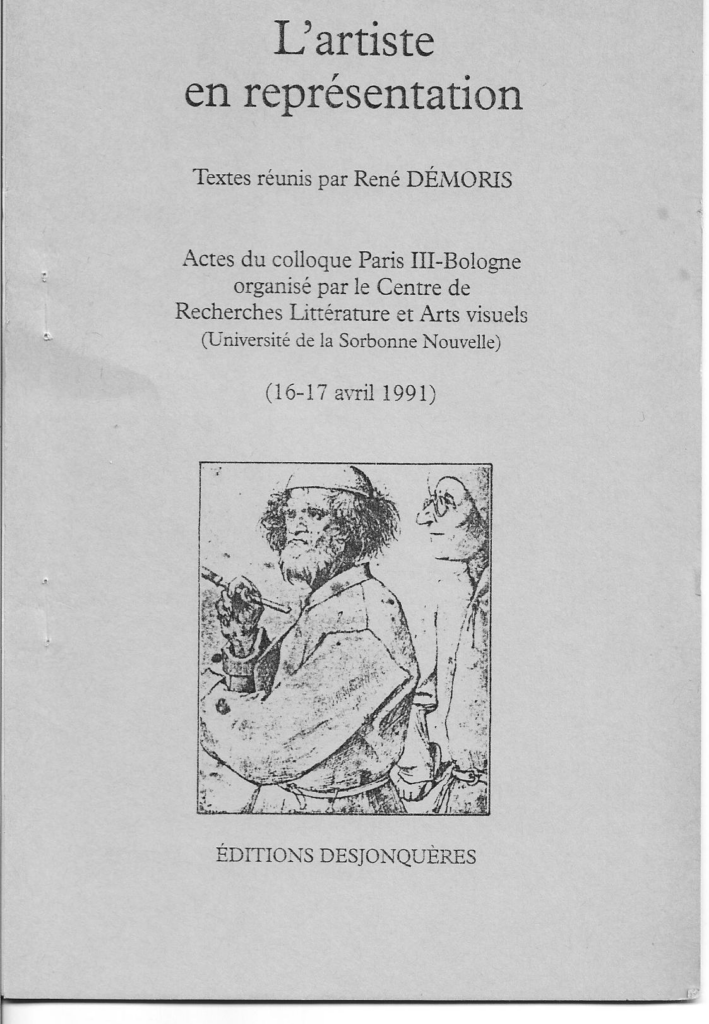
This first printing accompanies a "general public" edition, where the university reference is removed from the title page. Here is its presentation:
Since the end of the Renaissance, painters have the right to a history. Sacralized, heroized or cursed, the artist gives to dream, to think, to speak, to write, as if each one, in questioning an inexplicably different activity, found there the most secret of his fantasies. The questions about the painter's person, his relationship to the work, have gradually extended to the specific spaces he engenders — notably that of the studio. These reflections in turn influence the image that the artist has of himself. The various analyses collected in the artist in representation allow us to better appreciate how the pictorial universe works the imagination of literature.
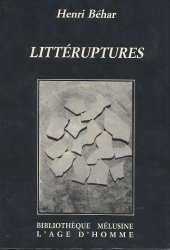
Text previously published in: Henri Béhar, Literuptures, Lausanne, L'Age d'homme, 1988, 256 p. "Mélusine Library", pp. 101-112.
Bibliographies on Arts and Literature
Dallenbach, Louis, Mosaics, Paris, Seuil ("Poetics"), 2001.
Cf. Arnaud Maillet, The Ink Mirror. Visual Images, Mental Images, Literary Images
Read:
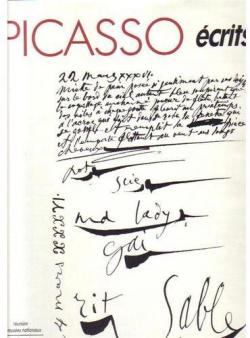
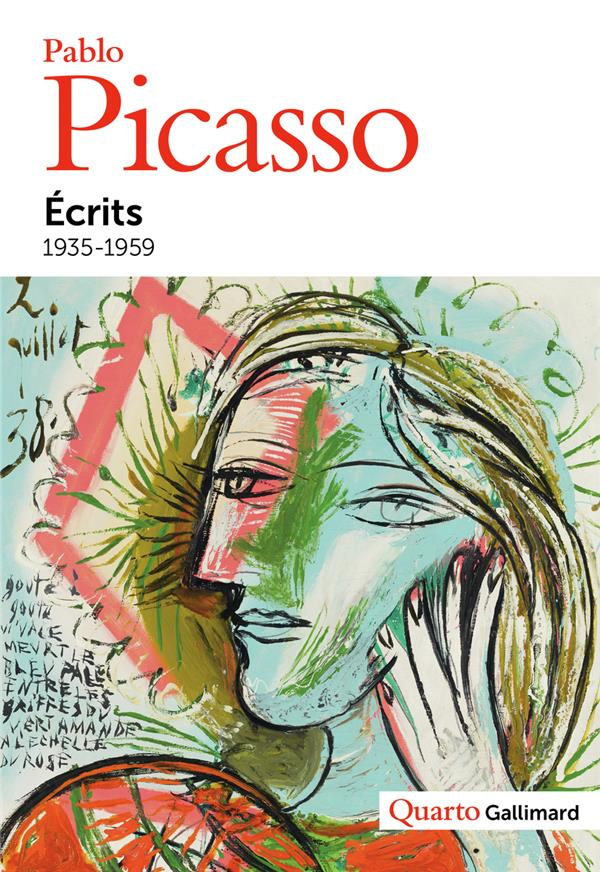
Picasso, writings, ed. Marie-Laure Bernadacet Christine Piot, translated from Spanish by Albert Bensoussan, Gallimard, 1989, 496 p. 2nd edition:
Summary:
This book presents for the first time all of Picasso's writings: more than three hundred and forty poetic texts and two plays, written in Spanish or French between 1935 and 1959. Apart from a few publications in journals or volumes, most of these texts had remained unpublished. Picasso has always maintained privileged links with writing, as evidenced by the use of letters and words in his cubist works and his close relations with the poets of his time. He truly began to write in 1935, at a time of crisis in his private life, which prevented him from painting for several months. Then he continues to pursue painting and poetry side by side until 1941. The war and post-war period see the appearance of two plays: Desire Caught by the Tail, in 1941, and The Four Little Girls, in 1947-1948. A few isolated texts still appear in the fifties to lead to the last known texts of 1957-1959, published under the title: The Burial of the Count of Orgaz. Of very free workmanship, and practically without punctuation, these texts largely fall within surrealist automatic writing, even if they are often reworked in several states or variations. They maintain close correspondences with painting, evoking the same themes (love and death, war and bullfighting, crucifixion and minotaur...). Written in Chinese ink on Arches paper sheets, they strike as much by their content as by their calligraphic aspect. The work presents the texts in chronological order, in French, with the original texts in Spanish. It is abundantly illustrated with reproductions of the manuscripts which allow one to appreciate their graphic qualities. Each text is completed with a detailed notice describing its various states, and establishing their differences. In appendix are the handwritten journals (1893-1895), the notes on art and painters, and the isolated or undated fragments. Picasso painter and poet: "After all the arts are one, he said, one can write a painting in words as one can paint sensations in a poem." The publication of these writings, already envisaged during the author's lifetime, reveals an unknown aspect of Picasso's genius, and constitutes a fundamental contribution to the knowledge of the work and the man.