"MASCULINE/FEMININE", BY ELZA ADAMOWICZ, HENRI BEHAR, VIRGINIE POUZET-DUZER MÉLUSINE, NO. XXXVI, 2016, PP. 9-18.
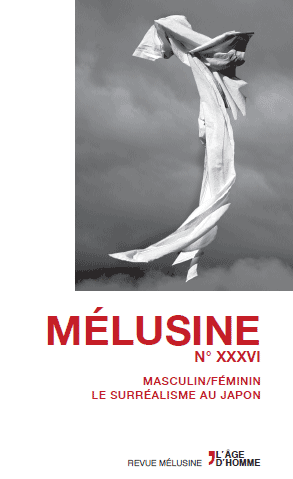
This thirty-sixth issue of Mélusine contains two dossiers:
The first, Masculine/Feminine, organized by Elza Adamowicz, Henri Béhar, and Virginie Pouzet-Duzer, asks not the question of genders in surrealism, in the Anglo-Saxon manner, but how each author or artist has translated the masculine or feminine part that is in each of all.
To the sociocultural approach, which obviously had to be recalled, we have here attempted a more precisely stylistic approach of genres (rhetorical sense) through genres (sexual sense). "I would like to be able to change sex like changing shirts". Simple quip on Breton's part? The fact remains that in interwar surrealism, masculine-feminine relationships as well as the concepts of femininity and masculinity are characterized by ambiguity (retrenchment and search), oscillation (the game of exchanges), transgression (the beyond of the body), becoming (the undefined of Cahun), fusion, even confusion.
This synthesis of the various progressive slippages of desire does not claim to exhaust the subject, much less to establish a ranking.
It is up to the reader to nourish himself on each contribution in order to complete the puzzle composed by a cohort of artists opportunely gathered over a period of twenty years to say, through their creations, and each in his own way, the world to which they aspired.
The second dossier, surrealism in Japan, constituted and presented by Martine Monteau and Atsuko Nagaï, gives an overview of the reciprocal influence exerted between surrealism as it was constituted in France, we must naturally agree, and Japan, and of the impact on the thought, writing or artistic practices of each other.
In the West, as in the East, it was a question of poetically grasping circumstantial, immediate beauty that passes and goes. This responds to the aesthetics of Japanese poetry and art – apprehending the eternity of the instant, conjugating the subtle alliance of opposites. The surreal is this place of epiphanies. Where the marvelous springs from reality, surprises, suspends the concept, surrealism is in familiar territory.
Table of the Masculine/Feminine dossier:
Elza ADAMOWICZ, Henri BEHAR, Virginie POUZET-DUZER Masculine/feminine 9
Martine NATAT-ANTLE Surrealism, historiographer of gender and transgender? 19
Elza ADAMOWICZ The couple in Max Ernst: "hirondil hirondelle" 29
Léa BUISSON Admissible and inadmissible transgressions. Penalties of Hell or New Hebrides by Robert Desnos 39
Justine CHRISTEN Clothing at the service of a "masquerade with sex" 49
Cosana ERAM Isidore Isou: the insurrection of erotology? 59
David HOPKINS Surrealism and male deficiency: Blind Swimmer, by Max Ernst 71 Constantin MAKRIS The triumph of Oedipus will not take place... surrealism facing the ancestral conflict between Oedipal reason and feminine mystery 81
Neil MATHESON Anatomical fragments: Magritte, trauma and the spoiler 97
Andrea OBERHUBER Towards the neutral: the weightlifter and the minotaur 113
Marie REVERDY Parental identity: sex, gender and citizenship in The Breasts of Tiresias 125
Annie RICHARD The surrealist bible of Gisèle Prassinos or the "sublime point" of the masculine/feminine difference 137
Camilla SKOVBJERG PALDAM The sexual revolution: Reich's influence on Danish surrealism 149
Pierre TAMINIAUX René Magritte and Georgette: the portrait of union 161
Darren THOMAS The transformation of genders in An Andalusian Dog 173
Download the introduction in PDF
Review:
Frédéric Saenen 06/27/2016 Comment Write a review
Unfortunately, not enough echo is made, in the world of criticism, to notebooks emanating from associations or study circles. However, these publications represent precious sources of knowledge. Although emanating from the academic world but not limited to pure researchers, they remain accessible in their content, at least to a public of enthusiasts and enlightened amateurs.
Directed by the specialist of the question Henri Béhar, Mélusine is an institution among publications devoted to surrealism. While one would willingly believe it turned towards the past of an avant-garde whose end many identify with that of its "pope" André Breton, Mélusine here demonstrates that the questions it raises touch on the most contemporary concerns. The first dossier of this thirty-sixth issue, devoted to the Masculine/Feminine duality, is exemplary in this regard. For if the themes of the representation of woman, eroticism, homosexuality, have already been addressed in previous issues, the relationship between sexes, hence between genders, had never been envisaged in the light of what gender studies have taught us since their flourishing in the 90s.
Certainly, the internal dynamics of the surrealist group, masculine to the point of machismo, constituted until now a form of obstacle, at least of bias, to an uncomplexed approach. An approach which nevertheless has all its relevance, if only to consider the upheaval experienced by the so-called "strong" sex following the Second World War, in proportion to a considerable social revaluation of woman; if only to also reconsider the ideal of Bretonian "mad love", implemented in Nadja. Facing this sublime character – incarnation of the primordial androgyne or again "fusion of the masculine and feminine principles of the occultist tradition" – emerges a "concept of open, fluctuating, non-essentialist gender" among other proponents of surrealism. It is this zone where blur, decentering and transgression reign that the various participants in the dossier explore.
In the inaugural intervention, "Surrealism, historiographer of gender and transgender?", Martine Natat-Antle has retraced the modernist and surrealist corpus, literary or photographic. She extends a thread that runs from Apollinaire's The Breasts of Tiresias to Aragon's Irène's Cunt, passing through Duchamp's LHOOQ, Victor Margueritte's The Garçonne, Cocteau's The White Book and Claude Cahun's radical self-portraits. Having reached the heart of the labyrinth where she has guided us, she concludes that surrealism will have known how to "question, record and document the multiple facets of gender [and] becomes, unwittingly, in many cases, the spokesperson and agent of plural sexual identities that remain at the heart of debates".
Léa Buisson's reading of The Penalties of Hell or New Hebrides offers us to plunge back into an offbeat text, signed by Desnos, and which remains still too discreet despite its reissue in Gallimard's Collection Blanche in 1978. Clearly situated in the Sadean wake, this catalog of practices veers towards unleashed melee and sings an ode to the "derangement of all the senses" dear to Rimbaud.
To illustrate Breton's aphorism prefacing Man Ray: "I would like to be able to change sex like changing shirts", Justine Christen carves three miniatures of perfect delicacy around the motifs of the glove, the mask and, as a climax, the "body in negative", that is when it clothes itself in night and shadow. She thus explains how the surrealist clothing attribute is put at the service of a veritable "sex masquerade"!
The psycho- and myth-analytical angle is addressed by Constantin Makris, who revisits the conflict, foundational in the West, between Oedipal Reason and Feminine Magic. To do this, he summons the ancestral figure of the Sphinx and sees how the surrealist revolution seized it, which "took charge of establishing the salvific power of the feminine, whose ultimate goal would be to save modern man who wanders in the deserts that Western culture has bequeathed to him".
To choose is to sacrifice; among the four contributions devoted to painters (two on Ernst, two on Magritte), that of Neil Matheson stands out for the ductility of his erudition, which zigzags between disciplines and circulates in René Magritte's complete work, even allowing itself a remarkable comparative escape towards Antoine Wiertz's La Belle Rosine. Starting from the scandal provoked by The Rape – but yes, you know this face recomposed by the sexual or sexed attributes of female anatomy –, Matheson thinks about the permanence of trauma in the Belgian painter.
We cross the permanent insurgent Isidore Isou, we rediscover with dazzlement the tapestries of The Surrealist Bible sewn by Gisèle Prassinos, and the dossier logically closes on an analysis of "the dance of genders", a fleeting but emblematic scene in the last minutes of the film An Andalusian Dog. Barely out of this first abundant part, which had already taken us to Denmark, in the trenches of Berry and to Brussels, the second part propels us to Japan, for a dialogue between the works of Japanese and French surrealists.
A journal, Mélusine? Rather a reference work that gives mad lovers of surrealism an unmissable annual rendezvous.
Frédéric SAENEN
Extensions:
https://www.gazette-drouot.com/article/le-surrealisme-une-affaire-de-femmes–3A-les-pionnieres/24107
"Is there a feminine surrealism?": https://lunettesrouges1.wordpress.com/2023/08/08/y-a-t-il-un-surrealisme-feminin/
Guillaume Bridet: Surrealism between effeminization and virilization (1924-1933): https://journals.openedition.org/itineraires/1273
Documentary: Surrealism in the Feminine, documentary by Maria Anna Tappeiner (Ger., 2019, 52 min).