"Surrealism and Science", preface to: Salvador Dali at the Crossroads of Knowledge, A. Ruffa, Ph. Kaenel, D. Chaperon (ed.), Paris, Desjonquères, 2007, p. 15-25.
I am not the only one to say it: Salvador Dali was much more serious than his antics suggested! Beyond his paintings, he nourished surrealism with his various speculations, and it is not by chance that he collaborated on The Immaculate Conception by Eluard and Breton. This is moreover one of the reasons why I insisted on publishing the manuscript of his Journal in the Mélusine Library (see below). I also supported the organization of a colloquium concerning him at Cerisy-La-Salle (cf.: Dali. On the Traces of Eros (2007) where I gave a lecture "Scatodali: from scatology to eschatology", in Salvador Dali on the Traces of Eros, proceedings of the international colloquium of Cerisy, Notari, Geneva, 2010, p. 82-93 (to read on this same site). The authors of the volume Salvador Dali at the Crossroads of Knowledge participated in this meeting, who asked me for the preface that can be read below. It coincides with the publication of volume XXVII of the journal Mélusine dealing with surrealism and science.
The collection published by Desjonquères editions: Salvador Dalí at the Crossroads of Knowledge, Work under the direction of A. Ruffa, Ph. Kaenel and D. Chaperon, Hors collection, 2007.
Presentation: If the eccentricity with which Salvador Dalí publicly staged himself contributed to his international reputation, it also harmed him by masking the depth of his views and the originality of his imagination as well as his production. Among the best-informed men of his time, Dalí shows a creative spirit, constantly drawing from the knowledge and discoveries of his era. This singularity of a work that takes root in a multitude of knowledge is studied in the light of the artist's writings which, beyond his pictorial, photographic or cinematographic interests, translate his fascination for optics, mathematics or nuclear physics. Some of the best specialists of the Catalan master's work contributed to this publication, following the centenary of the birth of the one who remains, in the memory of the 20th century, as the surrealist artist par excellence whose work constantly transgresses the boundaries between dream and science.
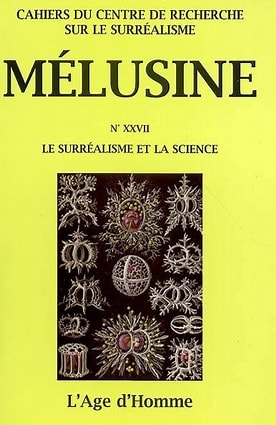
Presentation: The history that will be read in the present dossier begins with the meeting at the Val-de-Grâce, around a dissection table, of two medical students, poets in their spare time. Surrealism would not have taken the direction we know it, particularly in its relations with science, if two of its main animators, Aragon and Breton, had not themselves practiced medicine in wartime and, because they had a poet's complexion, had not emerged from it with intense frustrations. Hence their undisguised enthusiasm for Dada which had the merit, in their eyes, of sweeping away all the principles that had led to these ambient ruins. They absolutely approve of the disdain that Tristan Tzara expresses towards the scientific spirit in his Dada Manifesto 1918: "Science disgusts me as soon as it becomes speculative-system, loses its character of utility - so useless - but at least individual." Freed from its swaddling clothes, surrealism continues to affirm the same contempt for a civilization that has not been able to prevent such an intellectual and human disaster. As usual, Aragon outbids during a Madrid lecture: "I curse science, this twin sister of work." It must be said, in his defense, that he had been surpassed, and by far, by Antonin Artaud in his Letter to the Chief Physicians of the Asylums of the Insane. This offensive attitude, aimed at the establishment powers, as Pascal would have said, and particularly the positivist forces, was undoubtedly necessary in the aftermath of the carnage. It was absolutely necessary to restore to dream, imagination, even analogical thought, the place that had been confiscated from them. This is how Breton will state, in the Second Surrealist Manifesto, a prediction by Commander Choisnard according to which a conjunction of Uranus and Saturn would be likely to engender "a new school in matters of science". Now, he specifies, this conjunction characterizes the birth sky of Aragon, Éluard and his own.
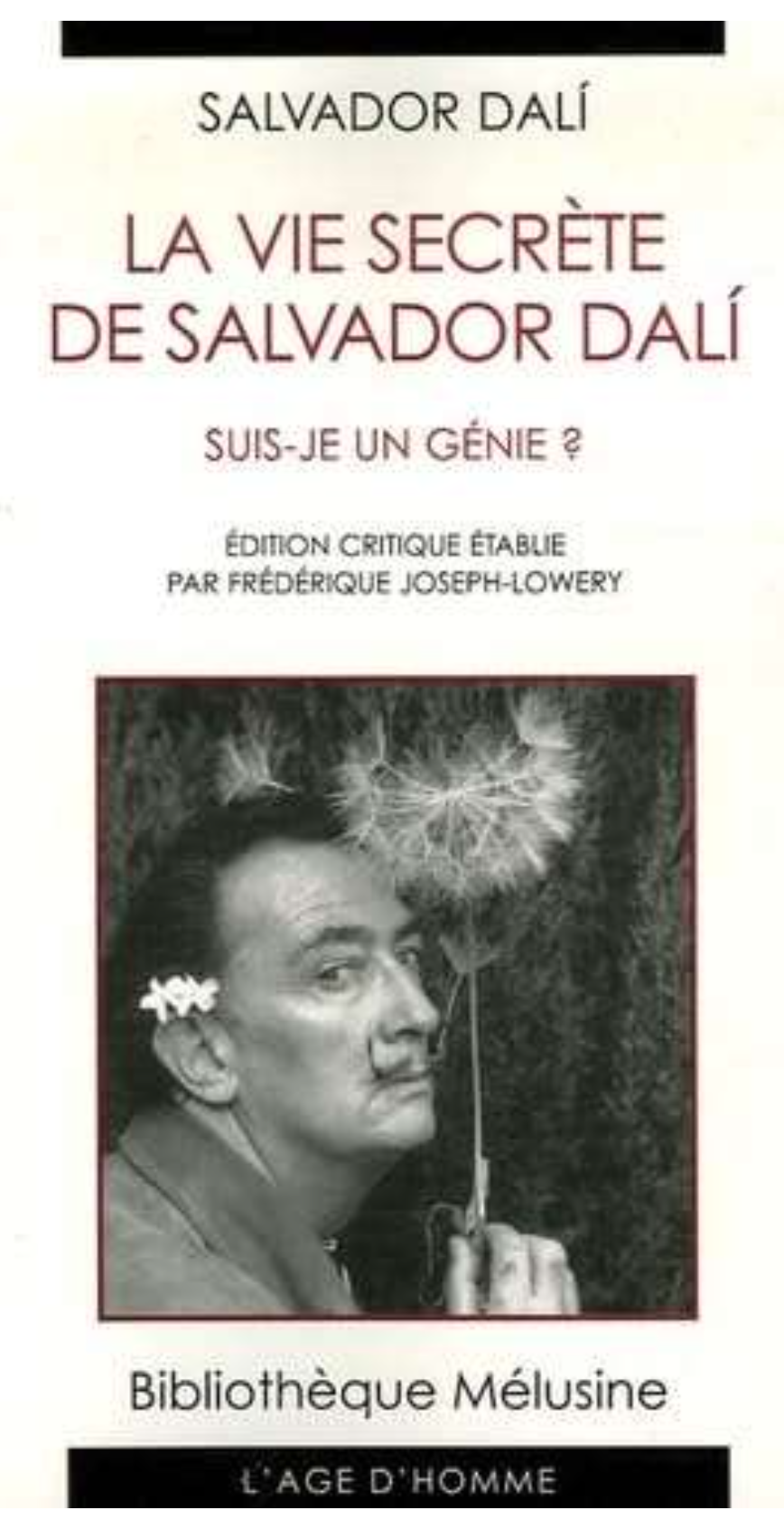
The Secret Life of Salvador Dali: Am I a Genius?: critical edition of the original manuscripts of The Secret Life of Salvador Dalii, L'AGE D'HOMME, 2006, 739 pages.
The Secret Life of Salvador Dali, by Salvador Dali, originally written in French, is published here for the first time. The title, with its signature, is redundant. It specifies an important thing: the text that we give to read was written by Salvador Dali himself. Necessary precision since the text published until today, in whatever language, is not by him. The first publication, American, is a translation signed Haakon Chevalier. It was made from the rewriting of the text by Gala, the painter's wife. The known French text is an adaptation by Michel Déon made from the translation of this second-hand work. A translation of a translation of Gala's text, therefore. The Spanish text is of the same nature. This is where the secret nature of this text lies. Less by what the work reveals - pseudo-confessions published in thousands of copies and reproduced endlessly in the catalogs of his works which recycle to boredom the interpretations - than by the way it held itself in reserve. By authorizing multiple and different versions of the original text, Salvador Dali put his text under secrecy during his lifetime. He placed it in a device of reflections and double images, he surrounded it with simulacra, in accordance with his painter's aesthetics and his famous paranoiac-critical method. A violent text appears. A language going against the careful, smoothed, varnished technique of the painter, and which announces the great splashes of ink and paint, dramatized during many happenings in the fifties. The disrespect towards the sacrosanct French spelling undoes it from its straitjacket and delivers it to us in a materiality to enjoy and full of meaning. The text is dense, sensual, elusive, changing, like the moiré that Dali loved so much. It is traversed by a formidable force, in the impulse of his reveries taken up with pleasure, and in his comic vigor. On the other side of the mirror, it is a text by an unrecognized writer. The painter shows himself adorned with stories; the writer, he is clothed only in his own language, but what a language! Let one judge!