“The Vastest Human Song,” Europe, No. 1066, September–October 2017, pp. 3–14
More than forty years had passed since Europe magazine had dedicated an issue to Tristan Tzara. In the meantime, his complete works had been published in a critical edition by Flammarion. Scholarship and research on this great poet had advanced, reaching well beyond his Dadaist period. It seemed to me timely and appropriate to introduce him to a new generation of the magazine’s readers. I managed to convince the Editorial Committee by drawing on the support of my most engaged colleagues in the field.
For reference:
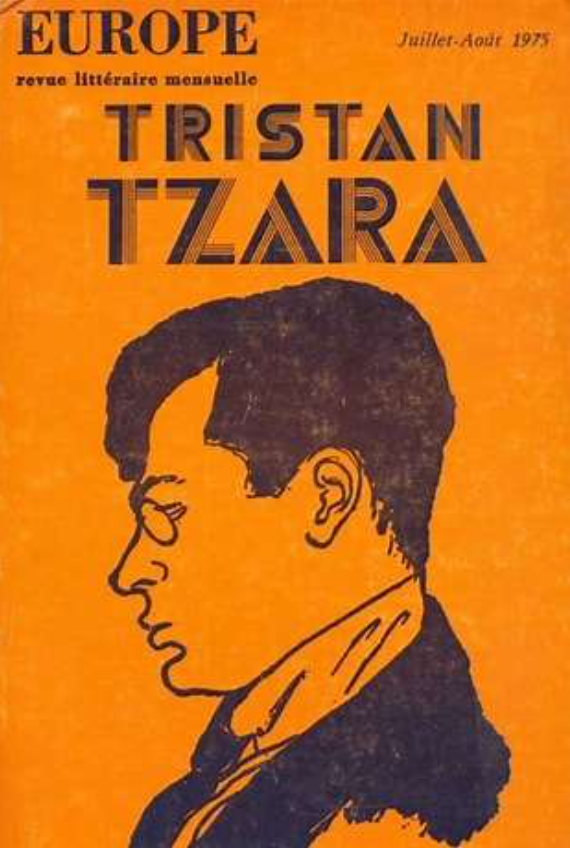
See also:
— “À mots découverts,” Europe, June 1975, pp. 95–112.
Presentation of unpublished works by Tzara, ibid., pp. 58–94.
Below, the cover and table of contents of this new issue:
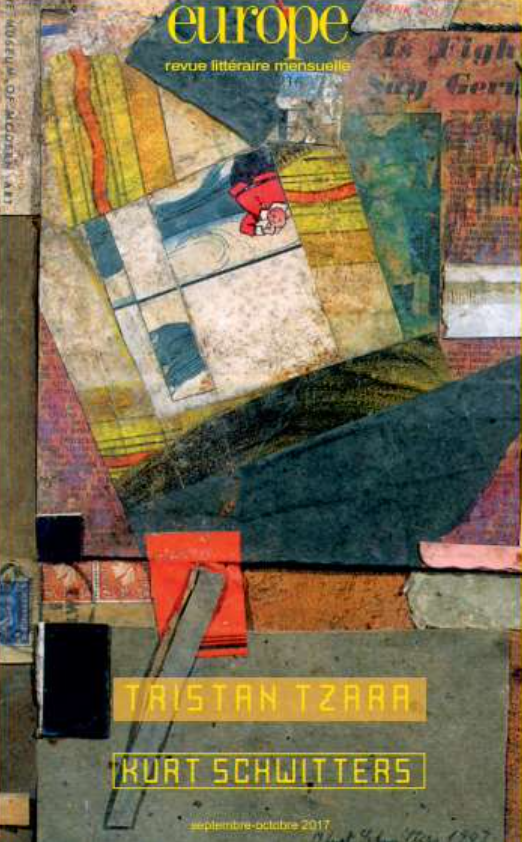
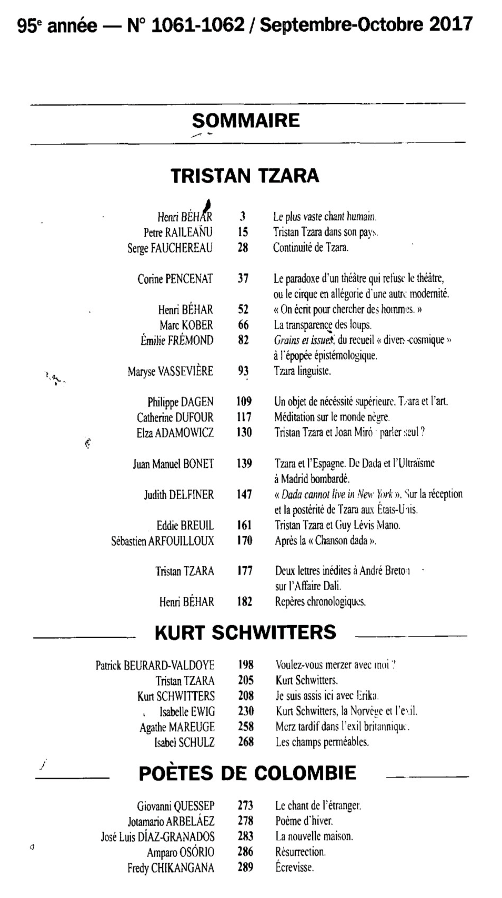
Introduction:
Is Tristan Tzara, like so many other poets, too well-known—therefore misunderstood?
A part of his creative activity, the most youthful phase, seems to have consumed the rest, as if four or five years of intense agitation at the center of Dada had erased a sustained poetic output lasting another forty years.
But do we actually know what his poetic work in service of Dada truly consisted of, beyond everyone’s theatrical gestures? Has Dada really been read?
Doesn’t the public, more often than not, fall back on anecdotes—on the sensational episodes that pepper the chronicles of Dada? And endlessly debate the philosophical meaning that should—or should not—be assigned to the Dadaist endeavor.
For some, Dada is sheer nihilism, and thus it is meaningless to seek to give a positive value to something that explicitly aims at total destruction.
Yet Tzara, for his part, from very early on, strove to demonstrate that any act of destruction led to creation, just as Père Ubu once proclaimed:
“By my green candle! we shan’t have demolished everything unless we demolish even the ruins!”
It is now essential to situate this poet within the continuity of his creative path, and to read his work for what it truly is—not for what it is supposed to represent. In listening to “that voice which had the genius to turn the words of every day into the words of every night,” as Aragon once wrote, we begin to hear a vast song bearing witness to the human condition.
Here is, in full, the introductory text of the special dossier devoted to Tristan Tzara:
Is Tristan Tzara, like so many poets, too well-known, and thus misread?
This has been said about Alfred Jarry, whose legacy is reduced to a single work—which, in fact, he didn’t even write! In this case, the creation consumed the creator, replacing him entirely and merging into a single entity: Ubu.
For others—Jack Kerouac, for instance—a single work, On the Road, was enough to secure their reputation, while casting everything written afterward into obscurity.
For Tzara, it is one segment of his creative career—the earliest and most impulsive—which seems to have obscured the rest, as though four or five years of Dadaist fervor had undone four more decades of steady poetic production.
But do we really know what Tzara’s poetic commitment to Dada was, apart from others’ antics?
I never tire of asking the question: has anyone actually read Dada? And moreover—is Dada even readable?
How does one even begin to engage with this poem, read aloud during a Dada evening in Zurich, of which I offer only the first lines:
AMER AILE SOIR by astronomical nocturnal revolution you gave me knowledge paper friend architecture suede to wait I telephone wings and the tranquility of an instant of limit build in columns of salt: cloud lamps snow and musical lanterns zigzag proportions rings yellow hills yellow yellow yellow oh the soul that whistled the stanza of the pipe yellowed with incense sweat the sister of dark memory mirror the pipes crack and rise and the rattles burst open splitting the air in zigzag [...]
THE VASTEST
HUMAN SONG
Might this be the implementation of the famous recipe involving words drawn from a hat, as proposed by Tzara in one of his manifestos?
Clearly, some of the phrases do carry meaning—or better, they offer the potential for meaning to emerge.
Aside from the pun embedded in the title (amer est le soir, “bitter is the evening”), allow me a textual clue (which I provided in the footnotes of the critical edition of his Complete Works): the poem’s first line comes from Nostradamus’s Centuries, which themselves require decoding.
In the absence of citation marks, we must consider this a case of plagiarism in Lautréamont’s sense—a practice of future poetry—or, to use the language of art criticism, a collage.
From there, words follow one another from line to line, forming the stilts of a hypothetical structure that an attentive reader cannot help but attempt to discern.
Here, nominal constructions and verbal phrases are intertwined, as if they escaped the bounds of rational control. Sparse glimpses of personal confession rise to the surface of the text, yet reveal nothing more.
I could prolong this interpretive effort—this hermeneutics—as there is no guarantee it corresponds, in any way, to the author’s intentions.
Our reading habits, the traditional protocols of textual explanation, collapse—replaced by… by what, exactly? No one knows.
As a result, it would be necessary to devise a new reading method appropriate for each of these supposedly Dadaist works. Few have attempted it!
Especially since there is always the possibility of mystification—as was the case with this Romanian poem, which Tzara allegedly pulled from his pocket and read aloud in public, according to Hugo Ball, the founder of the Cabaret Voltaire.
And so the public, once again, turns to anecdotes and colorful episodes to populate the Dada mythology—and to engage in endless debate over the supposed philosophical import of the Dada movement.
For some, Dada is pure nihilism, and therefore it makes no sense to seek any positive meaning in what proclaims itself to be total destruction.
And yet, from early on, Tzara sought to demonstrate that all destruction led to creation, just as Père Ubu once declared:
“By my green candle! we shan’t have demolished everything unless we demolish even the ruins! And I see no other way but to erect beautiful, well-ordered edifices in their place.” (Ubu Enchained)
Clearly, one must command a certain sense of dialectics to understand such a position.
Tzara, for his part, did not lack it—even before he had read a single word of Marx or Engels—for the simple reason that, above all, he was Hegelian!
This is evidenced by his masterpiece, L’Homme approximatif, discussed in what follows—profoundly dialectical, it lays bare all the contradictions of a man who throws himself into the heart of the multitude, and yet desires nothing more than solitude.
On this subject, noting what he perceived as the frequent use of the word in Tzara’s poetry, Jacques Gaucheron suggested—already in the 1975 issue of Europe devoted to the poet—that a linguist with a statistical bent might quantify its actual occurrence. Having digitized Tzara’s Complete Poems, I am now in a position to respond to that question. Our late friend would surely have been surprised: “solitude” appears 142 times—a figure which may seem high, but in fact pales in comparison with other recurring thematic words in the corpus. The most frequent is “man,” with 534 occurrences (701 if we include the plural), which aligns with results from similar statistical analyses placing this word at the top. In contrast, “woman” appears only 20 times (although “women” = 300). “Time” is mentioned 414 times, and if we turn to the four elements, we find “earth” present 385 times; “water,” 334 times; “fire,” 317 times; and “air,” 250 times.
Pleasingly, “Dada” asserts itself 155 times in the poetic corpus, as if the name of that collective sought to drown out “solitude”! But still less present than “laughter,” with 180 occurrences. This kind of quantitative approach offers promising paths forward—particularly for studying the poet’s material imagination. That said, one can immediately see that simply placing numbers beside words one deems important is not enough. Lexical statistics are an auxiliary science for literary studies, requiring proper methodology if they are to yield meaningful results—especially when one is analyzing nearly 300,000 word forms and must refer back to the text each time. And yet, it is not insignificant to note that within this body of work, “life” (587 occurrences) features far more prominently than “death” (392).
This digression may not be in vain if it encourages new venues of critical interpretation. At the very least, it shows that all of “Tzara’s matter”—as one might have said of the “Matter of Britain”—is entirely accessible. And I have no qualms in recasting that phrase, since his work constitutes a world, a material space—just as the pseudonym he chose for himself evokes, in Romanian, a land, a country. It is true that some volumes of the Complete Works are out of print, and the publisher has declined to reissue them. I regret this deeply. That said, the insatiable reader may still find most of the content in the pocket editions I personally edited (see bibliography), most notably in the Complete Poems. The titles from the Dada period have even been reproduced identically—facsimile edition included—by a specialist publisher. No one can now claim a given text is unavailable.
Therefore, the silence that still surrounds Tzara’s post-Dada work can only be explained by reasons unworthy of the cause—either the textual difficulty on the one hand, or the author’s political positions on the other.
In truth, we still do not know exactly what the pseudonym chosen by the young poet really means. I personally rely on the account told to me by Claude Sernet, another Romanian poet. There was, he said, first a reference to Wagner—or perhaps more accurately, to Corbière—followed by the obsessive presence of “earth” in the titles of Tzara’s books and poems (Earth upon Earth, “invisible earth,” etc.); and finally, Sernet proposed a French translation: “sad in the country.” He knew well that ţară means more than just “land,” and that “land-poet”… conveyed something deeper than “soil.” And then he smiled, nodded, and said, “perhaps,” the same way he did when asked about the name “Dada,” whose invention he was often credited with.
So let us not say, as I often read, that he was a Romanian poet who sought refuge in France. When he left Bucharest to pursue studies in Zurich, he had no idea he was “emigrating.” Later, after forming friendships with several European artists—among them Francis Picabia, who came to visit him, and André Breton, who wrote to him with impassioned invitations—he resolved to present himself in Paris, Dada in hand. The question of nationality did not concern him—at least, not unless it became a point of contention. He was deeply hurt the day Breton—whom he had believed a friend, despite strategic disagreements—warned others against “the promoter of a movement born in Zurich.” If xenophobia were to take root among artists who had survived the war, one might as well go back and join the Academy! In this instance, Tzara rallied his own friends, who comforted him and, through their unanimous protest, reassured him of his place in Paris. He remained there, met his wife, built a villa in Montmartre — which many envied — raised a family there, but never considered applying for French citizenship.
It took the Second World War, the reactionary decrees of Vichy, the vile articles appearing in the press—including Je suis partout—the experience of hiding, of the Resistance, to lead him to request—and receive—French nationality, thus making his new name officially recognized.
And now that Romania is a member state of the European Union, it claims him as one of its own. All the better! Surely it would have made him chuckle, this “Tristan Tzara, whose laughter is a great peacock,” as Philippe Soupault once wrote, and as he was seen by Aragon, Breton, and the rest. And now we may well ask: what role do Tzara’s Romanian writings play within his broader œuvre?
Granted, Tzara, born in Romania, published his first poems in Bucharest in a journal called Simbolul [“The Symbol”] in 1912. He therefore received a Romanian education, and his cultural foundation is necessarily Romanian. He came into poetry within the Romanian literary context—that is undeniable, and no one disputes it. However, Tzara himself never placed much value on those early poems, especially since he left Romania in 1915, leaving about fifteen unpublished texts with Ion Vinea, instructing him to publish them as needed.
To assess the importance of these early works within his overall oeuvre, one must compare the respective trajectories of Tzara and Vinea. The latter was, in a sense, his spiritual brother—the poetic companion he chose for himself. It is clear how the initial rupture initiated a transformation in Tzara that did not occur in his friend who remained in Romania.
At the outset, Vinea may have been the more innovative of the two, the bolder, the more iconoclastic toward poetic tradition. But in Bucharest he gradually withdrew into a kind of polite decorum that was acceptable to all.
In his correspondence with Tristan Tzara, there are remarkably beautiful phrases, some of which Tzara would later quote—sometimes with quotation marks, sometimes without. The exchange between the two propelled a strong sense of emulation.
Tzara’s Romanian poetry is a seed, of course—but a seed within a literary whole still in formation. In reality, Romania in 1913–1914 was still considering symbolism as an avant-garde phenomenon. Tzara would need to leave this predominantly rural, agrarian country in order to launch something new. What is most remarkable is that he was able to become the revolutionary poet he was—in spite of his origins and early cultural formation.
This is far from self-evident. It is a strange phenomenon—of emergence, of explosion. One expects literary revolutions to come from places where aesthetic experimentation has been pushed the furthest. Yet here was the idea of revolution—of total upheaval—emerging from a country with an undeniable literary tradition, but one quite out of synch with the major movements that shaped Europe. There is, of course, a Romanian Romanticism, and a Romanian Symbolism, and—certainly—Urmuz. But caution is needed: the Urmuz phenomenon was largely reconstructed after the fact, a retrospective construction advanced by Eugène Ionesco, who was thrilled to be able to claim that Tzara had a forerunner. We know that Urmuz would recite his absurd tales in Bucharest cafés before the First World War, but his first three stories—Ismaël and Turnavitu, The Funnel and Stamate, After the Storm—were published, under pressure from Tudor Arghezi, only in 1922, after Tzara had already left for Paris. The fact remains that there is no mention of this unique writer in Tzara’s work—or even in his correspondence. I would go so far as to say that there is no trace of influence between the two. That does not mean Tzara ignored the process of literary recovery undertaken by some Romanian surrealist-leaning journals from the 1930s onward.
For me, Tzara's Romanian poetry is significant, because it helps explain certain rhythms, images, and literary devices, and sheds light on how Tzara became a poet. But for Tzara himself, it meant very little. He had left those texts in Vinea’s care without concerning himself with their fate. He had turned the page. That remained the case until the day Sacha Pană had the idea of compiling them into a collection and asked for Tzara’s permission—along with illustrations by Yves Tanguy—to enhance the publication. When Pană proposed calling the volume “Poems Before Dada”, Tzara declined the title, stating that it would “suggest some sort of rupture within my poetic identity, if I may put it that way, caused by something external (the eruption of a quasi-mystical belief, let us say: Dada), which, strictly speaking, never existed, for what occurred was a continuity, albeit with more or less violent and determined surges, if you will—but a continuity and interpenetration nonetheless, closely linked to a latent necessity (1).”
Later, Sacha Pană (whom I met when I was able to bring him to Paris for a lecture) recovered additional poems left with Ion Vinea—or rather with his widow—which ultimately meant that more Romanian poems were published posthumously than during Tzara’s lifetime.
The fundamental question remains: how does one come into poetry? How does one become a poet? Some will say: everyone is born a poet, and society merely suppresses the individual’s poetic inclinations. Tzara himself was not entirely immune to this belief at certain moments in his life.
However, the reality is more complex. At the time, one entered poetry through a school journal—such as Chemarea [“The Call”] or Simbolul [“The Symbol”]. Two or three schoolmates would come together and say, “Let’s start a journal.” There would be approval or disapproval from parents, the school, the authorities, etc. That is how one became a poet—at least in the public, collective sense of the term.
Yet another refrain—insistent and endlessly repeated by a certain Marinetti and Futurism specialist—is the claim that Tzara (and therefore Dada by extension) used Marinetti as a springboard, climbing onto his shoulders to elevate his own status.
When it comes to the avant-garde, it is clear that the great model of the twentieth century is Futurism, present in every country, right up to Russia and Brazil. One can certainly draw a parallel between Dada and Futurism; both movements issued manifestoes, organized public events, and so on. There is at least a certain homology between the two. But there are also profound differences. Unfortunately, histories are often written by emphasizing similarities while forgetting the differences.
It is true—and I want to state this here once and for all—that Tristan Tzara, still in Bucharest, wrote to F.T. Marinetti in July 1915 to request poems or representative Futurist texts, and that Marinetti replied, explaining that free verse was no longer current, providing “words-in-freedom,” and offering to put Tzara in touch with several colleagues active in that vein. The letter apparently included material that could have appeared in the anthology Tzara was preparing. Ultimately, it was published only in Zurich, under the title Dada Anthology, that is, Dada no. IV-V, while fragments had already been read at Cabaret Voltaire evenings.
But it must also be said, and in just as much detail, that Tzara forcefully and unambiguously distanced himself from Marinetti and his followers. He did not believe in machines. Whereas Futurism claimed that an automobile was more beautiful than the Victory of Samothrace, Tzara was wary of technology, of speed, of machinery. Even if he adopted certain interventionist or institutional strategies from the Futurist movement—their methods of self-promotion—it was on the basis of a very different ideology. The ideology of Dada was a collective experiment, one that did not last very long, but for that very reason Dada continues to intrigue and fascinate us, because it is a story of repeated failures. The collapse of utopia. We always dream of an anarchism that could be perpetually renewed, a poetry with neither leader nor institution. Dada aspired to be a movement without a chief, without a singular spokesperson.
The political question should not be overlooked. The Italian Futurists participated in the war, which they considered healthy, salutary. “War, the world’s only hygiene,” proclaimed a Marinetti manifesto (1909). Between 1915 and 1918, Tzara had more Italian than French correspondents. In his radio interviews, he stated that the Italians were so warm that he felt smothered and eventually broke off contact. This was said as a joke, but in reality, some things—they were simply unacceptable to him, whether intuitively or rationally.
It is true that Dada replicates the Futurist model, including Cubo-Futurism—meaning the Russian Futurists we still fail to recognize adequately in France. But at the same time, Dada turned toward other illustrious examples.
At twenty, Tzara was corresponding with Apollinaire, Reverdy, Max Jacob, Cendrars, and others. It seems unbelievable. Imagine this young man launching something so new—a sort of platform for international poetry—at a time when the state was suppressing every means of communication. The idea of internationalism existed only in politics. The notion of promoting independent arts internationally was simply unheard of. Tzara was intensely courted by the Futurists; in fact, he published more of his poems in Italy than in Romania, for instance. But then he distanced himself from Marinetti, who was too bellicose for his taste.
I am well aware of the extensive correspondence with Julius Evola and Alberto Savinio. I have read it in its entirety, and I can attest that Tzara was never a disciple, right up until Savinio, upset over an aborted publication, revealed his true colors as a nationalist and an anti-Semite.
Indeed, Tzara also corresponded with Evola. He allowed the Dada label to appear on the cover of Evola’s collection Arte astratta, the first text published in the Dada Collection. But let us not fall into the error of anachronism; we must not judge Evola retrospectively, according to what he later became.
At that time, in 1916, he represented an important trend within the avant-garde—one turning toward abstraction, to which Tristan Tzara was especially attentive.
Dada, at the time, was a crucible. Every idea converged; everything was possible at first. That is precisely why the movement continues to fascinate us today.
Everything was germinating, anything was possible. It incorporated Futurism, German Expressionism, Cubism, and abstraction alike. Tzara was in contact with the journal Der Sturm and with Herwarth Walden. I should also mention that in Switzerland, he was among the first to meet and converse with Kahnweiler, the influential dealer of Cubist painters, and so on. It is not surprising that he failed to complete the studies his parents had wished for him. He spent his time reading and writing to artists all over the world, seeking their contributions to his journal. At that time, he enjoyed a kind of grace, which, of course, did not last.
To me, the real question is this: Why did Tzara, who was the guiding light, the leader of a Dada movement that spread to Paris and had its moments of glory, gradually and so quietly withdraw?
Another persistent question concerns the reproach often made to Tzara: that he was a communist.
I would first like to situate this affiliation in its historical context: why did literature, at a certain moment in France, feel compelled to take on a political role, to become politically committed?
There was, by contrast, the precedent of Futurism—a reason all the more not to imitate it!
Since the beginning of poetry, of writing, of literary organization in France, there have always been committed artists—serving a prince, a king, a national policy, an ideology. In the same way, intellectuals have shown themselves capable of taking sides, collectively, in the name of justice or peace—and at times, for the opposite. In France, the Dreyfus Affair, to simplify, marked a rupture, a deep divide that was only crossed during one brief historical moment, and even then, precariously. It was a moment when people, collectively, chose a side: for or against the individual, for or against the reason of state.
To my knowledge, many symbolists were anarchists or defended them—but always individually. There does not exist a single manifesto or declaration among the symbolists that explicitly proclaims an anarchist vision of art or politics. So who was the first, in our country, to hold that artistic activity had to be attached to the locomotive of politics? Who first claimed that poetry no longer had a future unless it passed through the Communist Party? That was André Breton. Was it the Communist Party that required this? I very much doubt it.
In truth, Breton led Surrealism into politics, whereas Tzara was resolutely opposed to such alignment. Here is what he told Ilarie Voronca, another Romanian poet, in 1927 (2):
I consider poetry to be the only state of immediate truth. Prose, by contrast, is the prototype of compromise with logic and matter. Recognizing the materialism of history, expressing things in clear statements—even in the name of revolution—can only be the creed of a skilled politician: an act of betrayal toward the perpetual Revolution, the revolution of the spirit, the only one I advocate, the only one for which I would be ready to give my life, because it does not exclude the sanctity of the self, because it is my Revolution, and because to realize it, I have no need to soil it with the wretched mentality and pettiness of an art dealer.
It is thus paradoxical to accuse Tzara of pulling poetry into politics, when he had always resisted such an idea. Let us not confuse the commitment of the man with that of the poetry.
The truth is that he could not maintain this individualistic stance—very close to that of Antonin Artaud—for long. In 1929, he joined Surrealism, or Surrealism came to him. By then, Surrealism had become politically engaged, aligned with the Communist Party, seen by these young people as the only party capable of realizing their revolutionary aspirations. That this belief was a collective illusion—and even a sustained one—is something we now know all too well, unfortunately.
Some Surrealists were victims of that illusion; others, to their credit, distanced themselves from it right away.
Tzara thus entered into this framework and remained loyal to the practices of the group he had joined. Until 1935, when he distanced himself from Surrealism on account of a new orthodoxy—choosing to follow the directives of the Communist Party even as Breton moved away from them. Considering himself no more than an intellectual, Tzara wished to place his trust in the structures of the Party and in the working class—at least, this is what he indicated in a draft text I discovered in his archives:
I demand: the dissolution of the Surrealist political group, the broadening of the intellectual front [...] with the aim of supporting unconditionally, affirmatively and without discussion the activity of the Communist Party (3).
Nonetheless, I challenge anyone to find in his poetry explicit traces of his political views and actions. On this matter, his stance remains unyielding: poetry cannot be subordinated to anything. When Sartre, in 1945, opened the debate on “committed literature,” Tzara, then both a member of the Resistance and of the Communist Party, was among the very first to take up arms, so to speak, against existentialism—on a crucial issue: the freedom of poetry. The poet may indeed be a revolutionary, yes, but poetry itself is not to be commanded (4). This was his fight, obviously overshadowed—as was everything set against existentialism—because, broadly, at the Liberation, existentialism was an unstoppable force; it drowned out all else, even surrealism.
But there is the dimension of lived experience. What was his situation during the Occupation? In what context? Here I try to describe the man more than the poet. Jewish, communist, without legal employment, he embodied everything the Vichy regime classified as suspect, and as a result, he was denounced by Je suis partout and faced the threat of deportation. He was sustained by the network of communist solidarity. He himself participated in it: in 1945, in Toulouse, he was one of the founders of the Institut d’Études Occitanes and, simultaneously, served as the representative for the southern zone of the National Writers’ Committee, born from the Resistance. With the Committee, the issue of the post-war purge (“épuration”) arose—a difficult, unresolved matter, still being debated today, simply because it was never properly addressed at the time.
Tristan Tzara was thus, if I may put it this way, a communist of strict adherence, subscribing to the positions of the Party’s leadership. During the Cold War, he chose his side and never wavered. Yet, he made a lecture tour through Central Europe in the last quarter of 1946, a time when he could have seen first-hand the realities of communism. But this was before the effective seizure of power by Stalinist regimes in Hungary and Romania.
For my part, I remain surprised that someone like Breton, who had very little political grounding, was able to denounce the Moscow Trials as early as 1936. He was not a Trotskyist, but he recognized the Stalinist manipulation for what it was.
Let us acknowledge that, in this instance, Tzara lacked such clarity—but, notably, his work was never affected by it.
The situation shifted in 1956. Tzara was visiting Hungary at the very moment the revolution broke out. If history were logical, in 1956 Khrushchev was in power, Stalin’s crimes had already been condemned, and Hungary ought to have been heralded for seeking its freedom. This is precisely what Tzara said.
Upon his return to France, he denied the notion of a fascist coup and spoke instead of the integrity of the people he had met, advocating on their behalf. Quite logically, he sought to address his comrades within the Party press. Aragon, however, refused the article he wanted to contribute to Les Lettres françaises. Consequently, Tzara released an interview with the Hungarian embassy’s press office, which appeared across various newspapers.
Tzara was therefore the first to tell the truth about the events in Budapest.
The first newspaper to publish him was Le Figaro. For someone with a background like Tzara’s, it was a bitter experience to be turned away by friends and welcomed by those who had always scorned him.
Tzara continued to insist that Hungary’s uprising was not a counter-revolution. Then he chose silence, preferring not to provide ammunition to the right. It was a personal drama. From that point onward, he remained in the orbit of communist intellectual culture, but did not act or speak out. He felt that he had already expressed himself at the crucial moment. He broke this silence in 1960 by signing, after Breton and the former surrealists, the Declaration on the Right to Disobedience—known as the Manifesto of the 121—in defiance of the Communist Party line. Did he then return his party card? He did not renew it, and unlike Paul Éluard, he was not buried beneath the Wall of the Federates.
To conclude, I wish to pay tribute to the magnificent exhibition mounted by the Musée d’Art Moderne in Strasbourg: “Tristan Tzara, the Approximate Man—poet, art writer, collector,” held in the last quarter of 2015.
Tzara’s work must be read for what it is, not for what it is supposed to exemplify. It stands as the vastest human song to testify to humanity.
Henri BÉHAR
As a supplement to this dossier, I would like to reproduce here the entry I wrote for the Dictionnaire du mouvement ouvrier, known as the Maitron:
Entry on Tristan Tzara in the Maitron
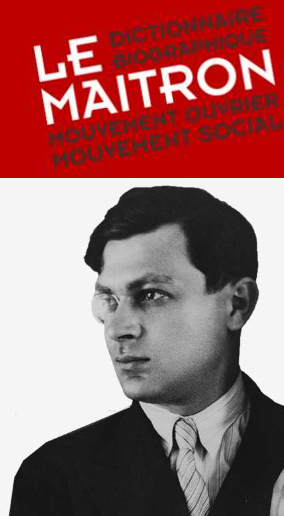
TRISTAN Tzara
By Henri Béhar
Born April 16, 1896, in Moinesti (Bacau province, Romania), died December 24, 1963, in Paris; poet, intellectual, collector; member of the Communist Party.
Of “Israelite nationality” according to his official documents, the son of Samuel Rosenstock and Émilie Sybalis, Tristan Tzara was born into a tenant-farmer family. A student at a French-model high school in Bucharest, he founded there, in 1912, a literary journal with symbolist leanings, together with friends Ion Vinea and Marcel Janco. After completing his secondary studies, he enrolled at the University of Bucharest to take courses simultaneously in philosophy and mathematics. Yet his literary and artistic pursuits, along with the imminent entry of Romania into the war on the side of the Allies, led his parents to send him to Zurich in autumn 1915. Supposedly to continue studies in philosophy, he instead frequented the Cabaret Voltaire, run by Hugo Ball.
He soon founded the Dada movement at the Café Terrasse (on February 8, 1916), designed as an assertion of a human ideal in the midst of world conflict. Enthusiastically, Tzara set about forging connections between artists from all the warring countries, inviting them to submit their paintings and poems for the Dada exhibitions and journal that he organized. At first, Dada took shape as a melting-pot of Germanic expressionism, Italian futurism, French cubism, and as an exploration of neglected artistic forms such as so-called “Negro art.” Tzara’s 1918 Dada Manifesto represented a radical break with all the modernist trends. In the name of universal doubt and spontaneity, he argued for the necessity of total destruction and sweeping away of the past, in order to rebuild upon reliable, quintessentially human values: kindness and the joy of living. A Zurich police investigation concluded that he was not involved in any political activity.
The major impact of his Dada Manifesto led him to France, where the members of the journal Littérature (Louis Aragon, André Breton, Paul Éluard, Philippe Soupault) soon converted to the new movement. Arriving in Paris on January 17, 1920, Tristan Tzara organized a variety of events that caused a sensation. His “couldn’t-care-less” attitude during the “Barrès Affair” on May 13, 1921 (a mock trial against the nationalist writer, accused of a ‘crime against the spirit’) infuriated Breton. The following year, Tzara obstructed the organization of a “Congress on the Directives and Defense of the Modern Spirit,” promoted by André Breton, which to him seemed ill-timed, as Dada had not yet finished its questioning of traditional thought and had not established the “dictatorship of the spirit.” This did not prevent him from preaching the Dada gospel in Germany and participating in the constructivist congress in Weimar. The following year, the sabotage of his stage production of Cœur à gaz by Breton and his friends marked a final rupture. In response, Tzara deliberately published his Seven Dada Manifestos in 1924, signaling his rejection of burgeoning surrealism.
As his poetry continued along the same lines, it was natural that Surrealism would welcome Tristan Tzara in 1929 and publish excerpts from his lyric epic L’Homme approximatif. Until 1935, he took an active part in what he called the movement’s ideological phase. Although he refuted “Freudo-Marxism,” his Essay on the State of Poetry (1931) and his collection Grains et issues (1935) both tried, in their own ways, to reconcile psychoanalysis and Marxism in the analysis of poetic phenomena. At the same time, from its foundation, he joined the Association of Revolutionary Writers and Artists (AEAR)—a branch of the Communist Party and a group that included the Surrealists—and the Maison de la Culture, founded by Aragon. An article in L’Humanité (February 27) attests to his support in early 1933, the year when André Breton, René Crevel, and Paul Éluard were expelled from the French Communist Party. During the factious unrest of February 1934, he privately expressed doubts about the unity of action advocated by Breton, specifically requesting the dissolution of the Surrealist political group. For his part, Tzara placed his trust in the Party’s leadership regarding mass organization and political analysis. In March 1935, his letter to Cahiers du Sud announced his break with a movement he regretted saw poetic activity as an end in itself rather than as revolutionary.
In June 1935, Tristan Tzara delivered a speech (“Initiates and Precursors,” published in Commune, the journal of the AEAR) at the International Congress of Writers for the Defense of Culture in Paris, while the Surrealists themselves were forbidden from speaking[2][3][6]. The following year, together with Aragon, Caillois, and Monnerot, he founded the Groupe d’études pour la phénoménologie humaine, which published the journal Inquisitions (single issue, June 1936), intended as a space for intellectual reflection within the context of the Popular Front[2].
He then became actively engaged alongside the Spanish Republicans. From the very beginning of the Spanish Civil War, he served as the representative of the Association for the Defense of Culture to Spanish intellectuals, acting as secretary for the group[2]. In 1937, when he addressed besieged Madrid at the Palais de la Mutualité (as part of the Maison de la culture), L’Humanité (January 12) introduced him as one of its correspondents in Madrid with Georges Soria[2][6]. There, he denounced the Francoists and rejected “the alleged atrocities of the Republicans” (L’Humanité, January 16, 1937)[6]. His speech at the congress on “The Individual and the Conscience of the Writer” at that time affirmed his faith in humanity and in revolutionary consciousness. He later helped organize the second International Congress of Writers in Valencia and besieged Madrid[4]. A photograph shows him on the platform honoring the memory of García Lorca “murdered by the rebels” (Ce soir, July 20, 1937 – photo). His speech, “The Individual and the Conscience of the Writer,” asserted his trust in human dignity within revolutionary awareness. That same year, he published in Regards (“The Beauties of Spain”) an article denouncing the non-intervention of French and British democracies. Of course, it was also in Ce soir (August 2) that he later paid tribute to Gerda Taro. In 1939, at the time of the Republic’s collapse, he organized collections to save “the Spanish intellectuals” (Ce soir, February 13).
During the Occupation, Tristan Tzara was forced to live underground in Souillac (Lot), where he secretly circulated a few poems (“Ça va,” “Une Route,” “Seul Soleil”). He contributed to several Resistance newspapers, particularly to Les Lettres françaises, as a member of the National Writers’ Committee, which he led clandestinely for the southwest zone, and from 1944 to 1946 presided over the Center for Intellectuals in Toulouse. He contributed to establishing the Centre d’études occitanes. His article “Poésie latente, poésie manifeste” refuted Sartre’s concept of “committed literature,” since for Tzara it is the poet who is immersed in life, up to his neck. Simultaneously, during a lecture at the Sorbonne, “Surrealism and the Aftermath” (March 17, 1947), he reproached Surrealists for having abandoned the struggle during the war and for having been of no help to individuals during that time (Les Lettres françaises, March 28, 1947). Here, Tzara settled his disputes with the Surrealists, especially Breton. That turbulent evening was part of the broader rebirth of “literary scandals” and part of the polemic around Arthur Koestler, supported by Breton in Le Figaro Littéraire (late 1946, following the publication of Koestler’s The Yogi and the Commissar).
Naturalized French in April of the same year, Tristan Tzara then joined the Communist Party, with which he had long-standing ties of trust. Major collections (La Face intérieure, De Mémoire d’homme) attest to the power of his poetic language, which he never subordinated to any particular cause. It was above all in Les Lettres françaises that he found his place, regularly contributing articles and attaining genuine literary recognition among Communists. His poetry was described as possessing “exceptional richness” (August 8, 1947, for the publication of Morceaux choisis), and praised for his “extraordinary capacity for renewal” and “verbal genius” (April 22, 1948). It was in the weekly edited by Aragon that the former Dadaist justified his membership in the PCF, and thus his rejection of Surrealism in favor of writing committed to action.
He also appears strongly involved in the Peace Movement of the early 1950s, defending the Turkish poet Nazim Hikmet at the Paris conference (Les Lettres françaises, April 27, 1950). In connection with the National Writers’ Committee, he also participated in the “Batailles du livre.” Without explicitly defending “socialist realism,” he promoted Party artists like Picasso (Les Lettres françaises, August 10, 1950), and praised the art of James Ensor (December 8, 1950).
From 1946, he was also an active advocate for rapprochement between French and Eastern European intellectuals, making several trips (see Les Lettres françaises, January 31, 1947 and February 7, 1947).
It was upon his return from a trip to Hungary that he took a stand for the Budapest uprising and published his account in a statement on October 27, 1956, which the Communist press refused to print. He then quietly withdrew from the party. In October 1960, he signed the “Declaration on the Right to Refusal in the Algerian War,” also known as the “Manifesto of the 121” (from the number of the initial signatories), which is now known to have emerged in Surrealist circles.
Tristan Tzara devoted the end of his life to his collection of African art and to scholarly research focusing on anagrams in Villon’s poetry.
TO CITE THIS ARTICLE:
https://maitron.fr/spip.php?article133310, entry TZARA Tristan by Henri Béhar, version first posted online November 30, 2010, last updated July 4, 2022.
SOURCES: T. Tzara, Œuvres complètes, edited, introduced and annotated by H. Béhar, vols. I–VI, Flammarion, 1975–1991. — Tristan Tzara archives held at the Bibliothèque littéraire Jacques Doucet. — André Breton, Correspondance avec Tristan Tzara et Francis Picabia 1919–1924, introduction and notes by Henri Béhar, Gallimard, 2017, 246 p. — Notes by Rache Mazuy.
Brief Tzara Bibliography:
- Tristan Tzara: Œuvres complètes, edited, introduced and annotated by H. Béhar.
Vol. I, Paris, Flammarion, 1975, 746 p.;
Vol. II, 1977, 473 p.;
Vol. III, 1979, 637 p.;
Vol. IV, 1980, 693 p.;
Vol. V, 1982, 714 p.;
Vol. VI, 1991, 640 p.
- Letter dated January 17, 1934, Œuvres complètes, vol. I, Paris, Flammarion, 1976, p. 632.
- “Tristan Tzara parle à Integral”, interview by Ilarie Voronca, Integral, 3rd year, no. 12, April 1927, cited in Œuvres complètes, vol. II, p. 418.
- Text fully reprinted in: Tristan Tzara, Œuvres complètes, vol. III, p. 514.
- See Tzara’s article: “Poésie latente et poésie manifeste”, Le Point, Souillac, no. 31, March 1945, reprinted in Œuvres complètes, vol. V, p. 652.