THE FREUDIAN-MARXISM OF THE SURREALISTS", MÉLUSINE, N° XIII, 1992, PP. 173-191.
Without returning to the abundant critical literature concerning the relations of surrealism with psychoanalysis, I wished to address in this issue of Mélusine, in a concrete manner, the intimate relationship of each surrealist, taken individually, with the psychoanalyst of his choice. My project certainly came too early. One will see, in the whole of the contributions responding to my call, a very stimulating and varied individual approach.
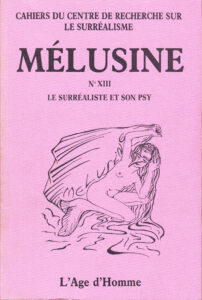
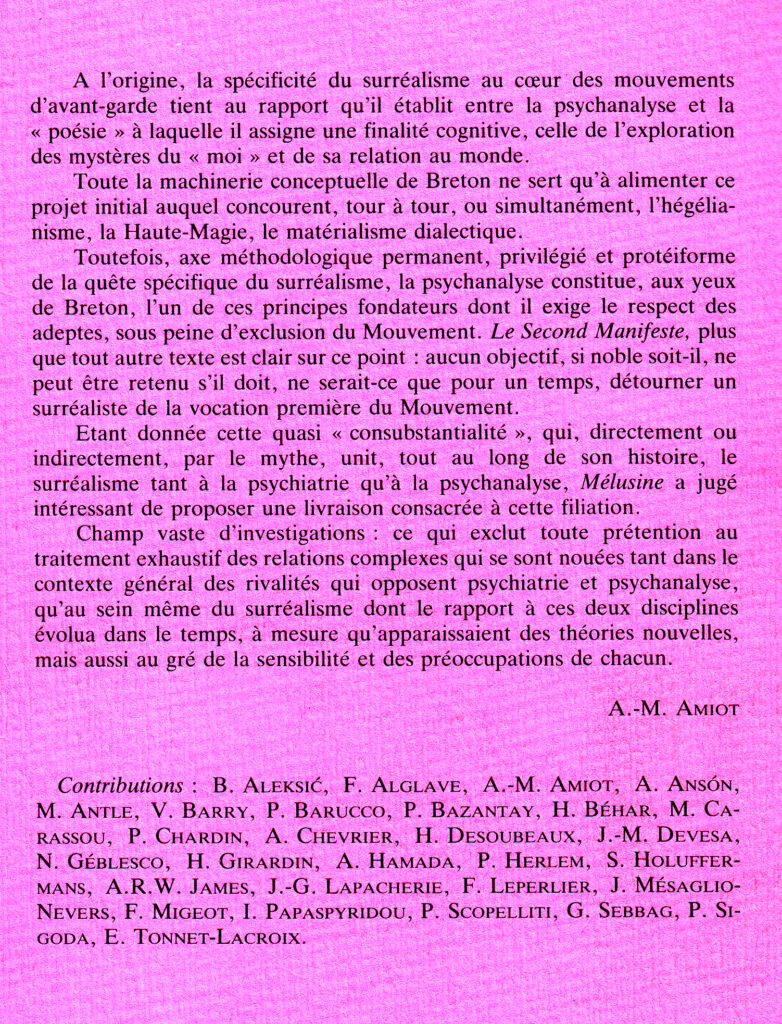
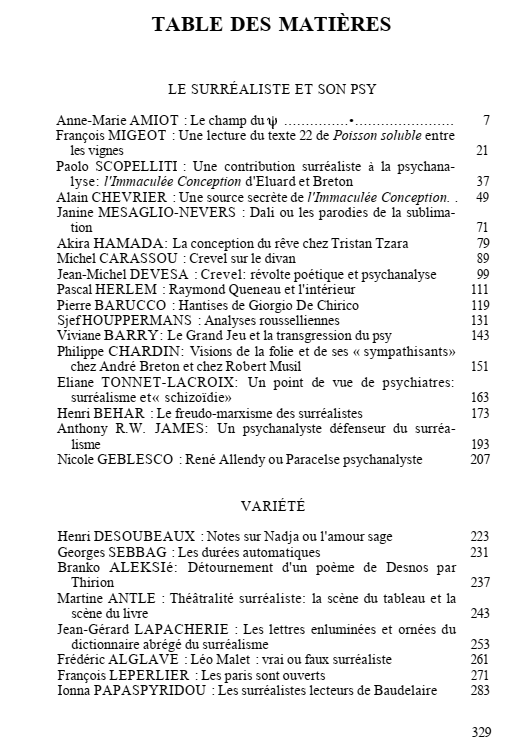
As for me, I attempted to address a precise period, that when the surrealists, far from the doctrine imposed in the USSR, endeavored, following the example of Tristan Tzara, to integrate the approach of the Freudian-Marxists known in France into their creation.
See the summary and extension given by Wikipedia:
Surrealism and Freudian-Marxism
According to Henri Béhar, it was during Hitler's accession to power in January 1933 that the Parisian surrealists, attached to dialectical materialism, discovered Freudian-Marxist thought (1).
It is above all André Breton, reader of Marx, Freud, but also Hegel, Fichte, Feuerbach, Nietzsche, who draws from philosophy the ideas allowing him to make poetic and political discourses dialogue in an original manner, updating romantic philosophy, in an always renewed invention of a philosophy of love and revolution. Seeking to demonstrate that the real world and the world of dreams are one, Breton examines the different theories that have proposed an interpretation of the dream, dwelling at length on that of Freud, in a frankly revolutionary perspective, which owes much to Marx, particularly in his essay The Communicating Vessels (1932). In his aim of a revolutionary art and a total liberation of man, he associates the two watchwords "transform the world" (Marx) and "change life" (Rimbaud), the unity of dream and reality passing through a profound social transformation. However, there is not a "philosophy of surrealism", according to Ferdinand Alquié's term, but indeed the philosophies of André Breton, oscillating between a systematic discourse and a more adventurous ideological bricolage, going successively from absolute idealism to the dialectic of the 1930s, from Freudian-Marxism to the philosophy of nature.
- Emmanuel Rubio, The Philosophies of André Breton (1924-1941), L'Âge d'Homme, coll. "Mélusine Library", 2009, particularly the chapter entitled "The Communicating Vessels: the Constitution of a Freudian-Marxist System? (1932)".