"THE METAPHYSICAL BROTHEL OR PICASSO'S THEATER", ESPRIT, JANUARY 1981, N° 1, PP. 76-79.
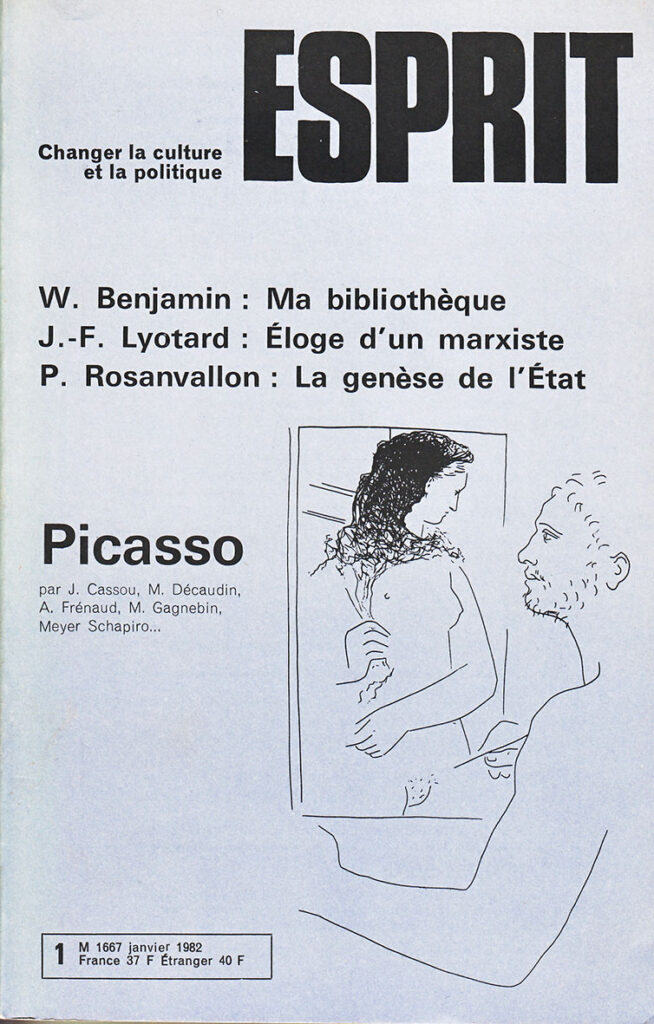
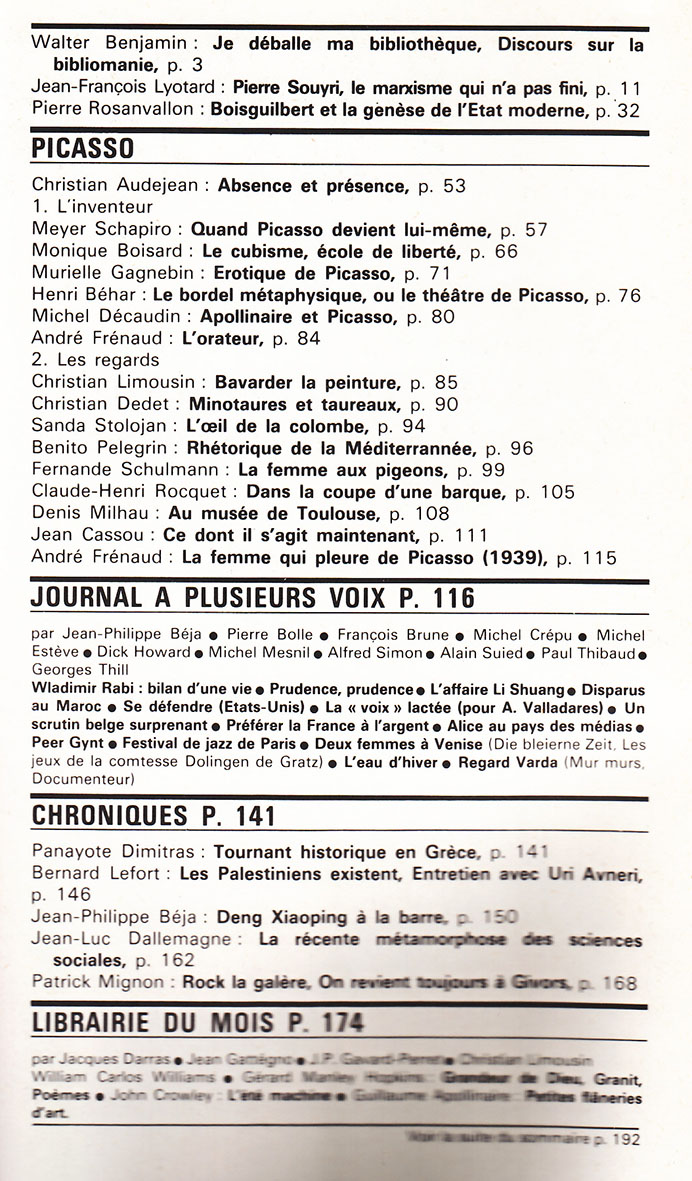
Download Henri Béhar's article in PDF
Read Picasso's text:
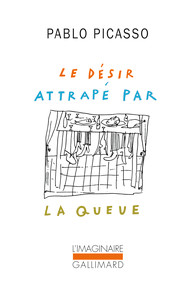
See also: "On Surrealism and Baroque in Picasso's Writing", Les Cahiers de l'Herne, Pablo Picasso, 2014, p. 264-270.
On Picasso's theater, see The Dada and Surrealist Theater
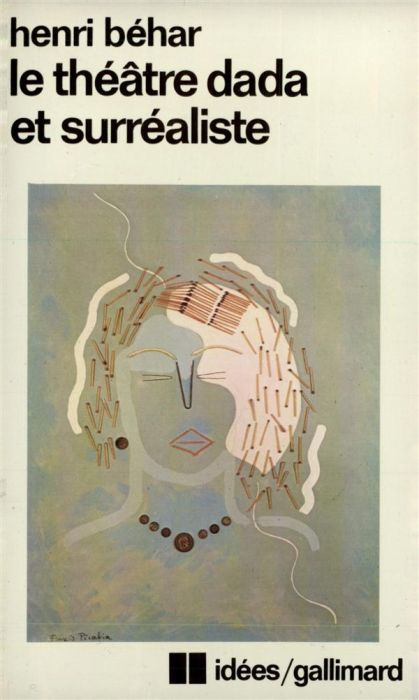
Between "this need for reality that torments us," characterizing naturalist aesthetics, and the "stage free to the whim of fictions" postulated by symbolism, the stage of our century has chosen a third way, not of compromise but of surpassing, represented by dada and surrealist theater, making room for surprise, poetry, dream, the marvelous. The adventure begins with Alfred Jarry's Ubu roi (1896) to flourish worldwide with Bob Wilson's Le Regard du sourd (1971). Studying little-known works, mounted by makeshift theaters in France between the two wars, this essay highlights the essential traits of a dramatic aesthetics that continues to fertilize current creation. The first part is devoted to precursors and marginals: Alfred Jarry, Apollinaire, Albert-Birot, Yvan Goll, the Douanier Rousseau, Raymond Roussel. The second analyzes some dada plays by Erik Satie, Ribemont-Dessaignes, Tristan Tzara, etc. Finally the third part evokes the surrealist theater of André Breton, Aragon, Artaud, Vitrac, Desnos, Huidobro, Georges Neveux, Georges Hugnet, Picasso; and, for the new generation, Julien Gracq and Georges Schehadé.
See also: the Mélusine journal
N° 34, SURREALISM AND PERFORMING ARTS
The exegesis of surrealism concentrates essentially on literature and visual arts, whereas this cultural current, the most innovative of the 20th century, has successfully fertilized other modes of expression. The present dossier bears witness to this: it deals with theater as a scenic art as much as a literary genre, and with other performing arts. Convocating various approaches, it brings together two professions that too often ignore each other: university critics (dramaturges, theatrologists or specialists of surrealism) and stage practitioners. Before coming to historical surrealism, the first third of the dossier goes back to previous centuries, both to illuminate the thought of Breton's group and to return to its aesthetic sources, in matters of representation. The last two thirds are situated downstream of the current and extend to the extreme contemporary, while covering a territory that embraces Europe and North America – which attests to the scope of the surrealist stage's influence. The vast domain of spectacle has accomplished reforms over the past hundred years, which are bearing fruit. Several present affinities with surrealism. Emerging practices stand out as a path that the latter had seeded, where it regenerates itself in unprecedented forms. In short, the scenic fortune of the movement guarantees it perpetual renewal.
See also the exhibition catalog
Finally, see my other articles on Picasso
"Picasso in the Ink Mirror", in The Artist in Representation, texts collected by René Démoris. Paris, Éditions Desjonquères, 1993, pp. 199-213.
"On Surrealism and Baroque in Picasso's Writing", Les Cahiers de l'Herne, Pablo Picasso, 2014, p. 264-270.