"THE NEBULA OF FEELINGS" [WITH MICHEL BERNARD] IN THEMATIC ANALYSIS OF TEXTUAL DATA, WORK EDITED BY FRANÇOIS RASTIER, PUBLISHED BY ÉVELINE MARTIN, PARIS, DIDIER ÉRUDITION, 1995, PP. 53-84.
We continue here our work within the National Institute of the French Language (InaLF), responsible for developing a dictionary intended to succeed Littré, called TLF (Treasury of the French Language) now accessible on the network: TLFi (atilf.fr). For this, the FRANTEXT textual database had been constituted, digitally recording French literary works of the 19th and 20th centuries. Thus this database could provide the examples integrated into the dictionary entries, but it was a textual source, the most important in France, for other studies, both grammatical and literary or semiotic. This is how a certain number of researchers, of which we were part, developed procedures intended to extract the thematic content of literary works. After having analyzed the nature of meanings according to different authors, Michel Bernard and I tried to approach the whole of feelings. As a result, our contribution joined the concerns of other colleagues at INaLF, which led to this book arranged by Eveline Martin and François Rastier.
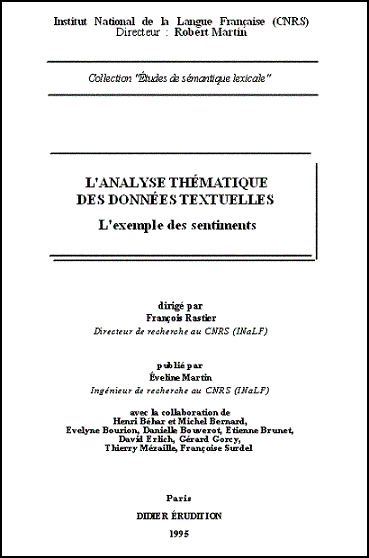
Electronic reissue of the volume in facsimile
FOREWORD TO THE ELECTRONIC REISSUE
This volume is organized around a problem, a computer tool and a corpus.
The problem concerns any semantic description of texts: how to define and identify themes, trace their privileged links, draw their diachronic evolution? As the expansion of textual databases generates growing needs, the development of thematics is of considerable interest, both for indexing and for text exploitation.
The stakes of the work can be summarized in the final chapter; we must above all justify here the choice of data.
We have remained with literary discourse, because literary texts are the most numerous in the Frantext database. We have selected a corpus of novels, the best represented textual genre: it groups 397 volumes of French novels and short story collections published from 1830 to 1970, or 350 works. This number ensures the corpus a critical mass that allows significant statistical processing and above all lends itself to debates and conjectures.
The chronological boundaries are justified as follows: the unification of typographic standards dates back to 1827, and the date of 1830 protects from variations that would hinder the query. After 1970, the corpus of novels captured is insufficient, in quantity if not in quality. We will see that this temporal extent allows us to trace significant evolutions.
This volume presents the first thematic study on a novelistic corpus of such scope: it thus poses problems on a completely different scale than the monographs generally available. In choosing the theme of feelings, we perhaps thought we were taking few risks, but the results of the survey lead us to reconsider many received ideas.
François Rastier
TABLE OF CONTENTS:
I. General studies and method research
Éveline MARTIN: Study theme, theme study Étienne BRUNET: Cardiograms Henri BÉHAR, Michel BERNARD: The nebula of feelings David ERLICH: A method of thematic analysis. Examples of boredom and ambition Evelyne BOURION: The associative network of fear Françoise SURDEL: Defense and illustration of a literary theme: pity Gérard GORCY: Euphoria and spleen, two antonymic themes? Danielle BOUVEROT: For the love of art Thierry MÉZAILLE: The color of feelings in Proust III. Epilogue François RASTIER: The semantics of themes. Or the sentimental journey Bibliography of the corpus used (alphabetical order) Bibliography of the corpus used (chronological order) General bibliography of studies consulted Download the PDF of our contribution
Article appearing in: Henri Béhar, Literature and its Golem, Paris, Honoré Champion, 1996, 254 p. Coll. Quantitative Linguistics Works, No. 58. pp. 77-111.
Extensions:
Beyond the chapters of the collective volume, each accessible under the author's name,
many presentations related to thematic data analysis can be found on the Internet
Publications by Michel Bernard:
What is this book about? Development of a thesaurus for thematic indexing of literary works, Champion, 1994, 365 p.
Introduction to Computer-Assisted Literary Studies, PUF, 1999, 225 p. Literary History at the Risk of Computing. The question of the literary canon, Presses de la Sorbonne Nouvelle, 2011, 149 p.
See also: the Alceste text and thematic analysis software and: Textual data analysis with ALCESTE software by Daniel Bart (Cairn)