Literature Through the Stomach
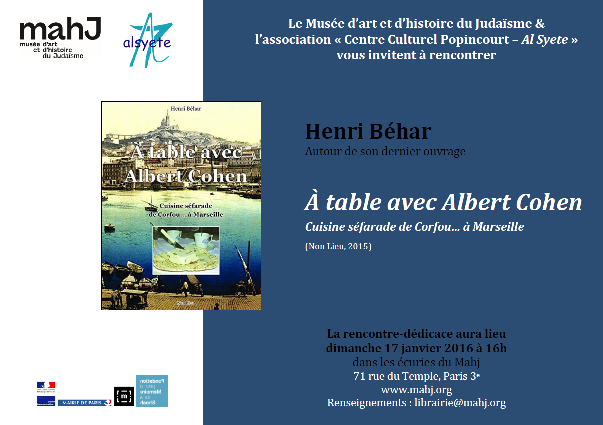
Talk given at MAHJ on January 17, 2016
Throughout my teaching and research activity, I have tried to systematize two ways of approaching the literary fact: the Hubert de Phalèse method, on the one hand, which is based on a certain use of digital tools; cultural analysis of texts, on the other hand, which, as its name indicates, postulates that every text summons different cultures. Today, I would like to articulate both of them with regard to Albert Cohen's work, showing how, starting from the stomach, he comes to deal with the interdependence of all parts of the body, and therefore, like Rabelais, to thought.
*
The Hubert de Phalèse method was developed with my students from the 1980s of the past century. It involves several successive phases, indispensable, in my eyes, for anyone who wants to study a text to the letter.
In brief, it is a matter of, with the help of the computer tool, and provided that the work is entirely digitized, systematically searching for the terms involved in this vocabulary, extracting the occurrences in their context, constituting a kind of dictionary, without omitting the nuances of each use.
Even if the approach is automated, there is nothing mechanical here, since the final objective is indeed to interpret a text, to arrive at an integral hermeneutics of Albert Cohen's work-life. I add that the extracted quotations require a back and forth: from the table to the mouth, from food to text, and vice versa.
*
Just as for the Hubert de Phalèse method, I have, on several occasions, tried to codify the method of cultural analysis of texts. The simple statement of the terms says how to understand the thing.
But, you will say, since a text is written in good French, as Albert Cohen's appears at first glance, why speak of cultural analysis? Is not Cohen, whatever the nationality inscribed on his passport, a worthy representative of our literature?
Certainly! However, as for any French or Francophone writer, his work could not do without our analyses.
*
Here, I must tell you about the rage that took me when reading certain erroneous information found on the Internet. Thus, a reader sensitive to the beauty of The Book of My Mother claims to "interpret" a passage, which she quotes at length, by adding to it the recipe for Greek lamb. Good! but the misfortune is that the recipe mixes meat and cheese, which Madame Louise Cohen, who was not ignorant of any of the precepts of her religion (which she transmitted orally to her son) would never have done! Is it too much to ask that a person who adds her grain of salt to the admirable prose of the writer, inform herself a little before writing, and especially that, being Catholic, as she confessed to me, she read the Old Testament, a thing recommended by the Pope himself, indispensable for the understanding of French literature!
Another provides us with the moussaka recipe in the same way, claiming to follow that of Mangeclous, but adding a béchamel sauce that is not in the text, that has nothing to do with it, always because of the dietary prohibitions transmitted from generation to generation by women!
This is to say that neither good will nor university degrees are sufficient to understand, today, what Cohen wanted to signify, consciously or not. That is why I felt obliged to recommend, again, a cultural analysis of Albert Cohen's texts, assisted by computer, of which I will give here a brief illustration.
*
To stay within the allotted time, I will limit myself here to the study of three elements: biblical culture; the feast; the language.
An Oriental and Biblical Culture
Mangeclous is the Panurge of modern times. To understand his behavior, to taste (it's the case to say) the food that Albert Cohen evokes in his books, one must be imbued with a minimum of "Israelite" culture (to use his vocabulary, from the time of the Third Republic).
Heir to the priestly caste, as his name attests, bathed in rabbinical culture by a Romaniote father; strongly attached to his mother, the guardian of the Law, he mentions, as in passing, what conditions the apprehension of the world by his characters. Thus Saltiel the wise writes to his nephew Solal that in London the buses "have the color of bleeding meat, abomination loved by pagans, and if you marry as my heart desires, recommend to your delightful wife to salt the meat well and even to wash it before cooking to remove the blood that might remain" (Val. 275). This holy horror of blood – life – is in accordance with the rules of Leviticus (17.10-16), and their practical consequences recorded in The Set Table (Shulchan Aruch), the ethical code developed in Safed in the 16th century by Joseph Caro. This is why Mangeclous, spreading the food for the picnic, takes out "beef sausages guaranteed of strict observance" (BDS, 559). Beef, therefore, because his friends could not eat pork, forbidden by religion. He himself allows himself well "Some slices of ham, which is the pure and Israelite part of pork" (BDS, 216), or again "What, you eat pork? gasped Solomon in horror. – Ham is the Jewish part of pork, said Mangeclous" (Val.253), rather by provocation, gesture of a strong spirit!
Even in London, Mangeclous and his cousins consume only kosher foods, admitted by the Law. He takes out of two baskets this little snack that he got from a Levantine Jew:
"Four pairs of boutargues of which by leonine right I reserve half for myself! No opposition? Adopted! Twelve large fried and crispy squids but a bit resistant to the tooth, which increases their charm! Eight for me because they are my supreme passion! hard-boiled eggs at will, cooked for a whole day in water garnished with oil and fried onions so that the taste penetrates! So assured me the noble grocer caterer and coreligionist, may God bless him, amen! ...Come on, gentlemen, to the table! Commotion of eating!" (BDS, 559)
All these products, coming from the Mediterranean basin, are the background on the religiously set table by Albert Cohen, who, this deserves to be noted, uses no local name to designate them, except for loukoum, itself in a Frenchified spelling (with a C for K). Wearing beards and skullcaps, see them eat, these cousins from Cephalonia, the mythical island which obviously has nothing to do with present-day Corfu!
Passover, The Seder
Despite their constant fantasy, the Valiant are indeed of their time. They praise the one God and are naturally religious. Thus when Solal evokes his childhood (just like the narrator), it is to the first evening of the feast commemorating the exodus from Egypt that he thinks, describing in free indirect style each stage of the ritual meal (itself conceived to mark each episode of the historical narrative) mixing word for word the sacred text:
"...oh my childhood in Cephalonia oh Passover the first evening of Passover my lord father filled the first cup then he said the blessing, in Your love for us You have given us this Feast of Unleavened Bread anniversary of our deliverance memory of the Exodus from Egypt be blessed Eternal who sanctifies Israel,...I admired his voice after that was the washing of hands after that was the chervil dipped in vinegar after that was the sharing of unleavened bread after that was the narration my lord father lifted the tray he said here is the bread of misery that our ancestors ate in the land of Egypt whoever is hungry let him come eat with us let every needy person come celebrate Passover with us this year we are here next year in the land of Israel this year we are slaves next year free people, then because I was the youngest I asked the prescribed question how is this evening different from other evenings why do we eat leavened bread on all other evenings and unleavened bread this evening I was moved to ask the question to my lord father then he uncovered the unleavened bread he began the explanation looking at me and I blushed with pride he said we were slaves of Pharaoh in Egypt and the Eternal our God brought us out with His mighty hand and His outstretched arm," (BDS, XCIV, 753)
I have no intention of explaining word for word this anthology piece, without punctuation, nor of providing a semiotic analysis of the ceremony. However, the reader, for lack of having attended this feast meal, must know the substratum, a certain number of indications relating to what can, rightly, be called Jewish culture, beginning with the other name that Jews give to this ceremony, the Feast of Unleavened Bread (hag hamatzot).
First, it must be known that the Passover feast commemorates several events at the same time: traditional on the one hand, historical on the other. It has a double meaning, originally a rustic feast, it has become a commemorative feast of the exodus from Egypt.
Then, the table is set. The mother has lit the candles, she has arranged in the center a tray containing a grilled lamb chop, symbol of the paschal offering, the holocaust, the animal formerly sacrificed, before the destruction of the Temple; a hard-boiled egg, symbol of mourning, in memory of the destruction of the Temple; the bitter herbs (maror) recalling the harsh conditions of slavery; the haroset (mortar) representing the construction work to which the Hebrews were subjected in Egypt; three matzot commemorating the exodus from Egypt; and four cups of wine which will be drunk at different stages of the evening, the men being leaned on the left side, as a sign of freedom.
Let us not forget the empty place, reserved for the prophet Elijah, supposed to announce the coming of the Messiah. In this expectation, it can be occupied by a poor person.
The rabbis count 15 stages in the unfolding of the evening. Solal retains only half. Allow me to refer you to them.
While evoking his childhood memories, with all their affective content, Solal highlights the pedagogical character of this commemorative staging. At the same time, he celebrates the memory of his father, his beautiful cantor's voice. The expression "the lord father" jars in French. It is a calque of the Judeo-Italian spoken by the mother, as well as of the Judeo-Spanish generally practiced by Jewish colonies in Greece.
This majestic father is therefore not exactly that of the writer, but one cannot dispense with seeing in it a tribute to the one he treated very badly in his entire work, to the benefit of the Mother.
Despite the precision of the memory, and the rigorous unfolding of the ceremony, the Narrator has omitted a certain number of phases, notably the tragic one that names the ten plagues of Egypt, from which the Hebrews were spared. The assistants turn their faces away from the table, the father, while reading aloud, pours water from a ewer to symbolize the divine miracle.
The Terrible Days (Yamim Noraim)
Now, the two books previously invoked were published after what is called the Shoah (annihilation, in Hebrew) or even genocide. After the millennial slavery, the Narrator writes in the memory of the massive destruction: "Suddenly haunt me the German horrors, the millions immolated by the wicked nation, those of my family in Auschwitz, and their fears, my uncle and his son arrested in Nice, gassed in Auschwitz" (Val.225).
It is the same one who, in a nightmare, sees his mother in occupied France, picking up old rags in the street to put them in a suitcase containing a yellow star (LM, 114). The same one again, who recalls the disappearance of his mother in Marseille, while he was in London.
Impossible to understand anything about the feelings and behaviors of one and the other if one does not see that they stand out against such a background. But there is more, and doubtless more intimately inscribed in their flesh. It is that, if they did not know direct persecution nor the Shoah (the word is absent from Belle du Seigneur and the Valiant), they know what the pogroms were that all Jewish communities in Russia, Poland or the Ottoman Empire suffered. Beyond his laughable manias, this is what pushes Mangeclous and his coreligionists to the accumulation of foods:
"The Jews hastened to have bars sealed to their windows and amassed, just as in times of pogrom, plenty of provisions: flour, potatoes, unleavened bread, macaroni, sugar loaves, eggs, beef sausages, chains of peppers, onions and garlic, balls of tomatoes dried in the sun and marinated in oil, goose fat and jars of water, smoked meats, purgatives and medicines." (Mangeclous, 88)
In short, the carnivalesque work is only explained by its opposite, the evocation of programmed death. Not the natural death of man, but that which was decided in the name of who knows what aberrations of the mind, during the Wannsee Conference, January 22, 1942.
The Passover vigil ends with traditional songs, of pedagogical and moral value. One of them is called Had gadia. One sees what morality children can draw from it, and even adults, understanding that no one occupies a place that cannot be contested by someone stronger than him, by the Almighty to finish. The angel of death is evoked several times by the Valiant.
*
And here on the table are all the scents, all the flavors, all the splendors of Judeo-Balkan cuisine that penetrate you, spreading pleasure, joy of living, even in the darkest days, because the lesson is always the same: "lehaim" to life, says the father, symbolically raising his glass of wine.
Reading all of Albert Cohen's work from the dishes he evokes is not only moving in his imaginary universe, it is also approaching his mode of creation and characterizing in the same way the individuals to whom he gives relief, a spiritual life without equivalent, so much is food consubstantial with the individual. Like the one God they pray to daily, for them, spirit and matter are one.
Let us not be mistaken: Albert Cohen's language, skillfully worked, is a refined French, which refuses local color. This is not a tourist or culinary guide. No tarama, no dolma, no fila or beureks, no albondigas, no boyos or yaprakes, none of these terms that abound in cookbooks or even in the memoirs of Sephardim. That is why we must refer to crackers, vine leaves (Val.249), meatballs and other pastries, etc. In such a way that one would think oneself at La Reynière's table, quite surprised to discover an oil-based cuisine where eggplant and tomato are queens. Notable exceptions: the raki offered by Aude to Saltiel (Solal, 233); loukoum, moussaka and cascaval, perhaps because these are names and products of Turkish origin? And finally halva, an authentically Turkish term, pronounced from the tip of the lips by Ariane, the beginnings of discord between the lovers (who would have done better to consume more of it!).
Beyond this legitimate concern to use a purified French, of universal extension, in an author whose mother tongue, Judeo-Venetian he tells us, was practiced by only a thousand people in Corfu, at the time when he was born there, there is perhaps that of reinforcing the myth of the Valiant of France, emancipated by the French Revolution, "made perfect French citizens by the effect of the charming decree of the National Assembly of September 27, 1791" according to Saltiel, proud to remain so and to maintain "the sweet speech" of our country.
In any case, the remarkable absence of foreign vocabulary, the refusal of borrowing testify to the concern for assimilation, even integration, on the part of Albert Cohen. Successful integration, not only through his career as a high international civil servant, but also as a French writer.
Let us not forget that he is an immigrant, Jewish moreover, which he is not likely to forget, as evidenced by the scene of the anti-Semitic hawker, insulting him and designating him to public vindictiveness on the anniversary of his tenth birthday (Ô vous, frères humains, p. 38), an indelible scene, which returns several times and will never be forgotten since he will still deal with it past his 80s (Carnets 1978, p. 19). Founding scene, symbolic, revealing to him the impossibility of any assimilation. This is not exactly the lesson he draws from it, just as Swann, ousted from the Verdurin clan, does not believe for a moment that his eviction could come from his Jewishness, he who, in parallel, is received and even claimed by the Faubourg Saint-Germain. Any reader of good faith, having reached the end of In Search of Lost Time, that is to say Time Regained, will not fail to notice this. It remains that the question of assimilation is not lacking in being always current, and that, by the contradiction it contains in itself, it confers great richness to the work that comes from it.
Henri BÉHAR
Psst! a listener intervened to tell me that he remembered reading the Valiant, 40 years ago, and that he had encountered the term almodrote in the letter that Mangeclous addresses to the Queen of England.
Verification made, and well made, this term, designating a sauce of Sephardic origin, still used in Spain to designate various compositions, is found nowhere in Albert Cohen's text. Besides reassuring me about the attention I pay to my work, and confirming my theory of the text, according to which the author, assimilated, is careful not to put local color in his vocabulary, there is here a "reading testimony", to speak like the theorists, very revealing.
Forty years ago, then, this reader is delighted reading Mangeclous's prose. He reads this paragraph:
"With minced meat, bought early in the morning, I made meatballs by adding finely crushed unleavened bread, beaten eggs, parsley, salt and a large quantity of pepper! On the other hand, I composed a delicious sauce by simmering hot peppers, onions and tomatoes! But the triple secret is to use olive oil, to simmer for at least five hours over low heat, and to add a little sugar! Excellent recipe that You could try! His Majesty the King would lick his fingers! Naturally, don't forget to salt and also put a little oregano!"
and this reminds him of his mother's cuisine, the keftedes and the accompanying sauce that she called almodrote. This remembrance, associated with his reading, therefore comes to superimpose itself on the text in an indelible way, to the point that he thinks my reading superficial, not to say erroneous! I am no less grateful to him for having spoken to confirm, involuntarily perhaps, the importance that reading certain books and the movements of the mind that accompany it have.