“The Stabbed Dove: Political Dada,” Dada and Beyond, Volume 1: Dada Discourses, Edited by Elza Adamowicz and Eric Robertson, Amsterdam/New York, NY, 2011. 246 pp. (Avant-Garde Critical Studies 26), pp. 21-35.
The text included in these two volumes in 2009 and 2011 was originally delivered in 2006 in two very different contexts: first at the University of Helsinki, where I had been invited by Timo Kaitaro, a dedicated attendee of the Paris seminar that I continued after my retirement in October 2003 and future author of a dissertation on the relationship between realism and surrealism (see below); then, the following month, at Swansea University in Wales, where I was invited by Elza Adamowicz, herself also a regular participant in the same seminar, in her capacity as professor. Due to the very short interval between these two events—and in order to see how two such different audiences would receive my presentation—I found myself repeating certain points, while also shifting my perspective according to the themes selected by the organizers. As can be seen from the programs reproduced here, these were two major conferences addressing the most current questions in our discipline.
At the request of the Helsinki symposium organizers, here is the abstract I submitted to them, which does not appear in the printed volume:
Abstract:
In a recent work, Gérard Durozoi states: “The rebellious avant-gardes challenge the notion of progress, are more concerned with meaning than with forms, and consider their subversive potential irreducible to any strictly political commitment—this may have involved certain individuals, but not the movements as a whole, and, from this perspective, the misadventures of surrealism should serve as a definitive warning...” This clearly positions Dada as apolitical, in contrast to the attitude of surrealism, the first movement to resolutely engage with politics (alongside the Communist Party) in its rationalist period. Thus, on one side, there would be a perfectly white dove, free from any compromise, and on the other, a tainted whole, compromised by a youthful error.
But things are not so simple: the traditional historiography of the Dada movement long opposed the apoliticism prevalent in Switzerland, New York, and Paris to the revolutionary commitment of the German Dadaists.
Yet the testimonies given by the principal German actors of Dada tend to minimize their political role, while others, who at the time rejected any political influence on their practice, now place it within the broader context of the individual’s relationship to society and its regulatory systems.
Ninety years after the birth of Dada in Zurich, it seems necessary to reassess all the literature accumulated on the subject, and to clarify the movement’s exact involvement in the political sphere. In short, was not the Dadaist revolution fundamentally political in seeking to engage human activity in its entirety?
Preliminary considerations:
- Everything is political, even the act of declaring oneself apolitical.
- Beware of the sin of anachronism: later testimonies by actors in the Dada saga are shaped by the context in which they speak and by their own political stance at the time of writing.
- The collective is a sum, an outcome of diverse individual positions, which are easily opposed in retrospect...
- Movement = dynamic, depending on local circumstances.
Helsinki Symposium: Programme
International Interdisciplinary Symposium
University of Helsinki, Finland, June 1–3, 2006
Colloque international interdisciplinaire
Université de Helsinki, Finlande, 1–3 juin 2006
Writing in Context: French Literature, Theory, and the Avant-Gardes
L'écriture en contexte : littérature, théorie et avant-gardes françaises au XXe siècle.
Thursday / jeudi 1.6. 19:15
Plenary Lecture / Conférence plénière – Rosalind Krauss (Professor, Columbia University, Department of Art History & Archaeology): Avant-garde and Kitsch
Museum of Contemporary Art Kiasma, Helsinki (Mannerheiminaukio 2)
Friday / vendredi 2.6. 09:00–10:00
Registration
Helsinki Collegium for Advanced Studies / Collège des Hautes Études de l’Université de Helsinki (Fabianinkatu 24)
10:00–12:00
Working Group / Groupe de travail 1: Nouveau Roman
Convenor: Riikka Rossi (Lecture Hall / Collegium)
Sarah Anthony (PhD candidate, University of Toronto, Literature): ‘Tropisms’, Speech Usage and ‘Childhood’: Sarraute’s Intratextuality
Martti-Tapio Kuuskoski (Phil.Lic., University of Helsinki, Comparative Literature): Alain Robbe-Grillet’s Mannequin as a Cognitive Machine
Laura Lindstedt (MA, University of Helsinki, Comparative Literature): Material Metamorphoses of Language – The Question of Literary Creation in Nathalie Sarraute’s Entre la vie et la mort
Hanna Meretoja (Graduate School of Literary Studies, University of Turku): Against the Myth of Naturalness: The Emancipatory Dimension in Robbe-Grillet’s Novels
Working Group / Groupe de travail 2: The French Avant-Gardes of the 1950s and 1960s (Journals) / Avant-gardes des années 50/60 (revues)
Convenor: Tiina Arppe (Seminar Room / Collegium)
Nimrod Ben-Cnaan (Centre for European Studies, University College London): Individuals, Revolutions, Illusions: Cultural Pessimism in Genet’s Le Balcon and Barthes’s Mythologies
Marie Doga (University of Toulouse – Sociology & Literature): Review and Avant-Garde: The Politicization of Tel Quel
Boris Gobille (Associate Professor, ENS Lyon, Letters and Humanities Department): Laymen’s Matter or Specialists’ Matter? Literary Avant-Gardes and the Question of Writing in May–June 1968 in France
12:00–14:00 Lunch / Déjeuner
14:00–16:00
Working Group / Groupe de travail 3: Around Bataille / Autour de Bataille
Convenor: Marina Galletti (Lecture Hall / Collegium)
Tiina Arppe (Postdoctoral Research Fellow, University of Helsinki, Sociology): Caillois and Bataille – The Sorcerer’s Apprentices Between Power and Force, Myth and Figure
Joost de Bloois (University of Amsterdam, Literary Studies): The General Economy: Derrida Tracing Bataille
Elana Commisso (Doctoral Candidate, University of Western Ontario, Center for the Study of Theory and Criticism): That Which Is Impossible to Know: The Movement and Dissymmetry at the Heart of Community
Donna Roberts (University of Essex, Art History and Theory): Roger Gilbert-Lecomte: Surrealism Beyond the Pleasure Principle
Marina Galletti (Associate Professor, University of Roma III, Communication and Performance): Georges Bataille and the Bicephalous Community: The Collège de Sociologie and the Secret Society Acéphale
Working group 4: Contemporary perspectives on avant-garde aesthetics and politics / Perspectives contemporaines : esthétique avant-gardiste et politique
Convenor: Kristina Svensson (Seminar room / Collegium)
Mervi Helkkula (Professor, University of Helsinki, French philology): Return to omniscient narration or a new type of narration? On Jean Echenoz
Sirkka Knuuttila (MA, University of Helsinki, comparative literature): Marguerite Duras as a modernist writer of colonial trauma
Luigi Magno (PhD candidate, University of Rome): Interface between writing and the visual
Harri Veivo (Professor, University of Helsinki, semiotics) & Sabine Kraenker (Assistant Lecturer, University of Helsinki, French philology): Autobiography as avant-garde?
17:30–18:00 Coffee
18:15–20:00
Plenary lecture – Denis Hollier (Professor, New York University, Faculty of Arts & Science, French): Avant-garde, colonialism and ethnography. The Case of Michel Leiris
University of Helsinki main building, lecture hall 10 (2nd floor) / Université de Helsinki bâtiment principal, salle de conférences 10 (2e étage) (Fabianinkatu 33)
20:00– Dinner (Restaurant Walhalla, Suomenlinna)
Saturday / Samedi 3.6. 10:00–12:00
Working group 5: Modernisms and the avant-garde / Modernisme et avant-garde
Convenor: Kai Mikkonen (Seminar room / Collegium)
Marieke Dubbelboer (University of Groningen, Romance languages and cultures): Ubu's dialogue with the Belle Époque; Alfred Jarry’s ‘Almanachs du Père Ubu’
Catherine Gaughan (University of Toronto): Mechanical image and aesthetics: The poetics of objects in the poetry and cinema of Jacques Prévert
Catherine Mavrikakis (Associate Professor, University of Montreal, French Studies): Premature births. The failures of the avant-garde in Antonin Artaud
Kai Mikkonen (Research Fellow, Helsinki Collegium for Advanced Studies, University of Helsinki): From l’art nègre to the Intimate Abyssinia: Michel Leiris’s readings of William B. Seabrook
Working group 6: Surrealism / Surréalisme
Convenor: Timo Kaitaro (Lecture hall / Collegium)
Terry Cochran (Professor, University of Montreal): Vanguard images of free radicals
Timo Kaitaro (Academy Researcher, University of Joensuu, Department of Philosophy): Surrealism and the Question of Works: The Autonomy of Art and Politics
Shane McCorristine (Doctoral student, Humanities Institute of Ireland, University of Dublin): Lautréamont and the Haunting of Surrealism
Richard Spiteri (University of Malta, French Literature): The tale ‘Le Dégel’ and the poem "L’éclat de l’acier" by Benjamin Péret
12:00–14:00 Lunch / Déjeuner
14:00–16:00
Working group 7: The Avant-Garde, the arts and the politics / Avant-gardes, arts et politique
Convenor: Matti Lipponen (Lecture hall / Collegium)
Alan Prohm (PhD, University of Art and Design Helsinki): Poetry's architectural vanguard
Sami Sjöberg (BA, University of Helsinki): Reconstructing [silence]: French lettrism
Jean-Christophe Valtat (Associate Professor, University Blaise Pascal, Clermont-Ferrand, Comparative Literature): Guy Debord, the arts of the death of art
Giuseppina Mecchia (Assistant Professor of French, University of Pittsburgh): The Situationist critique of the avant-gardes and its implications for the 21st century
Working group 8: Literature and literary theory / Littérature et théorie littéraire
Convenor: Kristiina Taivalkoski-Shilov (Seminar room / Collegium)
Sylvie Patron (University Paris 7): The Highest Consecration of Genette
Daniela Nardini (Doctoral candidate in literature, University of Cassino): One Avant-Garde Less: Gilles Deleuze and Carmelo Bene
Sanna Nyqvist (MA, Graduate School of Literary Studies, University of Helsinki): Literature of the Vestibule: Art Theory and Practice in Marcel Proust’s Pastiche of Hippolyte Taine
Iulian Toma (Doctoral candidate, University of Nice): Gherasim Luca, Dialectics and Writing
16:00–16:30 Coffee
16:30–18:00
Plenary lecture / Conférence plénière – Henri Béhar (Professor, Université de la Sorbonne-Nouvelle, Paris III): Dada Politics
Helsinki Collegium for Advanced Studies / Collège des Hautes Études de l’Université de Helsinki (Fabianinkatu 24)
18:00– Dinner / Dîner
Collaborating departments and institutions / organisé en collaboration avec les institutions suivantes:
Helsinki Collegium for Advanced Studies / Collège des Hautes Études de l'Université de Helsinki, Finland
Comparative Literature (University of Helsinki) / littérature comparée (Université de Helsinki)
Centre Culturel Français, Helsinki
Istituto Italiano di Cultura, Helsinki
Museum of Contemporary Art Kiasma, Helsinki
Law and Evil – research project (University of Helsinki)
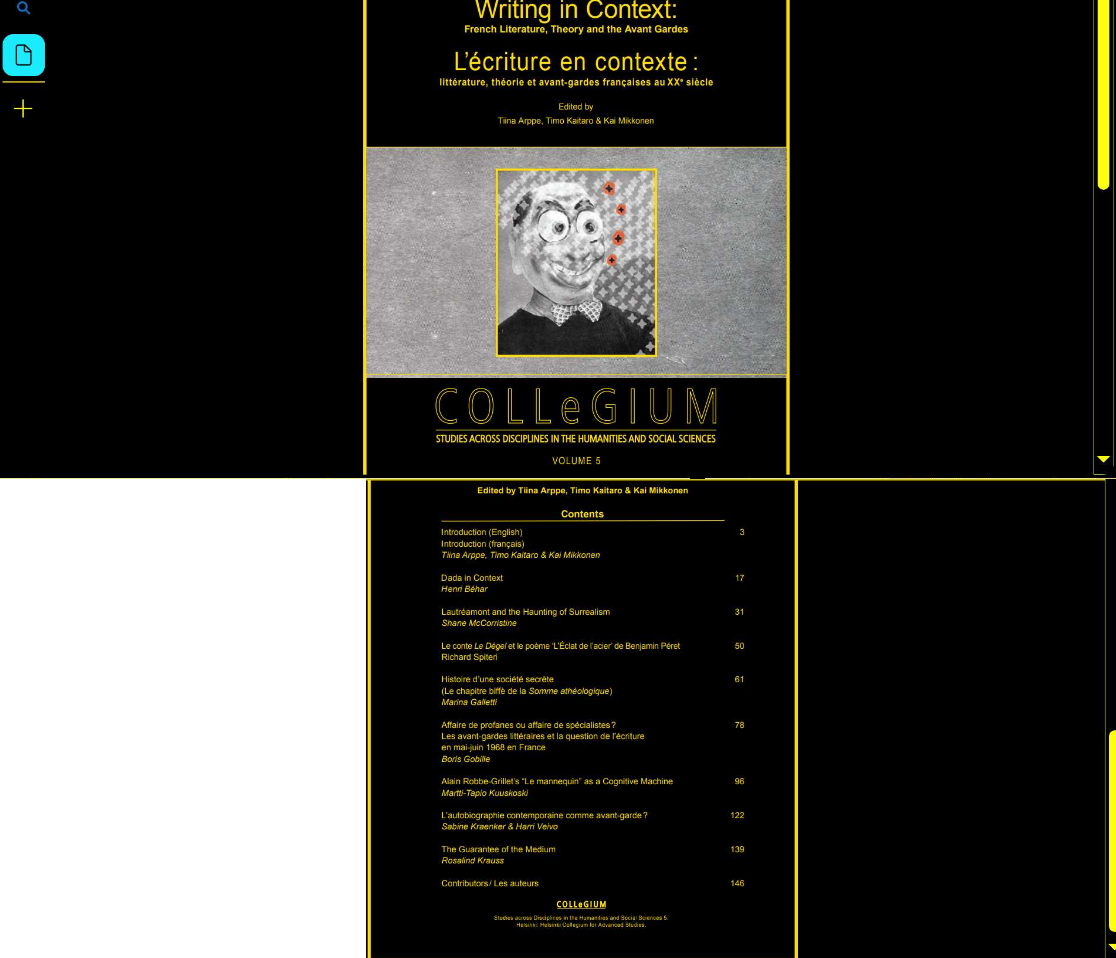
Read the resulting publication: 000_Cover&Contents.indd (helsinki.fi) 000_Cover&Contents.indd (helsinki.fi)
Read the complete introduction: 001_intro_final.indd (core.ac.uk)
Read my presentation in French, available online: _book_edcoll_9789401200547_B9789401200547-s002-preview (2).pdf
Read my presentation in English, titled “Dada in context”
Swansea Symposium: Programme
‘Eggs laid by Tigers’: Dada and beyond; Conference at Swansea University, 5-8 July 2006
Provisional Programme / Programme provisoire
The following timetable is still provisional. There is also an alphabetical list of speakers and a list of abstracts will be provided shortly. All sessions take place at the Callaghan Lecture Theatre (CLT) unless indicated otherwise. KH303 is in the Keir Hardie building (third floor), adjacent to the James Callaghan building. For the sessions in the Dylan Thomas Centre (DTC), a bus transfer will be organized. Working languages for the conference will be French and English, with informal gist interpretation provided as necessary.
Wednesday 5 July / mercredi 5 juillet
14:00–16:30
Registration / Inscriptions
16:30–16:45
Welcome, Introduction / Accueil, Introduction
Language of Politics, Politics of Language / Langage de la politique, politique du langage
16:45–17:45: Henri Béhar (Université Paris 3), "The Stabbed Dove: Dada and Politics" (Keynote speaker)
17:45–18:45:
Anna Katharina Schaffner (University of Edinburgh), "Dissecting the Order of Signs: on the Textual Politics of Dada Poetics"
Marc Décimo (Paris), "How, around DADA, the Construction of 'Modernity' and Description – Revolution – Revelation – Subversion of Language are Interwoven"
18:45–19:30
Reception / Vin d’honneur
19:30
Dinner / Dîner
Thursday 6 July / jeudi 6 juillet
Dada practices / Pratiques Dada
09:00–10:00
Mary Ann Caws (City University New York), "The Object of Dada" (Keynote speaker)
10:00–11:00
Janine Mileaf (Swarthmore College), "The Tactility of the Object"
Nina Parish (University of Bath), "To Make a Dadaist Book: Dada Experimentation with Book Form"
11:00–11:30
Tea-coffee break / Pause thé-café
Dada Geographies / Géographies dada
11:30–13:00
Raluca Lupu (Université de Montréal), "Belgian Surrealism and Dada: Paul Nougé and Strategies of Denial"
Nathalie Gormezano (ISIT, Paris), "Contemporary Avant-Garde Movements in Spain Related to Dadaism"
Matthew Witkovsky (National Gallery of Art Washington), "Defining Dada’s Diaspora"
13:00–14:15
Lunch / Déjeuner
Portraits – Identities / Portraits – Identités
14:15–15:45
Raihan Kadri (University of Essex), "Dadaist Poker: The Body and the Reformation of Form"
Elizabeth Legge (University of Toronto), "Turning One’s Story into a (Black) Loop: Portraits of Tzara"
Aurélie Verdier (Fonds National d’Art Contemporain), "The Temptation of the Void: The Dada Portrait in Paris"
15:45–16:15
Tea-coffee break / Pause thé-café
Dada, Surrealism / Dada, Surréalisme
16:15–17:15
Marc Berdet (Université Paris I), "Benjamin Post-Dadaist: Towards a Surrealist Release of the Collective Repressed?"
Timo Kaitaro (Academy of Finland), "Dadaist and Surrealist Irresponsibility"
17:15–17:30
Break / Pause
17:30–18:30
Parallel Sessions / Séances parallèles:
A: (CLT)
Dada Languages / Langages dada
David Christoffel (Paris): "The Melodist Reverse of Unique Eunuch"
Andreas Kramer (Goldsmiths, University of London): "Speaking Dada: The Politics of Language"
B: (KH303)
The Dada Eye / L’œil de Dada
Olivier Salazar-Ferrer (University of Glasgow): "Tararira by Benjamin Fondane and the Subversive Legacy of Dadaism"
Nicola Suica (University of Arts Belgrade): "Artistic Dissent in Belgrade in the 1960s"
19:30: Dinner / Dîner
Friday 7 July / vendredi 7 juillet
09:00–10:00
Bernard Noël (Mauregny and Paris): "Picabia: N’Importe quoi, n’importe comment" (Keynote speaker)
10:00–11:00
Parallel sessions / Séances parallèles:
A: (CLT)
Dada Cinema / Le cinéma Dada
Kim Knowles (University of Edinburgh): "Between Order and Chaos: Man Ray’s Emak Bakia (1926)"
Jennifer Wild (University of Iowa): "La jeune fille américaine: Female Figuration, The Cinema, and Dada"
B: (KH303)
Women’s Voices / Voix de femmes
Ruth Hemus (University of Edinburgh): '"The Manifesto of Céline Arnauld": A Woman Writer in Paris Dada'
Andrea Oberhuber (Université de Montréal): "The Spirit of Dada Filiation in the 'Autobiographic' Practices of Surrealist Women Writers"
11:00–11:30
Tea-coffee break / Pause thé-café
Performance / La Performance
11:30–13:00
Jill Fell (Birkbeck College, University of London): "Zurich Dada Dance Performance and the Role of Sophie Taeuber"
Catherine Dufour (Université Paris III): "The Dada Act"
Kerstin Sommer: "Dada is Dead – Long Live Dada: The Influence of Dadaism on Contemporary Performance Art"
13:00–14:15
Lunch / Déjeuner
14:15
10-minute coach transfer to Dylan Thomas Centre / Transfert en car au Centre Dylan Thomas (10 min.)
14:45–16:45
(Free afternoon / Après-midi libre)
16:45–17:45
Rudolf Kuenzli (University of Iowa): "Berlin Dada: Interventions into Mass Media" (Keynote speaker)
17:45–19:15
Parallel sessions / Séances parallèles:
A: (DTC1)
Dada Cultures / Cultures Dada
Dafydd Jones (University of Wales Cardiff): "The Location of Dada Culture"
Nadia Ghanem (Université Paris 8): "Cabaret Voltaire in Perspective"
Patrick Suter (Université de Genève): "Dada and the Ecological Function of Art"
B: (DTC2)
Beyond Dada / Au-delà de Dada
Vincent Antoine: "Johannes Baader Oberdada. Dada and Madness"
Guy Dureau (Université de Pau-Bayonne): "Presence and Legacy of Georges Ribemont-Dessaignes: A Dadaist after Dada"
Paul Cooke (University of Exeter): "The Critical Reception of René Crevel: The 1920s and Beyond"
19:30
Reception / Vin d’honneur
20:00
Conference Dinner / Banquet du colloque
23:00
Coach transfer back to campus halls / Retour au campus en car
Saturday 8 July / samedi 8 juillet
09:00–10:00
Roger Cardinal (University of Kent): “‘Sch... Sprechen Sie Merz?’ On reading Kurt Schwitters” (Keynote speaker)
Dada and Cinema / Dada et le cinéma
10:00–11:00
Ramona Fotiade (University of Glasgow): “Spectres of Dada: from Man Ray to Marker and Godard”
Alfred Thomas (University of Illinois at Chicago): “Dada and its Afterlife in Czechoslovakia: Věra Chytilová’s Daisies (1966)”
11:00–11:30
Tea-coffee break / Pause thé-café
Beyond Dada / Au-delà de Dada
11:30–13:00
Nathalie Roelens (Universities of Antwerp and Nijmegen): “In the Wake of Dada: Dubuffet, Alechinsky, Michaux and other ‘peripherals’”
Stephen Forcer (University of Birmingham): “The Importance of Talking Nonsense: Tzara, Ideology, and Dada in the 21st Century”
Olivier Penot-Lacassagne (CNRS–Université Paris III): “‘Notice to Ruin Builders’: Situationists and Punks, or the Legacy of Dada”
13:00–13:15
Closing remarks / Remarques de clôture
Questions liées
Comment le mouvement Merz de Schwitters influence-t-il la perception du Dada aujourd'hui
En quoi la destruction du Merzbau reflète-t-elle l'esprit de Dada et Merz
Quelles différences majeures existent entre le Merz et le Dada dans leur approche artistique
Pourquoi Schwitters a-t-il choisi d'utiliser des matériaux ordinaires pour ses œuvres Merz
Comment la notion de « total art » dans Merz peut-elle enrichir ma compréhension de l’art contemporain
13:15
Lunch / Déjeuner
14:00
Conference ends / Fin du colloque
See: my text available online:
_book_edcoll_9789401200547_B9789401200547-s002-preview (2).pdf
Dada and Beyond, Volume 1, Dada Discourses
Series: Avant-Garde Critical Studies, Volume: 26
Editors-in-chief: Elza Adamowicz and Éric Robertson
This collection of critical essays celebrates the subversive and stimulating creativity of the Dada movement, born in the pacifist city of Zurich in 1916 as a violent reaction to the First World War. It examines collective and individual activities...
Copyright year: 2011
Pages: 1–17
Chapter 1. The Stabbed Dove: Political Dada, Henri Béhar, pp.: 19–35
Chapter 2. Dissecting the Order of Signs: On the Textual Politics of Dada Poetics, Anna Katharina Schaffner, pp.: 37–49
Chapter 3. How, Around DADA, the Construction of “Modernity” and Description – Revolution – Revelation – Subversion of Language Were Interwoven, Marc Décimo, pp.: 51–60
Chapter 4. Dadaist and Surrealist Irresponsibility, Timo Kaitaro, pp.: 61–69
Chapter 5. The Object of Dada, Mary Ann Caws, pp.: 71–82
Chapter 6. Daily Miracles: The Object-Language of Arp, Éric Robertson, pp.: 83–92
Chapter 7. “To Make a Dadaist Book”: Dada Experimentation with Book Form, Nina Parish, pp.: 93–103
Chapter 8. Paul Nougé and Strategies of Denial, Raluca Lupu-Onet, pp.: 105–119
Chapter 9. The Manifesto of Céline Arnauld, Ruth Hemus, pp.: 121–131
Chapter 10. Johannes Baader, Dada and Madness, Vincent Antoine, pp.: 133–142
Chapter 11. Dadaist Poker: The Body and the Reformation of Form, Raihan Kadri, pp.: 143–155 (Restricted access)
Chapter 12. Hans Arp and Sophie Taeuber: The Quintessence of the Dada Couple, Walburga Krupp, pp.: 157–167
Chapter 13. The Temptation of the Void. Francis Picabia and the Dada Portrait, Aurélie Verdier, pp.: 169–185
Chapter 14. Between Museum and Fashion Journal: Hybrid Identities in Hannah Höch’s Photomontages, Elza Adamowicz, pp.: 187–197
Chapter 15. Speaking Dada: The Politics of Language, Andreas Kramer, pp.: 199–213
Chapter 16. “I Destroy the Drawers of the Brain”: Reading Incoherence in Picabia and Automatic Writing, Andrew Rothwell, pp.: 215–228
Chapter 17. The Melodist Reverse of Unique Eunuch, David Christoffel, pp.: 229–238
Chapter 18. Dada PaDada Dada, Bernard Noël, pp.: 239–246
The definitive revision of my article, entitled “Political Dada,” appears in: H. Béhar, Shockwaves, New Essays on the Avant-Garde, L’Age d’Homme, 2010, pp. 65–77.
Additionally, I delivered the same lecture at the University of Austin, Texas, on November 12, 2006, invited by J.C. Cauvin, titled “Political Dada.”
Further reading: the essential volume compiled by Catherine Dufour and myself, published by L’Age d’Homme (2005): Dada circuit total - Henri Béhar (lagedhomme.com)
See the dissertation by T. Kaitaro:
Certain clichés about surrealism, as well as dreamy surrealist painting as practiced by Dali and his imitators, easily give the impression that surrealism turned away from the real world to depict the subjective world of dreams, imagination, or the fantastic. This image of surrealism is misleading. It is important to stress the etymological meaning of the word: it is not about fleeing reality but approaching it with means that go beyond the limits of traditional realism. By transgressing traditional codes of representing reality, surrealism aimed to reconnect with reality without neglecting the irrational residue that escapes our rational and utilitarian categorizations. The purpose of this study on the philosophical stakes of the movement is to show that the surrealist project of "derealization" of objects does not result in anti-realism, but in an "open realism"… in the Bachelardian sense of the word. By challenging a narrow vision of reason, surrealism did not propose to abandon itself to irrational forces but to broaden the horizon of reason within the framework of sur-rationalism.
Late Addition:
André Breton (1896–1966)
Héloïse and Lautréamont
Autograph text, Paris
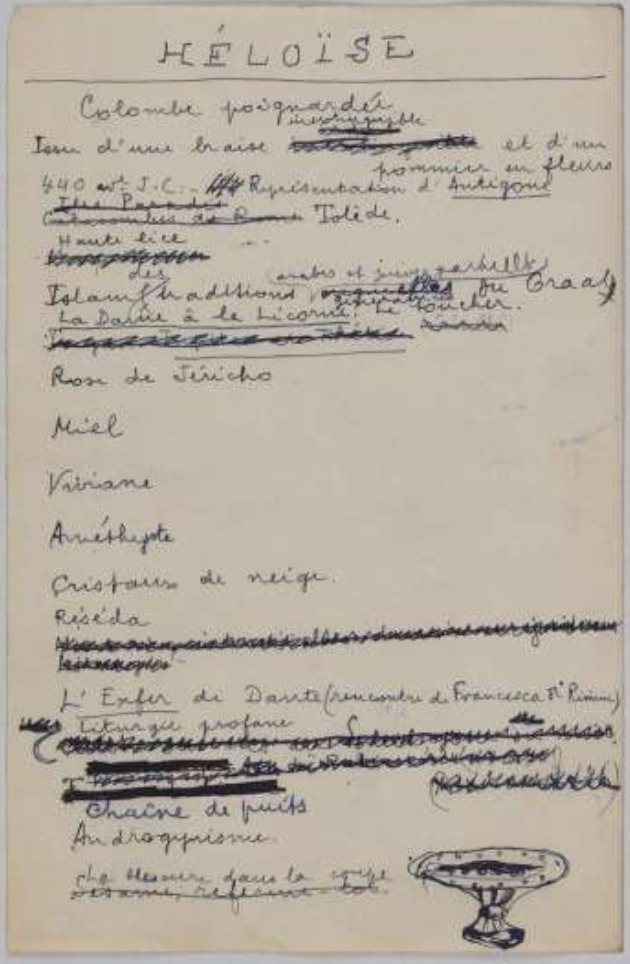
— On the back of an invitation card from Galerie Fürstenberg, autograph text by Breton:
“The hard stone is rolled (the one no longer threatened by its edges) [it] answers with a kind of very distant smile tinged with a condescension that could not reasonably hurt us/you... The portrait of Lautréamont that Dali claimed to establish by the paranoiac-critical method would best be sought through the agates of Uruguay.”
— Three handwritten pages in octavo, titled the first “Héloise,” the next two “Lautréamont” in blue ink by André Breton, with crossings-out and corrections.
“Héloise stabbed dove. Born from inextinguishable embers and a blossoming apple tree.”
“440 BC. Representation of Antigone” with an original Breton drawing of a cup: “The wound in the cup”
“Lautréamont,” “Killer whale (or ‘orca’): whale hunters... 4th century: Attila falls in love with Ursula and proposes marriage (episode of the 11,000 virgins)... The Lucifer of the Monk. Jean-Valentin Andrae: The Chemical Weddings. Minor diversions”... Estimated value: €300
Sale date: Saturday, April 12, 2003, 14:30