"Jocrisse or gendelettres? Jarry as he really is", Les Nouveaux Cahiers de la Comédie-Française, n° 5, 2009, p 5-13.
We know it well, but it must be repeated: the authors of the different articles in the program had not seen the new staging proposed by the Comédie Française before writing their paper. In other words, I asked in vain to see Jean-Pierre Vincent's work, move along, there's nothing to see! Hence the portrait I give of Ubu has nothing to do with the one realized by the director and the main performer. It remains that the entry of Jarry's play into the Comédie Française was a great first, particularly hailed by the young audience. Staging by Jean-Pierre Vincent at the Comédie-Française, 2009
"Ubu roi" enters the Comédie-Française repertoire By Nathalie Simon Le Figaro, Published on 05/27/2009 at 18:24 Jean-Pierre Vincent stages Alfred Jarry's sulphurous play, created for the first time in 1896. On December 10, 1896, the first performance of Ubu roi at the Théâtre de l'Œuvre caused a scandal, notably because of the famous "Merdre" repeated throughout the show. Jules Renard writes: "If Jarry doesn't write tomorrow that he made fun of us, he won't recover from it!" In response, the person concerned commits the article: On the uselessness of theater in theater? Shocking is not the Comédie-Française's intention, happy to finally bring Ubu roi and its author who disappeared at the age of 34 into the repertoire.
My contribution (page 1):
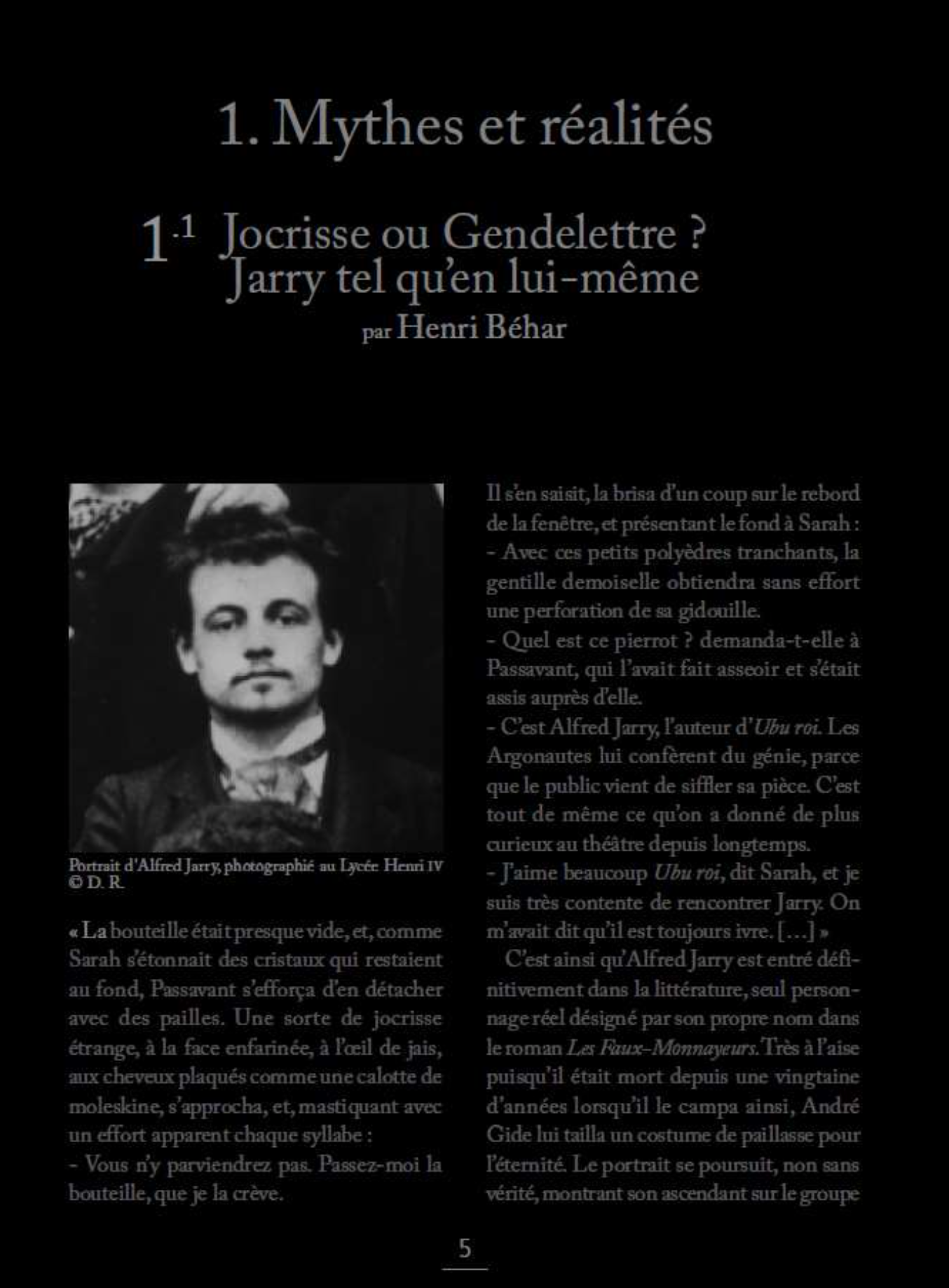
My complete text:
It was not Père Ubu, nor "the supermale of letters" (sic), nor even a belated schoolboy, indulging in immature jokes. The centenary of his death must be the occasion to set things straight, and for Alfred Jarry to appear in full light for what he has always been: a full-fledged writer, even if the circumstances and the works he had the audacity to produce set him entirely apart. In this regard, the biography recently published by Patrick Besnier sets the record straight, unlike the previous ones. Jarry is, simultaneously, the inventor of 'Pataphysics and Père Ubu, a creature that literally devoured him and whose traits he ended up adopting. He knew how to transcend the deleterious symbolism, which could only lead to the impoverishment of thought through excess of style, by introducing heterogeneous elements into it, nourished by life.
An inspired schoolboy
Alfred Jarry was born in Laval on September 8, 1873, into a bourgeois family, concerned with respectability. However, his mother seems to have had a marked tendency toward eccentricity: "Our mother [...], willful and full of fantasy, whom we were obliged to approve before having a say. She was very fond of cross-dressing." His parents having quickly separated, he was raised in Saint-Brieuc by his maternal grandfather, with his sister Caroline, called Charlotte, eight years his senior. She left an emotional testimony about her younger brother, more credible than is claimed. In the same way, it is now established that his father, Anselme Jarry, maintained relations with his children throughout his life, and that he was not quite the poor wretch without importance that his son said to shock the audience: "He certainly made our elder sister, [...], but he must not be for much in the making of our precious person!..." A precocious and mocking writer, imbued with Breton folklore, young Alfred composed the poems and sketches of Saint-Brieuc-des-choux (posthumous, 1964), fragments of a file, Ontogeny found long after his death and containing in germ several traits of his future work. The title, ontogeny or ontogenesis, which designates, in biology, the set of processes of development of an individual from the embryonic stage to the adult state, as opposed to phylogeny, which studies the development of the species, refers to the great scientific-philosophical debates of the time, while revealing, through a pun (shame on genius!), the author's superior attitude towards his childhood. I see, in this file, the characteristic approach of an adult writer who dares not publish creations directly from the juvenile universe, but who, unable to resolve to destroy them, leaves posterity the task of deciding... In the year of his fifteenth birthday, the family left Saint-Brieuc for Rennes. From his entry into the Rennes high school (where he was enrolled from 1888 to 1891), he had Les Polonais performed, with puppets and shadow theater. These were elements of a geste elaborated by several generations of students, targeting their physics teacher, Félix Hébert, alias "P. H." or "Père Heb", or "père Ébé", whom Jarry would name Père Ubu. His merit? having given dramatic form to adolescent genius, having brought it to the stage in various forms: Ubu roi (1896), Ubu enchaîné (1900), various drafts of Ubu cocu (1944) or Ubu intime (1985) and the Almanachs du Père Ubu (1899, 1901). This means that Jarry never gave up his "schoolboy" works, which he reworked throughout his existence, certainly convinced that he had something there that had much to do with literature, not that which reproduces mechanically, but as he conceived it. I call "schoolboy", derived from "potache", not only, according to the dictionary definition, what "has retained the spirit of adolescents and young students, the taste for joking", but more precisely what relates to the culture of students in high schools and colleges of the Third Republic, a compromise formation between classical education and various popular traditions. Pure products of this culture, these works, many times reworked, deal with scatological themes more than erotic ones, in forms parodying great literature.
Entry into literature
Having passed his baccalaureate in advance, with dispensation, a sign of certain precocity, Alfred Jarry entered the Henri IV high school in Paris to prepare for the École Normale Supérieure. He followed Bergson's teaching, and we have the notes he took in his course for two years. After three successive failures, he definitively renounced the teaching career, and presented himself, with as little success, to the license in letters, at the Sorbonne. It must be said in his defense that Jarry would have suffered from a serious illness in January-February 1893, perhaps typhoid fever, to the point that his mother came specially from Laval to care for him. She herself was to die shortly after, on May 10. It was then that, according to Dr. Michel Gazeau, the depressive episode that had marked the end of his schooling would have returned at a gallop, at the origin of his addiction to alcohol and his disorienting behavior to say the least. In other words, the disappearance of his mother, for which he blamed himself, would have provoked in him a profound psychological reaction, whose inscription in his literature would be interesting to follow. Nevertheless, from the same year dates what could be called his entry into literature, and his approaches to penetrate the milieu of men of letters. It was indeed during his "khâgneux" schooling that Jarry gave puppet performances of Ubu roi for his comrades in his room at the "Calvaire des Trucidés". Jarry entered the career of letters in a very original way, through the path of prize competitions in newspapers. L'Écho de Paris mensuel illustré awarded him the first prize three times in April, May and June 1893. He collaborated with essays and literary and pictorial criticism notes to the small journal L'Art libre, a publication to which he contributed financially. At the same time, Jarry went several times to rue de Rome to the famous Mardis de Mallarmé, without any traces of his interventions being recorded, all the less probable since the Master was in charge of the conversation alone! It was thus that he was noticed by the companions of the Mercure de France, the most representative organ of Symbolism. Rachilde, Alfred Vallette's wife, its director, invites him to her "Tuesdays". He gave readings of Ubu roi several times, playing all the roles with his admirable voice, to the memory of Jean de Tinan, in such a way that he triggered, unforgettably, the laughter of the audience. As we can see, Jarry did not hesitate to use Ubu, whose value he knew in the eyes of this audience, to penetrate literary circles. Astute, he consolidated his position by buying four shares of the Société anonyme du Mercure. Rachilde, who became the most faithful of his female friendships, appreciated him enough to devote to him, after his death, a vibrant testimony of sympathy, under the title Alfred Jarry ou Le Surmâle de lettres. With Remy de Gourmont, the éminence grise of the journal, he founded in 1894 a luxurious art journal, L'Ymagier, which had seven issues, then, on his own account, Perhinderion, for which he had special typographic characters composed. His first collection, Les Minutes de sable mémorial (1894) illustrates his aesthetics of the moment: "To suggest instead of saying, to make in the path of sentences a crossroads of all words", he writes in his "Linteau". He announces future "elements of pataphysics" and makes Ubu appear in Guignol, a text already published by L'Écho de Paris, where father Heb had become Père Ubu, "former king of Poland and Aragon, doctor in pataphysics". A year later, César-Antéchrist (1895), containing a condensed version of Ubu roi, appears as an absolutely symbolist play.
The invention of Ubu
His strategy of insertion into the literary avant-garde was interrupted by the call to arms. Jarry was incorporated into the 101st infantry regiment at the Laval barracks, from where he continued to direct L'Ymagier and program contributions to the Mercure de France. Numerous are the anecdotes relating to his stay at the barracks, but even more important is the transposition he gives of it in Les Jours et les nuits (1897), subtitled "novel of a deserter". Contrary to what one might think for a work whose setting is the barracks, this substantive is to be understood figuratively, since the singular hero takes advantage of the moments when he is on guard to "desert" external reality, to return to himself, to escape into his reveries, even his favorite hallucinations. Jarry's father died in Laval on August 19, 1895. Suffering from influenza, his son was bedridden in the infirmary. He therefore did not attend the funeral. In December, he was taken to the military hospital of Val-de-Grâce in Paris. At the end of the year, he was definitively discharged for "chronic biliary lithiasis", which then ruled out the hypothesis of tuberculosis or mental disorders, or even alcoholism. He also received a certificate of good conduct in support. Back in Paris, he managed to be employed as secretary-factotum by Lugné-Poe at the Théâtre de l'Œuvre where, as the latter writes, "he makes the Ubu pawn advance". He had renamed Les Polonais as Ubu roi, which he published in journal then in volume before having it performed on a real stage. With the historic premiere at the Théâtre de l'Œuvre on December 10, 1896, he became the most original figure of Symbolism, whose themes he exploited by pushing them to their most extreme consequences, while striving to lead the life of a man of letters. "Restored in its integrity as it was represented by the puppets of the Phynances theater in 1888": the subtitle immediately indicates the juvenile and collective origin of a work elaborated by the high school students of Rennes, of which Jarry wanted to be the faithful transcriber and adapter, passing from children's theater to adult stage. Fitting into the form of Shakespearean tragedy while parodying it, the play shows, schematically, how Ubu, commanding in the past once glorious, pushed by an ambitious woman, eliminates the king of Poland Wenceslas and seizes his throne. He conspires with Captain Bordure, whom he disowns once his crime is accomplished. The entire royal family is massacred. Only the king's son, young Bougrelas, who will finally avenge his ancestors, escapes. Ubu governs with the sole ambition of eating andouille and enriching himself: "I will kill everyone, then I will leave". He exterminates the nobles, magistrates, financiers who resisted him. The Czar of Russia declares war on him. He goes on campaign and entrusts the regency to Mother Ubu. The latter, driven out by the revolted people, takes refuge in a cave where, by a strange coincidence, she finds Ubu defeated. The reconciled spouses embark on the Baltic and sail towards new adventures. Ubu regrets his country: "If there were no Poland, there would be no Poles" he says to finish, alluding to the primitive title of the play, but also to the fact that the country was erased from the map since the Congress of Vienna. More than by the plot, the work makes history by its gestures, its language and its style: the initial "Merdre", the mixture of archaic vocabulary and expressions specific to Père Ubu: "by my green candle", "cornegidouille", the "phynance hook" and the inseparable "palotins". Language of such theatrical effectiveness that it communicates infallibly to all spectators who, from then on, begin to "speak Ubu". Supported by the symbolists, the creation was considered a new battle of Hernani, by its repeated provocations, its scatology, the debility of the plot and characters, while youth saw it as a good farce. With the hindsight of history, the play marks a dramaturgical revolution by sending back to back the opposing aesthetics of naturalism and symbolism. Many directors and even more critics have wanted to make it a political satire, which it could only be at an abstract level, by condemning any type of government. Retrospectively, the entire ubuesque work of Jarry takes the forms of a counter-culture on at least three levels:
- By taking on a collective creation, of schoolboy origin, by showing its realization capacities at the higher level, that of avant-garde theater, Jarry did not content himself with reconnecting the thread of the Rabelaisian tradition, he highlighted the creative virtues of a school group and reintroduced everything that classical or learned culture had evicted from the literary horizon, the corporeal, which, in sum, relates to the constitutive trilogy of Père Ubu, merdre, phynance and physics. This laughter of childhood, nourished by a whole buried, repressed past, came to strike head-on a society stuck in its celluloid collar, and it was understood, from then on, that the adolescent gaze had to be reckoned with, different from that of parents and the environment where it develops.
- On the artistic level, Jarry radically subverted the theater of his time, by introducing a fecal being, literally unbearable, a reappearance of Falstaff, at the center of the ethereal stage of the symbolists. Perhaps involuntarily, insofar as the initial representation was far from realizing all his projects, he showed the third way, between "this need for reality that torments us", characteristic of naturalist aesthetics, and "the stage free at the whim of fictions" postulated by symbolism. Positing, here again, an equivalence between puppet theater, what he called "mirlitonesque theater" (Ubu sur la butte, Par la taille, etc.) and the stage of the Théâtre de l'Œuvre, he sought a synthetic form, ridding theater of all its artifices, including the actor, concretely demonstrating that extremes meet, that extreme lightness borders on heaviness, and, conversely, that heaviness sometimes attains grace.
- Finally, with the Ubu type, he created one of the rare symbols of our time, ambiguous as desired, swollen with all meanings, the most contradictory. It is, according to the times and versions, a reincarnation of Nero, Caligula, Napoleon, the perfect Bourgeois, the Mufle, the bloody Dictator (Hitler or Stalin), or, at the other extreme, the Imbecile, the Coward, the Bastard. It is also instinct in its pure state, the Freudian "id", the power of lower appetites. All these interpretations are acceptable in the name of the equivalence of opposites. Except that the character is given to us as stupid, devoid of any spirit, and he could not defend any other political regime than that which provides him most surely with the satisfaction of his desires.
- Ubu inventor of 'pataphysics By a game of symmetry sometimes simple, sometimes inverse, all of Jarry's narratives illustrate the principle of equivalence of opposites. Thus, Les Jours et les Nuits, already named, presents a singular but doubled hero, who balances the antinomies, dream and wakefulness, real and imaginary, just like that of L'Amour absolu (1899), ultimate reverie of a condemned man identifying with God. It happens that Ubu is also the creator of "'Pataphysics". The term would have been used as a surpassing of the physics taught by Félix Hébert, professor of physics and initial model of Ubu, by the high school students of Rennes as early as 1889-90, and collected the following year by Jarry in Ubu cocu, where Père Ubu presents himself as a "Pataphysician". The latter defines his knowledge thus: "Pataphysics is a science that we have invented and whose need was generally felt." Jarry mentions it on various occasions in his early writings, up to the "Linteau" of Les Minutes de sable mémorial (1894) of which a note specifies that "Simplicity does not need to be simple, but complex tightened and synthesized (cf. Pataph.)". César Antéchrist brings it to the theater, under the species of the Bâton-à-Physique, sexual instrument, which is both the plus sign and the minus sign, masculine and feminine, by virtue of the identity of opposites. This is clearly exposed in Les Gestes et opinions du docteur Faustroll, pataphysicien, posthumous work (1911), elaborated as early as 1898. It contains several definitions: "An epiphenomenon is what is added to a phenomenon... And the epiphenomenon being often the accident, pataphysics will be above all the science of the particular, whatever one says that there is no science but of the general. It will study the laws that govern exceptions [...]" Book II, entitled "Elements of Pataphysics" opposes induction to deduction, accident to general, paradoxical to universal consent. It contains this "Definition: pataphysics is the science of imaginary solutions, which symbolically accords to the lineaments the properties of objects described by their virtuality." It is the opposite of positive science; it studies exceptions and explains universes parallel to ours, like the Grands Transparents that André Breton would postulate later. Followed an immobile journey, an exploration of imaginary universes conceived by the greatest contemporary artists, and a very learned calculation of the surface of God, defined as the tangent point of zero and infinity", which Boris Vian would take up. Born in the high school playground, pataphysics is a creation of the spirit of childhood, which it perpetuates in its works. Ubu and Faustroll are both doctors in pataphysics, they are therefore equivalent. Complementarily, Messaline, novel of ancient Rome (1901) and Le Surmâle, modern novel (1902) develop in chiasmus, like a representation of the limits of human forces for both sexes, indissolubly mixed with death. Realism situates man and machine in two absolutely separate universes. The fantastic (and particularly what will become science fiction) applies itself to confusing them. The American scientist, Ellen's father, is convinced that the Surmale does not love his daughter. To oblige him, he invents the machine to inspire love, made, roughly, of an induction coil placed on the head of the subject seated on a sort of electric chair of such powerful voltage that in principle he risks nothing (as in the Faraday cage). However, to the astonishment of the observers, they must face the evidence: "it was the man who influenced the Machine-to-inspire-love" (269). To the point that it becomes in love with the man. A positivist would account for this phenomenon by the overload of vital energy accumulated by the brain during its love record. An idealist will see in it the triumph of spirit over matter. Finally, the novel illustrates, in its entirety, the principle of identity of opposites in that it is the opposite of Messaline, novel of ancient Rome. To antiquity are opposed future times, to the empress "known in history for having wiped more than twenty-five lovers in one day" (206) responds the Surmale. Remembering his Latin versions, and the curiosity of schoolboys for all the licentious passages of literature, Jarry translates the verses of Juvenal on which he relies to construct his novelistic fiction, but, according to the good principle of his masters, he leaves in original language the most inappropriate words. I will not go beyond. Let us simply remember, therefore, that Messaline and the Surmale are inversely symmetrical. Both accomplish amorous exploits, both perish by where they have sinned, by adoring what seemed to them of no importance: Messaline by the phallic sword, Marcueil by the Machine-to-inspire-love. Pataphysics certainly falls under absolute idealism, a total confidence granted to the spirit and especially to words. But, by virtue precisely of the philosophy that underlies it, it includes a warning already formulated in L'Amour absolu: the absolute lies.
A programmed disaster
After squandering his inheritance in artistic enterprises without a future, Jarry lived miserably, asking alcohol and ether, "it detaches," he said, the vitality he could not afford otherwise. Surprised by his strange capacities, his friend Rachilde gives an overview of his daily regime: "...he began the day by absorbing 2 liters of white wine, 3 absinthes spaced between 10 a.m. and noon, then at lunch he watered his fish, or his steak, with red wine or white wine alternating with other absinthes. In the afternoon, a few cups of coffee mixed with marc or alcohols... then at dinner, after, of course, other aperitifs, he could still support at least 2 bottles of any vintage... However, I never saw him really drunk..." This resistance is perhaps explained by the fact that he lived as much as possible in the countryside, practicing sports (cycling and fishing). From 1901 to 1903, he regularly entrusted his articles to La Revue Blanche, from which he drew the bulk of his income. Starting from daily gestures or news items, these are exercises in applied pataphysics, first published under the title Spéculations (1901, posthumous, 1911) then under that of Gestes (1902) they were gathered under the title La Chandelle verte in 1966. Before his disappearance, Jarry thought to publish some of them with the publisher Sansot, who had published his "mirlitonesque theater": Par la taille (1906), Le Moutardier du Pape (1907), operetta inspired by Emmanuel Rhoidès' novel, La Papesse Jeanne, which he translated from Greek with Jean Saltas from 1905 (posthumous publication in 1908). In addition to these pen works, various operettas, written in collaboration: Léda (1900), Le Manoir de Cagliostro (1905), the interminable opera-bouffe Pantagruel (posthumous, 1911) undertaken since 1898 at the request of the composer Claude Terrasse, some fugitive collaborations to journals (La Renaissance latine, La Plume, Le Canard sauvage, L'Œil and even the daily Le Figaro, finally an unfinished novel, La Dragonne (1943), making a return to his mythical origins, gave the illusion of a feverish activity. Jarry died in Paris on November 3, 1907, at the age of 34, of tuberculous meningitis, at the Charité hospital. In fact, he had contracted this tuberculosis as early as 1894-95, and his state of health was aggravated by an alcoholic overdose.
A hermetic language?
Jarry did not write "like everyone else", we must recognize it, and yet it is he who, a new Rabelais, promoted popular and childish language to the supreme essence of theater. In fact, he cultivates several languages, reflections of his different cultures. There is on the one hand the symbolist Jarry, lover of paradoxes: "We only believe in the applause of silence" (Twelve arguments on theater); "The noblest conquest of the horse is woman" (La Chandelle verte). On the other hand, there is the journalist, cultivating the point, in the manner of songwriters. A militant alcoholic, he declares: "Anti-alcoholics are sick people in the grip of this poison, water, so dissolving and corrosive, that it was chosen among all substances for ablutions and laundry and that a drop poured into a pure liquid, absinthe, for example, troubles it." He is above all a great lover of rare words, linguistic pearls, using concentrated images, preferring ellipsis to articulated reasoning, abstraction to mimetic description. Jarry is a visionary because he wanted from the outset to abstract himself from the everyday to situate himself in eternity, or better yet ethernity, as he wrote: "If we want the work of art to become eternal one day, is it not simpler, by freeing it oneself from the swaddling clothes of time, to make it eternal right away".
Henri BÉHAR
Fabula press release: Les Nouveaux Cahiers de la Comédie-Française n°5: Alfred Jarry • Comédie-Française/L'avant-scène théâtre, coll. "Les Nouveaux Cahiers de la Comédie-Française", • EAN: 9782749811024; • Publication date: 0 May 2009 Published on June 25, 2009 by érenger Boulay (Source: Julien Schuh) Alfred Jarry. Paris: Comédie-Française/L'avant-scène théâtre, coll. Les Nouveaux Cahiers de la Comédie-Française n°5, 2009, 104 p. • EAN: 9782749811024 • ISBN: 978-2-7498-1102-4 • Price: 10.00 € • In a first part, Henri Béhar, Laurent Muhleisen, Barbara Pascarel, Matthieu Protin and Agathe Sanjuan explore the myths and different realities that made Alfred Jarry's existence a veritable dream with absurd connotations, but just as poetic as extraordinary. • The second part highlights what inhabited Jarry during his short life, namely art. Thus, through the articles of Matthieu Gosztola, Julien Schuh, Philippe Cathé, Florence Thomas and Patrick Besnier, we discover Jarry's enthusiasm for literary activity, journals, music and pictorial arts, to the point of devoting all his vital energy to them. • In a third time, Isabelle Krzywkowski, François L'Yvonnet, Isabelle Quentin, Paul Edwards, Jean-Pierre Vincent and Alexandre Le Quéré take stock of the posterity of the Jarry work, its heirs and influences, numerous and multiple. • Throughout the Cahier, appears a small dictionary devoted to Jarry's words, from Absinthe to Revolver, established by Sylvie Jopeck.
Born in 1873, Alfred Jarry created the character of Père Ubu as early as the courtyard of their Rennes high school in the company of the Morin brothers. As early as 1885, he appeared in a puppet show: Les Polonais. With a rapid and fulgurant career, Jarry is a very productive author who knows how to blur the tracks both on his creations and on his own person. Between the different scandals that break out, he develops his unavoidable Ubu character, declining his adventures in Ubu roi, Ubu cocu, Ubu sur la Butte... A true figurehead of the absurd, Alfred Jarry inspired many playwrights and artists including Antonin Artaud, Eugène Ionesco, and Boris Vian. In May 2009, Jean-Pierre Vincent staged Ubu roi at the Comédie-Française, Salle Richelieu. This Nouveau Cahier, fifth in the collection and devoted to the work, life and personality of Alfred Jarry, allows us to shed light on his work, but also on all the aesthetic and ideological evolutions of French theater at the beginning of the century. The authors: Henri Béhar, Patrick Besnier, Philippe Cathé, Paul Edwards, Matthieu Gosztola, Sylvie Jopeck, Isabelle Krzywkowski, Alexandre Le Quéré, François L'Yvonnet, Muriel Mayette, Laurent Muhleisen, Barbara Pascarel, Matthieu Protin, Anne Quentin, Agathe Sanjuan, Julien Schuh, Florence Thomas, Jean-Pierre Vincent.
Libération review: Jarry by Mathieu Lindon; published on February 6, 2013 at 21:42:
"If we want the work of art to become eternal one day, is it not simpler, by freeing it oneself from the swaddling clothes of time, to make it eternal right away." Henri Béhar quotes this phrase from the author of Ubu roi in his general introduction to the chronological edition of the Complete Works of Alfred Jarry that he directs and of which the first two volumes are published. Born in Laval in 1873, died in Paris in 1907, Jarry is 15 years old in 1888 when he discovers Les Polonais, a work inspired by the character of a teacher, père Hébert, and written by Charles Morin, another high school student, for their puppet theater. After multiple avatars, it will become Ubu roi and will be created in 1896 before an audience that will deliver a new battle of Hernani begun from the first word which is the famous "Merdre". Henri Béhar estimates that Jarry "raises the flag of counter-culture on at least three levels": socially, we must "henceforth count on the adolescent gaze"; artistically, "he radically subverted the theatrical codes of his time, by introducing a fecal being at the center of the ethereal stage of the symbolists"; mythically, he creates "one of the rare symbols of our time, ambiguous as desired, swollen with all the most contradictory meanings". Jarry is the astonishing missing link between symbolism and surrealism, between Mallarmé and Breton. "You have set up, with rare and durable clay on your fingers, a prodigious character and his own, that, my dear friend, as a sober and sure dramatic sculptor", the first will write to him late. Breton, for his part, sees Jarry as the one who mines the terrain of literature: "The author imposes himself on the margin of the work; the prop man, dismaying as desired, passes and repasses constantly in front of the lens while smoking a cigar." Jarry, the one who makes the codes explode, the one who will try to be personally the father Ubu, the one who, according to his own expression, can produce "a Masterpiece". In 1894, Les Minutes de sable mémorial appeared, "the most extreme example of symbolism and decadence", writes Paul Edwards. Illustrated by the author, the book is first original as an object (the cover is mute, the typography extraordinarily careful) and already puts shit at the center of the project. Publisher's note about the chapter entitled "Art and Science": "Science is represented by the automated shit pump, Art by the manual collection of excremental matter by plunging buckets into it." Jarry is an erudite schoolboy who handles scatology and the use of neologisms and rare words - for example, at the whim of a few pages of Les Jours et les Nuits, his 1897 novel: sandarac, anurans, catnip, hemeralope, amorose, tricuspid, perennial. Conscientious shoemaker, he imagines "Ecrase-Merdres for the plurality of tastes. Here for recent turds, here for horse dung, here for ancient spyrates, here for cow dung, here for infant meconium in the cradle, here for gendarme shit [...]". These first two volumes cover a period where "Pataphysics" is not yet triumphant: it is still soberly defined only as "a science whose need was generally felt". With a disconcerting elitism, Jarry despises the crowd and dreams of "the perfect anarchist" that Ubu is not in his eyes, since there is "this which prevents us from ever becoming the perfect anarchist, that it is a man, hence cowardice, dirt, ugliness, etc." There is an eternity of Ubu due to the fact that the play takes place both nowhere and anytime, in literary eternity, since no psychological, ideological or historical explanation pollutes the play. "Ubu roi is, literally, irrecoverable", writes Henri Béhar. "To maintain a tradition even valid is to atrophy thought which transforms itself in duration; and it is insane to want to express new feelings in a 'preserved' form", writes Jarry in his Réponses à un questionnaire sur l'art dramatique, he who wants to give the place of honor in theater to the absurd and the abstract. Les Jours et les Nuits, which takes place in the army, is subtitled Roman d'un déserteur, this desertion being more mental than concrete. Jarry wishes that each tradition be deserted when the time comes, including those that had appeared as revolutions, such as that of Ubu. However, everything happens as if his work and his own character remained eternally in an obligatory marginality - no one writes, no one thinks like that. In 1904, Jules Renard recounts that Jarry practices with the rifle and that the bullets "fall on the other side of the wall", to the great terror of his neighbor. "- You're going to kill my children!/ - We'll make you others, madam."
Performance review:
Le Monde, May 28, 2009: Ubu roi is a schoolboy play. Alfred Jarry (1873-1907) had the idea when he was a student at the Rennes high school. With friends, the Morin brothers, he wrote a little work for puppets, Les Polonais, whose main character was the caricature of Monsieur Hébert, physics teacher. Then he continued alone, delivering a series of plays in which Hébert became Ubu. At its creation in 1896, Ubu roi caused a scandal of all devils. Since then, the grotesque and tyrannical king, "pataphysical" cousin of Shakespeare's Macbeth, has traveled the world. He has just entered the Comédie-Française repertoire, in a staging by Jean-Pierre Vincent, on the bill until July 21. Without causing a scandal: Ubu belongs to our mental landscape, he no longer shocks. This man is capable of anything, even the worst horrors, to serve his instincts: to earn money and fill his "gidouille", his belly. Pushed by Mother Ubu, he gets rid of Wenceslas, king of Poland, to become king in turn. Faced with his wife, a bourgeois shrew in the sense where the adjective "bourgeois" represents an insult, he is only a heap on which everything slides: naive and sure of himself, insane and disturbing. We can't catch Ubu, he overflows from the frame of Ubu roi. Hence the difficulty: how to stage Alfred Jarry's play? How to get out of this text that is effectively schoolboy, which promises much more - by its reputation - than it offers - to its listening? Many directors have broken their teeth on it. The happiest used the play to pass on anger, craziness or a state of mind. Jean-Pierre Vincent knows like no other how to show a history of French mentalities through the plays he chooses. His Ubu roi illuminates the dark side of Dupont la Joie - Père and Mère Ubu - determined to make a place in the sun, by virtue of a right decreed by them alone. For them, the Republic is selfishness. And their selfishness has no equal but their cowardice: they flee like rabbits at the first obstacle. Sad France that this one, very well seen by Jean-Pierre Vincent, and remarkably served by Serge Bagdassarian in the role of Père Ubu. But this is not enough to convince that Ubu roi is anything other than a schoolboy play. On the contrary: the Comédie-Française presentation confirms the limited interest of a play that quickly becomes tiresome. Ubu roi, by Alfred Jarry. Staging: Jean-Pierre Vincent. Comédie-Française, 2, rue de Richelieu, Paris-1st. Mo Palais-Royal. Tel.: 08-25-10-16-80 (0.15 €/min). From 11 to 37 €. In alternation until July 21. Brigitte Salino