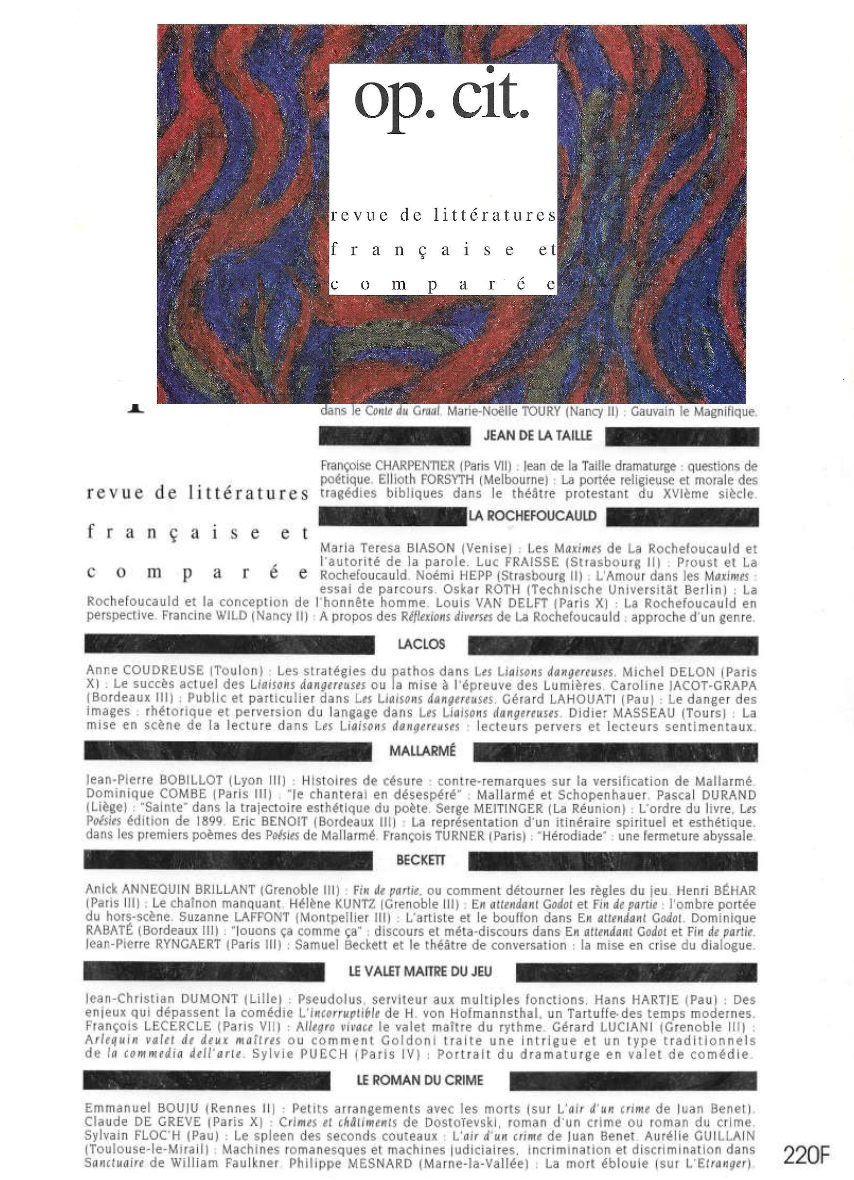
“Eleutheria, the Missing Link,” Op. cit., Journal of French and Comparative Literatures, No. 11, November 1998, pp. 219-227.
Samuel Beckett’s theater was on the syllabus for the 1999 agrégation, and, for my part, having contributed to the study proposed by Hubert de Phalèse (see below), I wanted to share this work on the relationship between the playwright and Roger Vitrac’s theater, and thus submitted this article to a journal aimed at candidates for teaching exams.
Subsequently, the silence surrounding this work led me to republish it in the journal Mélusine, which was more intended for enthusiasts of Surrealism. Read the text of this article in Mélusine, No. XXXIV, 2014, pp. 128-145.

Publisher’s Note
"Samuel Beckett did not want Eleutheria to be published.
It was the first play he wrote in French, at the end of the 1940s. In 1950, I first knew three of his novels, Molloy, Malone Dies, and The Unnamable. But as early as the following year, he gave me Eleutheria and Waiting for Godot to read. While he readily agreed to have the latter published in 1952, just before Roger Blin staged it at the Théâtre Babylone, he opposed both the publication and any possible performances of Eleutheria. Samuel Beckett was always very severe with his early works, and he would sometimes initially judge as unpublishable a work that, under the insistence of friends, he would eventually translate or send to the printer. Eleutheria is the only one of his works about which he never changed his mind. He was still talking about it a few days before his death, in front of a few close friends, regarding a project to publish his Complete Works: ‘In any case, do not include Eleutheria.’
Certainly, it would never have occurred to him to deny the existence of this work. The specialists in Beckett studies, who leave the pleasure of the text to amateurs to devote themselves to the scholarly search for variants, drafts, and all sorts of vestiges left by the author, were allowed to consult the manuscript at Éditions de Minuit, as well as in the archives of Dartmouth (USA) and Reading (UK) universities. Likewise, he authorized the Revue d’esthétique, in an issue dedicated to him, to reproduce an excerpt. But he always expected his friends to ensure that what he himself—and, after him, all the true connoisseurs of his work I have known—considered an unfinished play would not be presented as a completed work.
That was without counting on Barney Rosset. At the head of his American publishing house Grove Press, Barney Rosset published, for about thirty years, first the translations of Samuel Beckett’s books written in French, then the original works in English when the author resumed writing, intermittently, in that language. Unfortunately, this independent publisher eventually had to cede financial control of his company to a new owner, who, in 1986, ended up dismissing him.
Seven years passed. Samuel Beckett died on December 22, 1989. In March 1993, I received a letter from Barney Rosset asking me, by contract, for the right to publish Eleutheria in the United States for his new publishing house, Blue Moon, in a translation he had commissioned from Stan Gontarski. Barney Rosset based his request on the following story. At the time of his dismissal from Grove Press in 1986, he had come to Paris to seek Samuel Beckett’s help.
Beckett supposedly then gave him a typewritten copy of Eleutheria so that Blue Moon could publish it. Surprised by this claim, which contradicted what I knew of the author’s repeatedly expressed intentions, I first noted that it had taken Barney Rosset quite a while to consider fulfilling the mission Beckett had allegedly entrusted to him (“I had completely forgotten about it for several years,” he later told Matthew Flamm of the New York Observer, who had made the same remark). And since he said he had never stopped exchanging abundant correspondence with Samuel Beckett, I asked him to provide the letters mentioning this publication project. There were none. I had no trouble concluding that these supposed memories were, for the most part, the late product of his imagination. In full agreement with the author’s heirs, I informed him that I regretted I could not grant the authorization he requested.
I thought the matter was settled. I was wrong. The following year, he returned to the charge. Not only did he persist in his project to publish a work he described everywhere as wonderful, but he had also decided to have it staged in a new translation by Albert Bermel (Stan Gontarski’s having presumably been deemed unpublishable in the meantime).
Barney Rosset first wanted to organize a public reading of the play in September. But, faced with my refusal to authorize it, the director of the venue where the event was to take place withdrew, and the reading was held privately. As for the many New York producers Barney Rosset had approached to stage the play, they all backed out when they learned from the press that the rights holders were opposed.
Barney Rosset did not give up. In November, he sent me the proof of a catalog in which the publishing house Four Walls Eight Windows, associated with Foxrock—a brand he created for the occasion—announced the upcoming release of Eleutheria in bookstores. I immediately sent a warning to the publisher, distributor, and translator, urging them not to participate in an operation that was not only legally illicit but also an infringement of the author’s moral rights.
In December, it was Barney Rosset’s lawyer who wrote to me directly to try to change my mind. I reminded him that, as Samuel Beckett’s literary executor, I could only respect his wishes. I was his first and main publisher: if this play, Eleutheria, had been meant to be published, it would have long since appeared at Éditions de Minuit.
On January 10, an article in The Village Voice again mentioned the publication at Four Walls Eight Windows-Foxrock, but this time in a translation by Michael Brodsky. Barney Rosset emphasized that he was motivated solely by moral considerations and that, to prove his total disinterest, he had decided that Eleutheria would be published as a non-commercial edition distributed free of charge to the unfortunate academics who, he said, had been requesting it for so long.
... Alas, two days later, a paid advertisement in Publishers Weekly set the record straight: the copy of Eleutheria would be sold for 20 dollars (106 francs).
It was then clear that Barney Rosset would pursue his project to the end. Even if it meant crying persecution and censorship if we dared to take legal action. Gone were the justifications advanced in 1993 that Samuel Beckett himself had entrusted him with the publication of a translation of his play. Now it was only about satisfying the curiosity of readers frustrated by such a long absence. In truth, these potential readers are much more attracted by a cleverly orchestrated media buzz than by the desire to finally discover the missing fragment of a substantial body of work, of which very few have read all the available volumes. It is not the literary text that is awaited, but the object of scandal.
There are a few of us who value a pact of friendship. There are a few of us who believe in the fundamental difference between two works by the same author, depending on whether he considers one finished and the other failed. Should we let those who clearly think otherwise prevail? It seemed to us that, from the moment someone published an English version of Eleutheria not by Samuel Beckett himself, it became necessary to first publish the work in its original language.
I do not know, as I write, in what form Americans will discover Eleutheria. The edition we present here, though not desired by Samuel Beckett, is, in its nakedness, the one he wrote. May those who loved the thirty admirable books published during his lifetime forgive us. There will certainly be some newcomers who, never having read any of Samuel Beckett’s work, will approach it through Eleutheria. I beg them not to stop there."
Jérôme Lindon
Read a review on this subject in Libération
Read the article “The Missing Link”
My article is reprinted in: Henri Béhar, Histoire des faits littéraires, Classiques Garnier, 2022, pp. 119-130, Collection: Théorie de la littérature, No. 28.

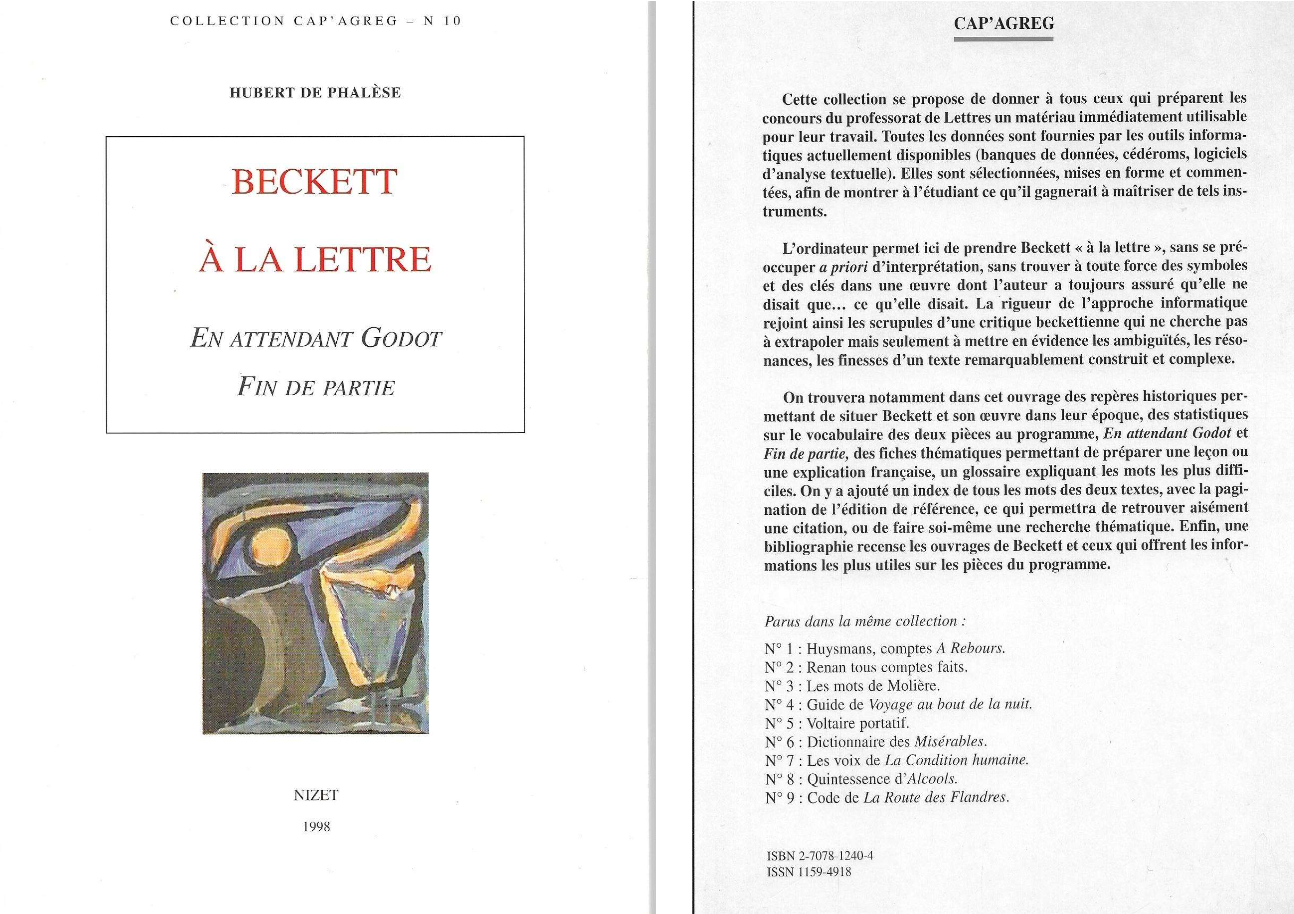
On Beckett’s theater, see the collective work by Hubert de Phalèse, Nizet Editions: