“ON SURREALISM AND THE BAROQUE IN PICASSO’S WRITING,” LES CAHIERS DE L’HERNE, PABLO PICASSO, 2014, PP. 264-270.
At the outset, there was a conference on Picasso's literary output, organized at the University of Zurich by Fabienne Douls-Eilcher in January 2011, the program of which is as follows:
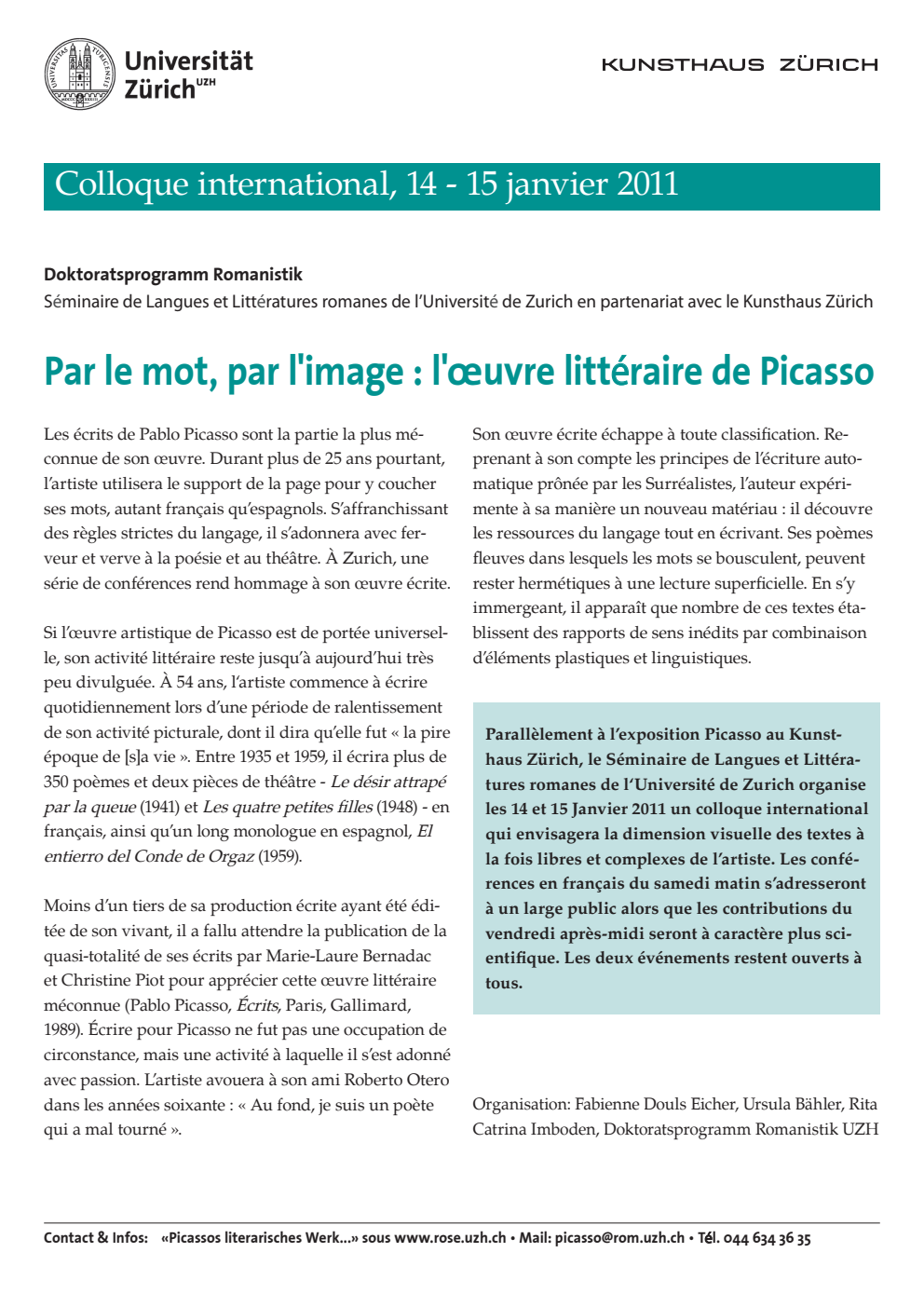
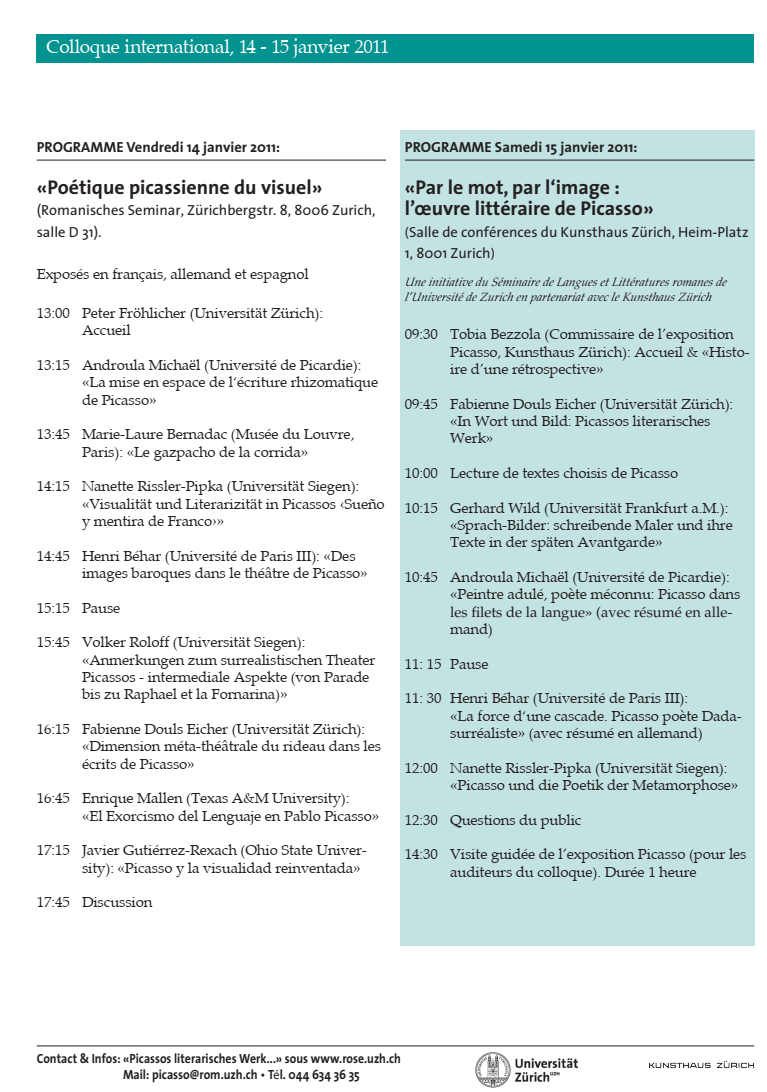
In the first instance, I gave a 20-minute presentation on “baroque imagery in Picasso’s theatre”:
“Baroque Imagery in Picasso’s Theatre”
Imagine that I spent countless hours, during my Spanish studies, attempting to translate Góngora’s Solitudes, and I must admit I have always had a soft spot for the fable of Polyphemus and Galatea. According to my teachers, my efforts were not unsuccessful—not only because they were dedicated to my ancestor, the Duke of Béjar ☻, but above all because the language was not so different from that which I spoke as a child. As for the images, metaphors, and other metamorphoses, I found it to be an intellectual exercise that I rather enjoyed. This is why, when I had the opportunity to read Picasso’s first play, Desire Caught by the Tail, and decided to include it in my study on Dada and Surrealist Theatre, I immediately drew a connection to the Góngorism of my youth. Hence the title of the chapter: “Picasso, Baroque Surrealist.” I was not surprised to learn that Picasso had, in fact, illustrated Góngora’s poems(1). The texts by Picasso published later in French only confirmed my initial impression as a reader. Thus, I will once again address the topic of baroque imagery in his theatre.
To stick to a broad and somewhat convenient definition, I would say that, as opposed to classicism, the baroque of any era is characterized by: the confusion of the natural orders, the inversion of high and low, the assimilation of opposites, the play of illusions, perpetual dynamism, constant metamorphosis, and the predominance of the figures of Eros and Thanatos, a continual play of light. To tell the truth, baroque is an appetite for life. At any rate, this is how we conceive of it in our seminar this year.
Baroque found particular expression in the theatre, where it relies on comic illusion, theatre within the theatre, and what I might call “showing” as opposed to demonstrating.
Aestheticians at the beginning of this century took pleasure in classifying artistic activities by the two categories of time and space. And of course, from this perspective, every creator’s ambition is to act upon both, or, more precisely, upon their intersection, which is found on stage.
As dynamic as the scenography of a painting may be, it will never reach the possibilities offered by theatre. Hence these silent tableaux that Picasso delights in imagining in his plays, for which he expects concrete realization, not without at times rewriting classical works, prior to Las Meninas. Here, the Tart “completely nude but with stockings” emerges from a bathtub while well-dressed gentlemen prepare for the celebrated luncheon on the grass; there, “In the kitchen garden, under a large table, the four little girls. On the table, a huge bouquet of flowers and fruit on a platter, a few glasses and a jug, bread and a knife. A large snake coils itself around one of the table legs and climbs up to eat the fruit, bite into the flowers, the bread, and drink from the jug.”
Did anyone, in this particular case, give a thought to staging? Obviously not—no more than for dramaturgical rules or adaptation to circumstances. And yet, isn’t this perhaps the surest way for an art form to progress? In 1971, when Jean-Jacques Lebel announced his intention to stage Desire in Saint-Tropez with absolute fidelity to Picasso's directions, he provoked a public outcry and had to move to a neighboring village, while the actress donned a modesty covering. I dare to believe that today Picasso’s imaginings would be realized right down to the last detail. Such is the nature of theatre! What matters is to anticipate its evolution and not be confined by sterile conventions.
Yet the pleasure of theatre is not simply in conceiving animated scenes: it is about breathing life into beings made of paper, a sequence of signifiers. Picasso’s characters—no more than Apollinaire’s—do not possess unforgettable presence. But one senses in them the vitality of their author and, from the very first reading, Gros Pied, the two Angoisses, and the four Little Girls come alive before our eyes, however undifferentiated they may seem, not to mention the Curtains, immobilized “in their vexation behind the expanse of unfolded fabric.” This has become a principle of contemporary dramaturgy: the less the characters are defined, the more the performers are invested by the audience. The era of shallow psychology has passed. Like Vitrac, Picasso prefers to suggest deep motivations and ambiguous relationships through behaviour.
Commenting on Picasso’s visual art, Tristan Tzara felt he could say that for Picasso “thought is created beneath the hand.” Yet the painter’s tendency to write poems at various points in his life—poems designed for public recitation by a range of performers, in other words, theatre—leads me to believe that such spontaneity of expression did not wholly satisfy him and that articulated language was needed as well. Thus, the Dadaist formula is confirmed with Picasso: “Thought is created in the mouth”; even better, thought is the body, in its entirety. The body of a painter, first, who chants the litany of colors and their legendary battles: “A large yellow oval struggles in silence between the two blue points with all its claws retouched in the fall of Icarus from the skein of lines in the trap of the olive-green diamond throttled with both hands by the tender purple of the square of vermilion bow, thrown from so far away by the orange.”
But also the body of a man who loves to hum, whose intoxicated words are drawn together by phonic association: “The beauty’s shirt pulled up, her motley charm, moored to her bodice, and the power of the tides of her graces shakes the golden dust of her gaze over the corners and recesses of the sink, as linens hang drying by the window of her sharpened gaze upon the whetstone of her tangled hair.”
Verbal automatism in which set phrases, proverbs, and sayings cluster together like so many pieces of pasted paper, where clauses link and propel one another through false coordination, accumulations of participles, and where figurative expression takes the form of noun complements.
This is what another poet, Rafael Alberti, referring to the poetic texts in which Picasso returned to his native language, called “liana poetry.” The sentence sends out its shoots and spirals to entwine reality, leaning on it and perhaps to suffocate it, but in any event, to transform it.
The agent of transformation, as in many surrealist texts, is none other than humour. A wild, unbridled humour, generated by the confusion of natural realms, the distortion of clichés, literalness—a process which, in theatre, brings abstract expressions onto the stage, laying them bare—by simultaneous contradiction, and the perverse delight of naming: Gros Pied, Bout-Rond, Desire Caught by the Tail!
But this language, brilliant though it may be, would remain “theatre poetry,” as Cocteau put it, and not theatre proper, if it were not the object of ritual and symbolic investment.
Symbolic in the Freudian sense; that is to say, the expression of desire is masked—as it must be in theatre, by definition. Let us be clear: Picasso’s two plays should not be seen as privileged material for a psychoanalysis of the painter, which is of little interest to us, but rather as among the rare dramatic creations that, for their characters, take into account the workings of the unconscious. Not because the expression of desire in the eponymous play, or of polymorphous perversity in The Four Little Girls, is difficult to elicit, but because it bears all the usual disguises of the libido within a dramatic form. Thus, when the women in love begin to scalp Gros Pied, like a sleeping Endymion, the lashes of the sun beat them bloody. And again, when one of the little girls’ monologues is interrupted by an apocalyptic vision: the entrance of a huge white winged horse dragging its entrails, surrounded by eagles, an owl perched on its head.
These two mythical examples immediately draw us into the ritual at the heart of any theatrical festivity, and which Picasso deliberately orchestrated, both through the scenic objects, the fireworks and the play of rainbows and lightning, and the ceremonial aspect. I can think of no more moving image than this: after tenderly caressing a goat, one little girl sacrifices it while the other rips out its still-beating heart. Clearly, a mere simulacrum would not suffice here. As with the bullfight—so dear to Picasso and indeed evoked during the play—theatre is a cult, an offering from shadow to light, to solar deities. Dionysus bows before Apollo, not without allowing the young heroines to learn everything about life and death that a passerby might know.
Let us not be mistaken: Picasso does not turn theatre into a grand, symbolist, secular liturgy. His conception of this total art is far more complex and representative of his philosophy. If theatre re-presents humanity’s obsessive images—desire, love, death, hunger, the thirst for knowledge—it also testifies to the unity of the individual and, particularly, to the reconciliation of the three souls that, following Plato, Jarry sought to bring together. Picasso does not merely speak of matter or stage it forcefully (the Tart “squats before the prompter’s hole and, facing the hall, pees and hot-pees for a good ten minutes”); he reunites it with body and soul. Thus, the contrasting, lyrical, and vulgar discourse is not merely an artist’s wordplay; it embodies this drive for synthesis between the base and the sublime that is the hallmark of deep humanism. Let us see no other reason for the properly obscene (i.e., offstage) insults uttered by the little girls, employing the entire discursive range. As evidence, consider this: in 1947, when The Four Little Girls was written, problems with provisions and hunger were no longer a daily concern, unlike during the painful winter of 1941. Yet food is just as present in this play as in the first. Thus, it is not merely a question of circumstances, but a fundamental theme—a desire to anchor anxieties, obsessions, and desires in a permanent human reality. This explains why both plays obstinately contain references to contemporaneous conditions, to what we now call circumstances of utterance, and why they are so precisely dated. This attachment to the external world (the object), for which Breton criticized Picasso, the concrete evocation of earthly nourishment, the Provençal bouquet, is nothing but a reminder of the garden of delights, an aspiration toward a world where human beings, reconciled with themselves and with nature, will finally know harmony.
To close with Jarry, who is unquestionably one of the forerunners of Picasso’s theatre, let me recall the unpublished notes he took from Bergson’s class in 1882 at the Lycée Henri IV: the three essential traits of genius, according to this philosophy professor, were fecundity, variety, and depth. “By these three characteristics, the productions of genius approach those of nature. Like genius, nature produces with inexhaustible fecundity. Like those of genius, its creations are infinitely varied, and each lives an independent life...” The philosopher did not judge badly the prospects for a genius of our time.
The next day, in a plenary session, I addressed “The Force of a Cascade: Picasso as a Dada-Surrealist Poet.” This text was later published in the Cahiers de l’Herne, in the 2014 issue on Picasso.
The Force of a Cascade: Picasso in Dada-Surrealist Texts
The idea for this talk came from consulting my own textual database, processed with an analytical program. The first occurrence that jumped out at me was from Tzara, who, in his “Note 1 on Some Painters” (1917), lyrically described Picasso’s enterprise: “With the force of a cascade, Picasso began by studying the problem from the summit to the base...” (OC I 553)
In the brief time allowed me, I propose to quickly survey what the leading poets of these two movements said about him, how he appeared to them, and what function he served in their eyes and upon them.
I am well aware that quantity has no direct relation to quality (except, perhaps, in Hegel), and an index has never replaced the reading of the works themselves, but the following figures are not without interest. In the collected works of each of these poets, and in the leading periodicals of the two movements, the name “Picasso” is cited as follows:
| Aragon, Collected Poems (1917-1952) | 63 |
| La Brèche (journal) | 13 |
| Breton, Complete Works, Pléiade I to IV | 176 |
| Dada (journal) | 3 |
| Éluard, Complete Works, Pléiade I and II | 73 |
| Péret, Complete Works, vols. I to IV | 4 |
| La Révolution surréaliste (journal) | 38 |
| SASDLR (journal) | 4 |
| Tzara, Complete Works, I to V | 160 |
Granted, there are repetitions between corpora, and all this requires interpretation. Nonetheless, these figures attest to the great interest these poets showed in their elder.
Reciprocally, it is now widely acknowledged that there was a Surrealist period in Picasso’s painting, but also in his writing, both poetic and theatrical. One should remember that Picasso, because of his age and his notoriety—both acquired much earlier—could easily have ignored the Surrealists. Yet he moved in their circles far more than is generally thought, and above all, he collected and studied their works. Proof of this is, for instance, his acquisition of the manuscript of L’Immaculée Conception… Thus, his Surrealist poetics are characterized, as Tzara put it, by the fact that “thought is made under the hand”; by his use of plagiarism or collage, and by a specific approach to automatic writing.
Naturally, the third part is devoted to examining the mutual influence between him and the movement. The key question is to discern precisely what the Dada-Surrealists—especially Tzara and Breton—wrote about Picasso’s theatre-poetry, and conversely, how Picasso understood Surrealist poetics.
Like a cascade, my conclusion flows naturally: on the textual level, Picasso is, like so many others, a Surrealist poet.
Download my article PDF Cahier Picasso
(1) Pablo Picasso, Gongora – Poems by Luis de Gongora y Argote, Editions Anthèse, Paris, circa 1985 (original edition: Les Grands Peintres Modernes et le Livre, Paris, 1948). Texts in Spanish followed by the French translation.
Exhibition review:
LE TEMPS
Exhibition, Saturday, November 20, 2010
After the 1932 Exhibition, Picasso Becomes a Writer
By L. W.
Writing was never a mere pastime for Picasso; he devoted himself to it passionately for a quarter of a century. What happened after the Zurich retrospective? Several weeks after its opening, Picasso celebrates his 51st birthday. He does not yet realize he is only halfway through his career, and is destined to produce tens of thousands more works. The selection of the 225 paintings shown in 1932, and especially the hanging captured in numerous photographs, gives the impression of a cycle coming to its end. It is impossible to say what Picasso himself felt once the exhibition was installed. However, it is known that painting becomes less dominant in his practice from 1933 onward; he dedicates more time to sculpture, does extensive engraving, and draws prolifically. From 1935, he enters a period he would later describe as the worst of his life, emerging from it only under the impact of political events and the Francoist attack on the legitimate Spanish Republic in July 1936. This impetus would give rise to Guernica, painted for the Spanish Republican Pavilion at the Paris World’s Fair in 1937. His personal life is complicated. He met Marie-Thérèse Walter in 1927 and began a long relationship parallel to his marriage with Olga Koklova, whom he had wed in 1918. In 1932, Olga discovered in a Paris gallery that Marie-Thérèse had become Picasso’s principal model, inspiring a number of loving portraits. In 1935, Marie-Thérèse became pregnant. Olga and Picasso separated. Then, in 1936, Picasso met Dora Maar, who would become his mistress. This turmoil—the only such disorder on this scale in his life—deeply affected Picasso, who would take a long time to recover. It also affected his reputation, as it was soon attributed to his personality; a view that aligns with the then-prevalent equation of modernism with mental illness (building on Jung’s diagnosis) and with the Nazi campaign against “degenerate art,” culminating with the Munich exhibition organized by Hitler in 1937. This accusation would reappear in similar terms during the 1960s, notably following the two exhibitions at the Palais des Papes in Avignon in 1970 and 1973, when paintings from Picasso’s later years still provoked scandal. In 1935, prompted by these circumstances and his ties with the Surrealists, Picasso turned to writing. He filled notebooks and large sheets of paper. He embraced automatic writing, adapting it to his own ends, producing a type of thoroughly organized automatism. He would write two plays: Desire Caught by the Tail in 1941, and The Four Little Girls in 1948. His literary career came to an end in 1959 with a Spanish-language monologue titled El Entierro del Conde de Orgaz. For Picasso, writing was never a mere distraction. He devoted himself passionately to it for a quarter of a century, producing numerous texts, often calligraphed and illustrated with drawings, which could only be fully appreciated with their publication in 1989 (Ecrits, Gallimard). With a keen sense of paradox and anachronism, instead of focusing directly on the exhibition itself, the Kunsthaus and the Seminar of Romance Languages and Literatures at the University of Zurich are organizing, next January, a symposium—one day of which is open to the public—on what is perhaps one of the main consequences of the 1932 retrospective: Picasso’s literary output. International conference, January 14 and 15, 2011. First day: "Picassian Visual Poetics," Romanisches Seminar, Zuribergstr. 8, 8006 Zurich. Second day: "By Word, by Image: Picasso's Literary Work," Conference Room of the Kunsthaus, Heimplatz 1, 8001 Zurich. Info: 044 634 36 35 and www.rose.uzh.ch
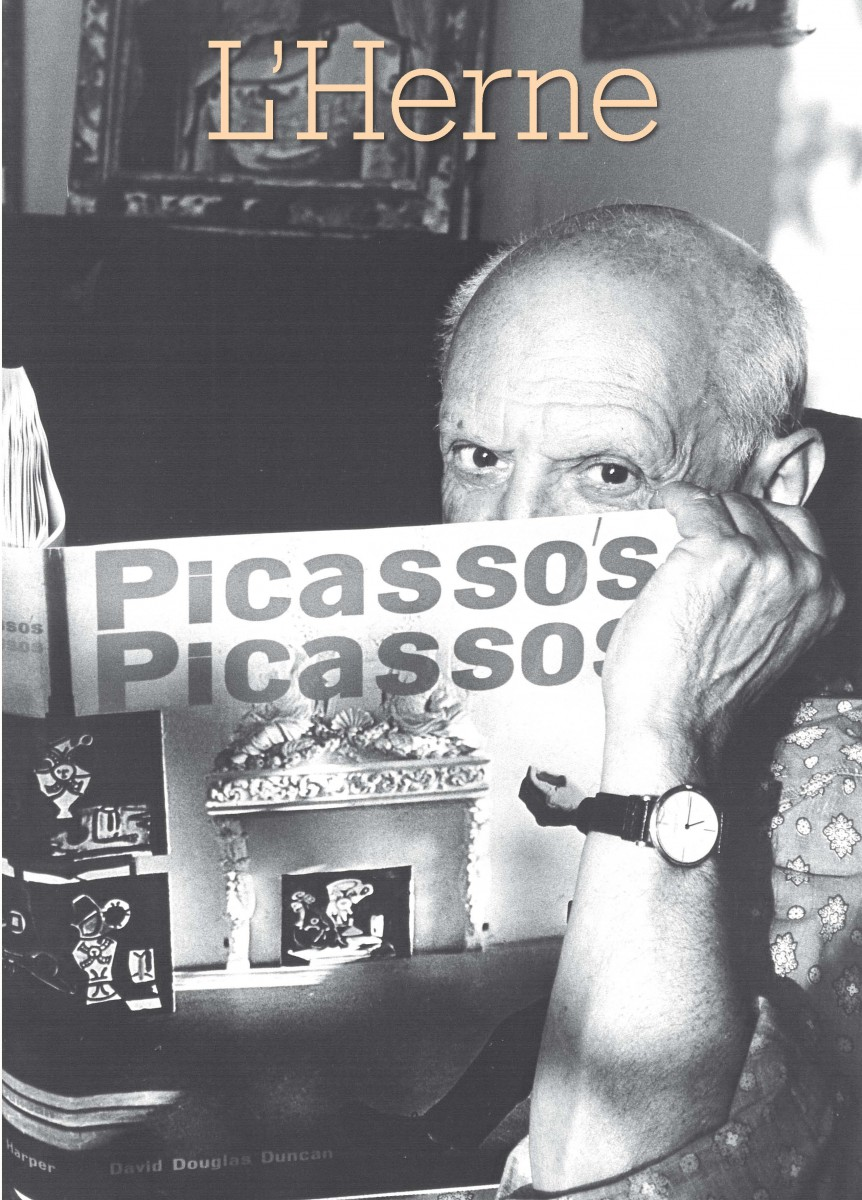
Forty years after his death, Pablo Picasso (1881–1973) remains one of the world’s most celebrated artists—perhaps the most celebrated. Yet, despite his central role in the history of twentieth-century art, his impact on the evolution of forms and styles, and the immense breadth of his oeuvre, much remains unknown to the general public, with countless misconceptions sustained by films, biographical anecdotes, and his reputation as a "bluebeard."
Today, "Picasso" is a term used worldwide to denote a particular approach—or several approaches—to art, for better or worse. It is a cliché that labels him either as the greatest genius of the twentieth century or as a mere stereotype of talent; as an artist who paints with both astounding virtuosity and astonishing simplicity (“my son could do the same,” one still often hears at his exhibitions); as the name of a car model; or all these things at once. Who, then, was Picasso? What did he achieve in more than eighty years of relentless work? What is the current state of knowledge and research? Are there vast areas of his work still unexplored, unexpected treasures yet to be revealed? What sort of painter was he? What kind of sculptor? What kind of artist? Does his legacy persist among today’s creators? This Cahier de l’Herne is dedicated to the ultimate global artist.
All contributors to this volume are scholars and specialists. They work with recognized institutions and approach their subjects with the distance afforded by time—they do not erect a statue. The Cahier de l’Herne Picasso does not offer a single theory, but rather a range of viewpoints, sometimes even contradictory. It seeks a balance between comprehensive vision and focused analysis. It is a work in progress, the description of an immense landscape that we hope will help Picasso emerge from hagiography and cliché, restoring his complexity—and inspiring fresh perspectives as vibrant as his own work.
See also:
“Le bordel métaphysique ou le théâtre de Picasso,” Esprit, January 1981, no. 1, pp. 76–79.
“Picasso le poète cosmique,” Chronique, Europe, no. 729–730, January-February 1990, pp. 218–220. Special issue dedicated to Montaigne and Jean Tortel
“The Perpetual Book Object: La Rose et le chien (1958) by Tristan Tzara–Picasso.”. Text of a paper delivered at the Paris III seminar, April 11, 2013.